No, HafizeBot is not passive income: it automates the execution of trades on your own Binance Futures account, with real risk that you manage, and it does not pay you anything on a schedule. The autotrader saves you the screen time of placing orders. It does not remove the chance of losing money, and it does not choose your stop-loss, leverage or position size for you once you change them. Futures trading can lose money in any week, with or without a bot.
An older version of this page, from 2024, called the bot a route to passive income. That was wrong, so we replaced it. Below: what the autotrader does, what stays your job, what can go wrong, the time it takes, and how to judge it without taking our word for anything.
If you want the broader question first, whether any kind of crypto trading counts as passive income compared with staking, lending or mining, read our breakdown of whether crypto trading is passive income. This page is only about HafizeBot.
Why HafizeBot is not passive income
Passive income means money that keeps arriving after setup, like rent or a dividend, paid by a tenant, a company or a borrower. Trading has no payer of that kind. Every trade the bot opens can end at its target, at your stop, at liquidation, or stay open after the signal has expired.
Three things make the word "passive" misleading here:
- The risk is yours. The money sits on your Binance account and every position is yours. A losing trade is a loss on your balance. Ours doesn't move.
- The settings are yours. The bot trades within the limits you set. Change leverage from 2x to 20x and it will trade at 20x.
- The result is not paid out. There is no rate, no yield and no amount per month. Some months your account may grow and some it may shrink, and nobody can tell you in advance which.
Automation changes the effort. It does not change what kind of activity this is: leveraged futures trading.
What the autotrader actually automates
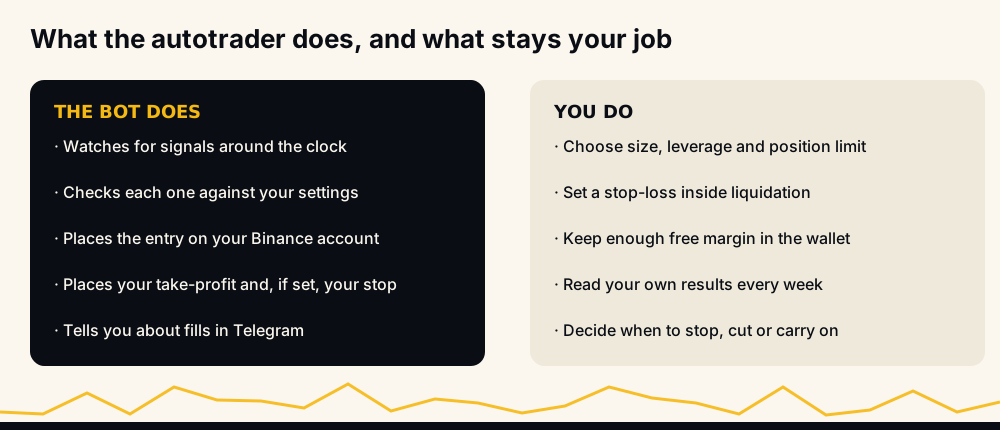
HafizeBot sends AI-generated signals from a model that evaluates 240+ indicators, formulas and components, across hundreds of Binance USDⓈ-M perpetual pairs. VIP members can switch on the autotrader, which does the mechanical part of following those signals:
- It watches for new signals around the clock, so you do not have to be awake for them.
- It checks each signal against your settings: minimum strength, direction, banned coins, your position limit, and the gap since your last entry on the same coin.
- It places a market entry on your account, then a take-profit at the signal's target and, if you have a stop set, a stop order. Both exits rest on Binance itself.
- It tells you about fills in Telegram, unless you turn trade notices down with
/setTradeNotices.
It works through an API key that needs futures trading permission only, never withdrawal permission. Your funds never leave your own Binance account, which is worth checking before you connect anything; how to connect a trading bot to Binance with an API key safely walks through the permissions to tick and the ones never to tick.
That is the full list. The bot does not move money in or out, and it does not decide how much of your wallet to put to work.
What stays your job: the settings that decide your risk
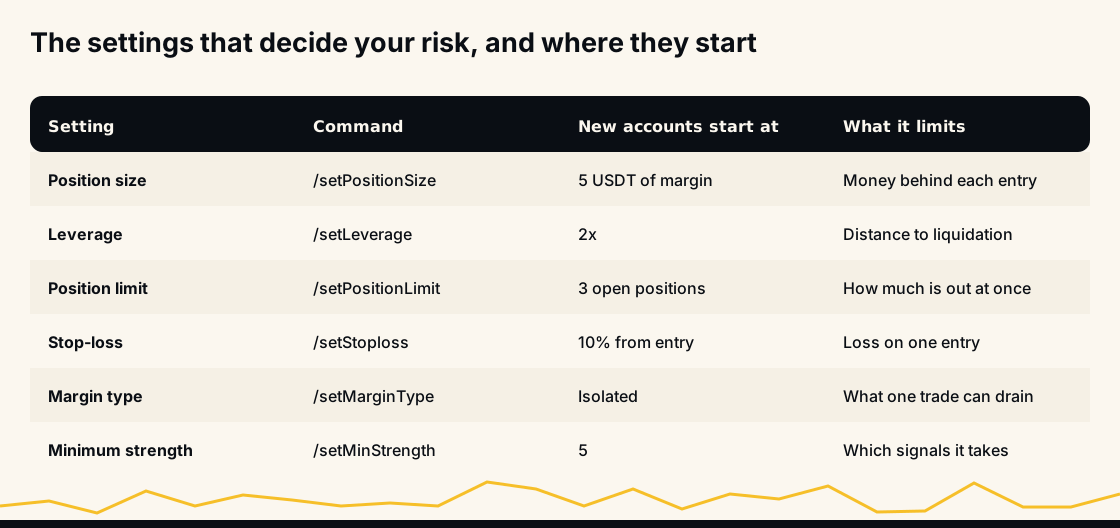
New accounts start with the values above, published on our default settings help page. They are a starting point, not advice, and you can change every one. /summary shows what yours are today and /explain says what each one does.
The ones that matter most for risk:
- Position size (
/setPositionSize): the USDT of margin behind each entry. Binance opens margin times leverage. - Leverage (
/setLeverage): from 1x to 20x. Higher leverage means a smaller price move against you before liquidation. - Position limit (
/setPositionLimit): how many positions can be open at once. It counts every open position on the account, including ones you opened by hand. - Stop-loss (
/setStoplossand/setStopType): a price move from your entry, measured without leverage. At 0, or with the type set to OFF, no stop is placed. - Margin type (
/setMarginType): isolated limits a position to its own margin; cross lets it draw on the whole futures balance.
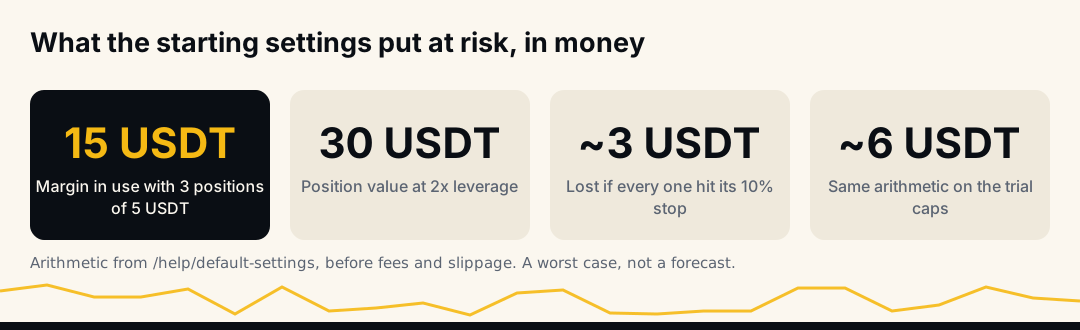
In money, as the help page also works out: three positions of 5 USDT of margin at 2x is 15 USDT of margin and 30 USDT of position value. If every one of them reached its 10% stop, the loss would be about 3 USDT, plus fees and slippage. That's a worst case you can redo yourself. It isn't a forecast.
Keeping enough free margin in the futures wallet is also your job. The bot's own message puts it simply: the wallet needs about position size times position limit free.
What can go wrong, even when the bot works as designed
Most autotrader losses are not bugs but settings doing what they were told in a market that moved the wrong way. Four situations cause most surprises.
Liquidation without a stop
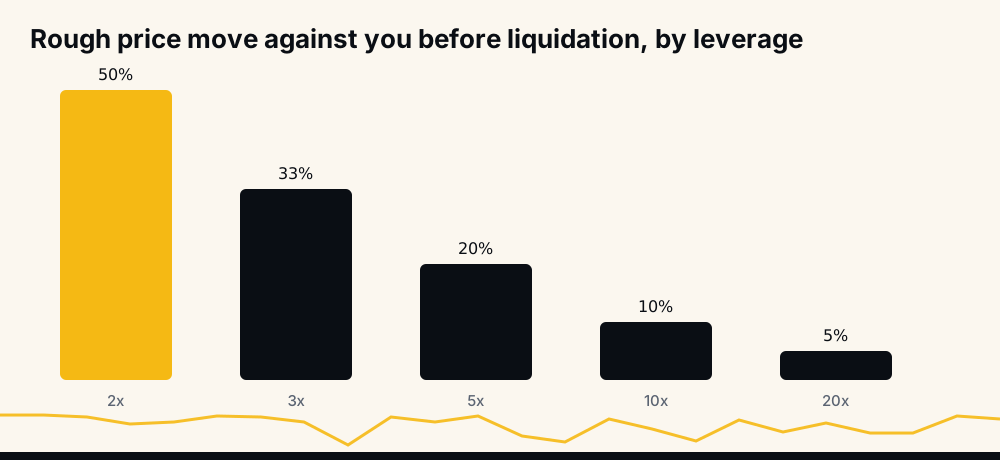
Without a stop, a position the bot opened closes only at its target, by your hand, or by Binance liquidation, unless you set a maximum hold (/setMaxHold) or a delisting close (/setDelistingClose). Nothing closes it when the signal expires. Leverage decides how far price can go against you first: roughly 100 divided by the leverage, and less on smaller coins where Binance's maintenance margin is higher.
A signal can move against the position before it reaches its target. On the public record that is still a win, because the signal reached its target in time. On a 10x account with no stop it can be a liquidation first. Our help page on why someone was liquidated when the signal later reached its target goes through it, and how leverage trading works in crypto explains the maths.
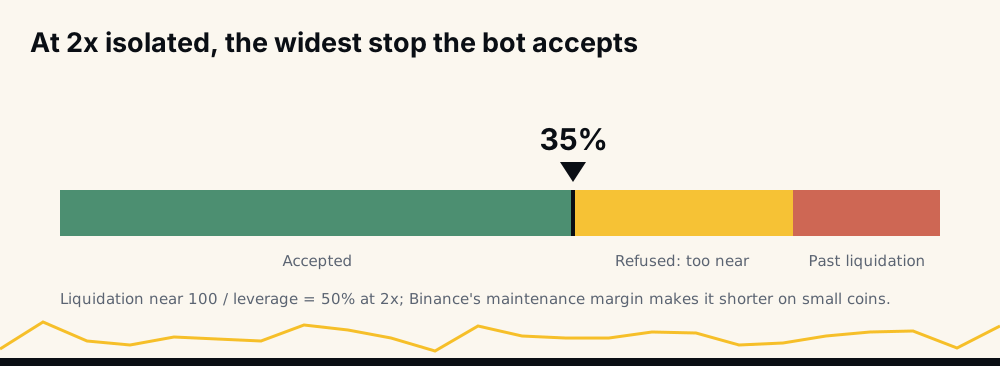
On isolated margin the bot refuses a stop that would sit beyond liquidation and tells you the largest one that works: 35% at 2x, 14% at 5x, 7% at 10x, 3.5% at 20x. On cross margin a wider stop is saved with a warning. A stop is protection only if it can act before liquidation does; how to set a stop-loss in crypto covers choosing one.
Losing streaks and expired signals
A high target-hit rate counts signals. It doesn't count money. One entry that hits a wide stop can cost more than several small targets earn, depending on how far your stop sits compared with the targets you see on the signals. A run of stops in a fast market is normal for any trading approach, automated or not.
Signals that reach their maximum hold without the target are counted as misses on the public record. On your account such a position is not closed for you and can still reach the target later, or move further against you. What happens when a crypto signal expires explains what that means in practice.
The bot switching off when margin runs out
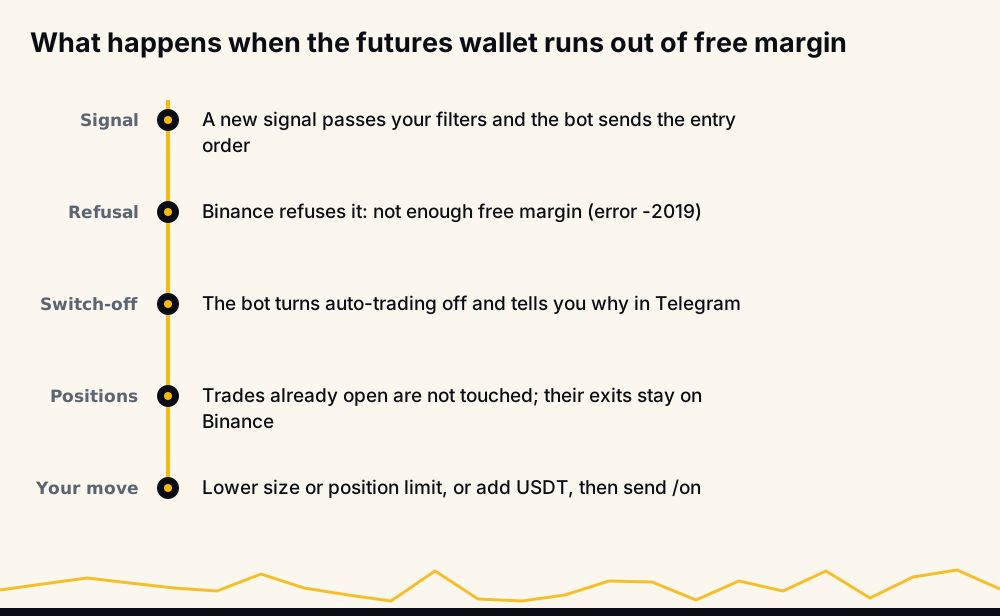
If your futures wallet does not have enough free margin for a new entry, Binance refuses the order with error -2019. The bot then switches auto-trading off and tells you why. Positions already open are not touched, and their exits stay on Binance. Nothing new is traded until you lower the size or the position limit, or add USDT, and send /on again. Our guide to the Binance "margin is insufficient" error covers the causes.
If you never look, you may not notice it has been off for days.
Exchange outages and missed entries
If Binance or the bot is unreachable, new entries are missed and are not replayed later. Take-profit and stop orders already resting on Binance keep working, because they live on the exchange rather than in the bot. A position without a stop stays exposed through any outage. What happens to open positions if the bot stops goes through it minute by minute.
When the bot skips a signal, it is usually a setting
Not every signal becomes a trade on your account. The bot skips a signal when auto-trading is off, the key is refused by Binance, the signal is below your minimum strength, the direction is not allowed, the coin or its group is banned, the position limit is full, the coin is already held in the other direction, or the same-coin gap has not been reached.
/lastsignals lists your recent signals with what the bot did and the reason for each skip, and the bot not trading help page has the checklist in order. This is also why your results differ from the signal provider's.
How much time does it really take each week?
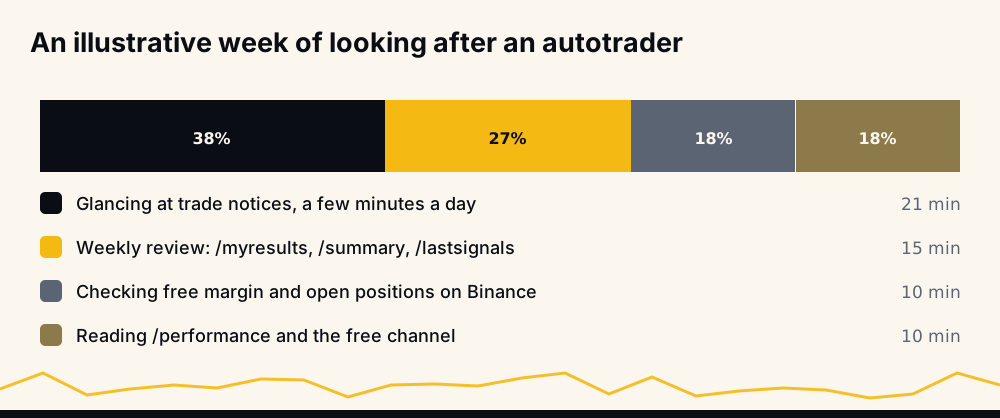
Less than trading by hand, more than none. The chart above is an illustration, not a measurement: a few minutes a day glancing at trade notices, a weekly review in the bot, a look at free margin on Binance, and a look at the public record. That comes to roughly an hour a week for a settled account.
The first weeks take longer: reading the settings, connecting the key, watching the first fills, and adjusting after a real stop or skip. So does any week after you change leverage or size.
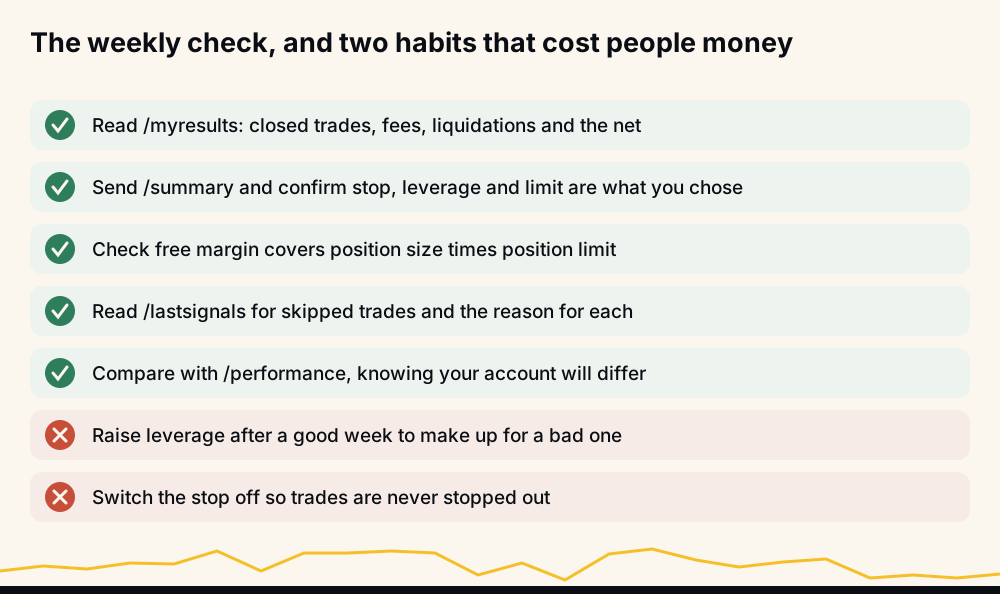
The two crossed-out habits are the ones that turn a bad week into a much worse one.
What does it cost, whether it wins or not?
The subscription is a fixed cost that does not depend on your results. VIP Tier 1 is 50 USDT a month, Tier 2 is 100 and Tier 3 is 200, paid in USDT with no card, and nothing renews unless you switch on /subscribe. Every tier gets the same signals at the same time; the tiers differ in auto-trading limits and support.
Binance's trading fees and funding come on top. On a small account the subscription can exceed what the trades return in a month. How much crypto trading bots make looks at that question without a number we could not defend.
How to judge it: the public record and your own /myresults
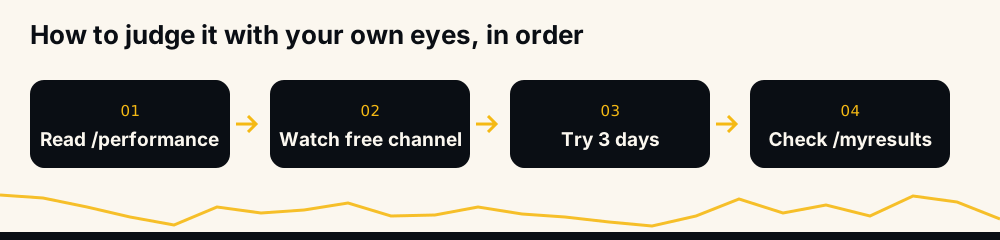
Two records matter, and they answer different questions.
The public record answers "do the signals reach their targets?" The live performance page is rebuilt hourly from the table the bot writes when it sends a signal, and counts expired signals against the rate. As of 10 October 2026 it shows August 2026, the newest settled month, at a 97.3% target-hit rate with expired signals counted as misses. The same page states that a target-hit rate is not account profit. The 2021 to 2024 archive is a free download at /data.
Your own /myresults answers "what did the bot do on my account?" It counts the bot's own orders over the last 30 days: closed trades, their result, fees, liquidations, and the net with liquidations counted against the bot. Trades you placed by hand are left out. /today does the same for the last 24 hours. This is the number to trust for yourself, because it already includes your settings.
The order that wastes the least money: read the record, watch the free signals channel for a couple of weeks (the stronger signals, strength 3 and up, 20 minutes late), then try the 3-day free trial, which caps auto-trading at 10 USDT of margin per trade and 3 open positions and charges nothing. Then read /myresults before deciding anything.
"Guaranteed daily income" bots: the pattern to walk away from
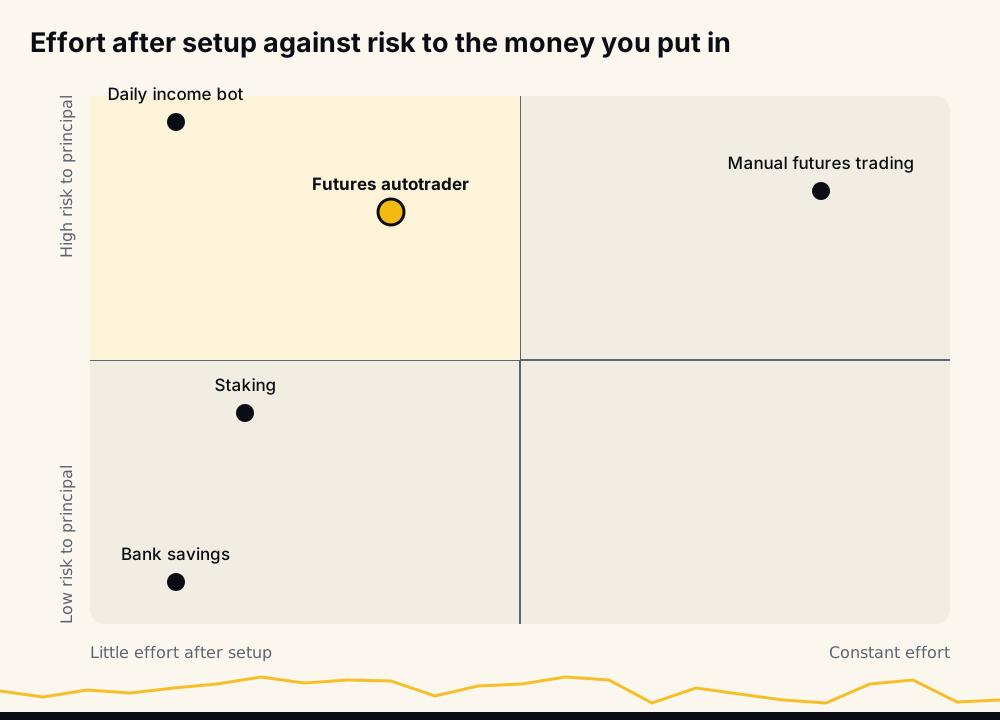
If you searched for a passive income Telegram bot, you have probably seen the other kind: a bot or group that promises a fixed daily percentage, takes your deposit into its own wallet, and shows a growing balance on a dashboard. The tells are consistent:
- A return quoted in advance, per day or per week, often described as guaranteed.
- Your money moves to their wallet or platform instead of staying on your own exchange account.
- Withdrawals need a fee, a waiting period, or a minimum you have not reached yet.
- Rewards for bringing friends, and pressure to deposit more before a deadline.
- No losing day, week or month ever shown.
Real trading has no fixed return, so anything quoting one is paying it from somewhere else, usually the next depositor. A bot that trades your own account through a key that cannot withdraw cannot hold your money hostage, and cannot promise a return either. Our list of crypto signal scam red flags goes further.
Who it suits, and who it does not
It can suit someone who understands futures, wants their own rules applied to every signal without watching a screen, can spare an hour a week, and is using money they could lose.
It does not suit someone looking for a monthly payout, who needs the money back by a set date, or who would not notice auto-trading had switched itself off. Then our advice is not to start with leveraged futures at all.
FAQ
Is HafizeBot passive income? No. It automates placing trades on your own Binance Futures account, within settings you choose. The risk of loss is yours, results vary from week to week, and you still need to check the account regularly.
Can I just switch the autotrader on and forget it?
No. The bot switches itself off when free margin runs out, and a position without a stop can be liquidated. A weekly check with /myresults, /summary and /lastsignals catches most of this.
How much can I earn with HafizeBot per month?
We do not publish an income figure, because there is no honest one. Your result depends on your size, leverage, stop, fees and the market, and it can be negative. /myresults shows what the bot actually did on your account over the last 30 days.
Does a high target-hit rate on /performance mean my account will grow? No. The rate counts signals that reached their target, with expired signals counted as misses; it says nothing about your leverage, stop or fees. The page itself states that a target-hit rate is not account profit.
Can HafizeBot take or withdraw my money? No. It never calls a withdrawal or transfer, the key it needs requires no withdrawal permission, and your funds stay on your own Binance account. It can still lose money by trading, which is why the stop-loss and position limit matter.
Is a Telegram bot that pays a fixed daily income real? A fixed daily return is the classic pattern of a scheme that pays early depositors with later deposits. Real trading has losing days. If a bot holds your deposit and charges a fee to release it, stop paying.
The short version
HafizeBot automates execution: watching for signals, checking them against your rules, and placing orders on your own account. It does not make the risk smaller than your settings make it, and it does not turn futures trading into income. Judge it on the public performance record and, if you try it, on your own /myresults. You can talk to the bot at @hafizebot on Telegram.
Nothing on this page is investment advice. Futures trading carries a high risk of loss; only trade what you can afford to lose.