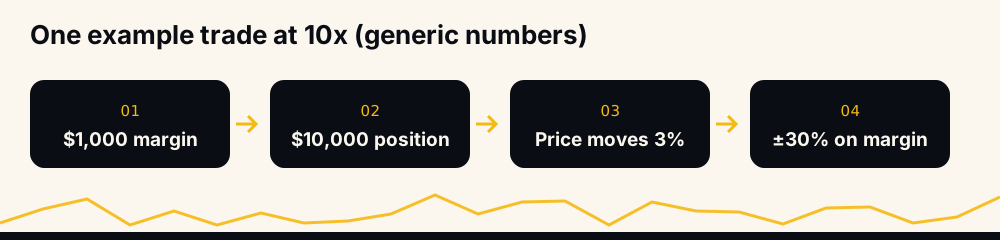
Leverage trading in crypto means using a deposit — called margin — as collateral to control a position several times bigger: $1,000 at 10x leverage moves a $10,000 position. Every price change is then multiplied by ten. A 3% rise becomes +30% on your margin, a 3% drop becomes −30%, and at roughly a 10% adverse move the exchange liquidates the trade and the $1,000 is gone. That multiplication — of gains, losses, fees and funding — is the whole subject, and this guide walks through the arithmetic most tutorials skip.
What is leverage in crypto trading and how does it work?
When you open a leveraged trade, you commit only a fraction of the position's value from your own balance — the margin — and the exchange effectively fronts the rest. On Binance USDT-M perpetual futures, you choose a multiplier per pair, post margin in USDT, and open a long (profits if price rises) or a short (profits if price falls). If that last part is new, start with what long and short positions mean in the crypto market.
Two facts define everything that follows:
- Profit and loss are calculated on the full position size (the notional), not on your margin.
- Your loss is capped at your margin by liquidation. When losses approach what you posted, the exchange force-closes the position — it will not wait for your permission.
One setting matters early: isolated margin risks only the margin assigned to that trade; cross margin lets a losing position drain your whole futures wallet to stay alive. Beginners should treat isolated as the default.
Margin vs leverage: two words for the same ratio
Margin and leverage describe one relationship from opposite ends: leverage = position size ÷ margin. Put $2,000 behind a $10,000 position and you are at 5x; put $200 behind it and you are at 50x. The position — and every dollar it gains or loses — is identical in both cases.
That is the part marketing ignores. Leverage does not enlarge your edge; it shrinks the distance to zero. The same $10,000 position dies 10 times faster at 50x than at 5x, because the buffer absorbing the loss is 10 times smaller.
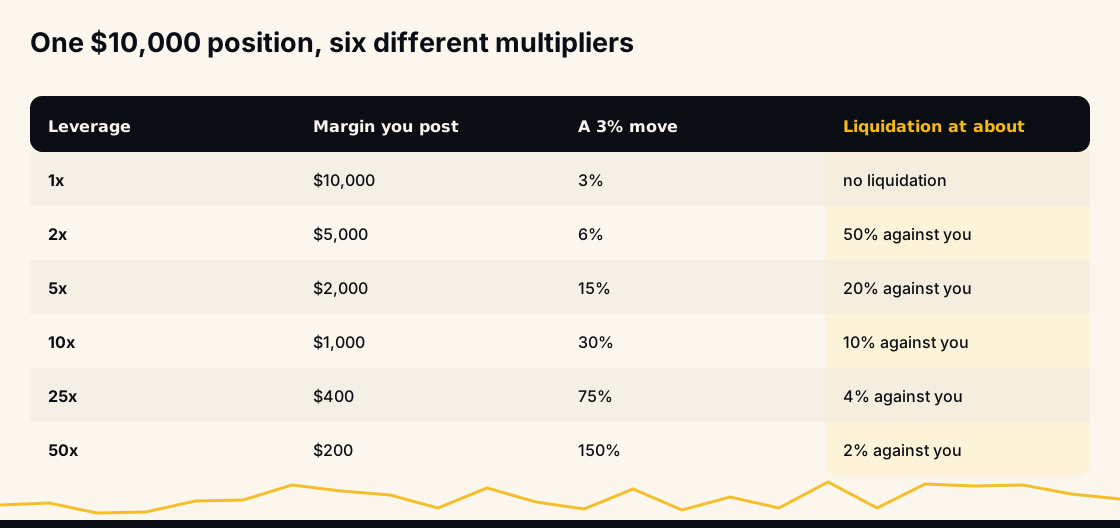
Read that table down the last column rather than across. The position never changes; only your buffer does. Choosing a multiplier is choosing how small an adverse move is allowed to remove you from a trade you might still have been right about.
The real math: what 5x, 10x and 50x do to a 3% move
Crypto majors move 3% in a day routinely. Here is what that ordinary move does to your margin at each multiplier:
- 1x: ±3% — annoying or pleasant, never fatal.
- 5x: ±15% of your margin.
- 10x: ±30% of your margin.
- 25x: ±75% of your margin — one ordinary day nearly wipes you.
- 50x: ±150% — except you never experience the minus side in full, because you were liquidated at roughly −2%.
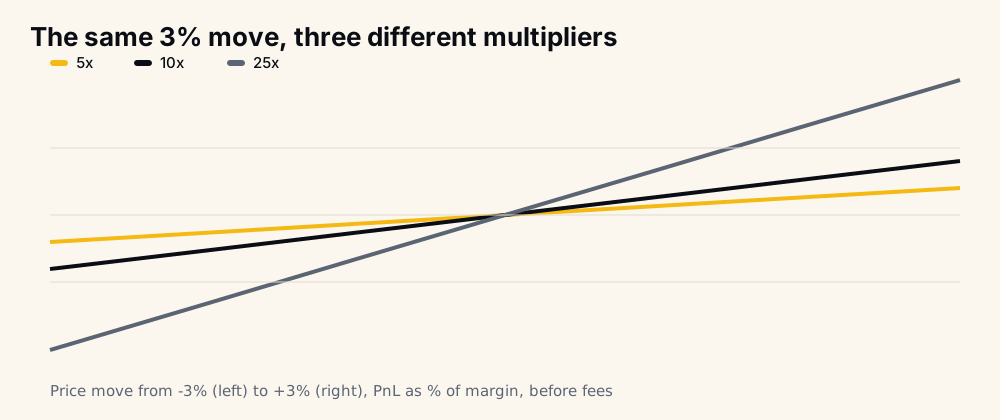
The three lines are the same market and the same trade idea — only the slope differs. Notice that the steepest line is also the shortest in practice: at 25x, the left end of that chart is past the liquidation point, so you never actually collect the loss it draws.
The asymmetry compounds. Lose 30% of your margin and the remaining stack must gain about 43% just to get back to even. Leverage makes drawdowns arrive faster and makes recovery arithmetic steeper at the same time.
A worked liquidation example with clean numbers
These are generic example numbers, not a price call. Say BTC trades at $50,000 and you go long with $1,000 margin at 10x — a $10,000 position, or 0.2 BTC, on isolated margin.
- Price +3% to $51,500: the position gains $300. That is +30% on your $1,000.
- Price −3% to $48,500: the position loses $300. Your margin is down to $700.
- Price −10% to $45,000: the position has lost $1,000 — your entire margin. In the simplified math, this is your liquidation point.
In practice the exchange liquidates earlier than the simple math suggests, because it reserves maintenance margin and liquidation fees — so the real trigger sits closer to something like −9.5% here, and closer still on bigger positions. The simplified rule of thumb: your liquidation distance is roughly 100 divided by your leverage, in percent, minus fees and maintenance margin.
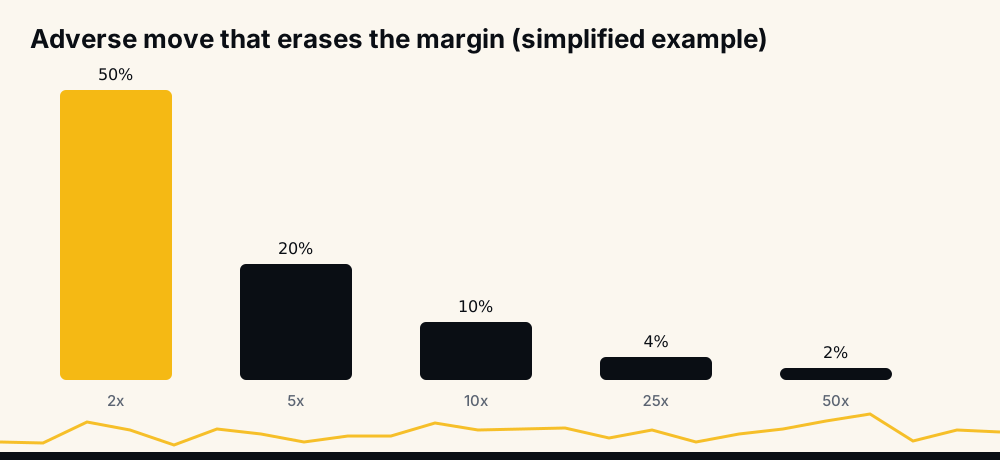
Read that chart against real volatility. BTC wicks of 2–4% happen in ordinary hours; altcoins do it before breakfast. At 25x–50x you are not trading a thesis about the market — you are betting that nothing ordinary happens for the life of the trade.
Liquidation is also not a single event but a short chain of them, and knowing the order helps you understand why the fill is usually worse than the number you calculated.
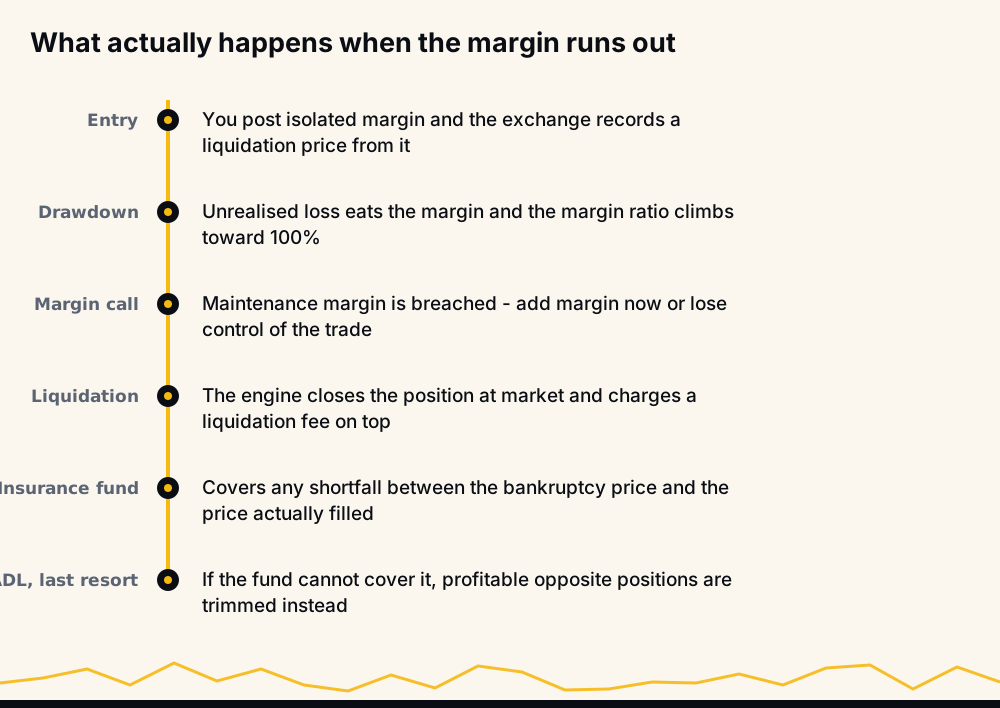
Two steps in that chain are worth remembering. The exchange closes the position at whatever the market offers, not at your calculated price, and the insurance fund exists because sometimes that is not enough — which is what auto-deleveraging cleans up when it isn't.
Why leverage amplifies fees and funding too
Fees are charged on the notional, not on your margin — and that surprises almost everyone the first month.
- Trading fees. Take an example taker fee of 0.05%. On a $10,000 position that is $5 to open and $5 to close: $10 round trip, or 1% of your $1,000 margin gone before the price moves at all. At 50x, the same round trip costs 5% of your margin.
- Funding. Perpetual futures charge or pay a funding rate, typically every 8 hours, again on the notional. At an example rate of 0.01% per interval, a held $10,000 long pays about $3 a day — 0.3% of a $1,000 margin, every day, compounding against you on long holds.
- Slippage and liquidation costs. Market orders in fast conditions fill worse than the screen showed, and a liquidation itself carries an extra fee. Both scale with position size.
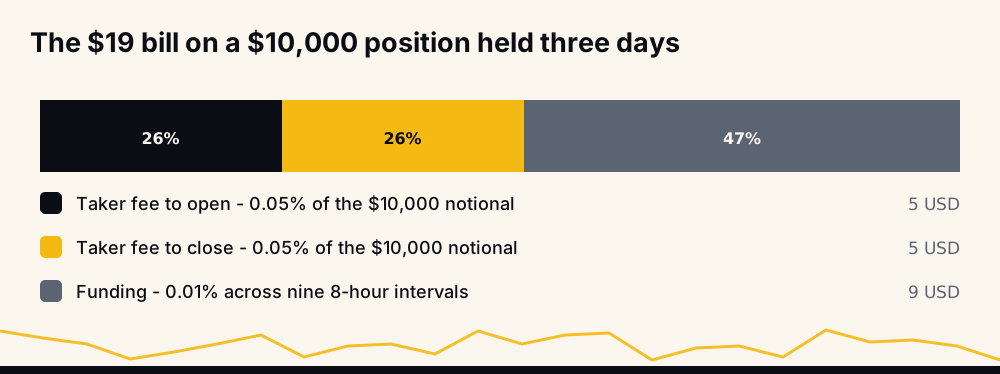
Put the three together on a $10,000 position held for three days at those example rates and the bill is about $19 — most of it funding, not the fees traders actually think about. Against $1,000 of margin that is 1.9% the trade has to earn before it breaks even, and against $200 of margin at 50x the identical bill is 9.5%.
This is why high-leverage overtrading loses money even for traders whose directional calls are decent: the arithmetic of costs is leveraged too.
Can you leverage trade crypto? Where it actually happens
Yes — the bulk of it happens on centralized exchanges through perpetual futures, with Binance USDT-M futures among the largest venues, listing hundreds of perpetual pairs against USDT. Margin trading on spot and leveraged tokens exist too, but perpetuals are where the volume is. If futures mechanics themselves are new to you — contracts, marks prices, funding — read the crypto futures trading guide for beginners first.
Availability depends on where you live. In the UK, the FCA banned the sale of crypto derivatives to retail consumers; in the US, most offshore high-leverage platforms are off-limits and regulated alternatives are narrower; several other countries cap retail leverage. Rules change — check your local regulator rather than a blog post, this one included.
What is high leverage crypto trading — and why it kills accounts
High leverage usually means 20x and up, with some venues advertising 100x+. Here is the blunt version: high leverage is how most retail futures accounts die. Not because every high-leverage trade loses, but because the math guarantees the eventual one that does is terminal.
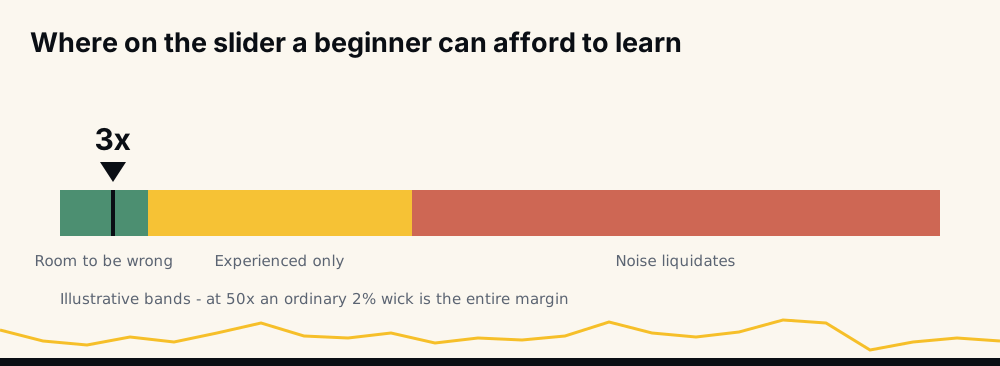
The bands are illustrative, but the marker is not arbitrary: at 3x an ordinary bad day is an inconvenience, and that is the only setting on the slider where a beginner gets to be wrong and still have an account to be right with later.
At 50x, your liquidation sits about 2% away. Ordinary noise — a news headline, a large market sell, a weekend liquidity gap — covers 2% routinely, and clustered liquidation levels are exactly where fast wicks travel. Survive that ten times and the eleventh still takes the whole stack, because a liquidation is not a bad trade you learn from; it is the balance going to zero. Run any strategy where a single routine event can erase you, repeat it, and ruin stops being a risk — it becomes a schedule. That is the textbook definition of unmanaged exposure, and it is worth understanding what financial risk actually means before touching the leverage slider again.
Position sizing that survives: risk per trade, not leverage
Surviving traders flip the question. Instead of "how much leverage should I use?" they ask "how much of my account am I willing to lose if this trade is wrong?" — and derive everything else from the answer.
- Fix your risk per trade. A common professional habit is around 1% of the account. On a $5,000 account, that is $50.
- Place the stop where the idea is invalid — below support, beyond the range — say 2.5% from entry.
- Size the position from those two numbers: $50 risk ÷ 2.5% stop = a $2,000 position. Leverage falls out at the end, and it is usually small.
With that sizing, a losing streak of five costs about 5% of the account — survivable, recoverable, boring. The leverage-first trader risking a third of the account per position needs only three mistakes to be effectively done.
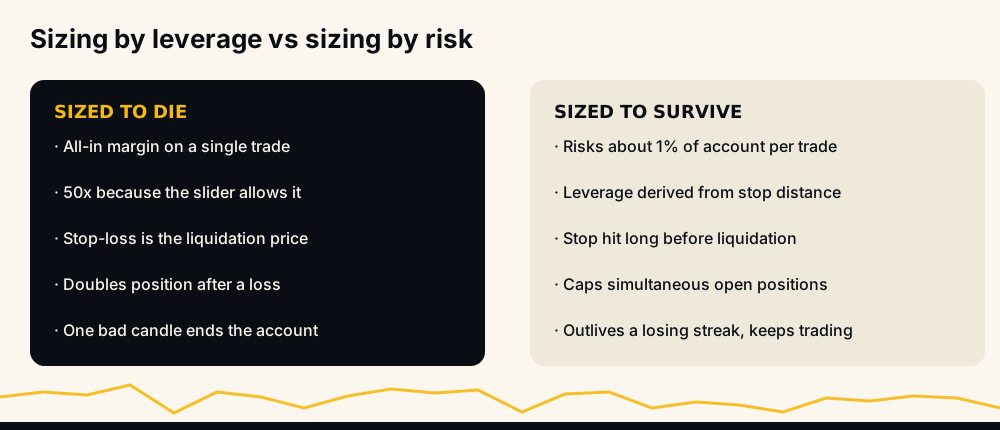
The stop-loss deserves its own sentence: a stop is not the liquidation price. Liquidation is the exchange salvaging its loan; a stop is you exiting with most of your margin intact. If your plan is "it liquidates or it wins," you do not have a plan — you have a countdown.
How to start leverage trading crypto as a beginner
If you are going to do this at all, sequence it so the market cannot hurt you while you learn:
- Paper trade or use a testnet first. Learn order types, margin modes and liquidation mechanics with zero at stake.
- Start at 2x–3x on isolated margin. Low leverage keeps liquidation far away while you learn how PnL, fees and funding actually behave.
- Never open a position without a stop-loss order placed at the same time as the entry.
- Risk about 1% per trade and cap simultaneous positions — correlated crypto positions lose together.
- Journal every trade and judge yourself on process over weeks, not on any single outcome.
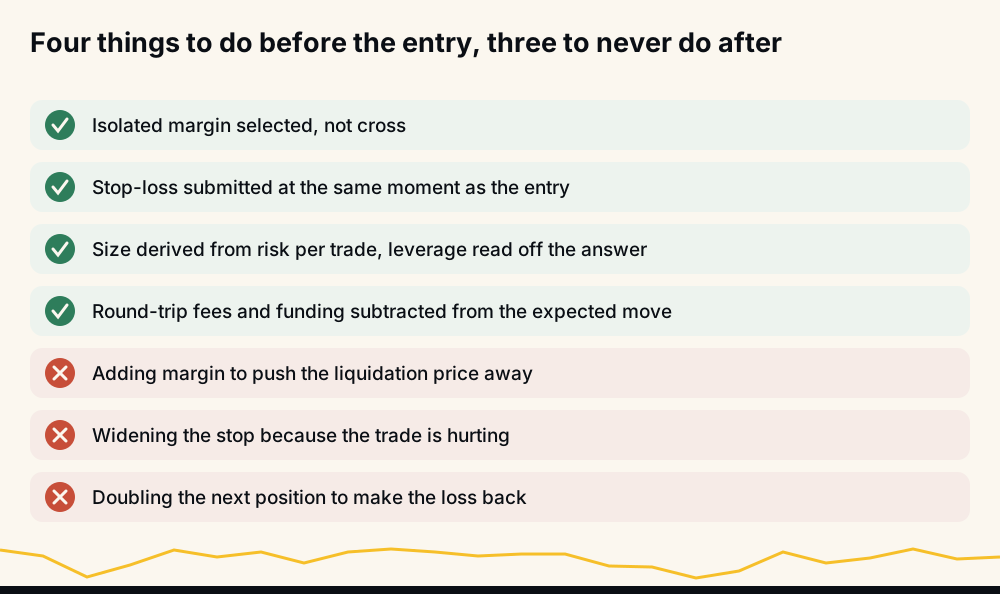
The three crossed-out lines are the ones that feel most reasonable in the moment. Each of them converts a sized, survivable loss into an unsized one, which is the single transition that ends leveraged accounts.
How automated risk limits enforce the discipline
Everything above fails at the same point: 3 a.m., a losing streak, and a human deciding "just this once" to size up. Automation is one way to make the rules non-negotiable.
HafizeBot's model evaluates 240+ indicators, formulas and components across 500+ Binance USDT-M perpetual pairs and rates each signal by strength — here is how to read those crypto signals — and its autotrading executes only inside limits the user sets in advance: minimum signal strength, position size, maximum simultaneous positions, and coin filters. The bot cannot revenge-trade, cannot move a stop out of hope, and cannot exceed the caps, because the caps are enforced in code. It never needs withdrawal permission and never calls a withdrawal or transfer, so funds never leave your own Binance account.
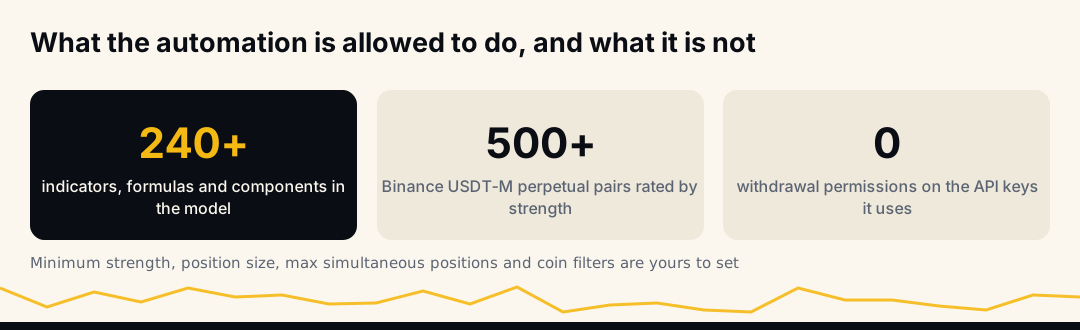
The third number on that panel is the one to check on any platform, not just this one: if a system needs permission to move your coins, its leverage settings are not your biggest problem.
Whether any system deserves that trust is an evidence question, not a marketing one. The /performance page is regenerated hourly from the trade database: a win means target hit, and the page shows Wins, Missed and Open. Broadcast signals carry a target and a maximum hold, not a stop, so every signal that does not reach its target in time counts as Missed and lowers the rate. PnL is shown unleveraged, so you can apply the leverage arithmetic from this article to it yourself. The older record — 33 monthly spreadsheets covering 33,694 signals from June 2021 to February 2024, with 98.9% median monthly accuracy as reported in those sheets — is downloadable at /reports for anyone who wants to check the math.
Leverage trading crypto FAQ
What is leverage trading crypto, in one example? You post $500 margin at 10x and control a $5,000 BTC position. A 4% price rise earns $200 (+40% on margin); a 4% fall loses $200 (−40%); around a 10% fall, the exchange liquidates the position and the $500 is gone.
Can you leverage trade crypto in the US or the UK? It is restricted in both: the UK's FCA banned crypto derivative sales to retail consumers, and US residents are barred from most offshore high-leverage platforms, with narrower regulated options at lower leverage. Rules change by jurisdiction and over time, so check your local regulator before trading.
Is leverage trading crypto halal or haram? Islamic scholars disagree; many consider leveraged derivatives problematic because of interest-like funding payments and excessive speculation, while some platforms market swap-free accounts. This is a question for a qualified scholar, not a trading blog.
What leverage should a beginner use in crypto? As little as possible — 2x–3x on isolated margin keeps liquidation roughly 30–50% away while you learn. Better still, size positions from a fixed risk per trade (about 1% of the account) and let leverage be a byproduct rather than a choice.
Can you lose more than you invest with crypto leverage? On major futures exchanges, liquidation plus the insurance fund normally cap your loss at the margin you posted — but that whole margin can vanish in minutes at high leverage, and extreme gaps can trigger auto-deleveraging. Treat the full margin as at risk from the moment you open the trade.
Leverage is a multiplier, and it multiplies discipline or its absence with equal enthusiasm. Learn the arithmetic, size from risk, and demand evidence from any system — human or automated — before it touches your money: the live performance record and the downloadable historical reports are where to point your skepticism first. None of this is investment advice, and leveraged or not, never trade money you cannot afford to lose.