Crypto futures trading means trading a contract that tracks a coin's price instead of buying the coin itself. You post a fraction of the position as margin, choose long (you profit if price rises) or short (you profit if it falls), and your gain or loss is the price move multiplied by your position size. That is the whole mechanism.
Everything else — perpetuals, funding, leverage, liquidation — is detail. But the detail is exactly what decides whether a beginner's account survives its first month, so this guide walks through all of it in plain words, including the part most guides skip: most beginners who trade at high leverage lose money, and the reasons are mechanical, not mysterious.
How does crypto futures trading work?
A futures contract is an agreement whose value follows an underlying asset. On Binance USDT-M futures, contracts are priced and settled in USDT: if you open a BTCUSDT long and Bitcoin rises 2%, your position gains 2% of its size — you never hold actual BTC. If you're new to the instrument itself, start with what crypto futures are and how the contracts are built.
A worked example, kept honest:
- You deposit 100 USDT of margin and choose 5x leverage.
- Your position size is 500 USDT of BTCUSDT.
- Price moves +2%: the position gains 10 USDT — +10% on your margin.
- Price moves −2%: you lose 10 USDT — −10% on your margin.
Leverage multiplied your exposure in both directions. Nothing about it changed the market's behavior; it only changed how much of your account each price tick represents.
Spot vs futures: what actually changes
On the spot market you exchange money for the asset and own it. On futures you own a position, not a coin — which unlocks shorting and leverage, and introduces liquidation and funding.
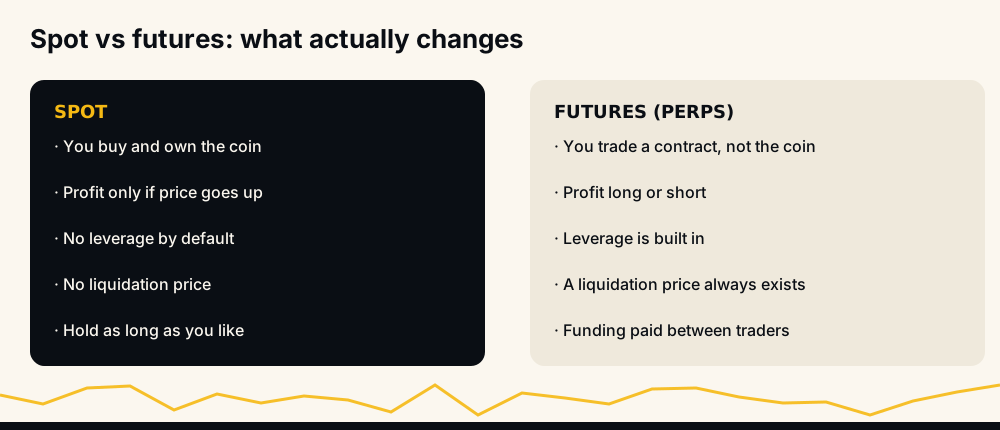
The practical consequence: on spot, a bad entry can be waited out for years. On futures, time is not free — leverage, funding payments and your liquidation price all put a clock on the trade. That single difference explains most beginner losses.
What are perpetual futures, and why crypto runs on them
Traditional futures expire on a set date. Crypto mostly trades perpetual futures ("perps"), which never expire — you can hold a position indefinitely, as long as your margin supports it.
Without an expiry date forcing the contract back to reality, something else has to keep the perp's price glued to the real spot price. That mechanism is the funding rate.
Funding rates: the quiet cost nobody explains to beginners
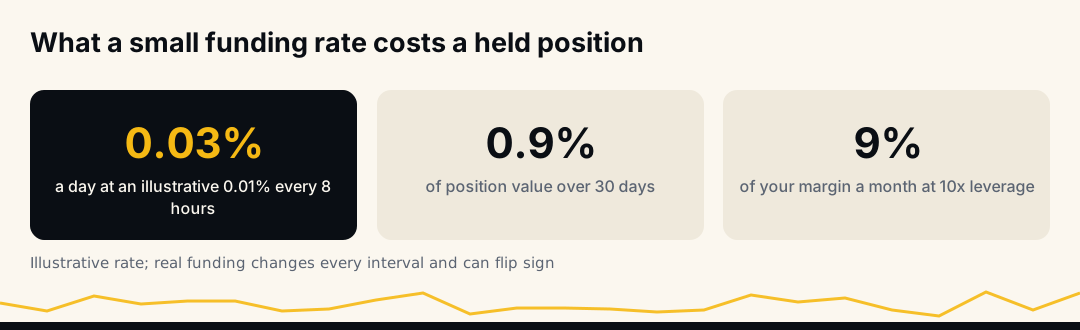
At regular intervals (commonly every eight hours), traders on one side of the market pay traders on the other. When the perp trades above spot, longs pay shorts, nudging the prices back together; when it trades below, shorts pay longs.
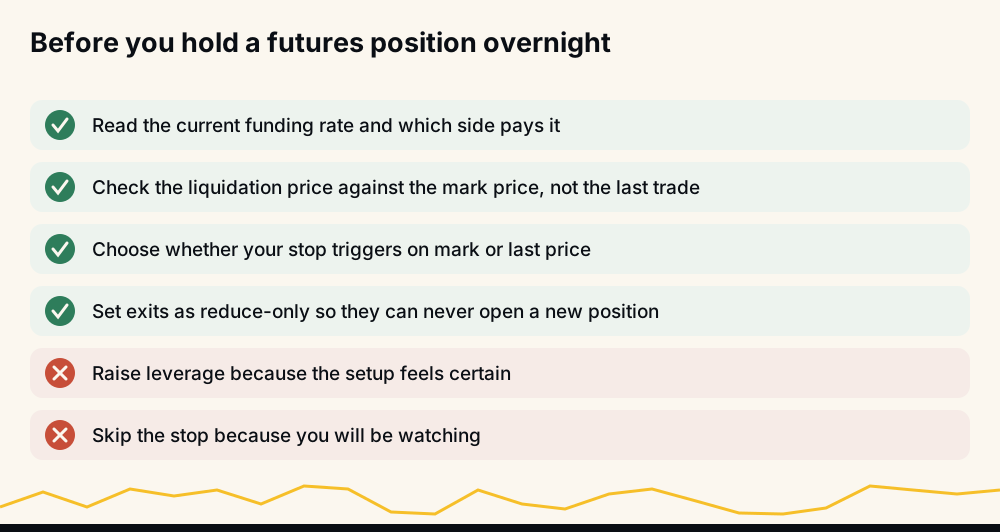
Each payment is small, but it compounds for anyone holding positions for days — and in a euphoric market, crowded longs can pay meaningful funding while waiting to be right. Check the current funding rate before you hold a leveraged position overnight; it's printed on every exchange's contract page.
Long and short: direction becomes a choice
Spot traders can only profit in one direction. Futures traders pick a side: long profits when price rises, short profits when it falls. Mechanically the two are mirror images — same margin, same leverage math, same liquidation logic in reverse.
For a beginner the useful part isn't doubling your opportunities; it's that you no longer need a bull market to have a plan. The full mechanics are in our guide to long and short positions in the crypto market.
Leverage and margin, in plain words
Margin is your collateral — the money you can actually lose on the trade. Leverage is the ratio between your position size and that margin. 10x leverage means a 500 USDT position controlled by 50 USDT of margin.
Two margin modes matter:
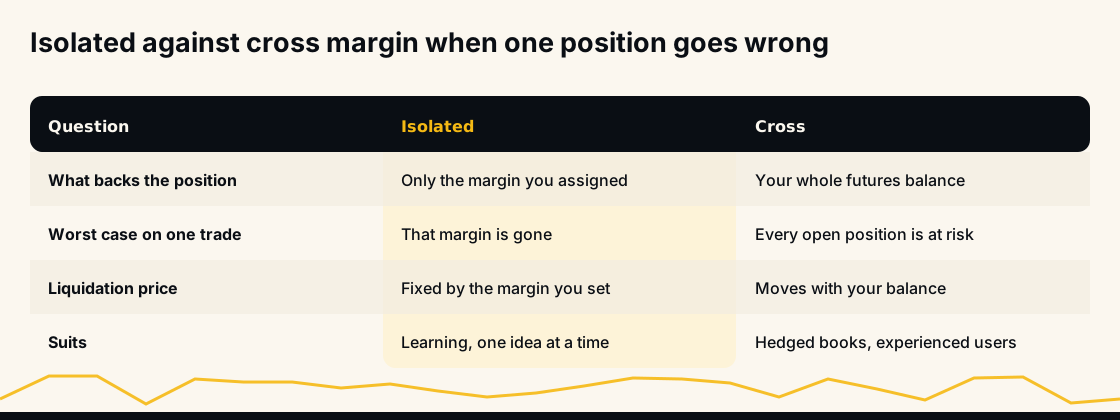
- Isolated margin: only the margin assigned to that one position is at risk. A liquidation costs you that stake and nothing more.
- Cross margin: your whole futures balance backs every open position. Losses on one trade eat the margin of all the others.
Beginners should use isolated margin until they can explain, from memory, why a cross-margined account can be emptied by a single position. Because it can.
Liquidation: the number that ends beginner accounts
Liquidation is the exchange force-closing your position because your margin can no longer cover the loss. It is not a penalty and not bad luck — it's arithmetic that was fixed the moment you chose your leverage.
The rough rule (isolated margin, ignoring fees and maintenance margin, so the real threshold is slightly closer): the adverse move that wipes your margin is approximately 100 divided by your leverage, in percent.
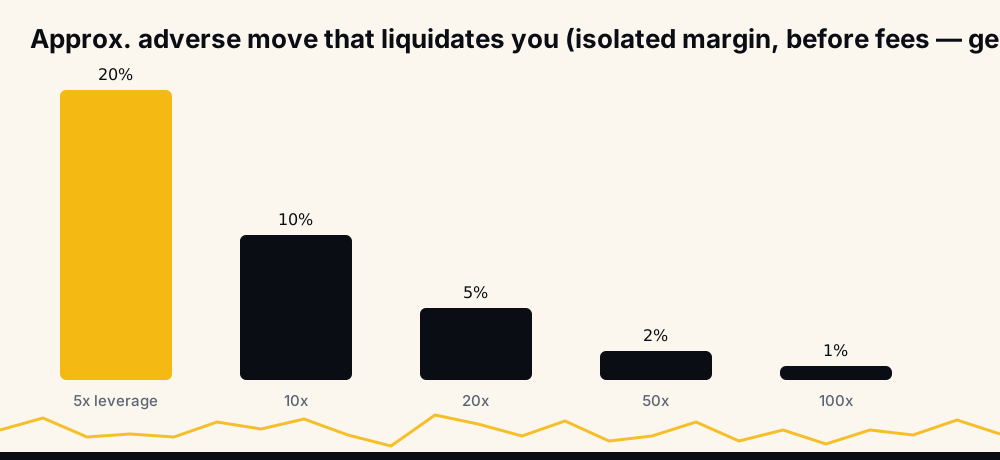
Look at the right side of that chart. At 100x, an ordinary 1% wiggle — the kind Bitcoin produces many times a day — is fatal. This is why most beginners at high leverage lose: they aren't wrong about direction more often than anyone else, they simply don't survive normal volatility long enough to be right. High leverage converts noise into ruin.
Mark price vs last price: which number liquidates you
Every futures screen shows two prices, and beginners usually watch the wrong one. The last price is where the most recent trade on that exchange filled. The mark price is a fair-value price the exchange calculates from an index of spot prices on several major exchanges, adjusted for the funding basis. Liquidation and unrealized profit and loss are calculated on the mark price, not the last price.
That design protects you from one thing and not another. A sudden wick on a single exchange's thin order book can print far below the mark price without liquidating you, because the mark price barely moved. A genuine move across the whole market moves the mark price too, and then nothing saves a position sized too large.
Two practical consequences follow. First, read your liquidation price as a mark-price level: a wick on the last-price chart can pierce it while you survive, and the mark price can reach it while the chart looks calm. Second, Binance lets you choose whether a stop order triggers on the last price or the mark price. A last-price stop reacts faster but can be set off by a brief wick; a mark-price stop ignores most wicks but may fill further away in a fast market. Neither is wrong, as long as you know which one you picked. When you close, mark exit orders as reduce-only, so an exit can never open a new position the other way; why a reduce-only order fails on Binance covers what happens when it is rejected.
Your first trade, step by step
Here's the entire lifecycle of a sane first trade, with training wheels bolted on:
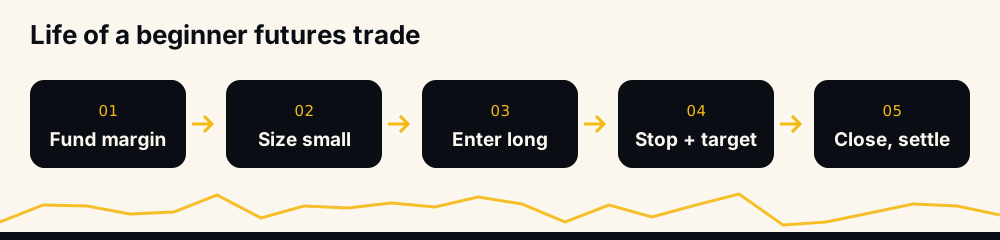
- Fund a small margin balance — an amount whose total loss would annoy you, not hurt you.
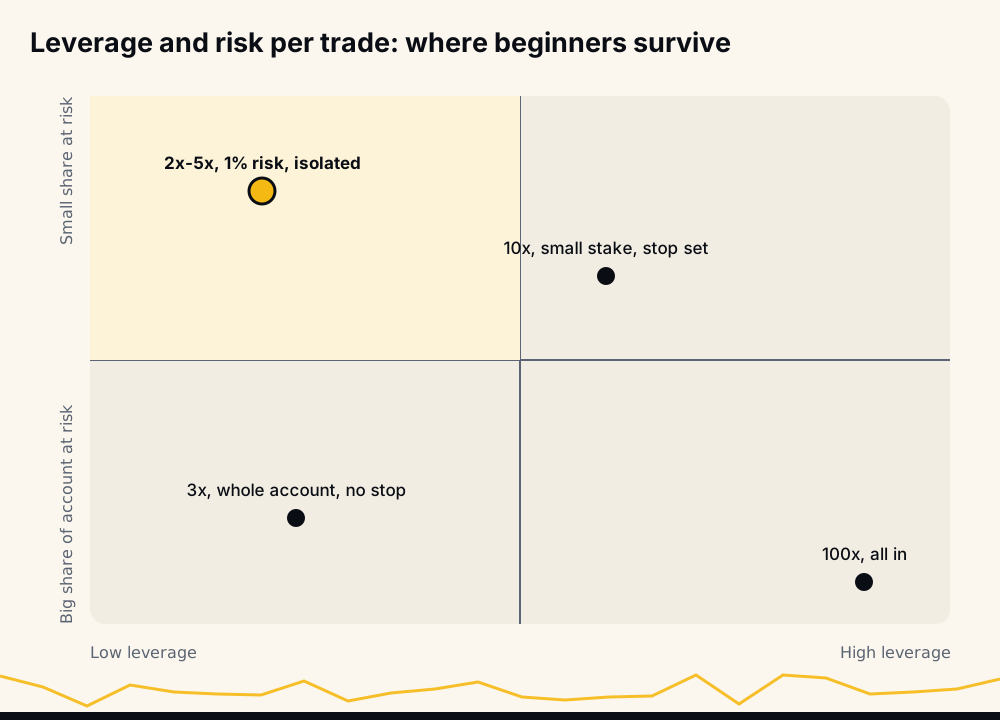
- Choose isolated margin and low leverage (2x–5x). Your liquidation price should be far from normal volatility.
- Enter with a reason — a setup, a signal, a level — not a feeling.
- Place the stop-loss and take-profit immediately, before the position can argue with you.
- Close and review. Win or lose, write down why. Ten reviewed trades teach more than a hundred impulsive ones.
If your account is genuinely small, read our older but still accurate guide to trading futures with a small account before funding anything.
Position sizing: the only edge a beginner fully controls
You can't control the market, your win rate, or the news. You fully control how much you risk per trade — and that alone decides how long you get to keep playing.
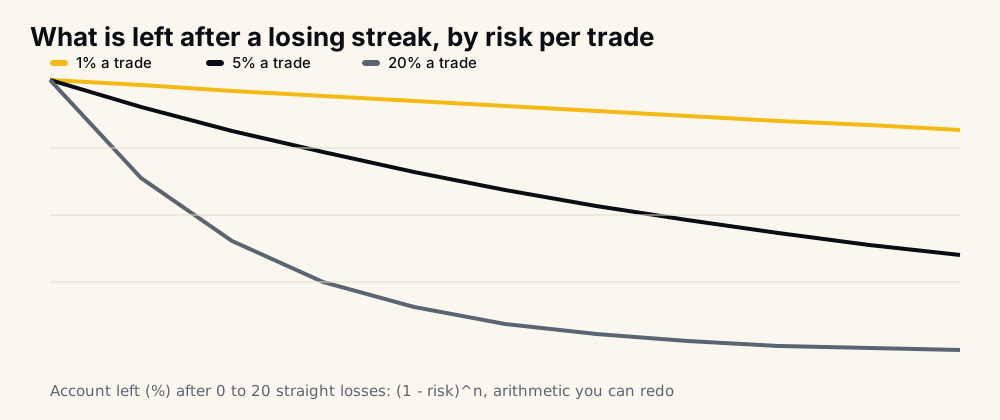
The classic rule scales down fine to crypto: risk 1–2% of your account per trade, measured from entry to stop-loss. With 1% risk you can be wrong twenty times in a row and still have ~80% of your account. With 20% risk, five bad trades end the story. Small size is not timidity; it's the entry fee for the long run.
The mistakes that empty small accounts
The same handful of errors, in roughly this order:
- Maximum leverage on day one — liquidated by noise, as the chart above shows.
- No stop-loss, or one that gets moved "just this once" as price approaches it.
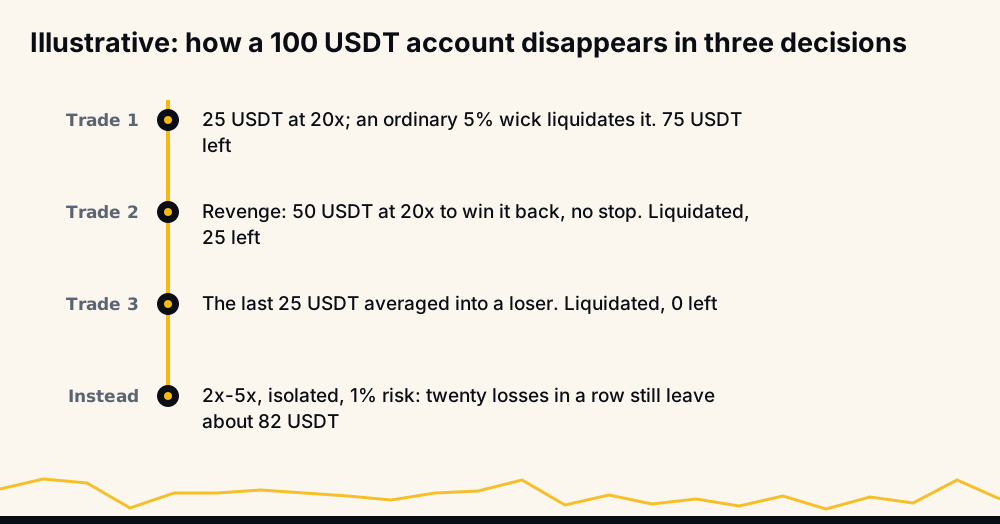
- Revenge trading: doubling size after a loss to win it back — the fastest known route from −10% to zero.
- Overtrading: taking every wiggle instead of a few clean setups. Fees and funding grind small accounts down.
- Averaging into a losing leveraged position, which drags your liquidation price toward the market.
- Trading illiquid pairs, where slippage on entry and exit quietly eats the edge.
None of these are knowledge problems; they're discipline problems. Which is exactly why rules — written down, or enforced by software — beat willpower.
Can you trade crypto futures in the US?
It depends on the venue. Binance's international futures platform does not serve US residents, and offshore exchanges that quietly accept them carry their own regulatory and withdrawal risks. US-regulated alternatives for crypto derivatives exist (CME futures and CFTC-regulated retail platforms), with different contract sizes and rules. This isn't legal advice: check the law where you live and trade only on platforms actually permitted to serve you — a great strategy on a platform that can freeze you out is not a strategy.
Where do signals and automation fit for a beginner?
Everything above is defense. For offense — finding entries worth taking — beginners face a coverage problem: hundreds of pairs, moving around the clock. That's the gap signal services and bots fill, and it's what HafizeBot does: a model evaluating 240+ indicators, formulas and components across 500+ Binance USDT-M perpetual pairs, rating each setup by strength before posting it.
The right way to use any signal service as a beginner is to make it prove itself first:
- Watch for free. The free Telegram channel (~3,980 members as of Aug 2026) carries the stronger signals VIP receives, strength 3 and up, with a 20-minute delay — enough to study them without paying or connecting anything. Learn how to read each signal line by line before acting on one.
- Check the record, not the pitch. HafizeBot published 33 monthly spreadsheet reports covering June 2021 – February 2024 — 33,694 signals, with a median monthly accuracy of 98.9% as reported in those sheets, downloadable here. Since June 2026 the live performance page is rebuilt hourly from the trade database and shows Wins, Missed and Open, with PnL shown unleveraged. Broadcast signals carry a target and a maximum hold, not a stop, so every signal that does not reach its target in time counts as Missed and lowers the rate. Losing months will show up there when they happen.
- If you automate, keep control. Autotrading never needs withdrawal permission on the API key — funds stay on your own Binance account — and you set the limits: minimum signal strength, position size, maximum simultaneous positions, coin filters.
A bot enforces the discipline part of this guide (fixed size, no revenge trades, stops placed instantly). It does not repeal the leverage math, and nothing here is investment advice — futures can lose money in any month, so only trade what you can afford to lose.
FAQ
Is crypto futures trading good for beginners? It's tradeable by beginners, but unforgiving of beginner habits. Start on isolated margin at 2x–5x leverage, risk 1–2% per trade, and treat the first months as paid tuition. Anyone who promises it's easy money is selling something.
How much money do I need to start trading crypto futures? Less than you'd think — minimum position sizes on Binance USDT-M pairs are small. The better question is how much you can lose without pain: start with that amount, and let position sizing, not deposit size, determine your risk.
What leverage should a beginner use? 2x to 5x. At 5x your position survives roughly a 20% adverse move; at 100x, roughly 1%. Low leverage doesn't cap your learning — it buys you enough survival time to do the learning.
What is the best crypto futures trading platform for beginners? One that is legal where you live, deeply liquid in the pairs you trade, and lets you set isolated margin and low leverage per position. Judge any add-on service — signals or bots — by a full published record like the performance page, never by screenshots.
Will crypto have a future? Nobody can promise that, and this site won't. What's observable: crypto derivatives volumes have led spot for years and perpetual futures are the market's core instrument. Trade the market that exists, sized so that no single opinion about the future can hurt you.
Want the evidence before the education? Fair. Browse the live performance record, download the 2021–2024 reports, or watch the free signal channel for a few weeks first — the record is the argument.