No — crypto trading is not passive income, and any product that sells it as one is misleading you. Trading is active risk-taking, whether a human or a bot presses the button. What automation genuinely changes is the effort, not the risk: a good bot removes the screen time, the 3 a.m. entries and the emotional mistakes, which makes automated trading semi-passive — while drawdowns, losing streaks and losing months remain entirely possible.
That distinction — effort versus risk — is the whole subject. Below is an honest comparison of the routes people actually mean when they ask how to make passive crypto income: staking, mining, lending and automated trading. No yield tables, no "up to X% APY" bait — just what each route demands from you, what can go wrong, and the one marketing phrase that reliably marks a scam.
What is crypto passive income, really?
Passive income means money that keeps arriving with little ongoing effort after an initial setup. In crypto marketing the term has been stretched to cover everything from staking rewards to leveraged futures trading — which is exactly how people end up "passively" losing half a portfolio.
Before believing any crypto passive income pitch, ask three questions:
- Where does the money come from? Real yield has a payer: a network paying for security, a borrower paying interest, a market paying for risk taken.
- What am I risking to earn it? Principal risk never disappears; it only hides.
- What will this need from me next month? That answer sorts passive from semi-passive from a part-time job.
If nobody can explain who pays the yield, the yield is being paid by the next depositor — and you are the exit liquidity.
Is staking crypto passive income?
Staking is the closest crypto gets to genuinely passive. You lock coins to help secure a proof-of-stake network and receive rewards in that same coin. After setup, ongoing effort is close to zero — we covered the mechanics in our plain-English guide to what staking is.
The trade-offs are real, even without quoting a single yield number:
- Rewards arrive in kind. You earn more of a coin whose price you still fully carry — a growing coin balance can still be a shrinking dollar balance.
- Lock-ups and unbonding periods mean you can't always exit the moment you want to.
- Validator, slashing and platform risk. Stake through an exchange and you've added a counterparty; run your own validator and you've added an operations job.
Verdict: passive in effort, but never risk-free — and the income is a slow drip, not a salary.
Is crypto mining passive income?
Mining is the least passive item on every "passive income" list. Hardware to buy and maintain, electricity to pay for, heat and noise to manage, difficulty adjustments and halvings that reshape the economics without asking you first. It is closer to running a small industrial business than to collecting a dividend.
Cloud mining contracts outsource the effort — and add a counterparty whose incentives you can't audit. Historically, that corner of the market has been a scam graveyard. Verdict: a business for people who like businesses, not passive income.
What about crypto lending and "earn" platforms?
Lending is passive in effort: deposit, receive interest. The risk is concentrated in one word — solvency. Your yield depends entirely on the platform staying alive, and depositors in the collapsed lending platforms of past cycles learned that the quoted yield was not the realized yield; their principal was the fee.
The qualitative test: interest exists because someone borrows. If a platform pays depositors more than any sane borrower would pay to borrow, ask what is actually funding the difference. When the answer is vague, it's you.
So is crypto trading passive income? The honest answer
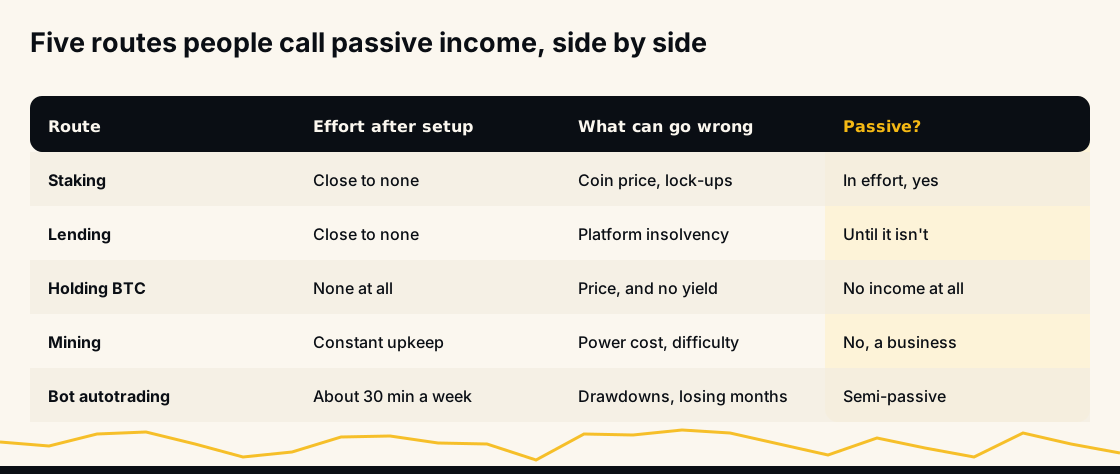
No. Trading — manual or automated — is the active taking of market risk, and with futures, leveraged market risk. The results are irregular: strings of wins, strings of losses, flat stretches. Income that can be negative for weeks at a time is not what anyone means by passive.
One nuance worth flagging: people also ask whether crypto is considered passive income in the tax sense. Tax systems commonly treat trading profits differently from passive investment income, and the rules vary by country — that's a question for a professional in your jurisdiction, not a blog. The practical point stands either way: trading is risk-taking, not rent collection.
Where a trading bot honestly fits: semi-passive
What a bot genuinely removes is the labor. HafizeBot's model continuously re-evaluates 500+ Binance USDT-M perpetual pairs against more than 240 indicators, formulas and components, rates each setup by strength, and — if you enable autotrading — executes on your own account within limits you define. Coverage, discipline and 3 a.m. execution no human can match; we unpacked that in do AI crypto trading bots actually work.
What no bot removes is the risk. Markets change regime, and models have bad stretches in regimes they weren't built for. If your definition of passive is "can't lose money while I'm not looking," no trading bot qualifies — including this one.
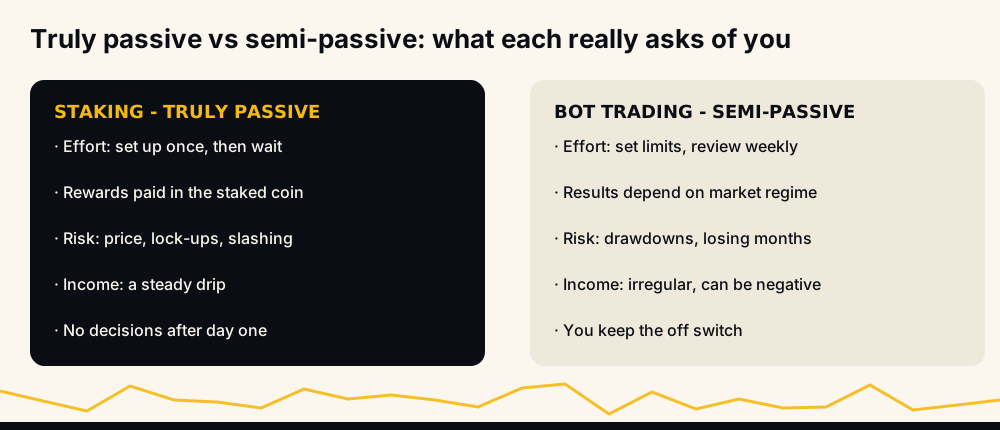
The honest label is semi-passive: the screen time goes to zero, the risk stays yours.
What still needs you, even with autotrading
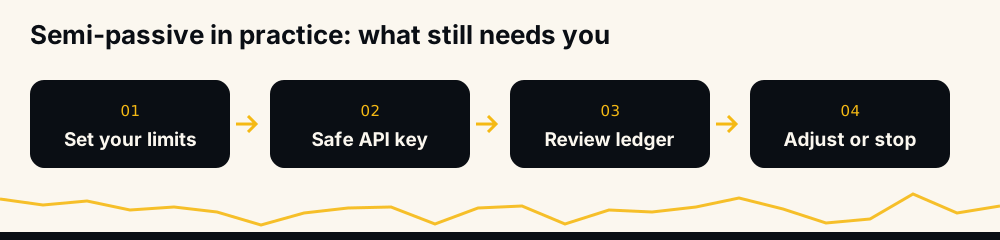
The "semi" in semi-passive is a short, concrete list:
- Set your limits. Minimum signal strength before the bot may act, position size, maximum simultaneous positions, coin filters. A bot with no limits has your account.
- Connect safely. Use a Binance API key with withdrawals disabled — HafizeBot never needs withdrawal permission and warns you if a key you add allows it, so funds stay on your own exchange account and you can revoke access any time.
- Review the ledger. Check results weekly against the record, not against your mood.
- Adjust or stop. Scale what the ledger has earned; cut what it hasn't.
That's perhaps half an hour a week. Not zero — and anyone telling you zero is selling something.
What "passive" actually costs in monitoring time
Half an hour a week sounds like nothing until you total it honestly. Over a year that's roughly 26 hours — a full working week — and it doesn't arrive evenly. Quiet months cost less than the ten minutes it takes to open the page. A bad stretch costs you an evening of deciding whether a drawdown is ordinary variance or a regime the model wasn't built for, which is a real decision that no amount of automation makes for you.
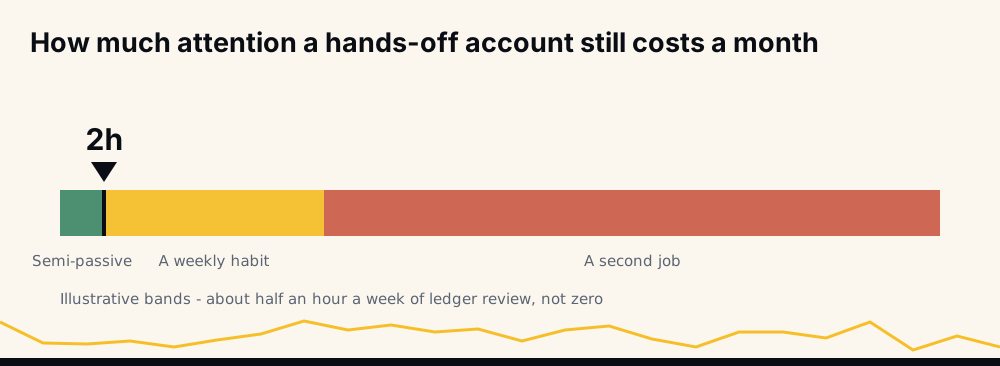
The bands are illustrative, but the shape holds. Anything asking under a couple of hours a month is genuinely semi-passive; anything asking ten is a habit you have to schedule; anything asking more is a job you didn't apply for.
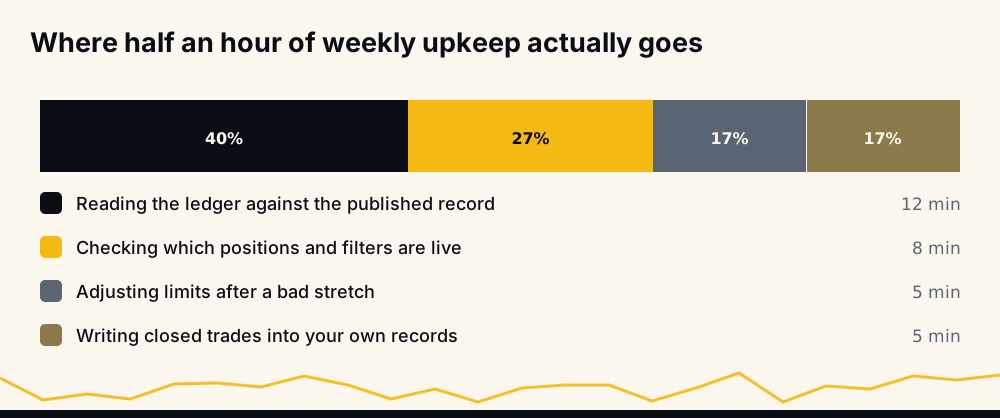
Notice what those minutes are not spent on: none of it is trading. It's upkeep — reading the ledger against the published record, checking which positions and filters are live, adjusting limits after a bad run, writing down what closed. Upkeep is the line item every passive-income pitch omits, because it's the part that proves the income isn't passive.
Tax and record-keeping: the least passive part of all
Automation multiplies your paperwork. A bot taking several positions a week produces several times the disposals a buy-and-hold investor reports — each with an entry price, an exit price, a fee and a date — plus funding payments settling every eight hours whether you were watching or not.

Exchanges hand you a CSV, not a completed return. Reconciling it is your obligation in most jurisdictions, and the classification matters as much as the arithmetic: many tax authorities treat frequent trading differently from long-term holding, which is exactly the question people mean when they ask whether crypto trading is "considered" passive income. Rules vary by country and change often, so ask a professional in yours. This is bookkeeping reality, not tax advice.
What breaks when you stop paying attention
Semi-passive setups fail quietly rather than loudly, and nearly always in the same handful of ways. An API key expires or gets revoked during a routine security review, and the bot simply stops trading without announcing it. A subscription lapses mid-position. Limits you chose for a calm market stay in force through a violent one, so your position count and size are quietly the wrong shape for the conditions.
The expensive failure is subtler than any of those. You stop reading the ledger during a losing stretch — precisely when the information is worth most — and discover two months later that the account did exactly what you told it to do. None of this is unmanageable, and none of it is dramatic. All of it needs someone to look.
Passive income versus a leveraged trading account
There's a category error at the centre of most passive-income marketing, and naming it clears up the rest. Passive income is a claim on somebody else's cash flow: a network pays you for helping secure it, a borrower pays you for the use of your capital. A leveraged futures account is not a claim on anything. It's a position — and a position can be closed against you, at a price the exchange chooses, on a schedule you don't control.
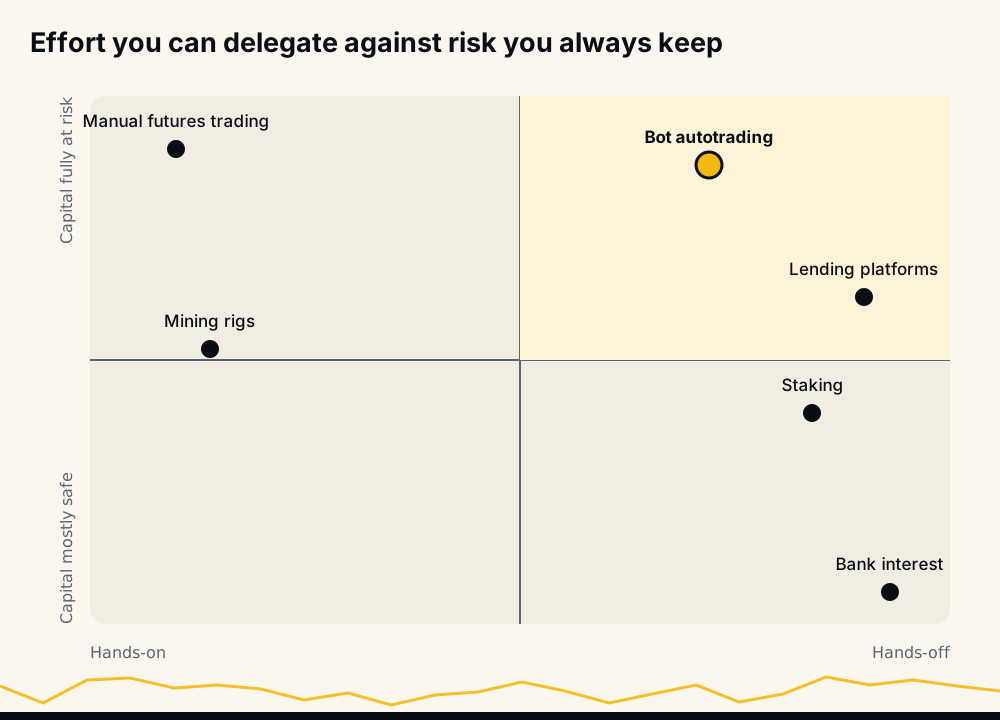
That map is the whole argument in one picture. Moving right on it means delegating effort, and it never moves you down. Futures are the sharpest case: margin, funding costs and a liquidation price that closes the trade whether or not you are awake — the arithmetic is in how leverage trading actually works in crypto. Rent does not have a liquidation price.
The scam tell: "passive income" with a fixed number
Here is the single most useful filter in all of crypto: anyone quoting you a fixed return is quoting you fiction. Markets do not pay salaries. A real trading record shows losing trades, losing days and sometimes losing months, because that's what markets do.
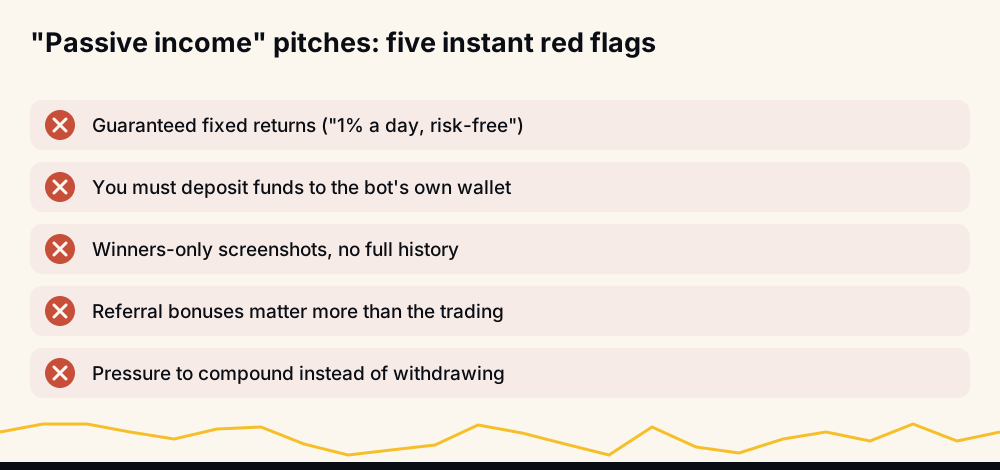
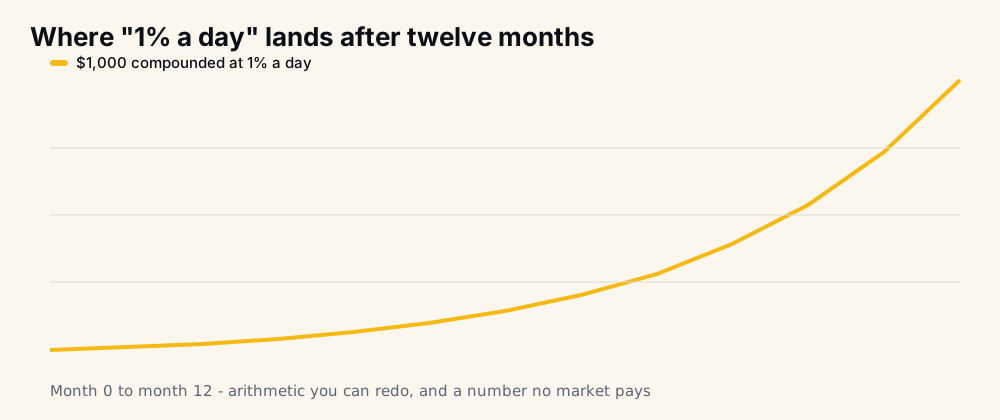
"Guaranteed 1% daily" is mathematically a Ponzi pitch, and the chart above is why: compound it for a year and $1,000 becomes roughly $36,000. Nobody quoting that number is doing it, because no market pays it — which makes the promise a recruitment tool rather than a return. A bot that needs your coins in its wallet is a withdrawal problem waiting to happen. A channel of winners-only screenshots is marketing, not evidence. And when referral bonuses matter more than trading results, the product is recruitment. The willingness to publish losing outcomes is the entire credibility test — pass or fail.
Judge the record, not the promise
Our answer to that test is a paper trail. Between June 2021 and February 2024 HafizeBot published 33 monthly spreadsheet reports covering 33,694 signals, with a median monthly accuracy of 98.9% as reported in those sheets — every order listed, downloadable so you can check the math yourself.
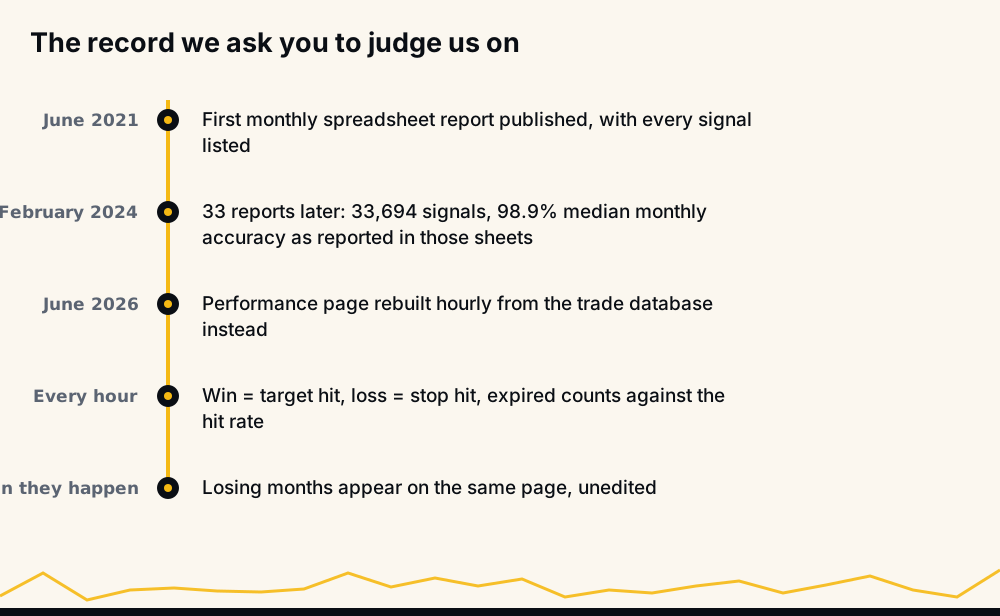
Numbers that strong deserve skepticism, which is why the record moved to something stricter. Since June 2026 the live performance page has been regenerated hourly from the trade database: a win only when the target was hit, and the page shows Wins, Missed and Open, with PnL shown unleveraged. Broadcast signals carry a target and a maximum hold, not a stop, so every signal that does not reach its target in time counts as Missed and lowers the rate. Losing months will appear there when they happen. Hold every "passive income" product — this one included — to that standard.
How to make passive crypto income without getting burned
A sane order of operations, from most passive to least:
- Want truly passive? Start with staking. Accept the in-kind rewards and the lock-ups, and size it so a bad year for the coin doesn't hurt you.
- Curious about trading? Watch before you spend. The free Telegram channel carries the stronger signals VIP members get, strength 3 and up, with a 20-minute delay (~3,980 members as of August 2026). It costs nothing and needs no API key.
- Paper-trade the signals against the performance page for a few weeks.
- If the record earns it, go small. Enable autotrading with tight limits and a non-withdrawal API key, and judge it on a month of ledger, not one great trade. Whether the subscription math works for your account size is its own question — we ran it in are crypto trading bots worth it.
- Only ever trade money you can afford to lose. Nothing here is investment advice; trading — automated or not — can and does produce losses.
Our earlier take, updated for 2026
We published earning passive income with crypto bot trading in an earlier, more optimistic cycle. Consider this the sober 2026 update — same product, harder-earned framing.
What changed: we'd no longer use "passive income" as the headline promise, because the phrase smuggles in "risk-free," and nothing in trading is. The right frame is delegated effort, retained risk. What hasn't changed: the argument was never a promise, it was a ledger — and the ledger has only gotten stricter since.
FAQ
Is crypto a good passive income? Parts of it can be a reasonable semi-passive income stream, never a guaranteed one. Staking is passive in effort with real price and lock-up risk; trading is semi-passive at best. Anything marketed as safe, fixed income from crypto is misdescribed or a scam.
Is staking crypto passive income? It's the closest thing crypto has: set up once, rewards accrue on their own. But rewards are paid in a volatile asset, exits can be delayed by unbonding periods, and validators or platforms add their own risks.
Is Bitcoin itself passive income? No. Holding BTC produces no cash flow — price appreciation is a potential capital gain, not income, and it can just as easily be a loss. Bitcoin only "yields" when you take on extra risk, such as lending it out.
Can a trading bot generate passive income? A bot can make trading hands-off: scanning, timing and execution without you. It cannot make trading risk-free, so treat bot profits as variable, sometimes-negative semi-passive income — and verify any bot's full record, like the hourly-updated performance page, before believing it.
Is crypto trading considered passive income for taxes? Frequently not — many tax authorities treat trading profits differently from passive investment income, and the classification varies by country and by how you trade. Ask a tax professional in your jurisdiction.
How can I start earning from crypto with the least risk? Start by risking nothing: learn staking mechanics, watch a free signal channel for a few weeks, and compare what you see against a published record. Commit real funds only after the evidence — and only funds you can afford to lose.
The honest pitch, then: not "passive income," but hours of your week back — with the risk still yours to manage. See what that looks like in practice on the live performance page, or download the 2021–2024 reports and check the math yourself.