With an honest provider, paid crypto signals are the same calls arriving sooner, sometimes more of them, but not better calls. The subscription buys latency and usually automated execution; it does not buy a different model or a higher win rate. So the free-versus-paid question reduces to something you can actually calculate: does the delay cost your account more than the fee does? For long holds it usually does not. For scalps it usually does.
That is the whole answer. The rest of this article shows you how to run that calculation on your own trades, how to tell a genuine free tier from a sales funnel, and what a paid tier should never be buying.
The honest split between the tiers
When a provider is running the model properly, the split looks like this:
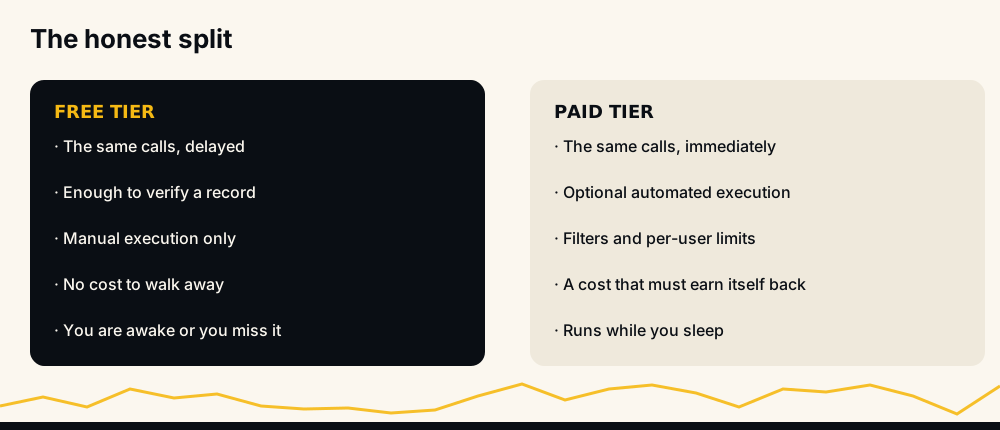
Read the left column carefully, because it is the part people underestimate. A free tier that mirrors every paid call, or every call that meets a rule stated in advance, is a complete dataset for what it carries. You can score it, argue with it, and decide whether the service is worth anything, all without paying. That is worth more than any testimonial.
Four different things "free" can mean
"Free signals" describes at least four business models, and they are not equally useful.
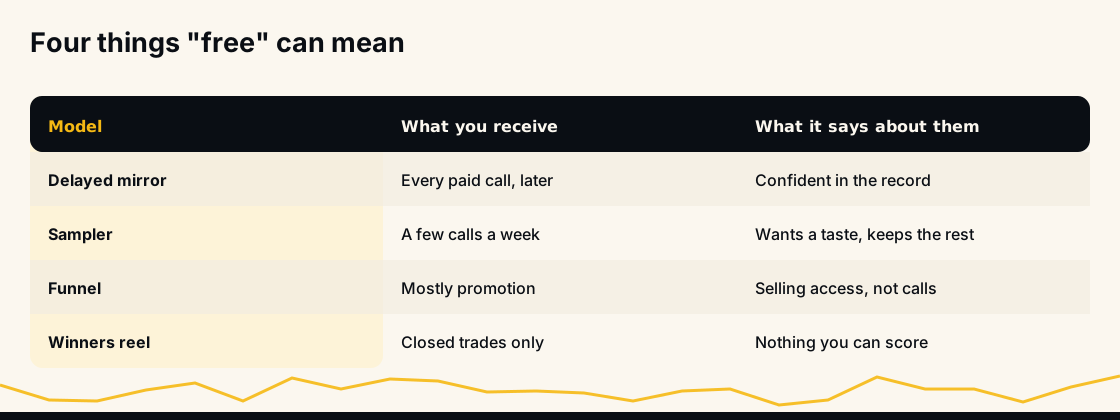
- The delayed mirror. Every paid call appears later, or every one that passes a published rule, chosen before anyone knows the outcome. This is the only version that lets you evaluate the service, and it is the only one a provider offers when they expect their record to hold up.
- The sampler. A handful of calls a week, chosen by them. You cannot compute a win rate from a sample the provider selected.
- The funnel. Mostly promotional, occasionally a trade. They are selling access; the calls are the bait.
- The winners reel. Closed profitable trades posted after the fact. Nothing here is scoreable, because you never saw the call before its outcome.
Only the first is worth your attention as evidence. The others can still be entertaining, but treating them as a track record is a mistake. It's the same failure that makes scam channels so hard to distinguish from real ones by scrolling alone.
How to read a free tier's intent
You can classify a channel in about ten minutes.
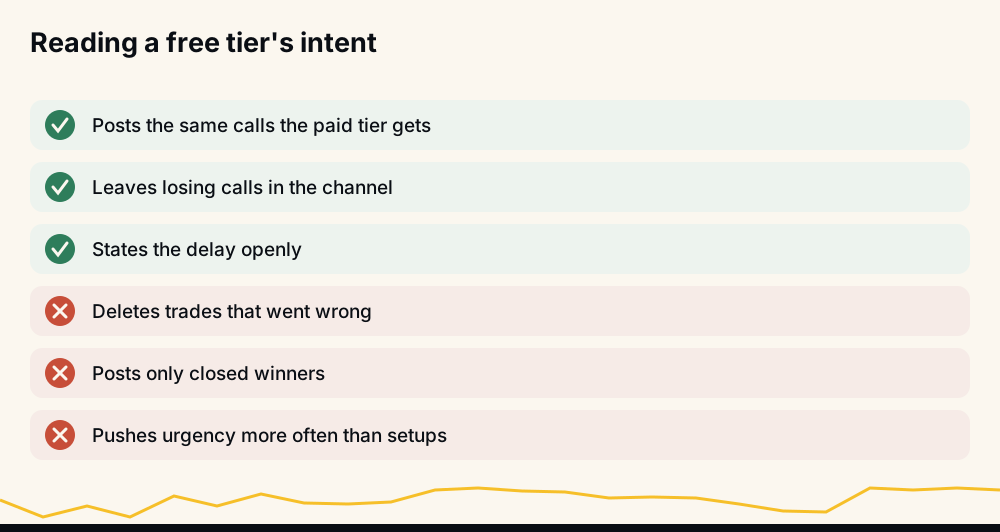
The single most informative behaviour is what happens to a call that went wrong. If it is still in the channel a week later, the operator is running an auditable service. If it has vanished, everything above it in the scroll is decoration.
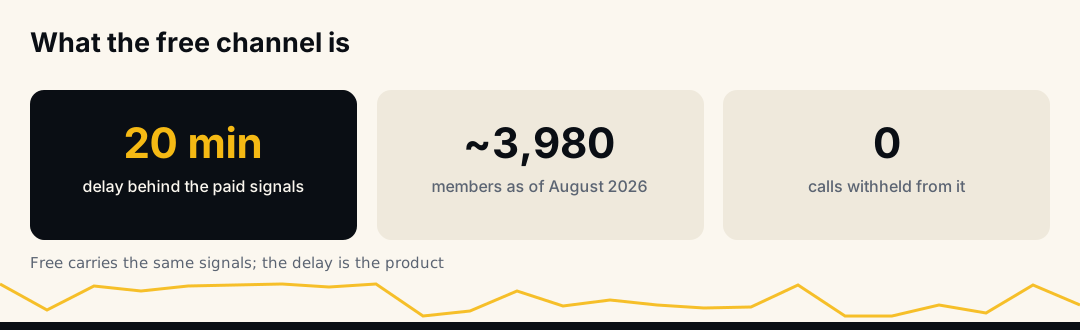
Our free channel, t.me/getbinancefutures, is a delayed mirror with one stated filter: the stronger signals the paid side receives, strength 3 and up, posted 20 minutes later, to roughly 3,980 members as of August 2026. VIP gets every signal the moment it fires.
What a delay actually costs
Here is where most of the free-versus-paid debate goes wrong. People treat "20 minutes late" as a fixed disadvantage. It isn't. It's a fraction, and the denominator is your holding period.
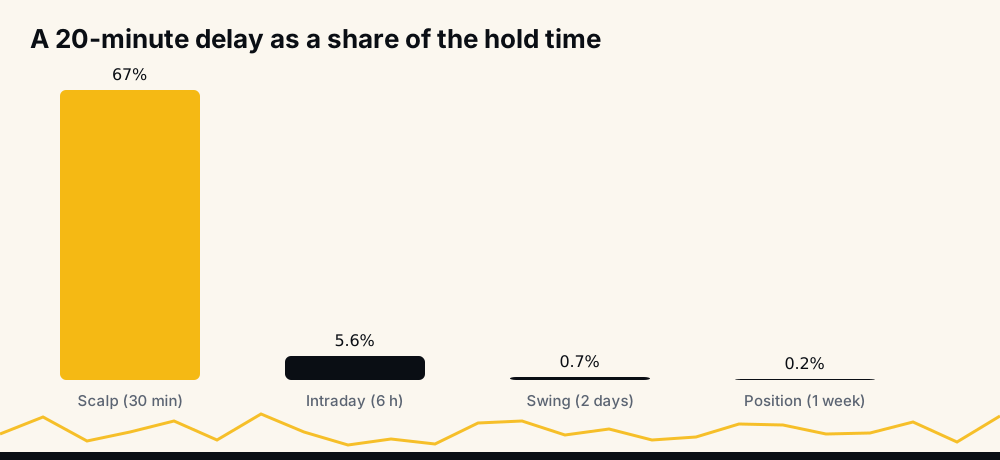
On a trade you intend to hold for a week, twenty minutes is rounding error. On a thirty-minute scalp, it is most of the trade. The same delay is either irrelevant or fatal depending entirely on how you trade. So the real answer to "is free good enough?" is it depends on you, and anyone who answers it without asking about your holding period is guessing.
There is a second effect worth naming: entry drift. In twenty minutes the price may have moved past the stated entry. Sometimes that is in your favour and sometimes against, but the important part is that it changes the trade's risk-to-reward, because your stop distance and your target distance both change while the levels stay put. If you are not sure how those levels interact, how to read crypto signals covers what each line of a signal actually commits you to.
When free is the right answer
Free is the correct choice, not a compromise, in these cases:
- You are still evaluating the provider. Nobody should pay before they have scored a month of calls themselves.
- You hold for days, not minutes. The delay is noise at that timeframe.
- You are learning. Reading calls without money at risk teaches you more per week than trading them does.
- Your account is small enough that the fee is a meaningful share of it. A subscription that eats several percent of your capital per month has to clear an unrealistic bar to be worth it.
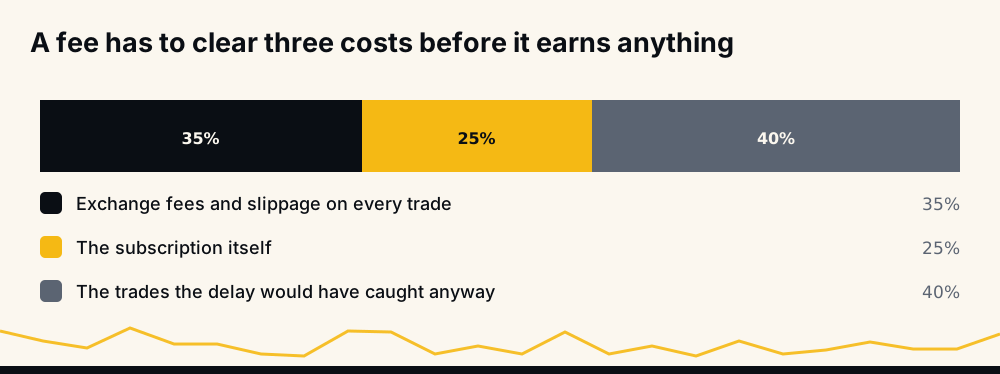
That fourth point deserves emphasis. Fees are a hurdle before profit rather than a deduction from it.
What free costs you in places the fee does not appear
The fee is visible and the costs of free are not, which biases the comparison. Four of them are worth pricing before you conclude the free tier is strictly cheaper.
Calls you never see. A signal arriving at 03:00 is only useful if you are awake for it. Over a month, the calls you slept through are a real cost, and they do not show up anywhere in your trading log because they never became trades. Count them: scroll the channel and mark every call that arrived while you were unavailable. For a lot of people that number is a third of everything posted.
Execution error. Entering by hand under time pressure produces mistakes that automation doesn't make: the wrong size, the wrong direction, a market order into a spread, a stop you meant to set and did not. These are individually small and collectively expensive, and they cluster exactly when the market is moving fastest.
Nothing enforcing your limits. Manual trading means your position sizing depends on your discipline at the moment you place the order, which is the moment discipline is weakest. A per-user cap on size or on simultaneous positions is a rule the software applies whether or not you feel like following it that day. This is the same argument as keeping a stop loss on every position: the value is in it being automatic rather than in it being correct.
Selective taking. Given a free channel and no system, most people take the calls that feel good and skip the ones that do not. That converts a provider's record into your intuition's record, and the two are unrelated. Whatever the channel's numbers are, they describe taking every call.
None of this argues that everyone should pay. It argues that "free costs nothing" is false, and the comparison is between two prices rather than between a price and zero. If you have decided the calls themselves are worth having, the useful question is which delivery method is cheaper for how you actually live. The smaller invoice doesn't settle it.
When paying starts to make sense
Conversely, the paid tier earns its keep when one of these is true:
- You trade short holds where twenty minutes materially changes the entry.
- You cannot be at the screen when calls arrive, and want them executed automatically.
- You have measured the drift and found it costs more than the fee, repeatedly, over a real sample.
- You want per-user constraints (a minimum signal strength, a position size cap, a limit on simultaneous positions, a filter on which coins are eligible) enforced by software rather than willpower.
That last one is underrated. Filters and limits are the difference between a system and a series of impulses, and they are much of what an autotrading setup is actually worth compared with executing by hand.
Who the upgrade is really for
Plotting it against how you trade makes the decision clearer than any feature list.
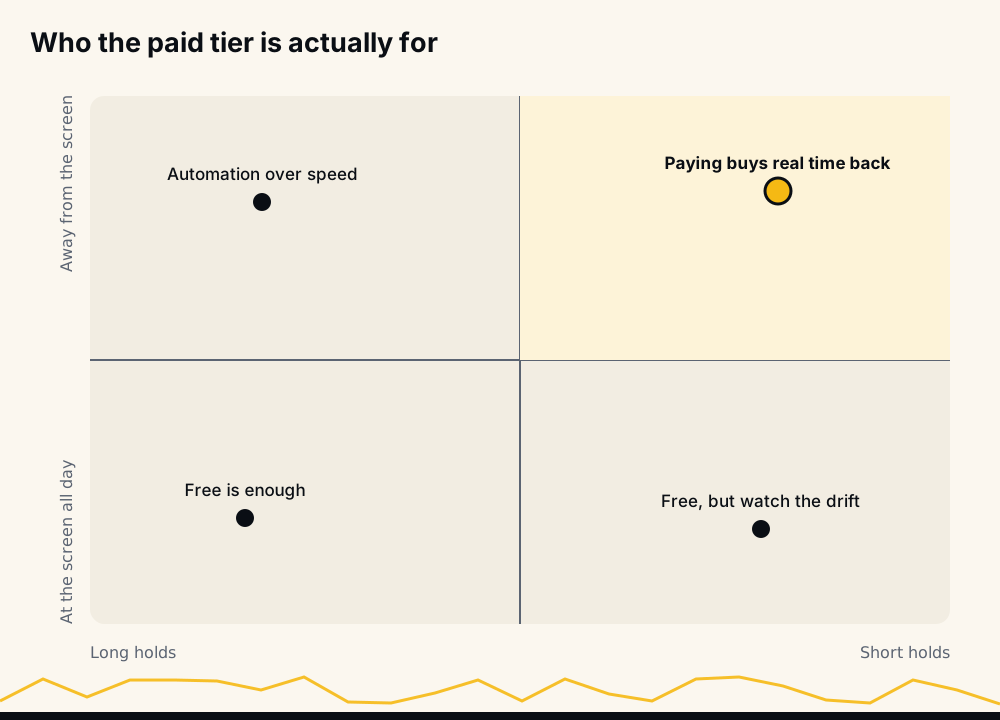
Someone holding for days who watches the market anyway gains almost nothing from paying. Someone taking short trades while holding a full-time job gains the most. The calls are no better, but they can act on calls they would otherwise never see in time.
How to price the upgrade for your own account
Do not guess this. Measure it.
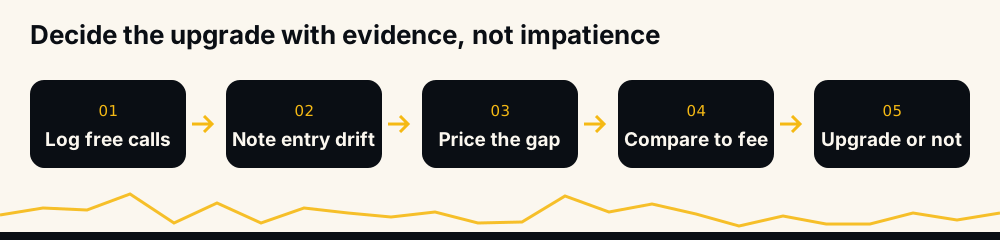
The method, concretely:
- Trade or paper-trade the free tier for a month, recording your actual fill against the signal's stated entry.
- For every call, write down the difference. Not a percentage of the move: the currency amount on the size you actually traded.
- Add it up, including the calls where the drift helped you. This is the honest number; taking only the bad ones inflates the case for upgrading.
- Compare the total against a month of fees. If the drift cost is smaller, the free tier is correct for you, regardless of how much faster paid feels.
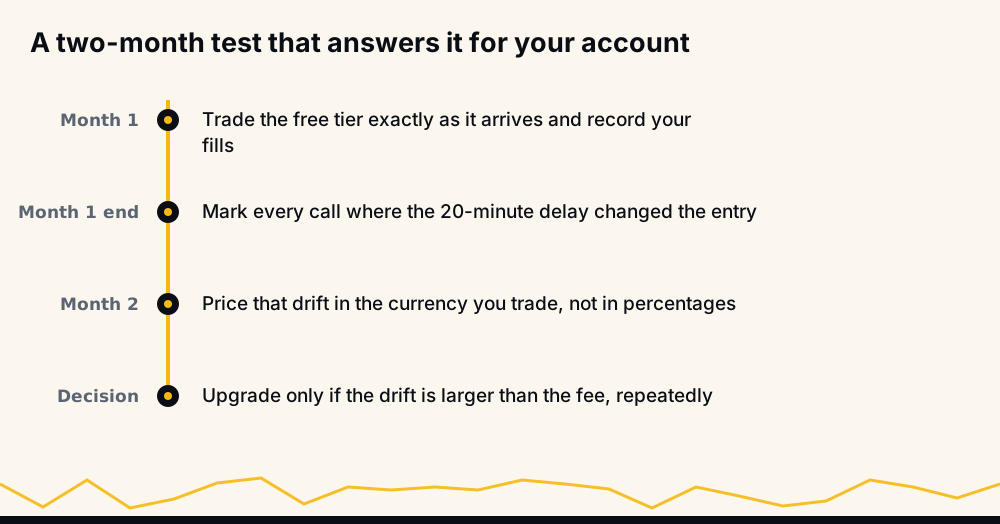
Run it over two months rather than two weeks. A single volatile week can make the delay look catastrophic or irrelevant, and you're trying to measure a tendency. One week is a mood.
What paid should never buy
Some things are not features regardless of price:
- Custody of your money. Autotrading should use API keys with withdrawal permission disabled, with funds staying on your own Binance account, the arrangement described in connecting a bot to your API key safely.
- A guarantee. No accuracy figure, ours included, is a promise about your results.
- Escape from your own risk decisions. Position size and leverage remain yours, and they matter more to your outcome than the calls do.
- A locked door. Pricing in USDT with no card means a period simply ends: nothing renews unless you switch on
/subscribe, which renews from the USDT balance you deposited. If leaving requires a support ticket, that is a product decision aimed at you.
What both tiers have behind them
Both sides draw on the same model: one evaluating 240+ indicators, formulas and components across 500+ Binance USDT-M perpetual pairs, rating each signal by strength. Paid members get every signal; our free channel gets those rated 3 and up. How it reaches a call is proprietary and stays that way; what we publish instead is the outcome. 33 monthly reports covering June 2021 to February 2024, 33,694 signals, median monthly accuracy 98.9% as reported in those sheets, downloadable at /reports. Since June 2026, /performance has regenerated hourly from the trade database, counting expirations against the hit rate and showing losing months when they occur. It counts every signal, so set a free-channel tally against the strength 3 and up rows: each month's page splits its results by strength.
Both tiers are subject to the same reality: trading is risky, and this is information. It is not investment advice. Leverage can end an account far faster than any hit rate implies, so trade only what you can afford to lose, and expect individual calls to be wrong.
FAQ
Are free crypto signals any good? They can be identical to the paid ones. When a provider runs a delayed-mirror free tier, the calls are the same and only the timing differs, or a stated rule decides which appear; ours carries the stronger ones, strength 3 and up. Being free isn't what makes free signals bad. Being a curated sample, a winners reel, or a funnel is, since none of those can be scored.
What is the difference between free and paid crypto signals? With an honest provider, latency and execution. Paid subscribers get calls immediately and can usually automate them with per-user filters and limits; free subscribers get the same calls, or a share fixed by a stated rule, on a delay and execute by hand. The underlying analysis is the same.
Is it worth paying for crypto signals? Only if the delay demonstrably costs you more than the fee. Measure it for a month: record the gap between the signal's entry and your actual fill on every call, price it in currency, and compare against a month's subscription. Short holding periods make paying worthwhile far sooner than long ones do.
How can I get free crypto signals on Telegram? Most established providers run a free channel; ours is at t.me/getbinancefutures, with the signals of strength 3 and up on a 20-minute delay. Judge any of them by whether losing calls stay visible in the history, since a channel that deletes them cannot be evaluated at all.
Do free crypto signals include losses? They should, and it is the fastest test of a provider's honesty. Scroll back a few weeks and look for calls that went against the channel. If every visible trade is a winner, entries are being removed and nothing in the channel is evidence.
Can I make money with free crypto signals? Some people do and many do not, and the deciding factor is usually risk management rather than the signals. Position size, leverage and stop placement determine whether a run of losses is survivable. Free or paid, those decisions stay with you.