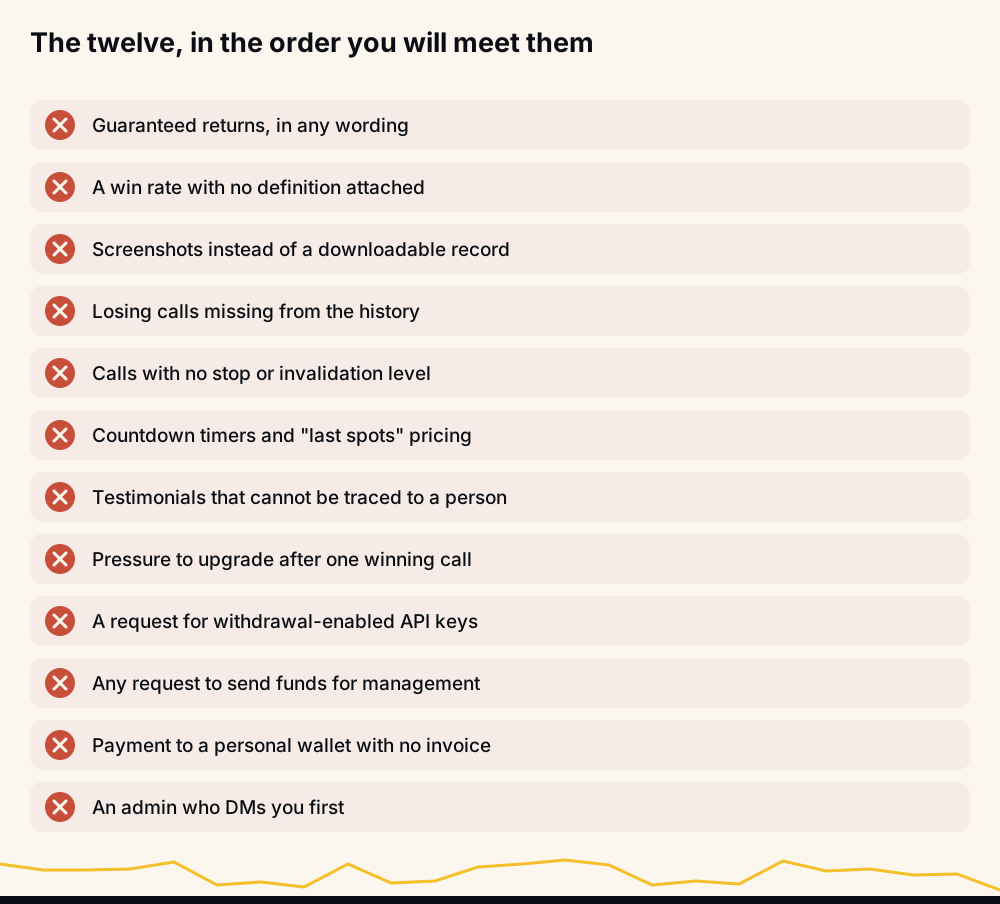
Three red flags end the conversation immediately: a guaranteed return, a request for withdrawal-enabled API keys or funds to manage, and a track record that exists only as screenshots. Each is decisive on its own. The other nine — undefined win rates, missing stop levels, deleted losing calls, countdown pricing, untraceable testimonials, pressure after one win, personal-wallet payments, unsolicited direct messages, and losses blamed on you — are strong enough that two together should be enough.
What follows is each flag, why it exists, and how the channel behind it makes money. Understanding the mechanism is more durable than memorising a list, because the wrapping changes constantly and the business model does not.
Why signal scams are structurally easy
A signal channel needs no capital, no licence and no product. Someone can post trade calls tomorrow, and for the first few weeks nobody can distinguish them from a competent operator — the outcomes have not arrived yet.
Worse, the medium itself is co-operative. Messages can be deleted, so a history can be edited after the fact. Screenshots can be composed. Follower counts can be bought. Almost every signal a reader uses to judge trustworthiness is cheaper to fake than to earn.
That is the environment. The flags below are the places where faking it still leaves a trace.
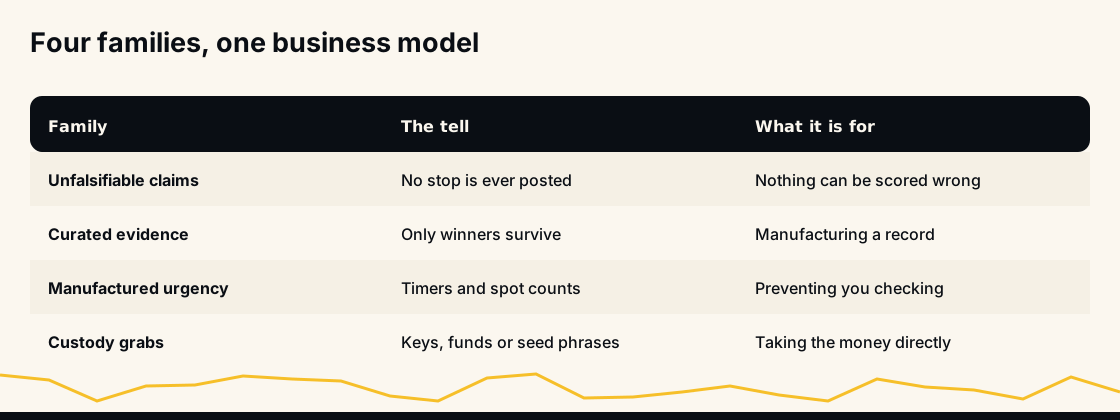
Family one: claims that cannot be wrong
Flag 1 — Guaranteed returns. In any wording: "guaranteed", "risk-free", "we cover your losses", "100% accuracy". Nobody controls the market. A guarantee is a statement about the seller's willingness to say things, and nothing else.
Flag 2 — A win rate with no definition. "92% accuracy" is not a fact until you know what a win is. The same trades can honestly be described by several very different percentages depending on whether expiries count, whether one of five targets counts, and whether a stop was ever published. How to verify a signal win rate sets out the questions that pin it down.
Flag 3 — Calls with no stop or invalidation. This one is technical and it is the foundation of the other two. Without a published level at which the idea is wrong, no call can ever be scored as a loss — it just stays open until it works or is forgotten. A channel structured this way has made itself unfalsifiable on purpose.
Family two: evidence that was curated
Flag 4 — Screenshots instead of a record. A screenshot is a view someone chose to show you. A file has a fixed number of rows that cannot be quietly reduced. If the only proof on offer is images, there is nothing to audit.
Flag 5 — Losing calls missing from the history. Scroll back three weeks and look for trades that went against the channel. If everything visible is a winner, entries have been removed, and every conclusion you might draw from the scroll is worthless. You cannot count what is no longer there.
Flag 6 — Testimonials you cannot trace. Reviews from accounts with no history, all posted in the same week, all phrased similarly. This is the cheapest thing on the entire list to manufacture, which is why it deserves the least weight.
Family three: urgency that exists to stop you checking
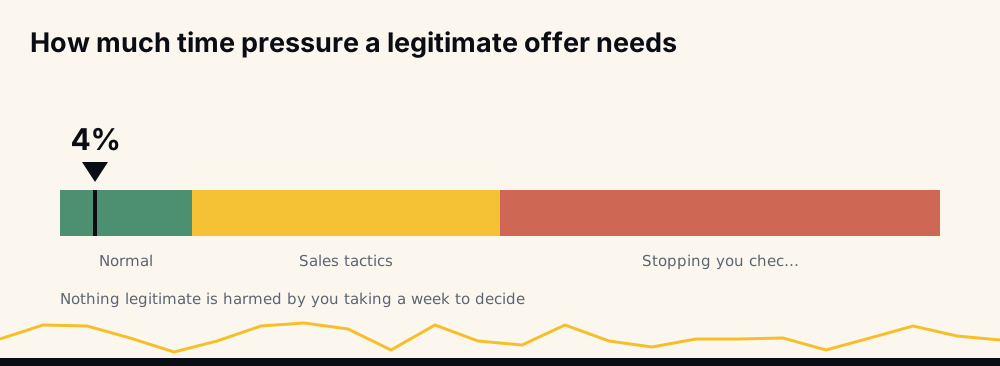
Flag 7 — Countdown timers and "last spots". A signal service has no capacity constraint; adding a subscriber costs nothing. Artificial scarcity exists to compress your decision time, which is another way of saying it exists to prevent the checks in this article.
Flag 8 — Pressure to upgrade after one winning call. "See what you missed on the VIP tier." One call is not evidence of anything — runs of five or six winners occur regularly at almost any win rate, including a coin-flip's.
Flag 9 — An admin who messages you first. Legitimate operators do not need to approach individuals in direct messages, and the impersonation of a known channel's admin is one of the most common attacks in this space. Assume any unsolicited DM offering help is not who it claims to be.
Family four: the ones that take the money directly
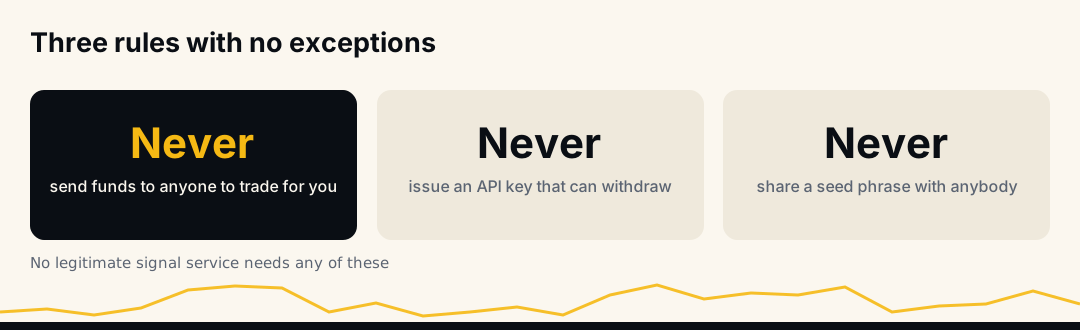
These three are not warning signs. They are the theft itself.
Flag 10 — A request for withdrawal-enabled API keys. Autotrading needs permission to trade. It never needs permission to withdraw. Any service asking for withdrawal rights is asking for the ability to move your funds out, and there is no configuration in which that is required. Connecting a bot to your Binance API key safely goes through the permission boxes one at a time.
Flag 11 — A request to send funds for management. This is a different business from signals and it is the one with the worst outcomes. Your money should stay on your own exchange account, always.
Flag 12 — Payment to a personal wallet with no invoice. Combined with pressure, this is the standard exit route, because the payment is irreversible and untraceable to an entity you could pursue.
Where the money actually comes from
It helps to know what you are to the operator.
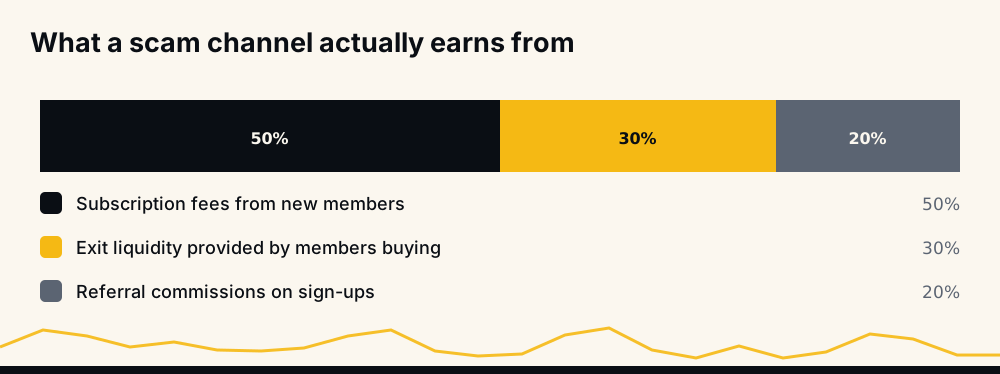
The middle slice is the one people do not see. On thin, low-liquidity pairs, the members themselves are the trade.
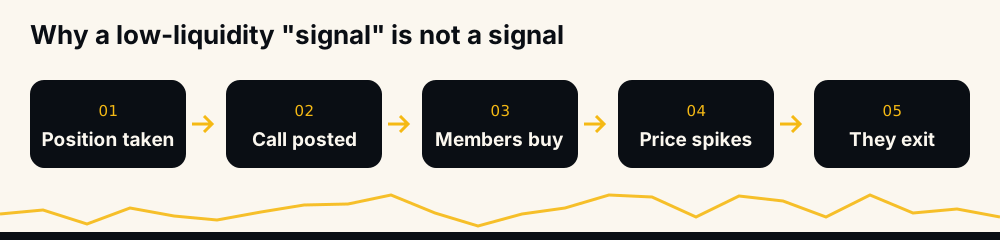
The mechanism only works on markets thin enough that a few hundred buyers move the price, which is why these calls are almost never on major pairs. A useful heuristic: be suspicious of urgent calls on coins you have never heard of, and of any channel whose calls cluster in illiquid markets. On deep markets like the major perpetual pairs, no channel is large enough to move the price meaningfully, so the tactic does not apply.
Two operators, described by their own behaviour
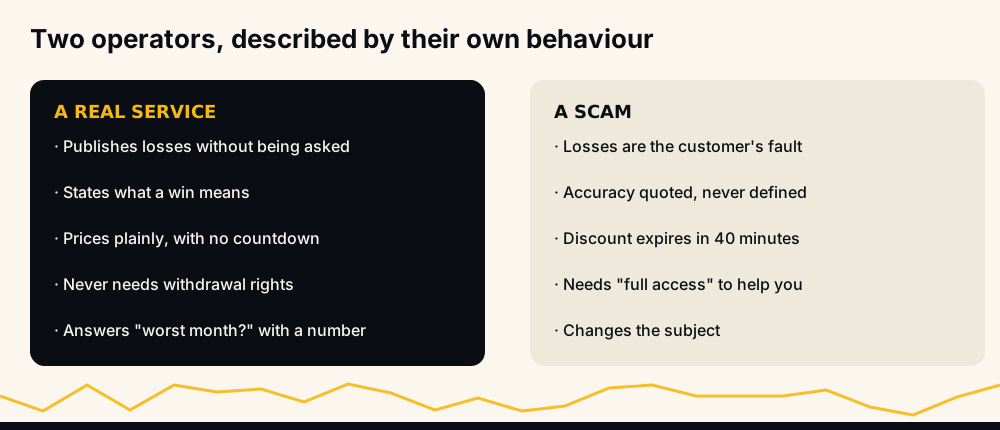
The bottom row is the single most efficient question you can ask, because it is hard to answer well without a record and easy to answer if you have one. What was your worst month, and what happened? A real operator has the number ready. Note also the first row on the right: losses being the customer's fault is the unfalsifiable claim in its most common form, and it is how a channel keeps a perfect reputation through a losing quarter.
The second scam that follows the first
If you lose money and say so publicly, expect to be approached.
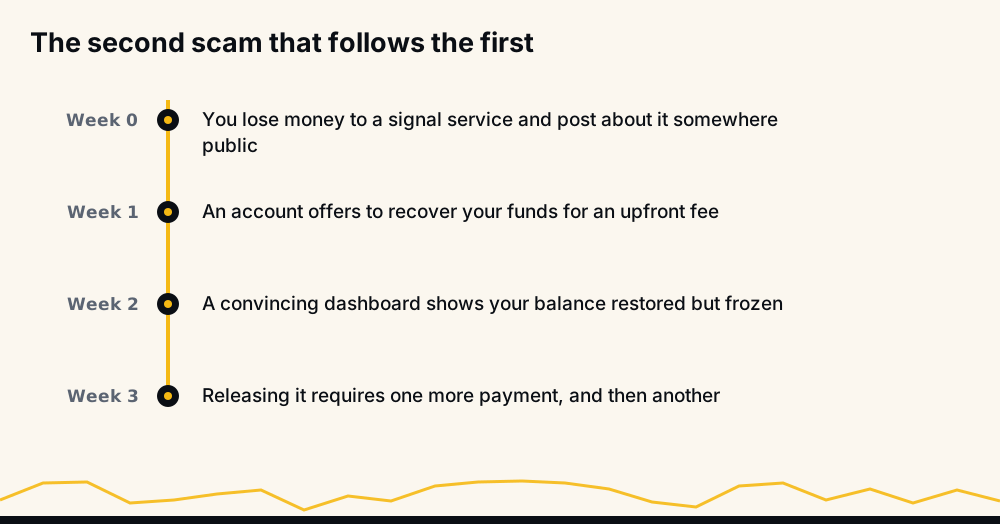
Fund-recovery offers are almost universally a second scam targeting people already identified as willing to pay and now motivated by loss. The dashboard showing your restored balance is a web page. Nobody who can genuinely recover crypto asks for money upfront from a stranger who contacted them nowhere.
Why a refund policy is not the safeguard it looks like
A stated refund policy reassures people, and it is one of the weakest protections on the list. Payment in crypto to a personal wallet is irreversible; the "policy" is a sentence on a page written by the person who would have to honour it, with no mechanism behind it. There is no chargeback, no intermediary, and frequently no identifiable entity.
This is why the checks have to happen before payment rather than being deferred to a remedy afterwards. Judge a payment method by what it lets you do if the counterparty simply stops replying — and in this market, the honest answer is usually nothing.
The flags that are not flags
Two things get called red flags constantly and are not, and mistaking them wastes your attention on the wrong candidates.
A small following. New and small are not the same as fraudulent, and a channel with three hundred members and a downloadable record is a better bet than one with fifty thousand and screenshots. Audience size is close to meaningless here precisely because it is so cheap to inflate — judging by it selects for marketing spend rather than for honesty.
A losing month, stated plainly. People treat a visible drawdown as evidence against a provider when it is usually the opposite. Every strategy has losing periods; the only operators without them are the ones not showing you everything. A channel that publishes a bad month unprompted has demonstrated the exact property you were trying to test for, and it should raise your confidence rather than lower it.
The inverse of both is worth stating too: a large following and an unbroken run of winners is the most suspicious combination on this page, and it is the one that converts best. If you find yourself reassured by those two things together, that is the moment to go looking for the downloadable record.
A five-minute triage
You do not need to evaluate a channel deeply to reject most of them.
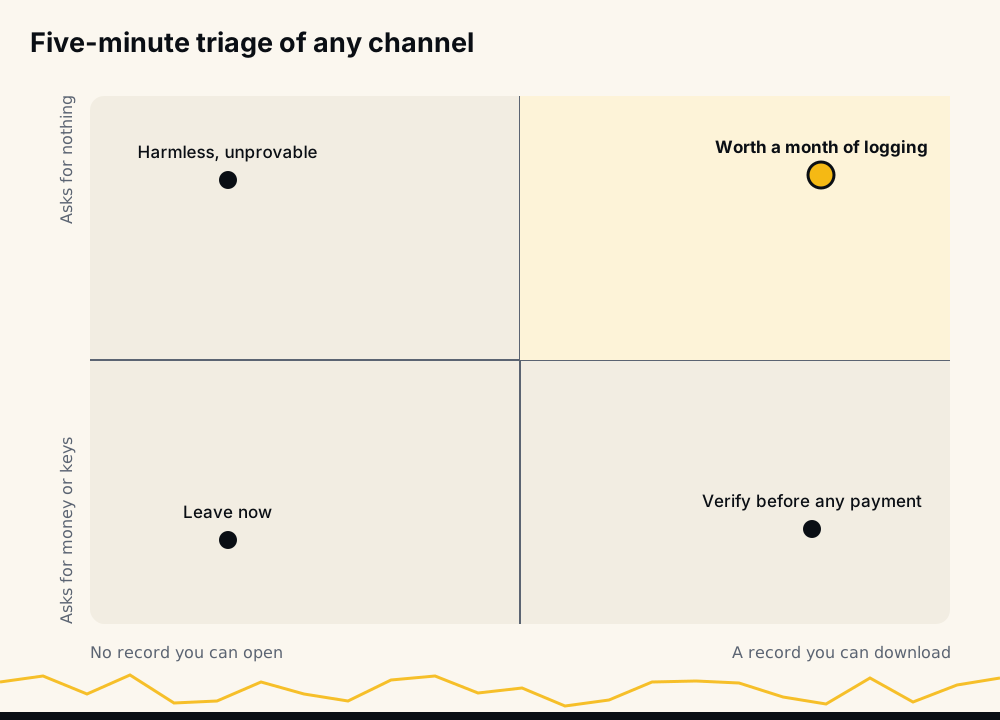
In order: does a downloadable record exist? Are stops published with the calls? Are losing calls still in the history? Is anything being asked of you before you have verified anything? Four questions, five minutes, and most candidates are gone.
What survives the triage has earned a month of your logging — not your money. Choosing a signal provider covers the deeper evaluation, and telling legitimate Telegram bots from scams covers the automation side of the same problem.
If you have already paid one
Practical steps, in order:
- Revoke API access at the exchange immediately, not in the provider's interface. Delete the key entirely rather than editing its permissions.
- Check for open positions and orders you did not place, and decide deliberately what to do with each.
- Enable withdrawal address whitelisting and review recent account activity and any devices with access.
- Stop paying. If a card is involved, cancel the recurring authorisation with your bank; crypto payments cannot be reversed.
- Expect the recovery approach and ignore it.
- Report the channel to the platform. It rarely helps you and sometimes helps the next person.
Do not send more money in an attempt to recover what was lost. That instinct is exactly what the second scam is built for.
What the honest version looks like
For contrast, the things a legitimate operator can point at: a record you can open and count — ours is at /reports, 33 monthly spreadsheets covering June 2021 to February 2024, 33,694 signals, at a median monthly accuracy of 98.9% as reported in those sheets — and a live page, /performance, regenerated hourly from the trade database since June 2026, where expirations count against the hit rate and losing months appear when they happen.
Alongside that: a free channel at t.me/getbinancefutures carrying the same signals on a 20-minute delay so nothing has to be taken on trust, autotrading that runs on withdrawal-disabled API keys with funds staying on your own Binance account, and pricing in USDT with no card and no auto-renewing subscription. The model behind the signals evaluates 240+ indicators, formulas and components across 500+ Binance USDT-M perpetual pairs; its workings are proprietary, which is precisely why the evidence offered is the published outcomes.
None of that makes trading safe, and this is information, not investment advice. Trade only what you can afford to lose.
FAQ
How do I know if a crypto signal group is a scam? Check three things first: whether returns are guaranteed in any wording, whether anyone is asking for funds or withdrawal-enabled API keys, and whether a track record exists as a downloadable file rather than screenshots. Any one of those failing is enough to walk away.
Are Telegram crypto signal groups legit? Some are and many are not. Telegram is only the delivery channel — legitimate providers use it too. Judge the operator by whether losing calls remain visible, whether stops are published with each call, and whether the record can be counted rather than only viewed.
Why do scam signal channels only post about obscure coins? Because the tactic requires a market thin enough that a few hundred buyers move the price. On deep markets like the major perpetual pairs, no channel is large enough to do that. Urgent calls on unfamiliar low-liquidity coins deserve particular suspicion.
Should I ever give a signal provider my API keys? Only keys with withdrawal permission disabled, and only for autotrading you actually want. Trading permission is enough for any legitimate service. A request for withdrawal rights has exactly one purpose, and no configuration requires it.
Can I get my money back from a crypto signal scam? Usually not, particularly with crypto payments, which are irreversible. Revoke API access, stop any recurring payment, and ignore anyone who approaches you offering recovery for an upfront fee — that is a second scam aimed at people who have already lost money once.
Is a high follower count a sign a signal group is real? No. Follower counts and testimonials are among the cheapest things to manufacture in this market. A downloadable record with a fixed row count is worth more than any audience size, because it is the one piece of evidence that cannot be quietly edited afterwards.