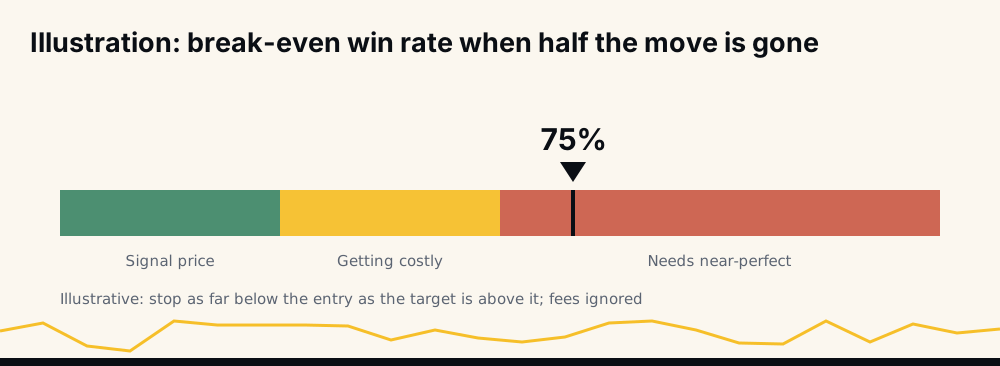
You can enter a crypto signal late only while the trade still pays for its risk. Every bit of price movement toward the target comes off your reward and goes onto your risk, so the win rate you need to break even climbs in a straight line. With your stop as far from the entry as the target, entering halfway there needs 75% wins instead of 50%, before fees. Set your limit before you look at the price.
Below is the arithmetic behind that answer, with every number an illustration you can redo on paper, a rule you set for yourself, and the three things that make a late entry worse than it looks: fees, slippage and a delayed feed.
What changes when you enter a signal late
A signal gives you a direction, an entry price and a target. Some providers also publish a stop. HafizeBot's broadcast signals carry a target and a maximum hold, not a stop, so the stop in everything below is your own, and it is the most important number in this article.
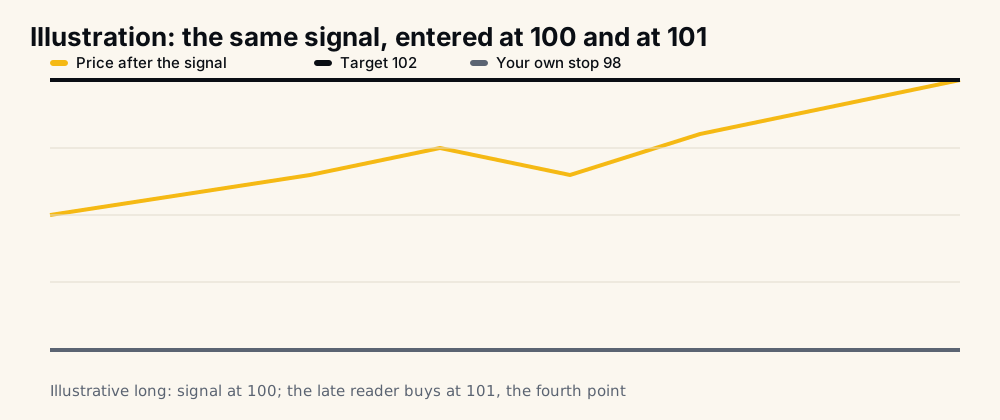
Picture a long signal: entry 100, target 102. You decide that the idea is wrong if price falls to 98, so that is your stop. Seen at the moment it was sent, the trade risks 2 to make 2.
Now you see it late, at 101. The target and the level where the idea is wrong have not moved. Only your entry has, the wrong way for both sides of the trade.
The arithmetic: reward shrinks while risk grows
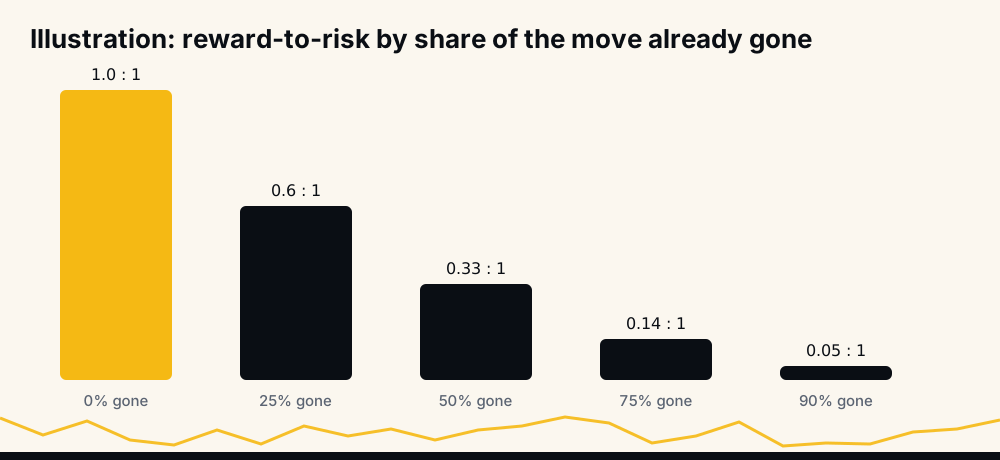
From 101, the reward left is 1 (to 102). The risk is 3 (down to 98). Your reward-to-risk went from 1 : 1 to 1 : 3, and price moved only half of the way to the target.
A late entry cuts more than the upside: every unit price has travelled is taken from the reward and added to the risk at the same time.
Written as a formula, call the distance from entry to target D, the distance from entry to your stop S, and the share of D already gone f:
- reward left = D × (1 − f)
- risk = S + f × D
- reward-to-risk = D × (1 − f) ÷ (S + f × D)
With D = S = 2 and half the move gone (f = 0.5), that is 1 ÷ 3, about 0.33 : 1.
Break-even win rate: the number that actually moves
Reward-to-risk is hard to feel. The win rate you need to break even is easier. Binance Academy's guide to the risk/reward ratio (updated 25 June 2026) gives it as break-even win rate = 1 ÷ (1 + R), where R is reward divided by risk. Equivalently, it is risk ÷ (risk + reward).
Here is the useful part. Risk plus reward is always the distance from your stop to the target, S + D, and that distance does not change when you enter late. So the break-even win rate is simply how far along the stop-to-target line your entry sits:
- break-even win rate = (S + f × D) ÷ (S + D)
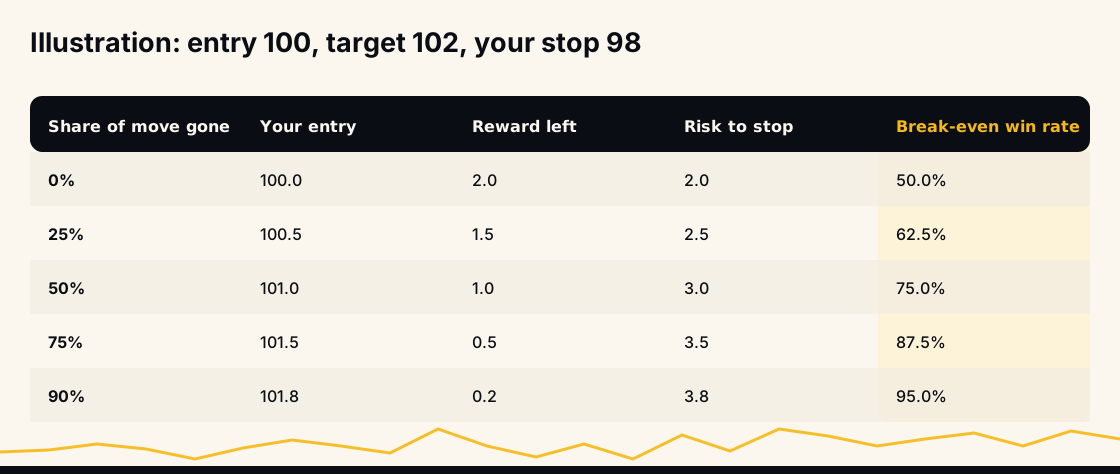
In the example, the stop-to-target line runs from 98 to 102, four units long. Entering at 100 puts you halfway along it: 50%. Entering at 101 puts you three quarters along it: 75%. At 101.8 you need to be right 95 times in 100 just to stay level, before fees.
A worked long and a worked short
The same steps work in both directions. Write down three prices and do one division.
Long, illustration. Signal entry 100, target 102, your stop 98. Price now 100.5.
- Share gone: (100.5 − 100) ÷ (102 − 100) = 25%.
- Reward left: 1.5. Risk: 2.5. Reward-to-risk 0.6 : 1.
- Break-even win rate: 2.5 ÷ 4.0 = 62.5%.
Short, illustration. Signal entry 50, target 49, your stop 51. Price now 49.6.
- Share gone: (50 − 49.6) ÷ (50 − 49) = 40%.
- Reward left: 0.6. Risk: 1.4. Reward-to-risk about 0.43 : 1.
- Break-even win rate: 1.4 ÷ 2.0 = 70%.
For a short, everything is mirrored: price falling toward the target is the move you missed, and your stop sits above.
If price has moved against the signal instead, the arithmetic looks better: more reward, less risk. It also means the idea has started badly, so treat it with care rather than as a bargain.
A rule of thumb you can set yourself
The formula turns into a rule in one step. Decide the highest break-even win rate you are willing to need, call it B, and solve for how much of the move can be gone:
- maximum share gone = (B × (S + D) − S) ÷ D
When your stop is as far away as the target (S = D), that simplifies to 2B − 1:
| Highest break-even you accept | Skip if more of the move is gone than |
|---|---|
| 55% | 10% |
| 60% | 20% |
| 65% | 30% |
| 70% | 40% |
With a wider stop, twice the target distance, the starting break-even is already 66.7%, and each 10% of the move gone adds about 3.3 points. With a tighter stop the start is lower and each step costs more.
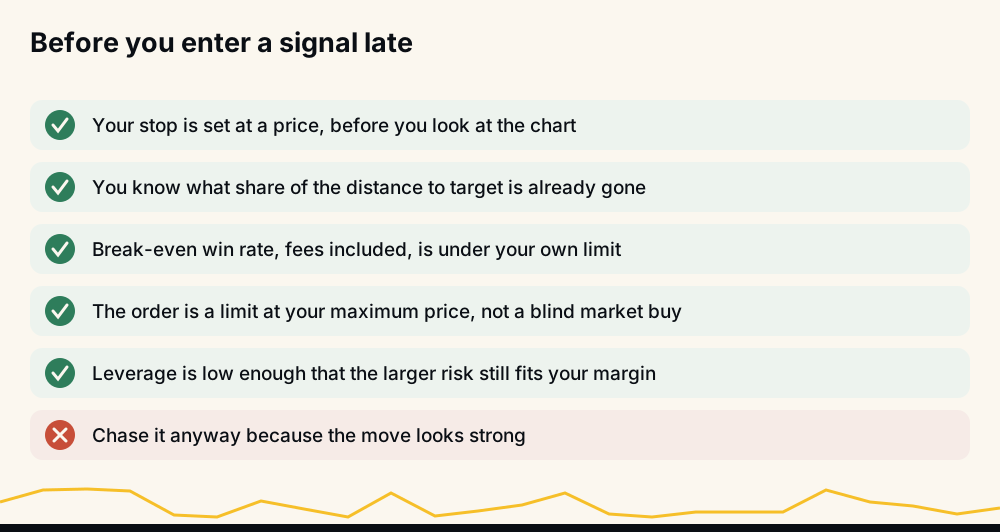
This is your rule, not ours: the right B depends on your stop, your costs and how your own trades go. Pick it before the chart is in front of you; a rule set while watching a green candle tends to bend.
Why the published hit rate does not transfer to a late entry
A provider's hit rate answers one question: did price reach the target from the posted entry? It cannot answer yours, which is: from the price I got, with my stop, did I make money?
HafizeBot's live performance page, regenerated hourly since June 2026, scores each broadcast signal from its own entry as a Win, Missed or Open, and every missed signal counts against the target-hit rate. It has no stop, because the signals carry none. A late entry with a stop is a different trade: a signal that dipped before reaching its target may count as a Win there and still hit your stop first. So do not plug a provider's rate into the break-even formula and call the gap profit. Measure your own entries instead, as why your results differ from the signal provider's walks through.
The same caution applies to any other record. A cropped winning trade, or a chart with an entry drawn in afterwards, tells you even less, which is the subject of why crypto signal screenshots prove nothing.
Fees: why late entries pay proportionally more
Binance's futures fee FAQ (updated 1 May 2026) gives the formula for USDⓈ-M contracts: trading fee = position value × fee rate, where position value is contract size times execution price. Its example rates for a regular user are 0.02% for a maker order, one that adds liquidity to the book, and 0.05% for a taker order, one that executes immediately. Your own rate depends on your VIP level, and paying in BNB from the futures wallet takes 10% off.
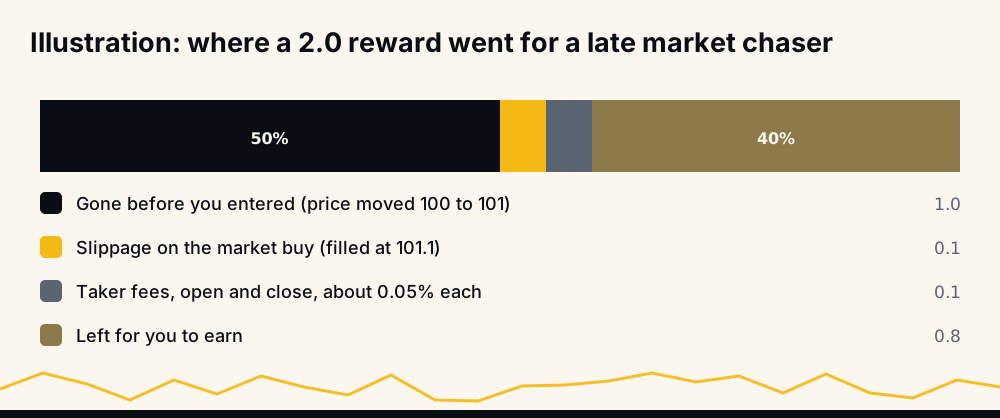
Fees are charged on the position, not on the reward, so they do not shrink when you enter late. At a price near 100, two taker fills cost about 0.1 in price terms. On the full 2.0 reward that is 5%. On the 0.5 left after a 75% late entry it is a fifth of everything you could make. Costs work like a later entry: they move you further along the stop-to-target line.
At 10x, 0.1% of the position is 1% of the margin behind it, every round trip. More in Binance Futures fees explained.
Slippage: the cost of chasing with a market order
Binance's futures order-type FAQ (updated 7 April 2026) says a market order "is matched immediately at the best available price" by taking prices from limit orders on the book, and that "slippage could occur where you get an executed price different from what you expected."
Late entries tend to happen when slippage is worst: price is moving and the orders resting near the price on your screen are being taken. In the illustration above, a market buy meant at 101 filling at 101.1 costs another 0.1 of reward and adds 0.1 of risk.
With the 0.1 of slippage and 0.1 of fees, the late chaser's break-even is 3.2 ÷ 4.0 = 80%, not the 75% the chart suggested. The full background is in what slippage is and why it happens.
Limit order at the signal price, or market order now?
There are three ways to act on a signal you see late.
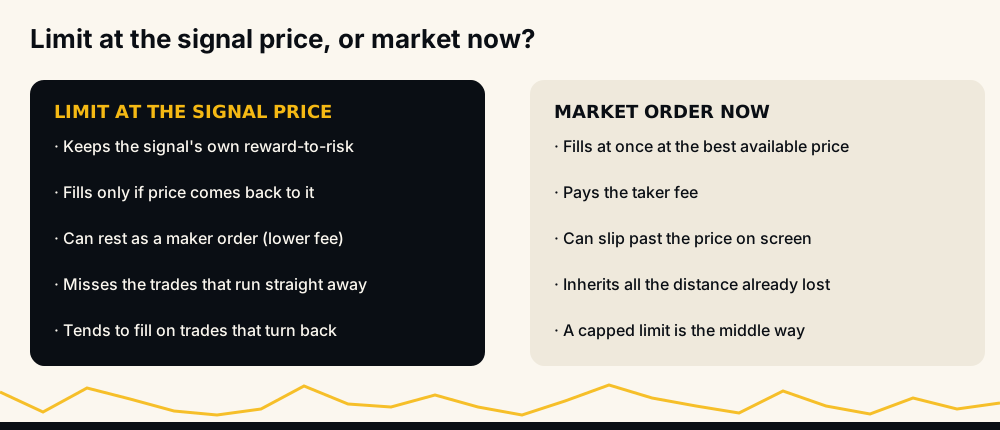
- A limit at the signal price. Binance says a limit order "allows you to place an order at a specific or a better price", and also that "placing a Limit order does not guarantee execution." You keep the signal's own arithmetic if it fills. A Post Only order goes further: Binance cancels it if it would execute immediately, so it only ever rests on the book as a maker order. The trouble is selection. The trades that run straight to the target never come back to fill you, while the ones that turn around do. A missed trade costs nothing, but count how your filled ones go.
- A market order now. Certain fill, taker fee, possible slippage, and all the distance already lost.
- A limit at your maximum price. The middle way. Work out the highest price your rule allows and place a buy limit there (a sell limit at your lowest price for a short). Binance fills a buy limit "if the price matches or is lower than your limit price", so if price is below your cap it fills at once at the best price available, and nothing fills above the cap. It is a market order with a ceiling.
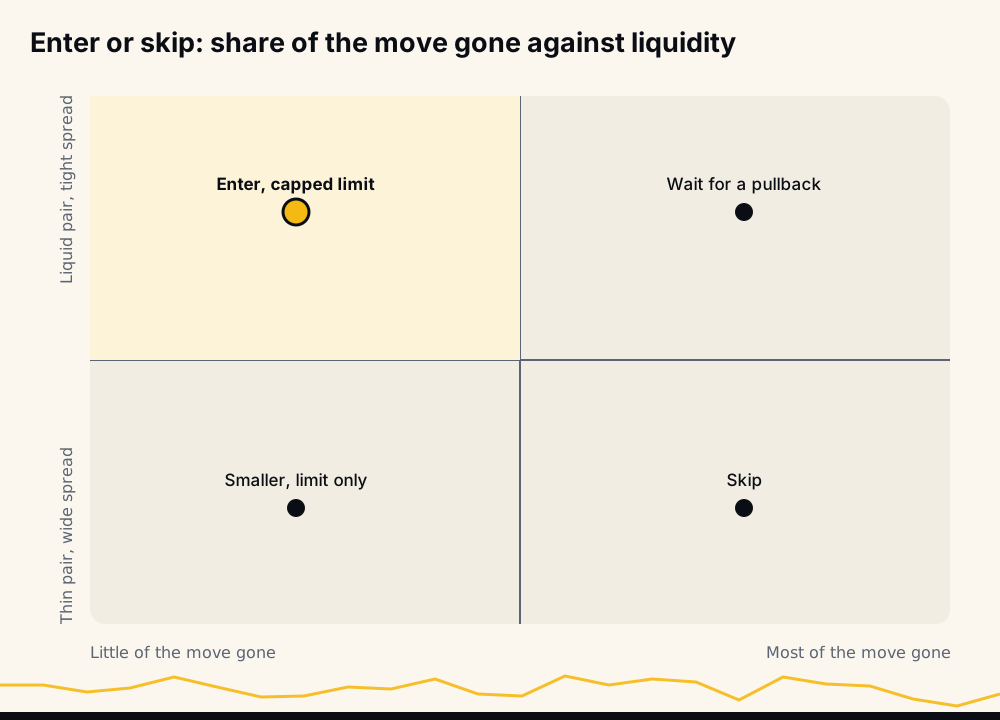
On a thin pair with a wide spread, the cap matters more and the size should be smaller, because your own order moves the price.
Delayed free feeds change the calculus
On a delayed free channel, a late entry is the normal case. HafizeBot's free channel, t.me/getbinancefutures, posts the stronger signals (strength 3 and up) 20 minutes after VIP. VIP members receive every signal at once.
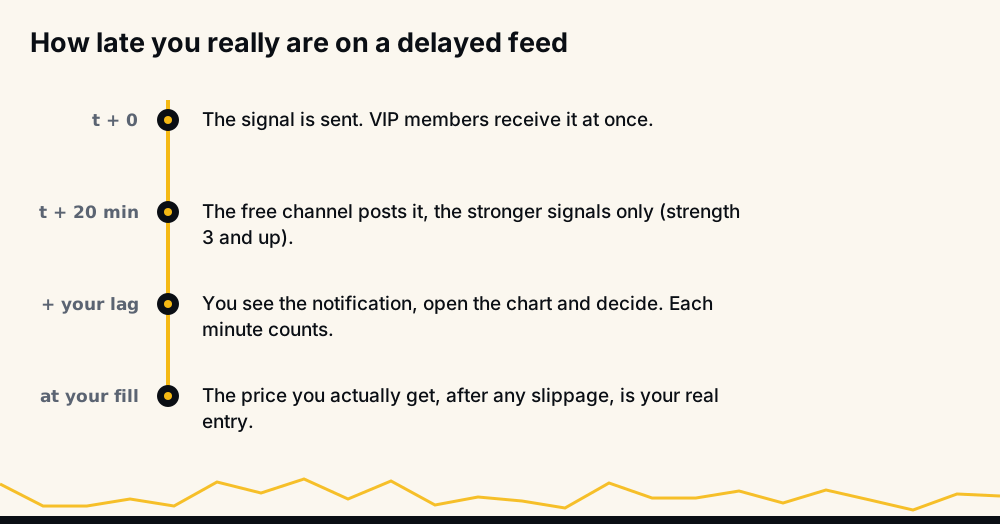
Three things follow for a free reader:
- You are never at the posted price. Before acting, compare the current price with the posted entry and run the share-gone check. Some signals will be fully spent; on those, skipping is the right answer.
- Your own lag adds to the delay. Notifications arrive late, you finish what you were doing, you open the chart. Every minute after the channel post is on top of the 20.
- Time is spent as well as price. HafizeBot's broadcast signals carry a maximum hold, and a late entry has less of it left. What happens when a crypto signal expires explains what that means on the record and on your account.
What the delay costs on the archive, and when it does not matter, is measured in the HafizeBot free plan. How much crypto signals cost puts that time against the price of a paid plan.
Leverage makes a late entry worse, not better
A late entry tempts people to raise leverage to make the small remaining reward worth taking. That multiplies the risk side too, which is now the larger side.
In the example, the late entry at 101 risks 3 on a price near 100, about 3%. At 10x that is about 30% of the margin on one trade, before fees. Binance liquidates an isolated position at 10x after roughly a 9.5% move at an illustrative 0.5% maintenance rate, so a wider stop chosen to give a late trade room can drift towards that line. Liquidated before your stop-loss shows where that goes wrong, and how to set a stop-loss in crypto covers where a stop belongs in the first place.
The 60-second check before a late entry
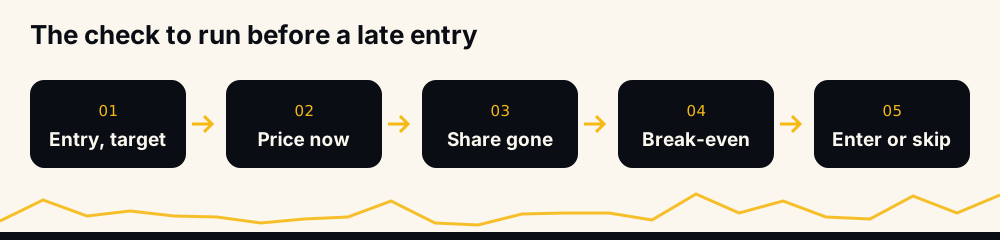
- Write down the signal's entry and target, and your stop as a price.
- Read the current price.
- Work out the share of the distance to target already gone.
- Work out the break-even win rate, adding about two fees to the risk side.
- Enter with a limit at your maximum price, or skip.
If you are new to reading the fields of a signal, how to read crypto signals explains each one.
Frequently asked questions
How late is too late to enter a crypto signal? It depends on your stop rather than the clock. Work out what share of the distance to target is already gone and the break-even win rate that leaves you. If it is above the limit you set in advance, it is too late, whether the signal is two minutes old or twenty.
What is the risk reward ratio in crypto? It compares what a trade can lose, down to your stop, with what it can gain, up to the target. Binance Academy writes it as potential loss divided by potential gain; many traders quote the inverse, reward-to-risk. Its break-even win rate is 1 ÷ (1 + R), where R is reward divided by risk.
How do I calculate risk reward ratio on a late entry? Use your own fill instead of the posted entry. Reward is the distance from your fill to the target; risk is the distance from your fill to your stop, plus fees and any slippage. Divide reward by risk.
Should I use a limit order or a market order for a signal I see late? A limit at the signal price keeps the signal's arithmetic but may never fill. A market order fills at once with the taker fee and possible slippage. A limit at the highest price your rule allows fills immediately when price is below it and never above it.
Is it worth entering a signal after the price has already moved? Sometimes. If only a small share of the move is gone and costs are small, it can still fit your rule. Past your own limit, skip it; a missed trade costs nothing.
The short version
A late entry moves only your entry, so it costs reward and adds risk at once. The break-even win rate is your position on the line from stop to target, plus costs. Pick the highest one you will accept, convert it to a share of the move, and use a limit at your maximum price. The Binance rules above come from Binance's futures fee FAQ, its futures order-type FAQ and Binance Academy's risk/reward guide.
To receive signals without the delay, try 3 days of VIP Tier 1 free with /trial in @hafizebot; trial autotrading is capped at 10 USDT of margin per entry and 3 open positions. VIP is 50, 100 or 200 USDT a month via /join. The signals come from a model that evaluates 240+ indicators, formulas and components across 523 Binance USDⓈ-M pairs, and the record is public: the performance page since June 2026 and the 33 monthly reports from 2021 to 2024, also downloadable at /data.
This is not investment advice; leveraged futures can lose your whole margin, so trade only what you can afford to lose.