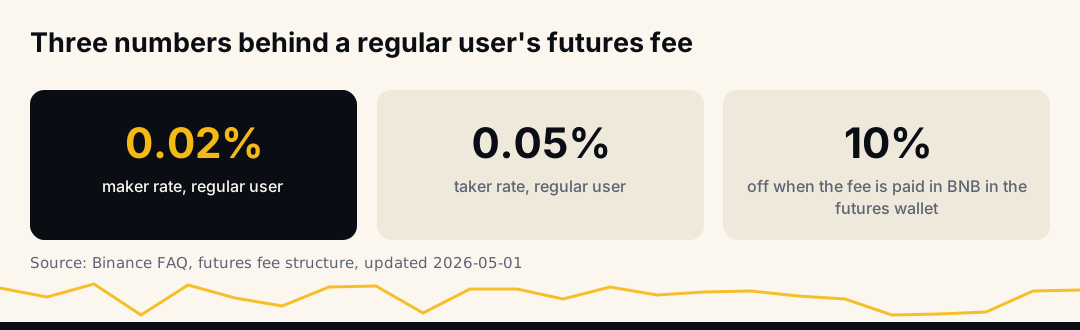
On Binance USDⓈ-M Futures a regular user pays a 0.02% maker fee and a 0.05% taker fee, charged on the notional value of every fill, and 10% less when the fee is paid in BNB held in the futures wallet. Because the fee is on position value, not margin, leverage multiplies it. VIP levels lower the rates; funding and the liquidation clearance fee are separate costs.
What are Binance futures fees?
Binance's own FAQ, "What Fees are Generated in Binance Futures Trading?" (updated 5 January 2026), lists three kinds of charge on a futures position:
- The commission, or trading fee, charged every time an order executes, at a maker or taker rate set by your VIP level.
- Funding, a periodic payment between longs and shorts. Binance says it "does not charge any service fees" on it.
- The insurance clearance fee, shown in your history as Liquidation Clearance, charged only on a forced liquidation.
That is the whole list: none of the three is a charge for simply holding a position. When people search for a Binance futures "holding fee" or "overnight fee", the thing they have met is funding, covered briefly below. Most of this article is about the first charge, the one you pay on every trade.
Binance futures fees maker vs taker: the regular rates
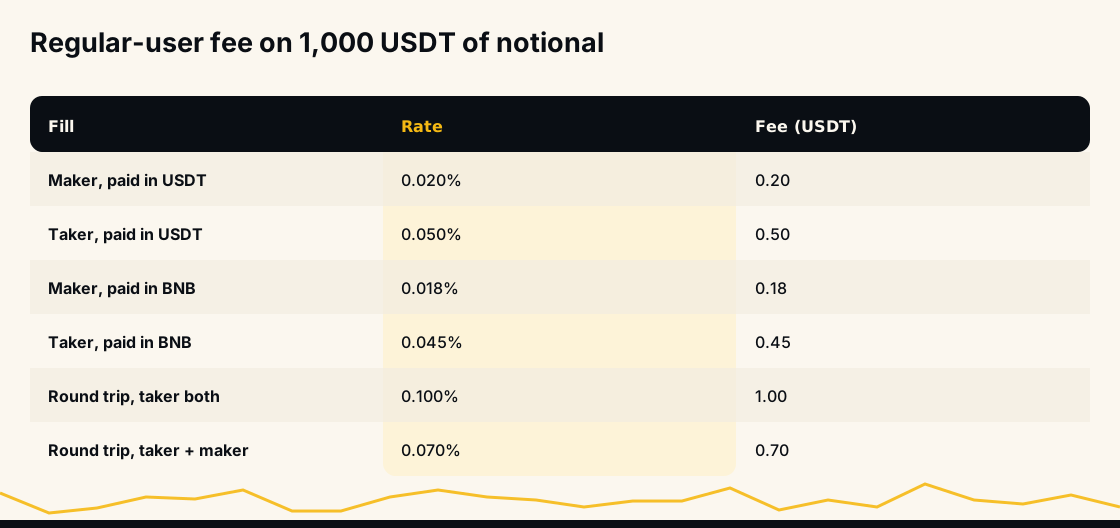
Binance's "Binance Futures Fee Structure & Fee Calculations" FAQ (updated 1 May 2026, read on 17 October 2026) gives the regular-user rates in its worked examples: "a Regular User's maker fee is 0.02% and a Regular User's taker fee is 0.05%." Its own example: buying 1 BTC at 10,104 USDT with a market order is a 10,104 USDT position and a 5.052 USDT taker fee.
Two things to keep in mind:
- A trade has two fills. Opening and closing are each charged. Taker in and taker out is 0.10% of notional; taker in and maker out is 0.07%.
- The FAQ points to a live fee rate table as the final word. Our cost-of-signals article quotes the same 0.02% and 0.05%, which the FAQ still showed on 17 October 2026.
Which orders pay maker and which pay taker?
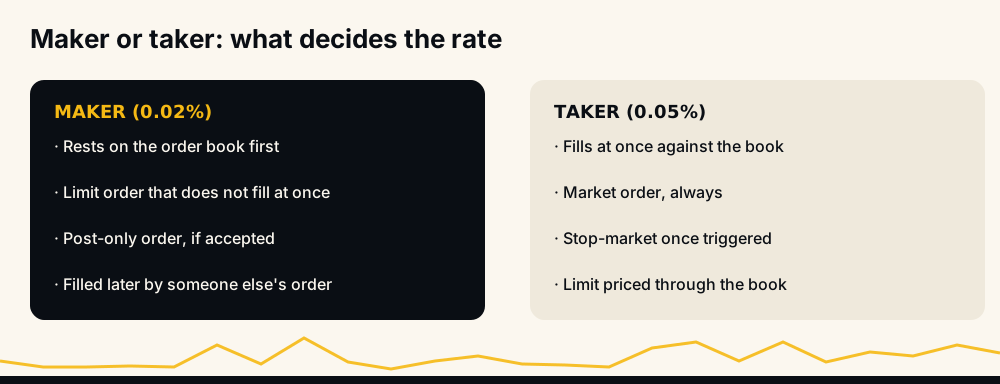
The rate is decided by how an order fills, not by what you call it. Binance's definitions: a taker order "executes immediately, fully or partly" against orders already on the book, and market orders are always takers. A maker order rests on the book until someone else's order matches it.
Binance's "Types of Order on Binance Futures" FAQ (updated 7 April 2026) gives the consequences for each order type:
- Market order: "matched immediately at the best available price". Taker, every time.
- Stop-market: "when the stop price is reached, it'll trigger a Market order." Taker when it fires.
- Trailing stop: once the price reverses by the callback rate, it "will be executed at market price". Taker.
- Limit order: maker if it rests and fills later; priced through the book, the part that fills at once is taker.
- Post-only: "designated to add liquidity to the order book by ensuring your order will not execute immediately upon placement". If it would match at once, Binance cancels it.
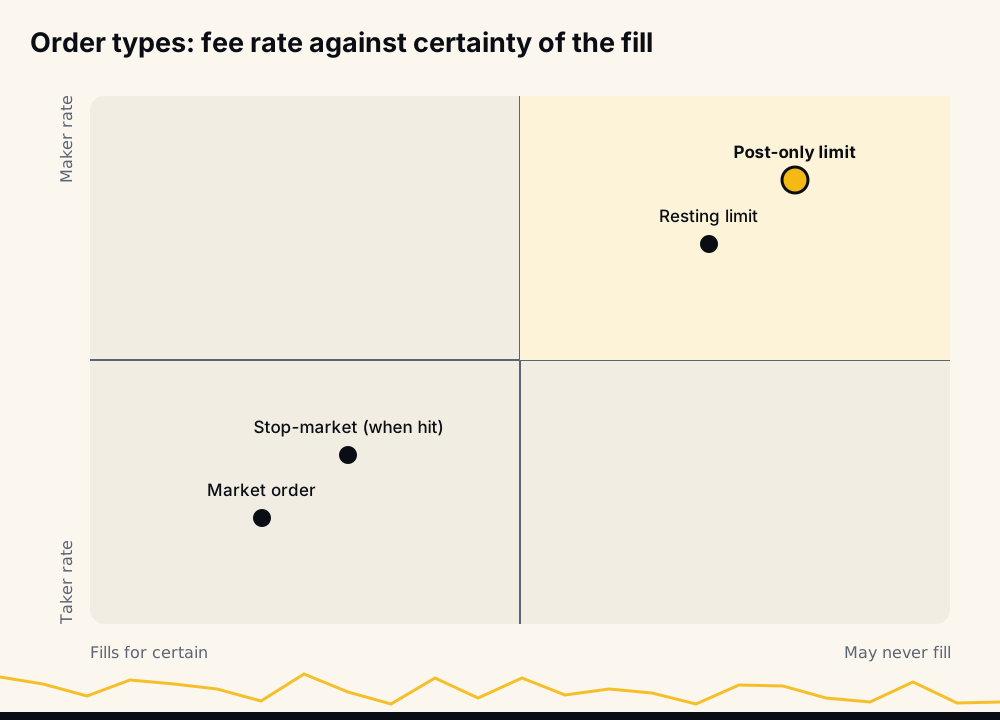
The cheap rate belongs to orders that might not fill. On an exit you must get, a stop-loss above all, the taker rate is the right price.
Fees are charged on notional, so leverage multiplies them
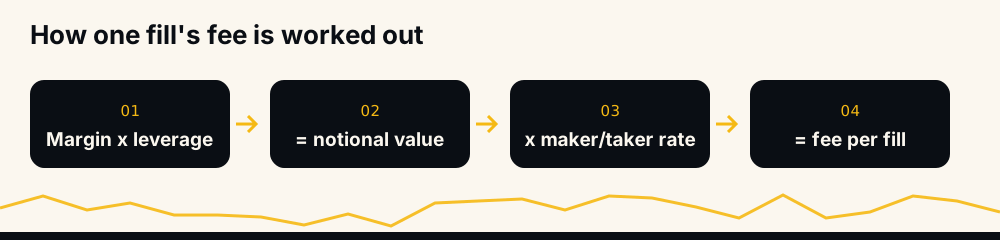
Binance's formula is short: Trading Fee = Position Value × fee rate, where Position Value = contract size × execution price. Margin does not appear in it. The fee is on the whole position you control, and leverage is what makes that position bigger than your margin.
Put 100 USDT of margin into a position and close it, taker both ways, at the regular rate:
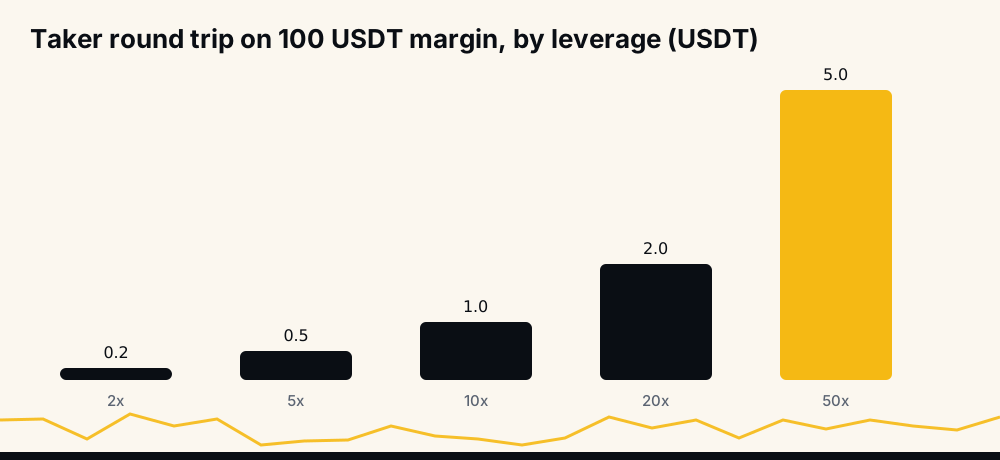
At 50x, one round trip costs 5% of the margin before the price has moved at all. How leverage trading works matters for fees as well as risk: leverage does not change the price move needed to cover the fee, but it changes how much of your margin the fee eats.
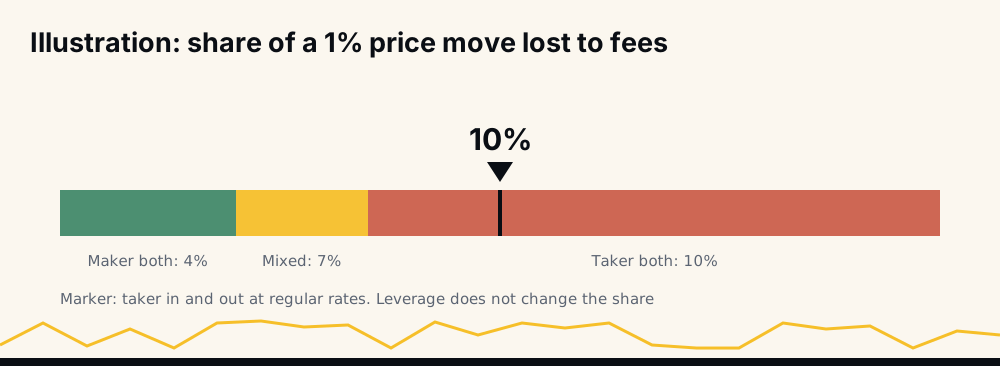
A taker round trip costs 0.10% of notional, a tenth of a 1% move. If your trades aim for small moves, fees take a large share of each win, whatever the leverage. (The exit fee uses the exit price, so it differs from the entry fee by cents.)
The BNB fee discount
Binance gives 10% off standard trading fees on USDⓈ-M Futures when the fee is paid in BNB. The conditions, from the same fee-structure FAQ:
- The BNB has to be in the USDⓈ-M Futures wallet. BNB in your spot wallet does not count; you transfer it across.
- If the futures wallet holds too little BNB to cover a fee, Binance deducts the fee in USDT and no discount applies to it.
- The discount is a switch on your account. Binance's API documents it as the BNB fee discount toggle (
POST /fapi/v1/feeBurn), which turns it on or off for every symbol, andGET /fapi/v1/feeBurnreports its state.
That makes the regular rates 0.018% maker and 0.045% taker. One caveat: the BNB you park there is a holding whose price moves, and a modest fall in it can wipe out the saving. Hold roughly a few weeks of fees, not a pile.
Binance futures fee tiers: how VIP levels work
Above the regular rate sit the VIP levels. On Binance's fee schedule (read 17 October 2026), the spot table sets VIP 1 at 1,000,000 USD of 30-day trading volume and at least 5 BNB, and VIP 2 at 5,000,000 USD and 25 BNB. The same page says "VIP fees and benefits gained from any VIP program will apply universally to all Binance products." The futures fee FAQ adds that "Futures fee tiers mirror the spot market but are generally lower", with the futures volume requirement for each tier "5 times that of the spot market due to the leverage provided".
The futures tier rows sit on a live page we could not read in a form we could quote, so we do not list VIP futures rates here; read them on Binance's USDⓈ-M fee rate page.
For most readers it is simpler: even the spot route to VIP 1 needs a million dollars of 30-day volume plus 5 BNB. Trading more to reach a tier is the one way of "cutting fees" that costs fees.
Funding: a separate cost, not a trading fee
Funding is a periodic payment between longs and shorts on perpetual contracts. Binance's fee FAQ describes it as:
- paid every 8 hours (00:00, 08:00 and 16:00 UTC) on most contracts, every 4 hours on some;
- charged only if you hold a position at the settlement time;
- paid by longs to shorts when the rate is positive, and the other way when it is negative;
- calculated on notional, like the trading fee, so leverage multiplies it too.
Unlike the trading fee it can be income as well as cost, and it is not paid to Binance. A position opened and closed between settlement times never pays it. Funding rates get their own guide soon.
The liquidation clearance fee
If a position is liquidated, Binance takes a further fee. The "Binance Futures Liquidation Protocols" FAQ (updated 4 January 2026) says a portion of the assets kept to maintain the position "will be deducted and paid to Binance", unless the position ends bankrupt, and the entry appears as Liquidation Clearance in your transaction history. The fee FAQ gives its form as notional value × fee rate, with the rates per contract listed in Binance's Trading Rules.
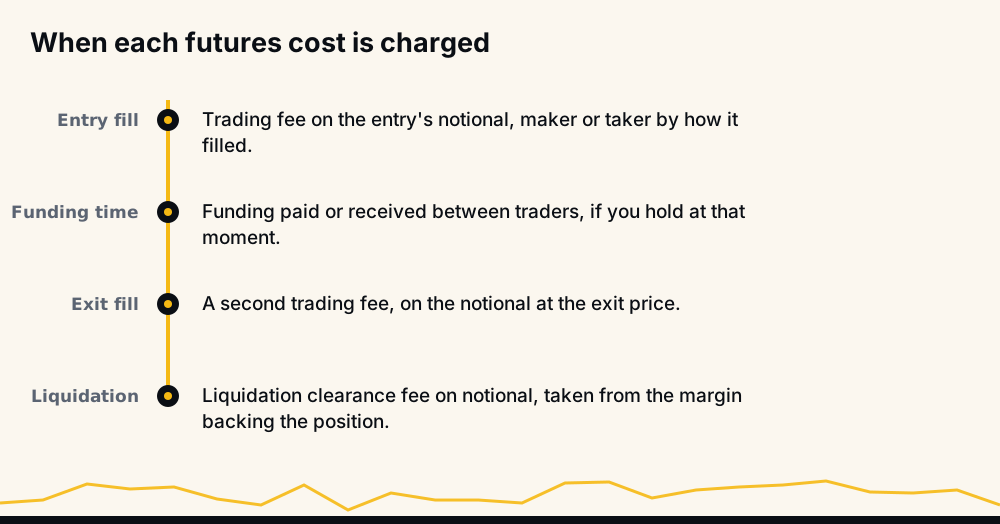
The fee is sized on the full position, not your margin, and comes out of the assets backing it. One more reason a stop that fires, even late, is usually cheaper, the subject of why you can get liquidated before your stop-loss; why the level itself moves is in why your liquidation price changes.
A worked month of fees you can redo
An illustrative month: a 1,000 USDT account, each trade 100 USDT of margin at 5x, so 500 USDT of notional, and 40 round trips, at regular rates. This is arithmetic, not anyone's account.
Step 1, entries. Market orders, taker: 40 × 500 × 0.05% = 10.00 USDT.
Step 2, exits. Resting limit orders, maker: 40 × 500 × 0.02% = 4.00 USDT.
Step 3, funding. Assume each trade holds across one funding time at 0.01%: 40 × 500 × 0.01% = 2.00 USDT. An assumption, not a typical rate; funding varies and can be received too.
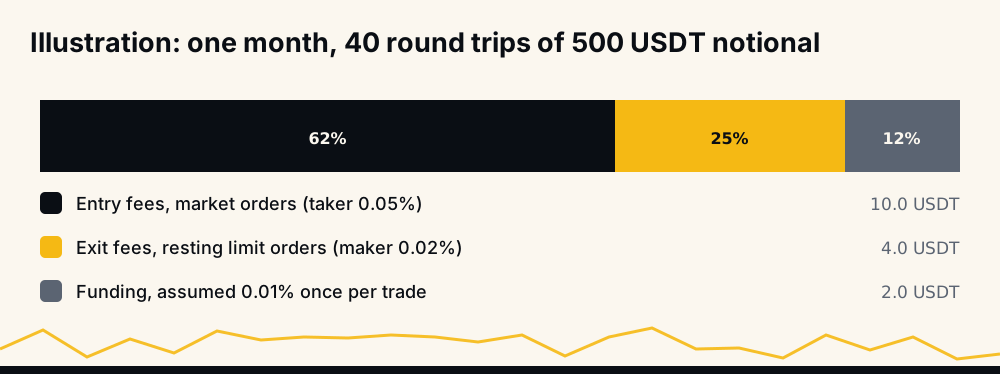
Total: 16.00 USDT, or 1.6% of the account in a month, before a single loss. Now change one input at a time:
- All taker: 20.00 in trading fees, 2.0% of the account.
- BNB discount on: the 14.00 of trading fees becomes 12.60.
- 10x instead of 5x on the same margin: notional doubles to 1,000, and so does every line: 32.00.
- Half the trades: half the bill. Nothing else on this list is as reliable.
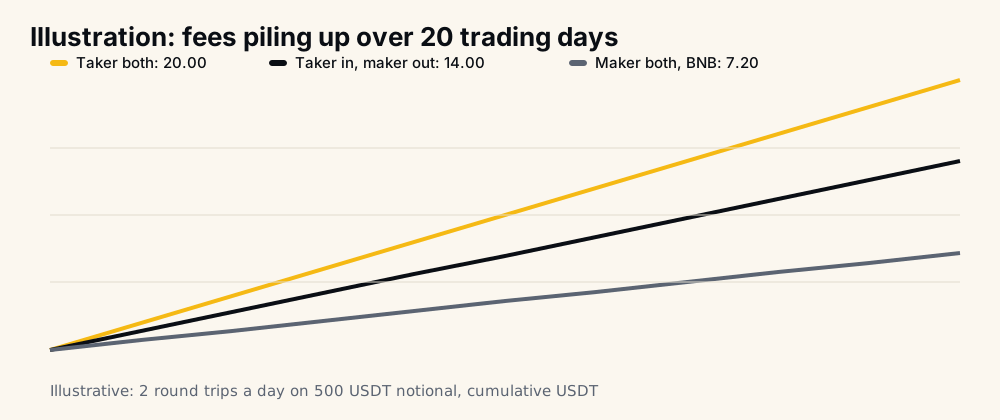
On your own numbers: trades per month × notional × (entry rate + exit rate), plus funding, divided by account size, is the return you need to stand still. What a crypto trading bot really costs uses the same sum, and how much money to start crypto futures shows why it weighs most on small accounts.
How to reduce Binance futures fees
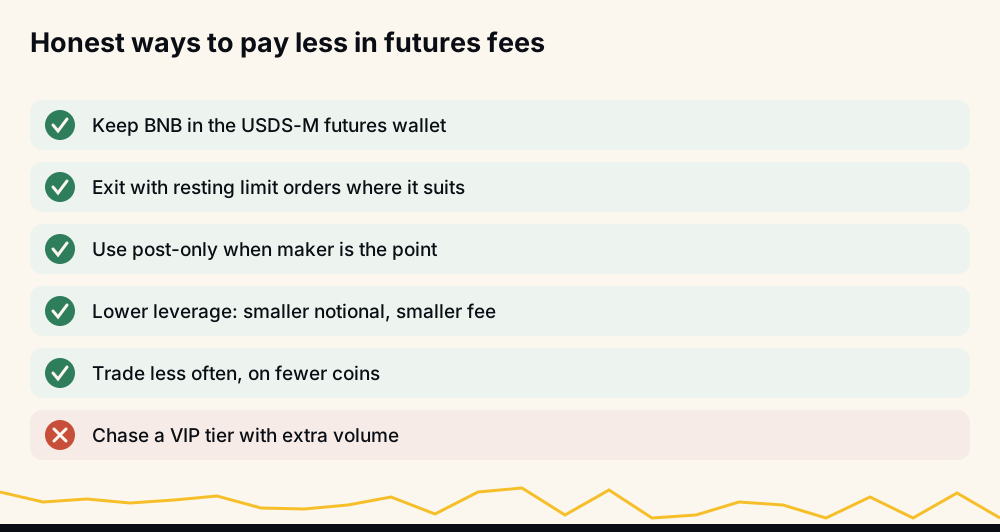
Honest ways, in rough order of effect:
- Trade less. The fee is per fill. Fewer, better trades cut the bill linearly, and it is the only saving that is certain.
- Use less leverage. Notional sets the fee. Lower leverage on the same margin is a smaller position and a smaller fee, as well as a liquidation price further away.
- Let exits rest as limit orders where it fits. A take-profit sitting on the book fills as maker. Keep stop-losses as stop-market orders anyway: an exit you must get is worth the taker rate.
- Use post-only when the maker rate is the point and you can live with the order being cancelled instead of filled.
- Switch on the BNB discount and keep a modest BNB balance in the USDⓈ-M wallet.
- Do not chase a VIP tier with extra volume. The volume costs fees, and the tiers start far above what most retail accounts trade.
Before raising leverage, read Binance Futures leverage limits.
Checking what you actually paid
The rates above are a schedule; your history is the record.
- Transaction history on the futures wallet lists commissions, funding fees and realized PnL as separate entries you can filter, and a liquidation shows up there as Liquidation Clearance.
- The fee on a fill tells you its side. Divide it by the fill's notional: about 0.02% was a maker fill, about 0.05% a taker fill, at regular rates.
- API users can read their tier from the
feeTierfield of the account information endpoint, and the User Commission Rate endpoint returns the maker and taker rate for a symbol on the account.
A fee higher than expected usually means the order filled at once (taker), the futures wallet ran out of BNB, or the notional was bigger than you thought.
Fees on autotraded signals with HafizeBot
HafizeBot sends AI-generated signals from a model that evaluates 240+ indicators, formulas and components, across 523 Binance USDⓈ-M pairs. Autotrading members trade on their own Binance account with a key that needs futures trading only (use a key with withdrawals off; the bot never withdraws or transfers), so Binance charges the fees at the member's own rate. How the fills land:
- Entries are market orders, to catch the signal fast, so they pay the taker rate.
- The default take-profit is a reduce-only limit order at the target, resting on the book, so when it fills it is a maker fill. A trailing take-profit, which members can choose instead, exits at market.
- A stop-loss, if you set one, is a stop-market order: taker when it fires.
Members set their own leverage, position size, maximum open positions and stop-loss, so the notional each fee is charged on is in their hands. Our subscription is a flat 50, 100 or 200 USDT a month by tier.
Broadcast signals carry a target and a maximum hold, not a stop. Each one's outcome is on the performance page, where a signal that misses its target in time counts against the target-hit rate, and the 2021 to 2024 archive is downloadable as one file at /data.
Frequently asked questions
What are the fees for Binance futures? A regular user on USDⓈ-M Futures pays 0.02% maker and 0.05% taker on the notional value of each fill, per Binance's fee-structure FAQ updated 1 May 2026. Paying in BNB held in the futures wallet takes 10% off. Funding and the liquidation clearance fee are separate charges.
Does leverage increase Binance futures fees? Yes, in money terms. The fee is position value × rate, and leverage raises position value for the same margin, so a 100 USDT margin trade at 10x pays fees on 1,000 USDT. As a share of the price move needed to cover it, the fee stays the same at any leverage.
Is a market order maker or taker on Binance futures? Always taker, because it fills at once against orders already on the book. A stop-market order also places a market order when triggered, so it pays the taker rate too.
How do I get the BNB discount on Binance futures? Transfer BNB into your USDⓈ-M Futures wallet and make sure the BNB fee discount is switched on. If that wallet holds too little BNB to cover a fee, Binance charges it in USDT without the discount.
Does Binance charge a fee for holding a futures position? No trading fee is charged for holding. What you meet instead is funding: on most contracts every 8 hours, paid or received between traders if you hold at the settlement time. Binance says it takes no service fee on funding.
How much is the Binance futures liquidation fee? It is notional value × a clearance fee rate that Binance lists per contract in its Trading Rules, and it appears as Liquidation Clearance in your transaction history. It is taken from the assets backing the liquidated position, unless the position ends bankrupt.
The short version
Binance's fee guide uses 0.02% maker and 0.05% taker for a regular user, on notional, twice per trade, 10% off in BNB. Leverage multiplies the money, trade count multiplies everything, and funding and liquidation sit on top. Price your own month before choosing leverage or trade frequency.
To judge HafizeBot before paying anything, read the performance page, misses included, or follow the free Telegram channel, which posts the stronger signals (strength 3 and up) 20 minutes after VIP. VIP gets every signal instantly with optional autotrading; there is a 3-day free trial, and plans start at 50 USDT a month with /join in @hafizebot. This is information, not investment advice: futures fees and leverage can turn a small edge into a loss, so trade only what you can afford to lose.