Crypto signals cost anything from nothing to a couple of hundred dollars a month. Free channels charge nothing and send a delayed or partial feed. Paid VIP groups charge a flat monthly fee or a prepaid term; HafizeBot's plans run from 50 to 200 USDT a month. Copy trading takes a share of profit instead, up to 30% on Binance. The price tag is rarely the biggest cost, though. Exchange fees, slippage and missed signals usually cost more, and they are what decides whether a subscription pays for itself.
Every other service's price below comes from its own pricing page as read on 17 October 2026, linked so you can check it. We sell signals ourselves, so our numbers appear as one data point, not as the answer.
The six ways signals are priced
Almost every signal service fits one of six pricing models, and the model tells you more than the number: it decides who carries the risk and what the provider is paid to care about.
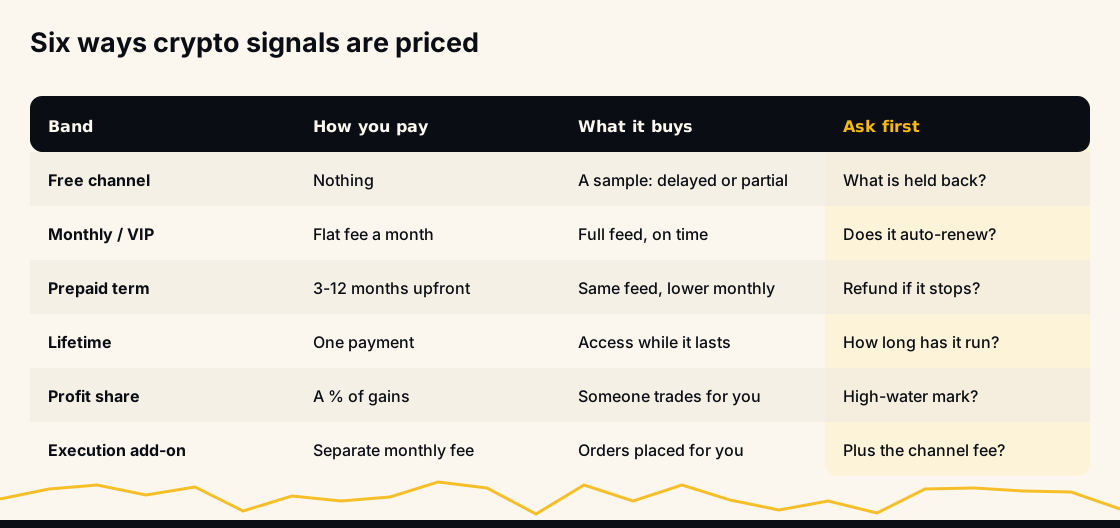
- Free channel: costs nothing and exists to show you a sample. Ask what is held back: the timing, some of the signals, or both.
- Monthly subscription or VIP tier: a flat fee for the full feed on time. This is the most common model for paid crypto signal groups on Telegram.
- Prepaid term: three, six or twelve months paid upfront, usually at a lower monthly rate.
- Lifetime: one payment for access "forever", which in practice means as long as the service lasts.
- Profit share: no fixed fee. You pay a percentage of gains, most often through copy trading.
- Execution add-on: a separate tool that turns someone else's signals into orders, billed on top of the channel.
Free channels: what zero actually costs
A free feed is rarely the same product as the paid one, and the honest ones say how they differ. The usual differences are a delay, a subset of the signals, or both. Our own free channel, t.me/getbinancefutures, carries the stronger signals (strength 3 and up) twenty minutes after VIP receives them. It is a smaller, slower version of the paid feed, not the same feed for free.
The cost of free is time. On signals with tight targets, a twenty-minute delay can mean the move has already happened by the time you see it. We measured that against our own archive in what the HafizeBot free plan gives you, and the wider trade-off is in free vs paid crypto signals.
What free does well is let you watch a provider before you pay. If a free channel shows only wins and never a miss, that is itself an answer.
Monthly VIP and paid Telegram groups
Flat monthly pricing is the most common band and usually the easiest to judge. You pay a fixed amount, you get the full feed on time, and you can stop at the end of the period. As listed on their own pages on 17 October 2026:
- Fat Pig Signals sells VIP access in ETH: 0.50 ETH for 3 months, 0.75 ETH for 6 months and 1.25 ETH for 12 months, plus a free Telegram group. A price in ETH has a dollar cost that moves with ETH, so the same plan costs a different amount in USD from one week to the next.
- HafizeBot charges 50, 100 or 200 USDT a month for VIP Tier 1, 2 or 3. All three tiers get every signal instantly. They differ in how much the optional autotrader may deploy and which controls you get. The full list is on plans and prices.
With any monthly plan, check whether it renews by itself before you pay. Ours does not unless you switch on /subscribe; payment is in USDT and there is no card on file.
Prepaid terms and lifetime deals
Paying for a longer term lowers the monthly rate and moves the risk onto you. Our 12-month plans are 500, 1,000 and 2,000 USDT, which is twelve months for the price of ten. That is a real discount if you stay a year, and a worse deal than monthly if you stop after three.
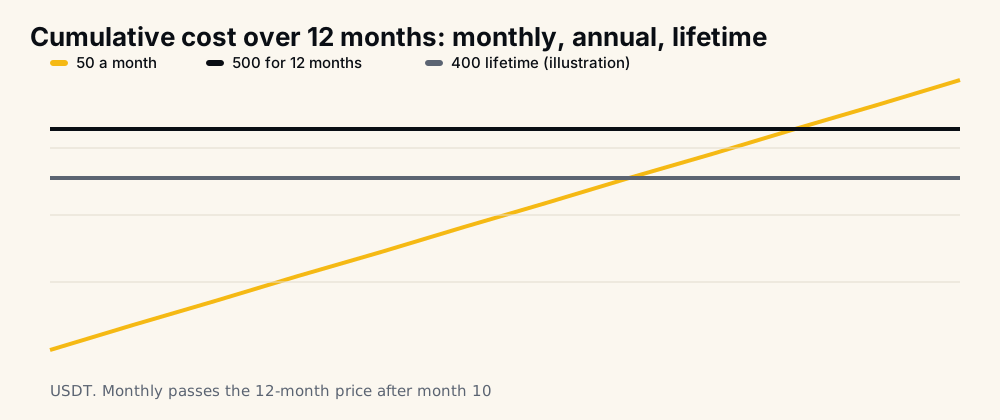
Lifetime pricing goes further. You pay once, and the provider has your money whether or not the signals stay good or the service survives. It is only cheap if the provider outlasts the break-even point, and the price cannot tell you that. Lifetime-only pricing, with no monthly option to try first, is a pricing red flag: it asks for full commitment before you have seen a month.
The sensible order: free feed, then one month, then a prepaid term only if the results held up.
Profit share and copy trading fees
Profit share replaces the subscription with a cut of your gains. It is the model behind most copy trading. Binance's own futures copy-trading FAQ, updated 16 July 2026 and read on 17 October 2026, says lead traders "can receive up to 30% profit share from their copy traders" (Binance copy trading FAQ).
It sounds like the fairest model: no profit, no fee. The catch is how the share is counted. A share taken on every winning period, with nothing refunded after a losing one, can charge you twice on the same money.
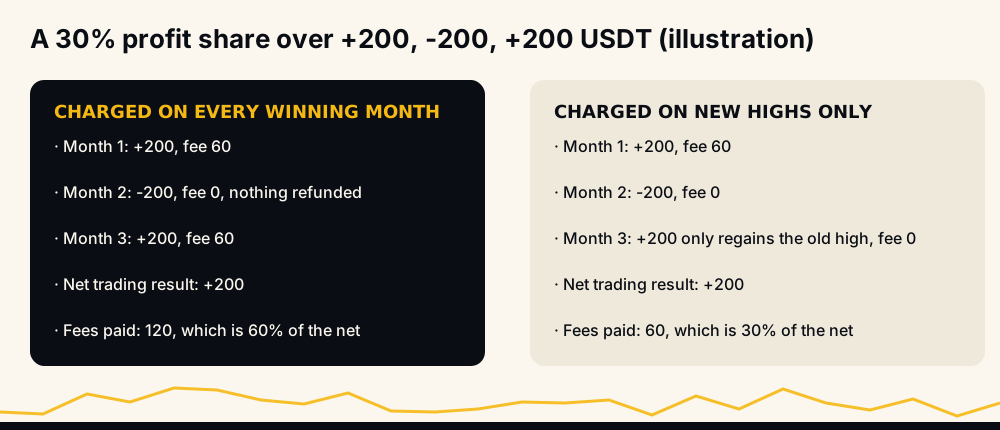
The illustration above is arithmetic, not anyone's actual terms. The protection is called a high-water mark: the share is charged only on gains above the previous peak. Ask whether one applies and how often the share is settled before you agree to any percentage. We compare the two models in more depth in copy trading vs crypto signals.
Execution tools billed on top of the channel
Many traders pay twice: once for the signals and once for a tool that places the orders. Execution tools read a channel's posts and trade them on your exchange account. They do not make signals, so their price stacks on top of whatever the channel costs. As listed on 17 October 2026:
- Cornix: Advanced at $32.99 a month and Premium at $52.99 a month, both billed annually, with a 14-day free trial that needs no card.
- 3Commas: Starter at $20 a month (spot only), Pro at $50 a month and Expert at $140 a month (spot and futures), each lower when billed annually.
They are the right tool if you already follow a channel you trust or trade on several exchanges. For budgeting, add them up: a 50-a-month channel plus a 32.99-a-month execution tool is an 83-a-month arrangement, rounded. A service that makes its own signals and executes them, as ours does on Binance USDⓈ-M Futures, puts both in one fee. We set out the differences in HafizeBot vs Cornix, 3Commas and other signal bots.
The costs that are not on the price tag
The subscription is the only cost you see before you buy. Every other cost shows up later, trade by trade.
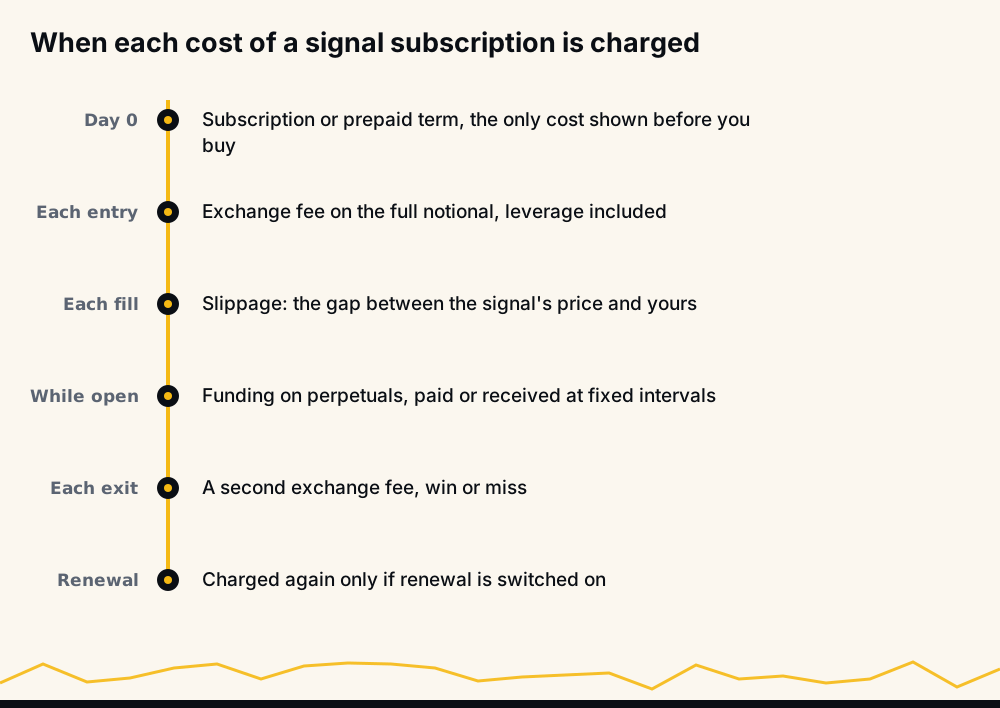
- Exchange fees. Binance's own fee guide uses 0.02% maker and 0.05% taker for a regular USDⓈ-M futures user, with 10% off when fees are paid in BNB held in the futures account (Binance Futures fee structure, read 17 October 2026). Fees are charged on notional, so leverage multiplies them. A market entry and a market exit at those rates cost 0.10% of the position each round trip, win or miss.
- Slippage. The gap between the price in the signal and the price you got. Small on liquid pairs, larger on thin ones and in fast markets. Mark price and last price can also differ, which matters for stops, as mark price vs last price on Binance explains.
- Funding. Perpetual futures exchange funding between longs and shorts at fixed intervals. You may pay or receive it; on positions held for days it adds up.
- Misses. A signal that does not reach its target still costs fees, and if it runs against you the loss can be several times a typical win. That is why a win rate means nothing without the average miss beside it, the subject of what a realistic crypto signal win rate is.
- Liquidation. High leverage with a stop set too wide can close a position before the stop ever fires, which is the most expensive way to pay for a signal. See why you got liquidated before your stop-loss.
Here is one month put together. Every figure is an assumption chosen to show the method, not a forecast:
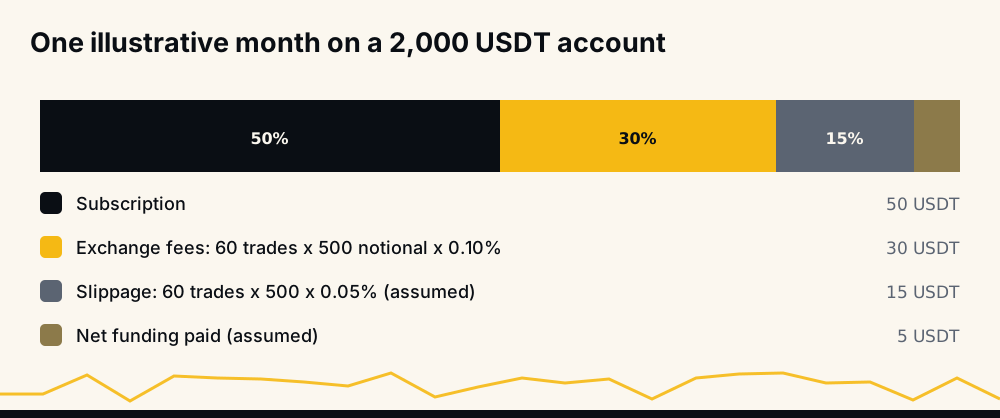
In this example the subscription is half the bill. Trade more often or with more leverage and the exchange becomes the largest line, which is the main argument of how much a crypto trading bot costs.
What a subscription has to earn to pay for itself
The break-even arithmetic fits on one line:
Monthly return needed = (subscription + fees + slippage + funding) ÷ account size
Start with the subscription alone. A 50 USDT monthly fee is 20% of a 250 USDT account and 0.5% of a 10,000 USDT account. Same price, a forty-fold difference in what the signals must earn before you have made anything.
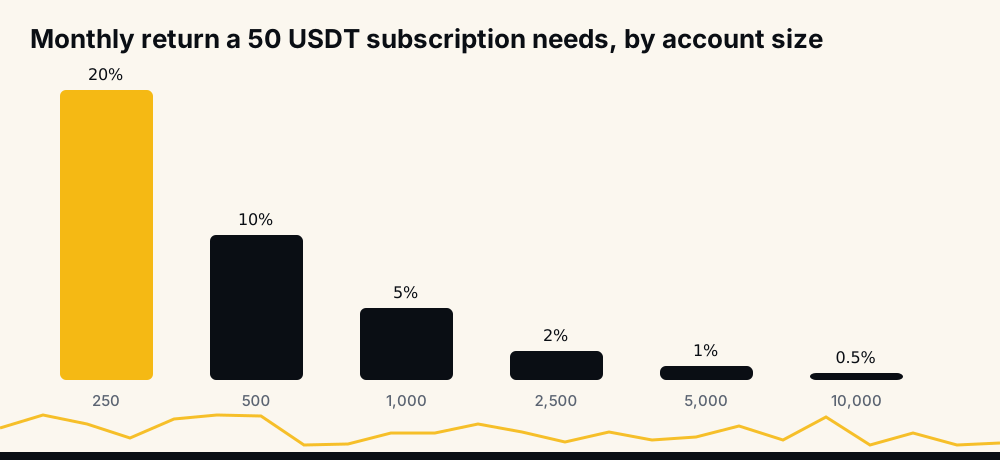
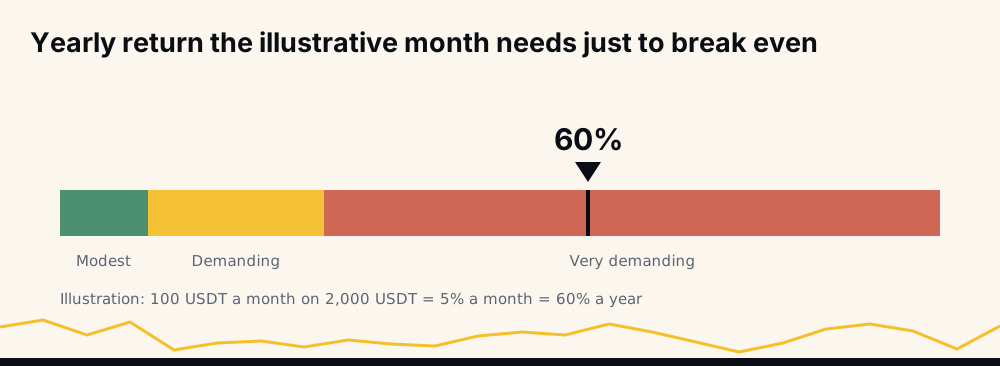
Now add the rest. The illustrative month above costs 100 USDT on a 2,000 USDT account: 5% a month, or 60% a year in simple terms, before a single cent of profit.
To redo this for yourself:
- Write down your account size and the plan's monthly price.
- Estimate trades per month at the settings you will actually use, and the notional per trade, leverage included.
- Multiply trades × notional × your round-trip fee rate (0.10% if both sides are taker at the regular rate above).
- Add a slippage allowance; half the fee figure is a reasonable placeholder until you have your own fills.
- Divide the total by your account. If the result is above a few percent a month, change the plan, the settings or the account size before changing provider.
This is why "are crypto signals worth it?" has no general answer: the same plan can be cheap for one account and impossible for another. Are crypto signal groups profitable? covers the other side of the ledger.
Red flags in how signals are priced
Some price structures are warning signs on their own, whatever the number.
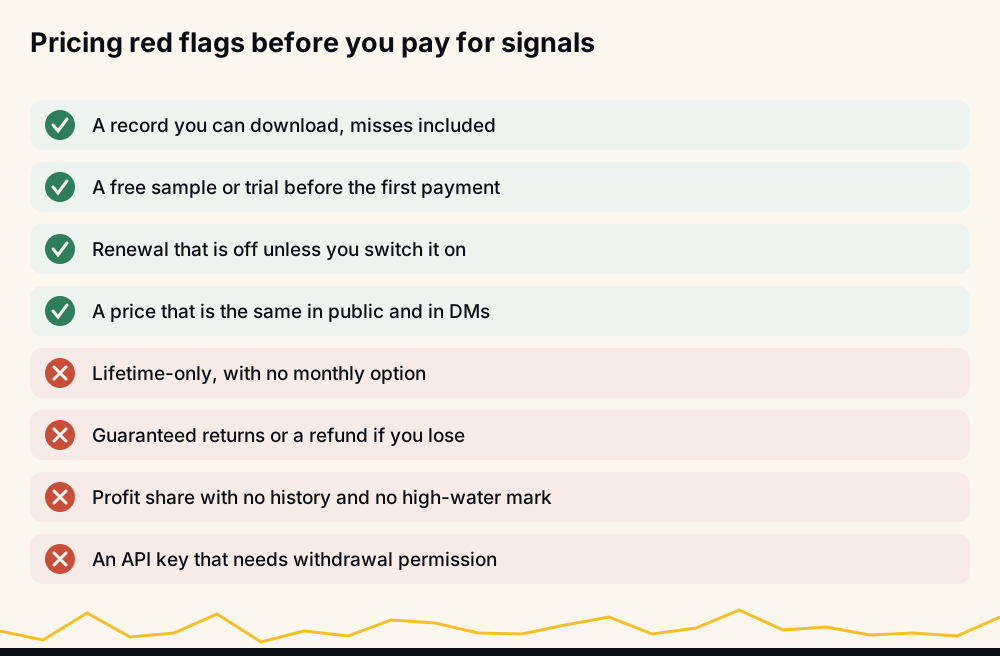
- Lifetime only. All the risk is moved onto you before you have seen a month.
- Guaranteed returns, or "refund if you lose". Nobody can guarantee a futures result. A refund promise tied to profit is a sales tool, worth only what the provider is willing to pay out.
- Profit share with no history. A percentage of profit from someone with no checkable record is a bet on a stranger.
- A different price in DMs. Discounts offered privately under time pressure are a pressure tactic, not pricing.
- Withdrawal permission. No signal or autotrading service needs it. An API key for autotrading needs futures trading only. Ours never withdraws or transfers, and funds stay on your own Binance account.
The wider list, with how each scam makes its money, is in crypto signal scam red flags.
Check the record before you pay
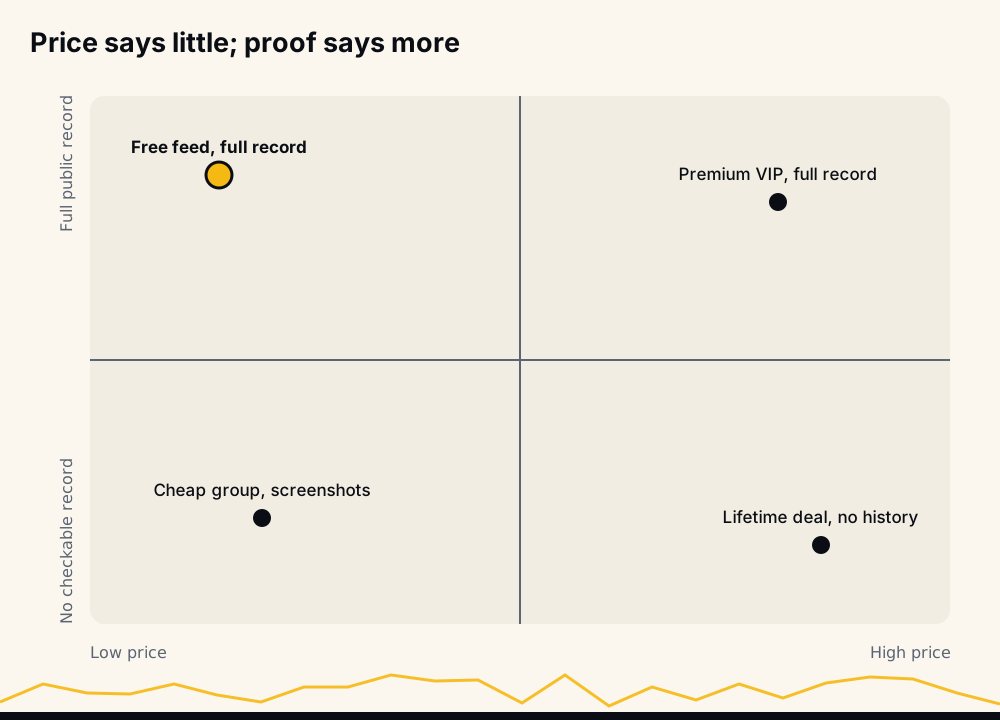
Price and proof are separate questions, and proof matters more. A free feed with a full public record can be better value than an expensive VIP group that offers screenshots.
Before the first payment:
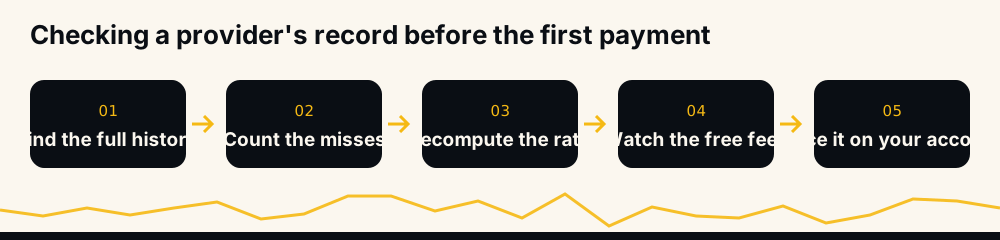
- Find the full history: every signal, not a highlights reel.
- Count the misses. Where do signals that never reached their target go?
- Recompute the rate yourself from the file.
- Watch the free feed for a few weeks and compare it with what the record later shows.
- Price it on your account with the break-even line above.
How to verify a crypto signal win rate walks through each step. For our own signals the material is public: the live performance page is regenerated hourly from the trade database and sorts every broadcast signal into Wins, Missed and Open, with every missed signal counted against the target-hit rate. Older history is in 33 monthly spreadsheets, 33,694 signals from June 2021 to February 2024, at /reports and as one file at /data.
Where HafizeBot sits, as one data point
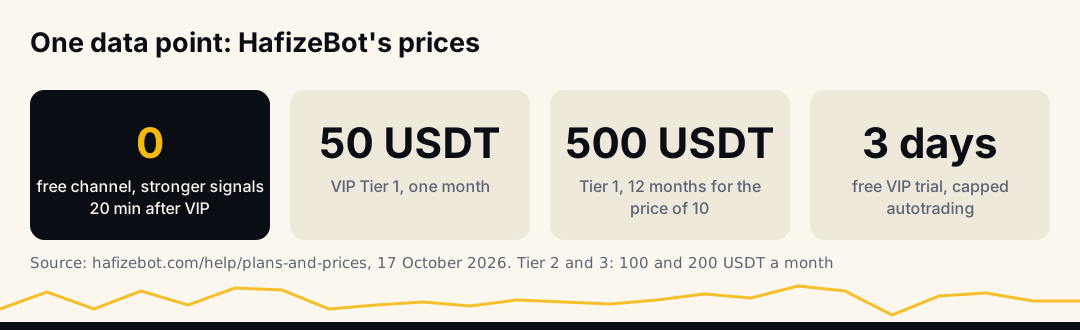
Our prices, from plans and prices on 17 October 2026:
- Free channel: 0. The stronger signals (strength 3 and up), twenty minutes after VIP.
- VIP Tier 1, 2, 3: 50, 100 or 200 USDT a month; 500, 1,000 or 2,000 USDT for 12 months. Every signal instantly, plus optional autotrading on your own Binance USDⓈ-M Futures account.
- Free trial: 3 days of VIP Tier 1 with /trial in @hafizebot, autotrading capped at 10 USDT of margin per entry and 3 open positions; one free VIP per Telegram account.
- Payment: USDT only, no card, no profit share, nothing renews unless you switch on /subscribe.
The signals are AI-generated by a model that evaluates 240+ indicators, formulas and components across 523 Binance USDⓈ-M pairs. Plan details are in HafizeBot pricing.
Frequently asked questions
How much do crypto signals cost? From nothing to a couple of hundred dollars a month. Free channels cost nothing but are delayed or partial; flat monthly VIP plans are the most common paid model; prepaid and lifetime deals lower the monthly rate in exchange for paying upfront; copy trading takes a share of profit instead, up to 30% on Binance. Exchange fees and slippage come on top of all of them.
Are paid crypto signals worth it? Only when the expected result beats the full monthly cost on your account. Divide subscription, fees, slippage and funding by your account size: that is the return the signals must make before you gain anything. For a small account a modest fee can be a very high hurdle.
Is there a free trial for crypto signals? Many providers offer a free channel or a short trial. Ours is 3 days of VIP Tier 1 with /trial in @hafizebot, autotrading capped at 10 USDT of margin per entry and 3 open positions. Use a trial to see how signals arrive, not to judge results; three days is too short for that.
Is a lifetime crypto signal membership a good deal? Only if the provider outlasts the break-even point and the signals stay good, and the price cannot tell you either. A lifetime deal with no monthly option and no public record puts all the risk on you. Try a month first.
What do I pay besides the subscription? Exchange fees on every entry and exit, charged on the full notional including leverage; slippage between the signal's price and yours; funding on perpetual futures while a position is open; and, if you use one, a separate execution tool. On an active account these often add up to more than the subscription.
Why do crypto signal prices vary so much? Because the products differ: delayed or instant, a subset or the full feed, with or without execution, flat fee or profit share. A published record of every signal, misses included, says more about quality than price does.
Before you pay anyone
Watch the free channel for a few weeks, compare it with the live performance page, and price a plan on your own account with the break-even line above. If it still makes sense, start the 3-day trial or join with /join in @hafizebot. The same steps work for any provider.
This is not investment advice. Crypto futures carry a high risk of loss, and paying for signals does not change that; trade only what you can afford to lose.