HafizeBot has four plans. The free channel costs nothing and carries the signals of strength 3 and up, twenty minutes after VIP. Tier 1 is 50 USDT a month, or 500 for a year, and adds every signal instantly, autotrading on your own Binance account, and the hourly VIP reports. Tier 2 is 100 USDT a month, or 1,000 a year, and lifts the autotrading limits from 50 to 10,000 USDT per position and from 10 to 100 open positions, and adds the finer controls: Smart sizing, trade rules, take-profit distance, minimum volume and coin age, and bans on signal types and groups. Tier 3 is 200 USDT a month, or 2,000 a year, for large accounts: every Tier 2 control, up to 50,000 USDT per position, up to 500 open positions, priority support, and risk settings only Tier 3 has, such as loss limits, a drawdown brake and a size that follows your wallet. Payment is USDT on BEP20, TRC20, Solana or TON, credited to a balance you spend on a plan; there is no card, no processor and no auto-renew unless you switch it on.
The plans side by side
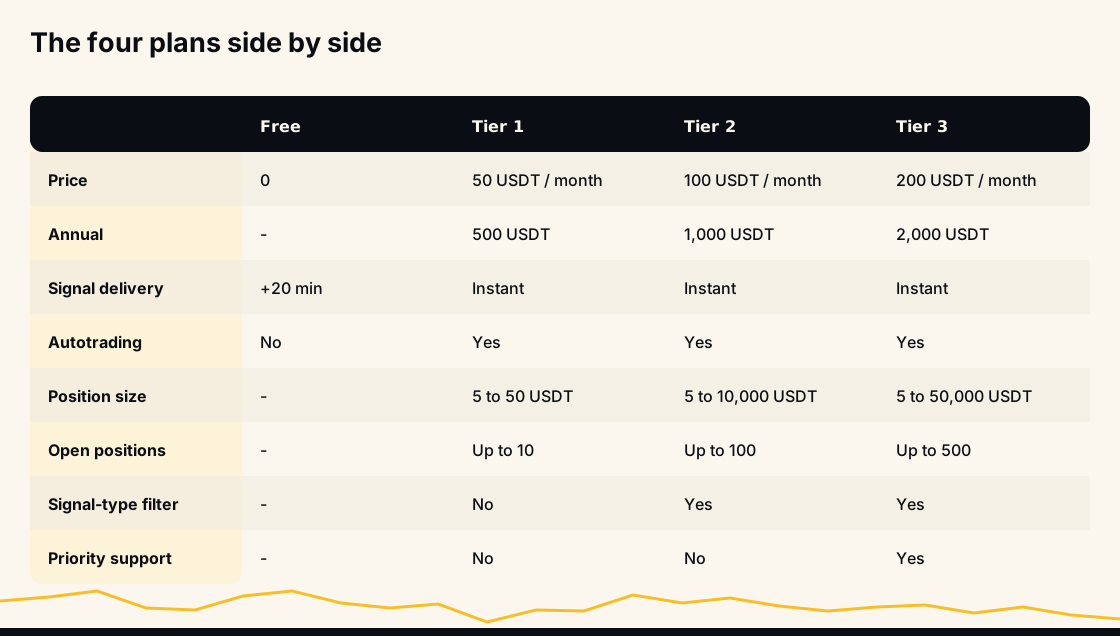
The rest of this page explains the table row by row. Every plan runs on the same model: free gets the signals of strength 3 and up twenty minutes late, and every paid tier gets every signal at once; the tiers differ only in how much the bot may put to work, which controls you get, and how fast we answer you.
What free actually includes
The free plan is the public Telegram channel, t.me/getbinancefutures, and it needs no registration, no username, no wallet. It receives the element signals rated strength 3 and up (pair, direction, entry, target, strength) twenty minutes after the VIP channel. It also includes everything on this site: the monthly order reports, the downloadable signal dataset, the live performance page and the blog. It leaves out timing, the signals rated below 3, autotrading and the VIP-only hourly reports.
Whether twenty minutes matters depends on how you trade. In the archive, strength 3 and up signals reached target in a median 27 minutes, and 44.5% within twenty, so many have finished before the free channel sees them; what the free plan actually gives you measures the rest.
Tier 1: 50 USDT a month
Tier 1 is the plan for an individual account. For 50 USDT a month you get:
- Instant delivery in the VIP channel, the moment a signal fires.
- Autotrading: the bot opens and manages positions on your Binance USDT-M futures account through an API key you create with futures permission only; it never needs withdrawals. Funds never leave your exchange account.
- Position size from 5 to 50 USDT per trade, and up to 10 open positions at once.
- Every strategy control: minimum signal strength (0–5), leverage (1–20), long only, short only or both, isolated or cross margin, a stop-loss mode (off, single, or combined) with its percentage, a limit or trailing take-profit, a coin banlist, a same-coin gap so the bot does not stack entries on one pair, and a switch for repeating signals.
- Hourly VIP reports: market reports posted to the VIP channel every hour, alongside the signals.
- Contact with the admins inside the VIP channel.
The autotrading limits are the point of the tier: ten positions of 50 USDT is 500 USDT deployed at most, unleveraged, a sensible ceiling for a first month and for accounts up to a few hundred USDT; above that, the limit rather than the price becomes the reason to look at Tier 2.
Tier 2: 100 USDT a month
Tier 2 is Tier 1 with the ceilings removed and the finer controls added. Position size runs from 5 to 10,000 USDT and open positions up to 100. The controls are Smart sizing (a share of your position size per kind of trade), trade rules (your own stop, same-coin gap, cap, leverage or on/off per kind of trade, for one coin, or for a band of 24h volume or coin age), take-profit distance (where your take-profit sits against the signal's target), a minimum 24h volume and coin age for the coins you trade, and a banlist that can exclude whole signal types and Binance groups (TradFi, Meme, Layer-2) as well as single coins. Signals, timing and reports are identical to Tier 1.
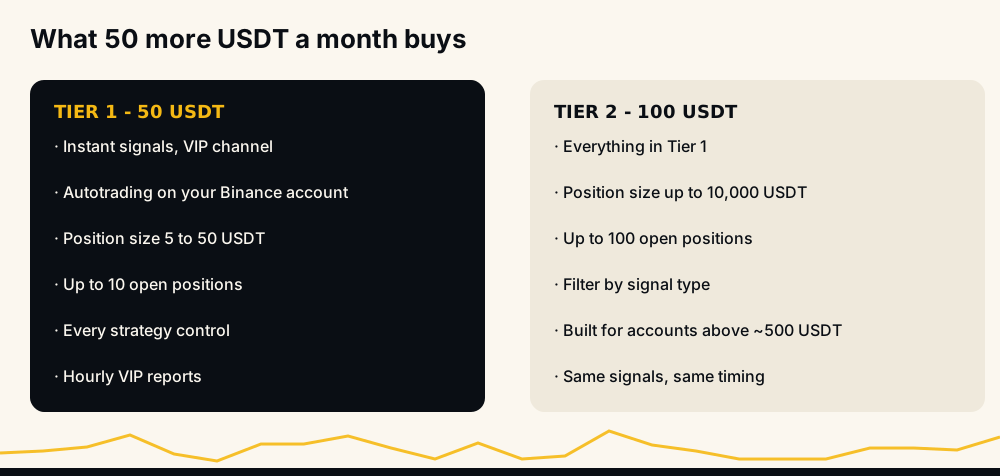
The arithmetic for choosing is simple. If 50 USDT per position and 10 positions can deploy the capital you intend to trade, Tier 2 buys you the controls and nothing else. If your account is 2,000 USDT and you want 100-USDT positions, Tier 1 physically cannot do it, and the extra 50 USDT a month is the cheapest part of the decision.
Tier 3: 200 USDT a month
Tier 3 exists for accounts that Tier 2's ceilings would constrain: position size up to 50,000 USDT, up to 500 open positions, every Tier 2 control, and priority support. Signals and timing are, again, identical.
It also has risk settings no other plan has, each off until set: daily and weekly loss limits, an entry cap per coin, a maximum hold time, skips for new coins by their last 24 hours, a drawdown brake, a funding pause, and a size and position limit that follow your wallet. They are tools with trade-offs, not better signals: in our tests on past signals several gave up more than they saved. Tier 3 limits explains each.
The arithmetic is the same as for Tier 2: if 10,000 USDT per position and 100 positions can deploy what you intend to trade, Tier 3 buys you priority support and those settings, nothing else; if your account is 20,000 USDT and you size positions at 1,000, Tier 2 cannot hold what you need and the extra 100 USDT a month is a rounding error against the account. Annual: 2,000 USDT, two months free.
What a signal costs, per signal
Prices are easier to judge per unit of what they buy. In August 2026 the bot broadcast 5,262 element signals; at 50 USDT, Tier 1 works out to just under a cent per signal, or about 1.6 USDT per day. June had 6,304 signals, July 5,448. The count moves with the market, so the per-signal figure moves with it, but it stays in cents.
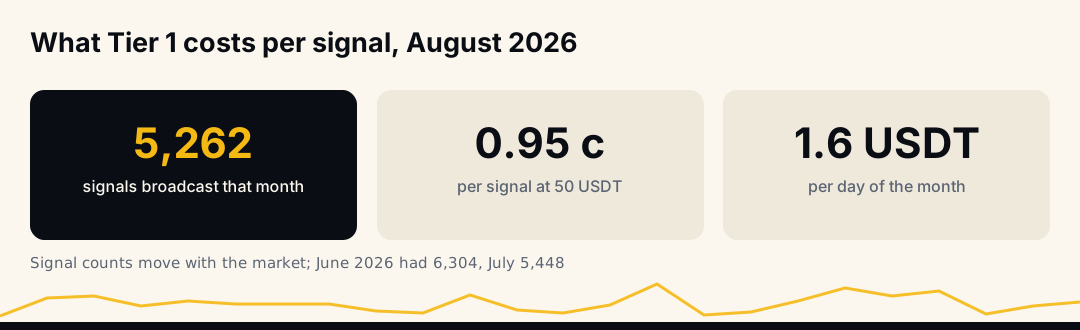
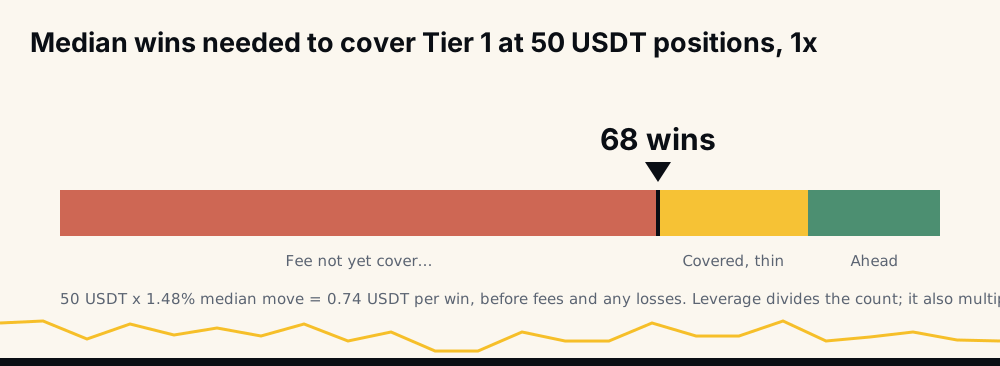
The more useful question is how many of those signals need to work for the fee to be covered. At 50 USDT positions and no leverage, the archive's median winning move of +1.48% is worth 0.74 USDT, so roughly 68 median wins pay for the month before fees and before any losses. Leverage divides that count (14 wins at 5x) and multiplies the losses by the same factor. We spell this out because a win rate on its own is not a number, and the fee is the easiest part of the month to calculate.
Annual plans: twelve months for the price of ten
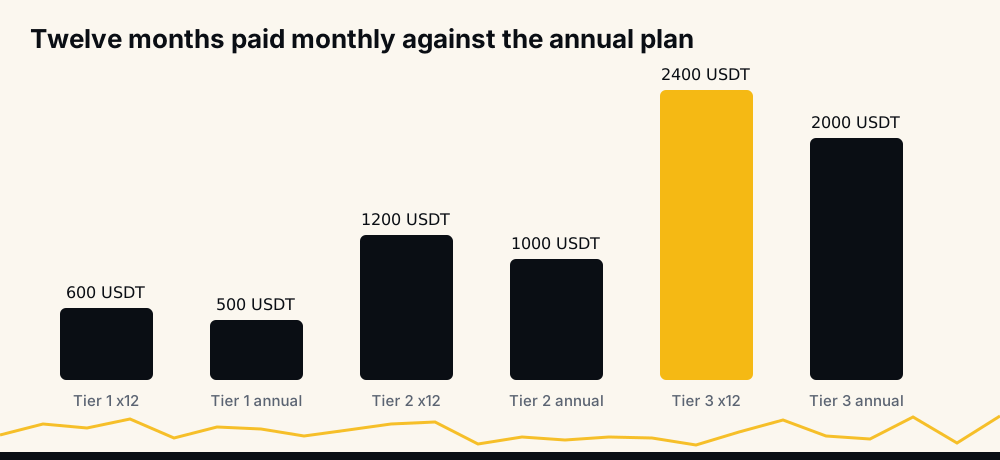
Every tier has an annual plan at ten times the monthly price: 500 USDT for Tier 1, 1,000 for Tier 2, 2,000 for Tier 3. The saving is two months, or 16.7%. The trade-off: you commit a year in advance to a service whose results you only know backward. Run a month first, on Tier 1, and consider the annual plan once the live record has spent a few more months matching what you saw.
How payment works
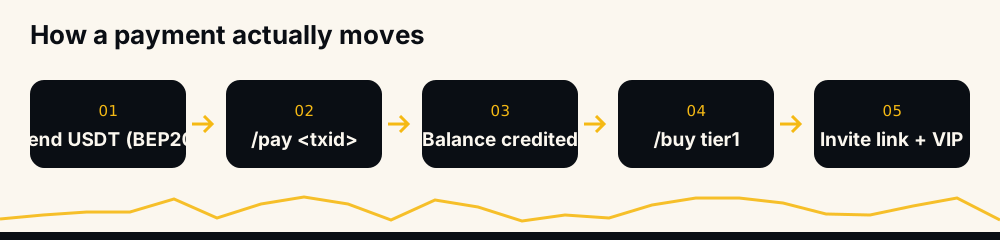
The flow runs through the bot, t.me/hafizebot, or through the same checkout on the website at /app/billing after you sign in with Telegram. Either way it has two steps.
- Deposit. After
/join, pick the network you will send on (BEP20 (BSC), TRC20 (Tron), Solana or TON) and send USDT on that network only to the address the bot shows for it. Send the plan price: 50 USDT for Tier 1, 100 for Tier 2, 200 for Tier 3. The address is a Binance address, so from a Binance account the transfer is internal and free and the full amount arrives; from another wallet, add its network fee. Then send/pay <transaction id>(or/deposit). The bot checks the transfer against the deposits our Binance account received and credits the exact amount to your balance. - Buy. Send
/buy tier1,tier2,tier3,tier1_annual,tier2_annualortier3_annual. The price is debited from the balance, VIP is activated, and you receive a single-use invite link to the VIP channel.
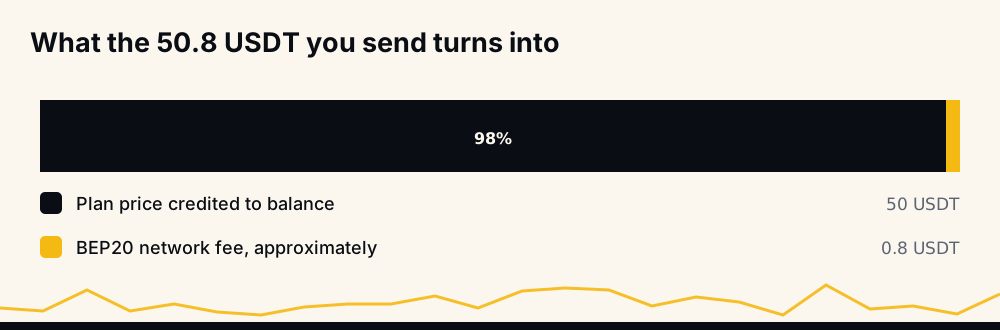
The balance model exists so that a deposit is never lost to a rounding error: if 49.6 arrives because the fee was underestimated, it sits in your balance and you top up the difference rather than starting again. Wrong network or a different coin cannot be verified and cannot be credited, which is why the bot shows an address only after you pick its network.
Binance's own fees, which are not ours
One cost sits outside the price list and applies only to autotraded positions: Binance's trading fees on USDT-M futures, charged per side at the exchange's standard rates, plus funding on positions held across a funding interval. They are the fees you would pay trading the signal by hand, paid to Binance rather than to HafizeBot. They matter to the arithmetic above: a +1.48% median move loses a visible slice to two market orders, a signal that expires flat loses its whole result to them, and market entries add a small slippage. A pricing page that stopped at the plan price would understate what a month of autotrading costs.
What is not charged
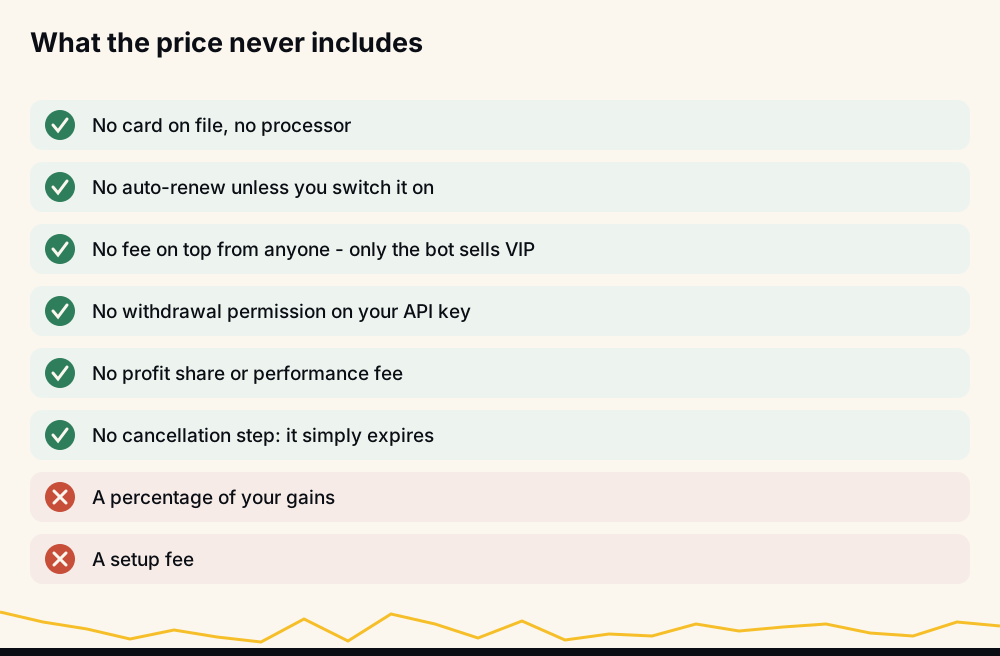
- No card, no payment processor, no stored payment method.
- No auto-renew by default; VIP simply expires.
/subscriberenews it from your balance, and only when the expiry is within three days and the balance covers the price. - No performance fee, no profit share, no setup fee.
- No fee from anyone else. Only the bot sells VIP; nobody in the channel, admin or otherwise, is authorised to take payment.
- No withdrawal permission needed on the API key, ever, and a warning if a key you add has it. The bot trades; it never calls a withdrawal or transfer. How to connect a trading bot to Binance safely explains the permissions in detail.
How membership time is counted
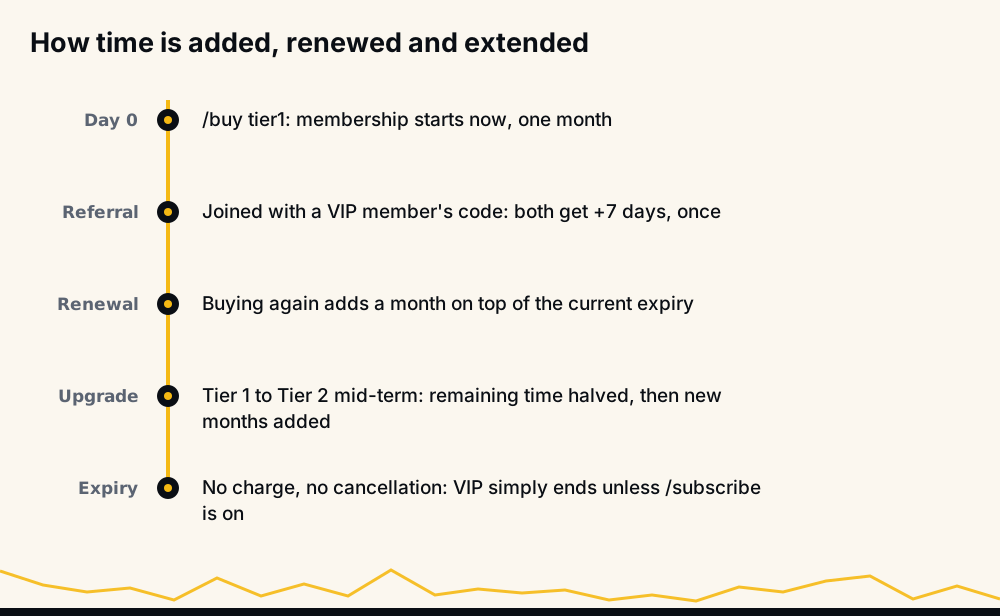
- A new purchase starts now and runs the number of months bought.
- Buying again while active adds on top of the current expiry, so renewing a week early does not cost you the week.
- Upgrading from Tier 1 to Tier 2 mid-term halves the remaining time, then adds the new months: the fairest conversion between two prices we found without a proration table.
- Referral: if a VIP member gives you their username and you send
/invite <username>before joining, both of you get one extra week. It applies once per member and there is no limit on how many people a member can refer.
Which plan is for you
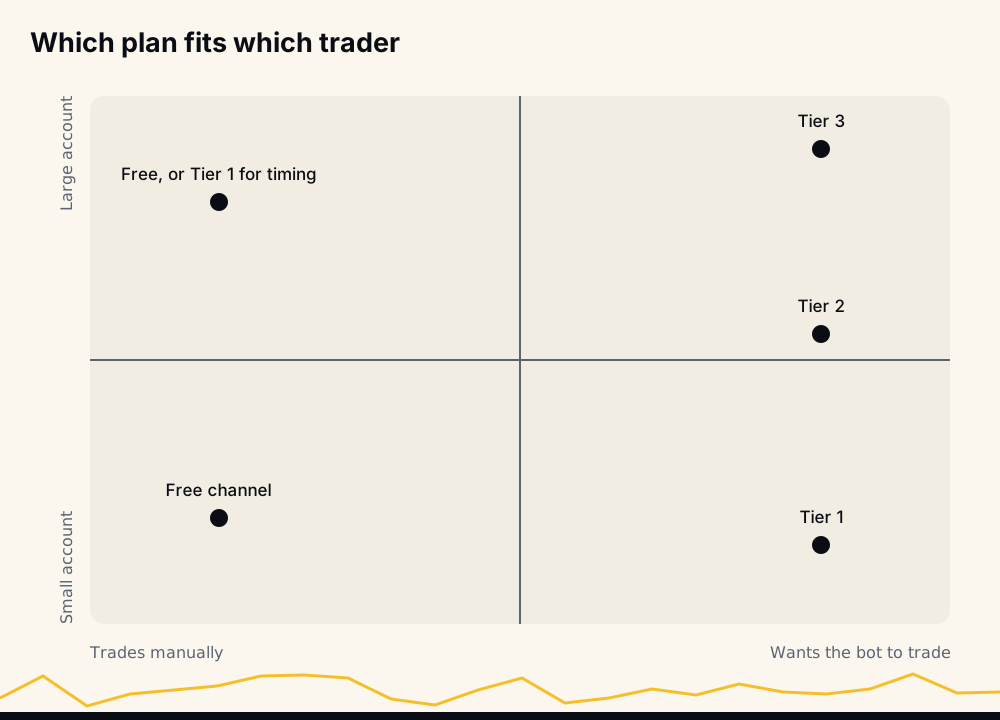
- You trade manually and want to see the signals first: stay on the free channel until you have watched a month of the live record. It costs nothing and the delay shows you whether the timing matters to your style.
- You trade manually and the twenty minutes hurts, or you want every signal: Tier 1. The autotrader can stay off.
- You want the bot to trade an account up to a few hundred USDT: Tier 1.
- You want the bot to trade a larger account, or to size positions above 50 USDT: Tier 2, because Tier 1 cannot.
- You want to size or stop kinds of trades differently (smaller shorts, a tighter stop on one kind, no trades on new coins): Tier 2 has Smart sizing, trade rules and the volume and coin-age minimums.
- Your positions run above 10,000 USDT or you hold more than 100 at once: Tier 3, because Tier 2 cannot.
- You want loss limits, a drawdown brake or a size that follows your wallet: Tier 3, the only plan with them.
What every plan is priced against
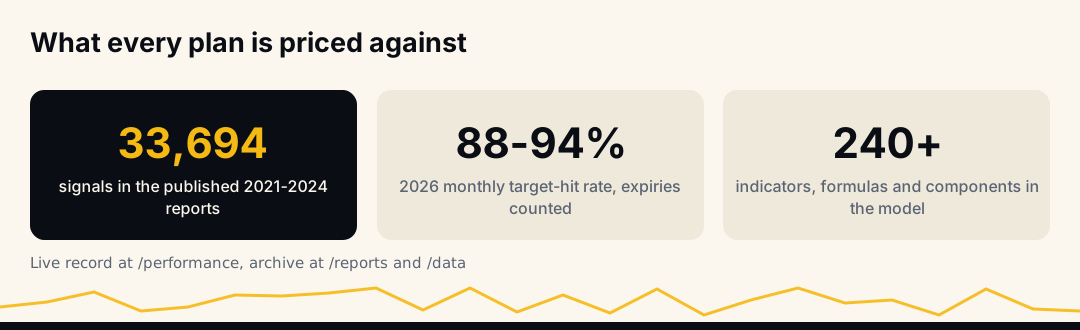
The price buys access to a signal stream whose record is public: 33,694 signals in the 2021–2024 spreadsheets, and a live page since June 2026 that sorts every broadcast signal into wins, missed and still open. Broadcast signals carry a target and a maximum hold, not a stop, so a signal that does not reach its target in time counts as missed and lowers the rate: 97.3% in August 2026, the latest finished month. If that record is not enough to decide on, no price is low enough, and whether HafizeBot is legit is the page to read before this one.
Frequently asked questions
How much does HafizeBot cost? The free channel is 0. Tier 1 is 50 USDT a month or 500 a year. Tier 2 is 100 USDT a month or 1,000 a year. Tier 3 is 200 USDT a month or 2,000 a year. Annual plans give twelve months for the price of ten.
What is the difference between the tiers? Autotrading limits, finer controls, and support. Tier 1 allows positions of 5 to 50 USDT and up to 10 open at once; Tier 2 allows 5 to 10,000 USDT and up to 100, and adds Smart sizing, trade rules, take-profit distance, minimum volume and coin age, and bans on whole signal types and Binance groups; Tier 3 has the same controls, allows up to 50,000 USDT and 500 positions with priority support, and adds loss limits, an entry cap, a hold time, 24-hour skips, a drawdown brake, a funding pause and wallet sizing. Signals, timing and reports are the same.
Can I pay with a card or PayPal?
No. Payment is USDT on BEP20 (BSC), TRC20 (Tron), Solana or TON, sent to our address for that network and credited with /pay. There is no processor in the loop.
Does HafizeBot auto-renew?
Not unless you turn it on with /subscribe. By default VIP expires and nothing is charged.
Is there a free trial of VIP? Yes, since September 2026: three days of VIP, auto-trading included with small limits (10 USDT of margin per trade, 3 open positions). Send /trial in @hafizebot to start it at once, or ask for a one-time code at hafizebot.com/trial and send it to @hafizebot with /coupon. It is one trial per email address, Telegram account and Binance account, and not for past VIP members.
What happens if I send the wrong amount?
Whatever arrives is credited to your balance exactly. If it is short of the plan price, top up the difference and then /buy. Sending on the wrong network or in another coin cannot be credited.
Are there any hidden fees? No performance fee, no profit share, no setup fee, and nobody other than the bot is allowed to charge for VIP. Binance's own trading fees apply to autotraded positions as they would to any trade.
Closing note
HafizeBot's price is four numbers: 0 for the stronger signals twenty minutes late, 50 for every signal at once, 100 when the account is large, 200 when it is larger still. The record it is priced against is public and the payment path has no way to take more than you send. Read the free-plan page next if the delay is the question, and the legitimacy page if trust is.
None of this is investment advice. Cryptocurrency futures carry a high risk of loss; trade only with money you can afford to lose.