You can open a crypto futures position with tens of dollars — exchange minimums are small — but the amount that lets you size positions properly and survive a losing run is several hundred at minimum, and the amount that makes trading fees stop mattering is in the thousands. The exchange minimum answers "what will be accepted". The useful question is "what can absorb ten losses in a row without ending", and that one has a different answer.
Below is the arithmetic behind both numbers, why very small accounts fail for structural reasons rather than bad luck, and how to work out your own figure instead of adopting someone else's.
Three different questions hiding in one
"How much do I need" is usually three questions at once, with three different answers.
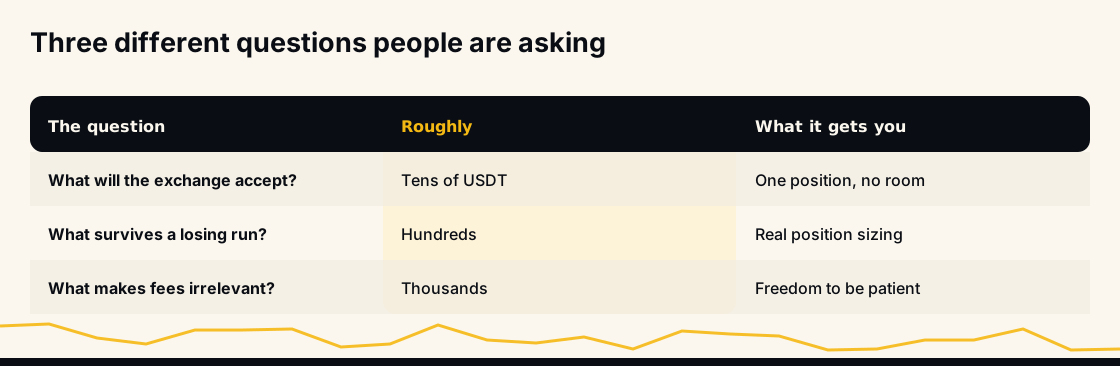
Most articles answer the first and stop. It is the least useful of the three, because being allowed to place a trade and being able to trade sustainably are unrelated conditions.
The exchange minimum, and why it misleads
Exchanges set a minimum notional value per order — on Binance USDT-M perpetuals this has generally been a small figure in the single-digit-to-low-tens of USDT, though it varies by pair and changes over time, so check the specific contract rather than trusting any article's number including this one.
The trap is that this minimum is a notional value, not a margin requirement. With leverage, a small margin balance can control a much larger notional, which is exactly how a very small account ends up with a position it cannot manage. The exchange is telling you the smallest trade it will accept. It is not telling you the smallest trade that makes sense.
The number that actually matters: risk per trade
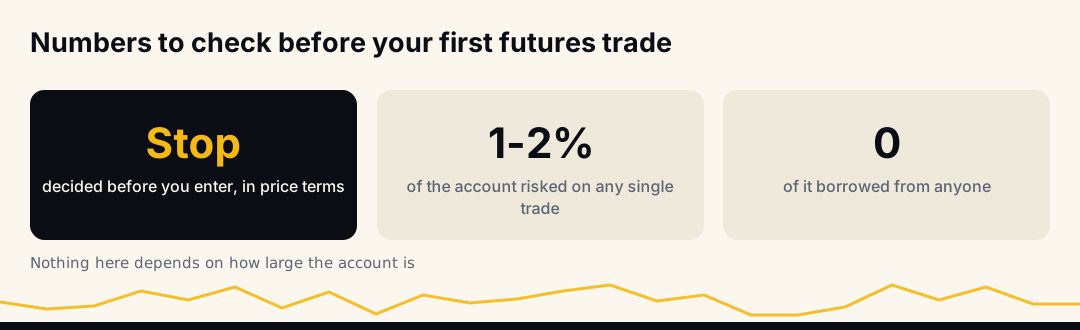
Everything about account size follows from one decision — what percentage of the account a single losing trade costs you.
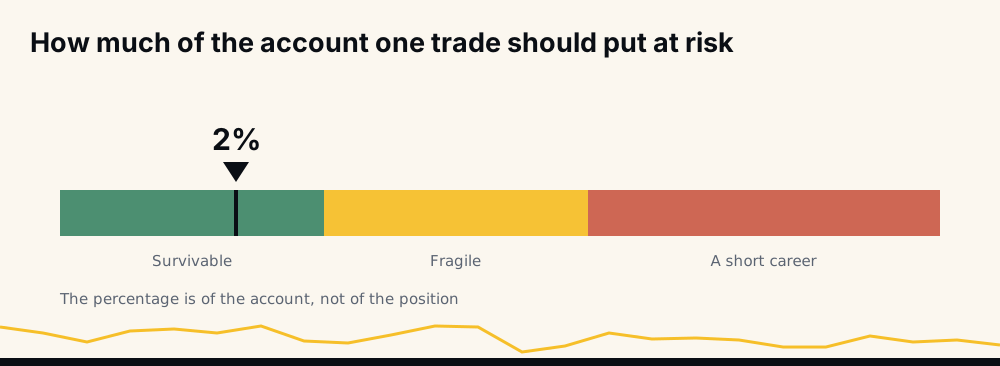
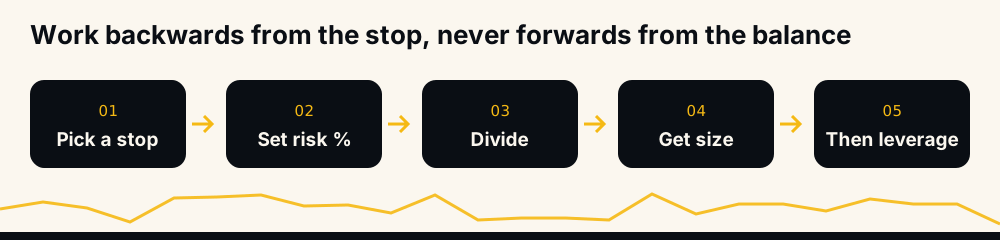
That percentage is of the account, not of the position, and the distinction is where most beginners go wrong. Risking 2% of a 1,000 USDT account means a losing trade costs 20 USDT. It does not mean putting 20 USDT into the trade — the position may be much larger, with a stop placed so that the loss, if it happens, is 20 USDT.
If that ordering is unfamiliar, how to set a stop loss in crypto works through the mechanics. The short version is that you decide the stop first and the size second.
What each risk level costs you in survivability
The reason 1–2% keeps appearing is not superstition. It is what the compounding arithmetic produces.
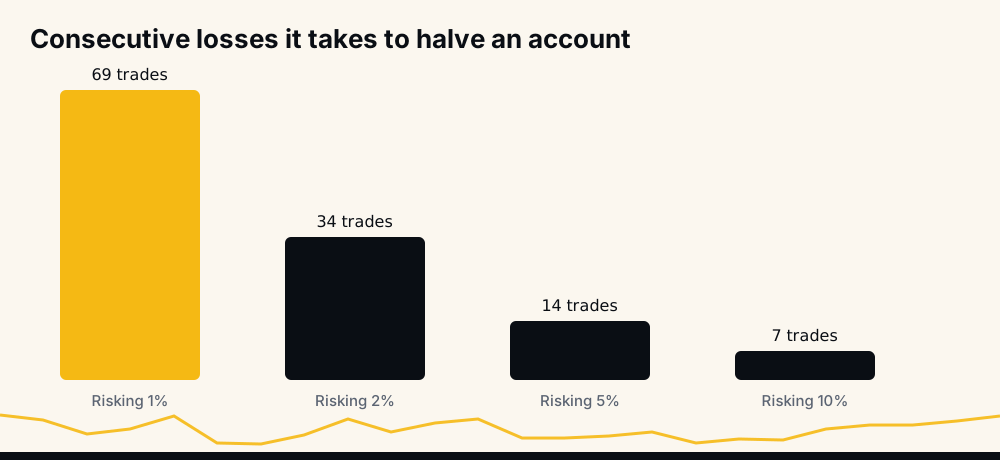
At 10% risk per trade, seven consecutive losses halve the account. Seven in a row is not an unusual event — it happens to profitable systems regularly, because a 60%-accurate system produces a run of seven losses fairly often across a few hundred trades. At 2%, the same run costs you about 13% and you are still trading.
This is the entire argument for a larger starting balance: a bigger account lets a small percentage still be a workable position size. On a 200 USDT account, 2% is 4 USDT of risk, and with the minimum order sizes on many pairs you simply cannot construct a position whose loss is capped at 4 USDT. So you either risk far more than you intended or you cannot take the trade. That is the structural problem, and no amount of discipline fixes it.
What a very small account actually changes
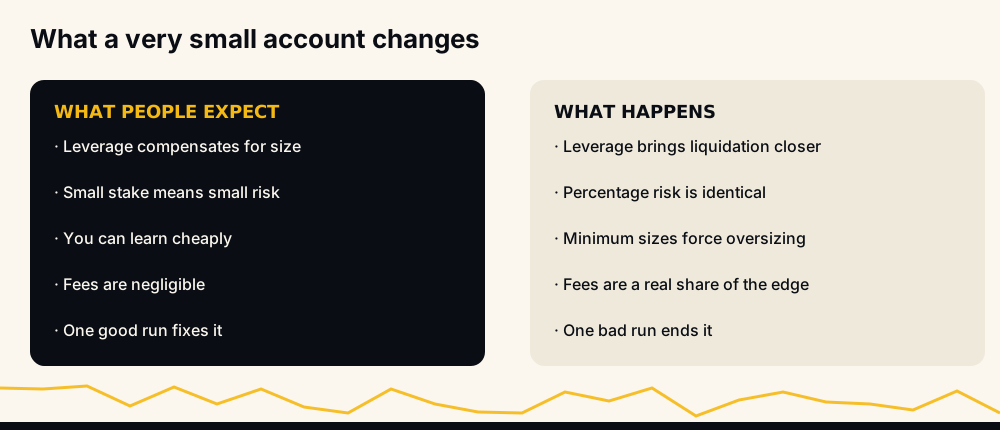
The most damaging belief on that list is the first. Leverage does not compensate for a small account; it moves the liquidation price closer to the entry, so the market has less room to move against you before the position is closed for you. How leverage trading works covers that relationship properly, and it is the single most important thing to understand before funding a futures account at all.
The second belief is subtler and just as costly. "I'm only putting in $100 so I can only lose $100" is true and irrelevant — what matters is the percentage of that $100 you lose per trade, and small accounts routinely risk 20% or more per position because the minimums force it.
Fees, at a small scale
Trading fees are charged on notional value, which means they do not shrink with your account — they shrink with your position size, and leverage pushes position size back up.
The practical consequence: on a small account trading frequently, fees can consume a meaningful share of whatever edge exists. A strategy that is mildly profitable before costs can be reliably unprofitable after them. Before deciding your starting amount, work out roughly what a month of your intended trade frequency costs in fees, and ask whether the account can support it. Exchange fee schedules change, so read the current one rather than a figure from an article.
How to lay out a starting account
Whatever the total, do not put all of it in one place.
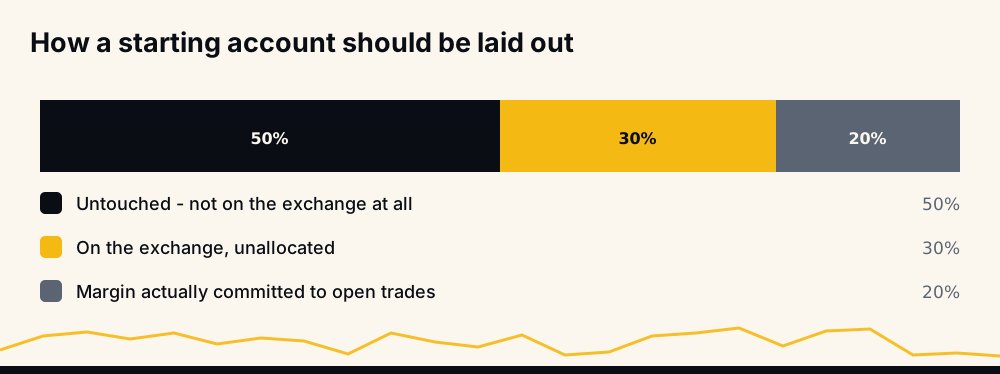
The reserve exists for two reasons. It caps what any single failure — an exchange problem, a mistake, a run of losses — can reach. And it means adding to the trading balance is a deliberate decision rather than a reflex after a bad week.
The unallocated portion on the exchange matters too: margin that is committed is margin that cannot absorb an adverse move, and an account running at full allocation is one that gets liquidated by ordinary volatility.
So what is the actual number?
Working from the above rather than from a slogan:
- Under ~200 USDT, minimum order sizes usually make correct position sizing impossible. This is educational money, not a trading account, and there is no shame in that as long as you are honest about which it is.
- Roughly 500–1,000 USDT is where 1–2% risk starts producing positions the exchange will actually accept on most pairs, and a losing run stops being fatal.
- A few thousand is where fees become a minor line item and you can be patient — skipping setups without feeling you are wasting the account.
Those are ranges, not thresholds, and they depend on which pairs you trade and how often. The honest test is: can I risk 2% on this trade and still meet the minimum order size? If not, the account is too small for that pair, whatever the total.
The mistake that turns a small account into no account
There is a specific sequence that ends most small futures accounts, and it is worth recognising because it feels reasonable at every step.
It starts with an account too small to size correctly. The trader knows the position is larger than they would like, but the alternative is not trading at all, so they take it. It works a few times — most trades do — which reads as evidence the concern was overblown. Size creeps up, or leverage does, because the returns on a small account feel too small to be worth the effort.
Then a normal losing run arrives. Not an unusual one: four or five in a row, the kind any system produces. On an oversized book that is a large percentage of the account, and now the arithmetic turns hostile, because recovering from a 40% drawdown requires a 67% gain rather than a 40% one. Losses and gains are not symmetric, and that asymmetry gets worse the deeper the hole.
At that point the account is too small to size correctly and the trader needs an outsized return to get back to where they started. The only way to produce one is more risk. That is the last step, and it is the one that finishes it.
Nothing in that sequence involves bad analysis or bad luck. It follows from starting below the size where correct sizing was possible, and every subsequent decision was locally sensible. The way out is not better discipline in the middle of it — it is not starting there, or accepting from the outset that a very small account is for learning the mechanics and that its balance is not going anywhere.
Money is not the only prerequisite
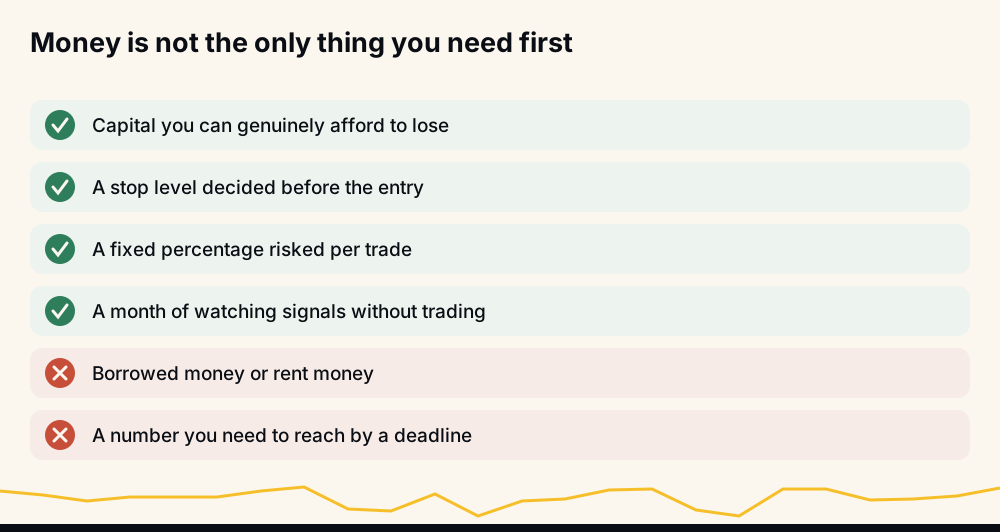
The two crossed items end the discussion regardless of the amount. Borrowed capital converts a bad month into a debt problem. A number you need by a deadline forces oversizing at exactly the wrong moments, because the only way to reach a target faster is to risk more per trade — which, per the chart above, is the reliable way to reach zero instead.
A ninety-day start that does not depend on luck
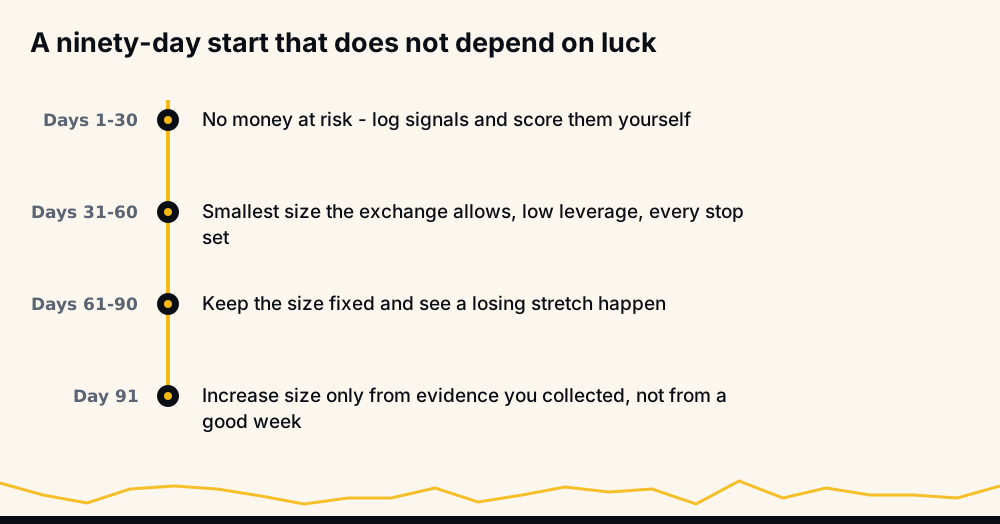
The third month is the one people skip and the one that teaches most. You cannot know how you size, or whether you follow your own rules, until you have lived through a stretch where the account goes down and stays down for a while. Everything before that is a test under favourable conditions.
If you are starting from the beginning, crypto futures trading for beginners covers what a perpetual contract is and how margin works before any of this sizing arithmetic applies. And if you plan to trade signals rather than your own analysis, spend the first month scoring them yourself — choosing a signal provider explains how, and doing it costs nothing.
Where autotrading fits
If a bot will be placing the trades, the size question becomes a setting rather than a decision in the moment — which helps, provided the setting is right. HafizeBot's autotrading lets you fix position size, cap the number of simultaneous positions, require a minimum signal strength and filter which coins are eligible, running on API keys that cannot withdraw so funds stay on your own Binance account.
The cap on simultaneous positions deserves attention on a small account in particular. Five positions open at 2% risk each is 10% of the account exposed at once, and crypto pairs frequently move together, so those five can behave like one larger trade when the whole market turns.
For what the underlying signals have historically done, /reports holds 33 monthly spreadsheets from June 2021 to February 2024 covering 33,694 signals, at a median monthly accuracy of 98.9% as reported in those sheets, and /performance regenerates hourly from the trade database with expirations counted against the hit rate.
This is information, not investment advice. Futures with leverage can lose more than a beginner expects and can do it quickly — trade only what you can afford to lose, and treat the sizing arithmetic above as the part that decides whether you are still trading in six months.
FAQ
How much money do you need to start trading crypto futures? The exchange will accept tens of USDT, but proper position sizing generally needs several hundred, because risking 1–2% of a very small account produces a position below the minimum order size. Around 500–1,000 USDT is where the arithmetic starts working on most pairs.
Can I start crypto futures with $100? You can place trades, but you will usually be forced to risk a large percentage per trade to meet minimum order sizes, which makes a normal losing run fatal. Treat $100 as tuition rather than capital, and keep the leverage low.
How much should I risk per trade in crypto futures? One to two percent of the account per trade is the common answer because of what compounding does: at 2%, thirty-four consecutive losses halve the account, while at 10% only seven do. The percentage is of your account balance, not of the position size.
Does leverage mean I need less money to start? No. Leverage lets a small balance control a larger position, but it also moves the liquidation price closer to your entry, so the market has less room to move against you. It changes the position size you can take, not the amount of risk you can survive.
Is crypto futures trading worth it with a small account? As a way to learn mechanics with real consequences, it can be. As a way to grow a small amount into a large one quickly, the maths is against you: the risk levels required make a losing run terminal. Growing the account by adding to it is slower and far more reliable than growing it by risking more.
How much do fees cost on a small futures account? Fees are charged on notional value rather than on your balance, so they do not shrink as your account does. On small accounts trading often, they can absorb a real share of any edge — check the exchange's current fee schedule and multiply by your intended trade frequency before you start.