A crypto signal screenshot proves nothing because it shows one position, at one moment, chosen by the person who wants your money. It cannot show the calls that were deleted, the leverage that inflated the ROI%, whether the account was a demo, whether the profit was ever realized, or whether the image was edited. Evidence is a record: every call timestamped before its outcome, misses included, in a file you can recompute.
What a PnL screenshot actually shows
Open any signal channel and the proof looks the same: a Binance Futures position card with a large green ROI%, a pair, a leverage figure and an entry price. The card is the currency of the signal business.
Look at what the image contains. One position. One timestamp, often cropped out. A percentage that depends on settings the viewer cannot audit. What it leaves out is everything a buyer needs: how many other calls were made that week, how they ended, and whether this trade was ever closed at the number shown.
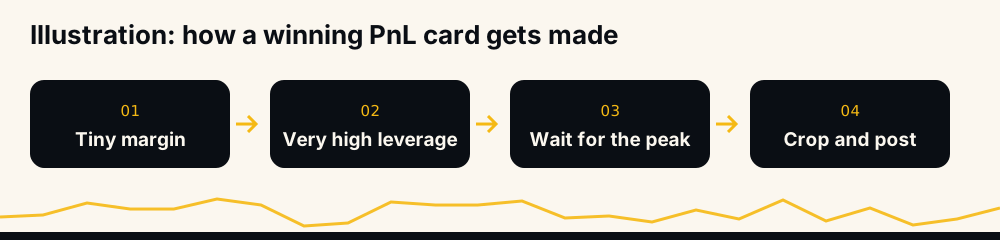
None of the steps above requires a good call. Each of the eight reasons below is one way the card can say something true about a single position while saying nothing about the provider. Our guide to crypto signal scam red flags lists screenshots as one flag among twelve; this article takes that one flag apart.
Reason 1: the ROI% is leverage, not skill
The big number on a futures card is ROI, and Binance defines it against your margin, not your position. Binance's futures calculator FAQ (updated 9 January 2026) gives "ROI% = PnL / Initial Margin", with initial margin equal to the position's value times the initial margin rate, and that rate equal to 1 divided by leverage.
So ROI% is roughly the price move multiplied by leverage. A 2% move becomes a 100% ROI at 50x and a 200% ROI at 100x, with the trader's judgement unchanged.
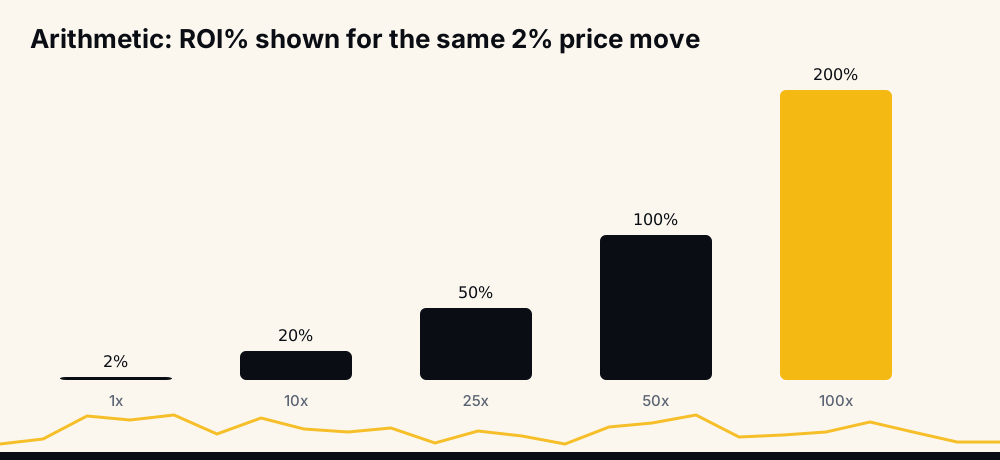
The size behind it can be tiny. Put 10 USDT of margin on a position at 50x and you control 500 USDT; a 2% move earns 10 USDT, and the card says +100%. The same 2% against you would have wiped the margin out, and Binance liquidates before that point because of the maintenance margin. How leverage trading works in crypto walks through that arithmetic.
The quick test: divide any ROI% by the leverage on the card. A "+340%" card at 75x is a move of about 4.5%. Then ask what happened to the positions where the same leverage met a 4.5% move the other way.
Reason 2: unrealized PnL is a moment, not an outcome
An open position's card shows unrealized profit, which Binance calculates on the mark price: its PnL FAQ (updated 2 February 2026) states that "unrealized profit and loss are calculated based on the Mark Price." That number changes every second. Mark price vs last price on Binance explains where the mark price comes from.
A screenshot freezes the best second. Nothing on the image tells you whether the position was closed there, held through a reversal, or liquidated an hour later.
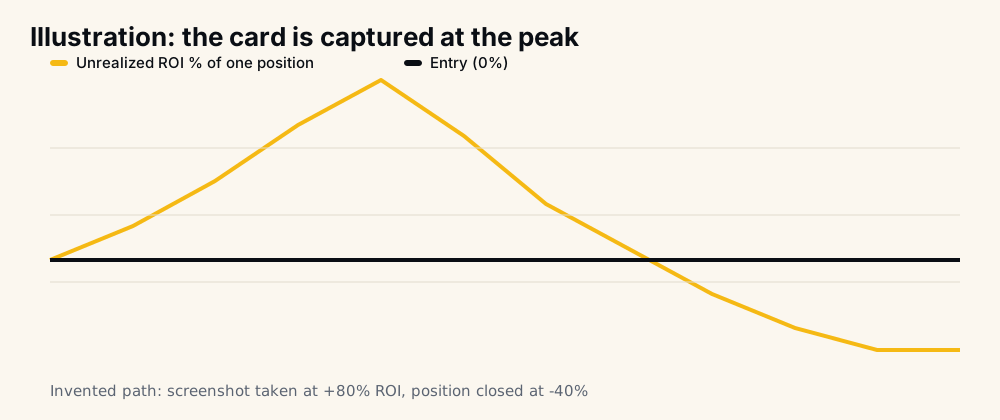
A closed trade has a realized PnL and fill times in the order history. When a provider shares open positions and never the matching close, you are looking at a mood, not a result.
Reason 3: twenty wins on screen, twenty losses deleted
A Telegram channel can be cleaned after the fact, and Telegram says so in plain words. Its channels tour: "you can delete any message at any time, for everyone", and "Deleted messages will vanish from the feed, for both new and old subscribers." The same page notes you can edit channel messages "regardless of how long ago they were posted."
Here is what that does to a record. Suppose a channel posts 40 calls in a month. Twenty reach their target with an average move of +2%, twenty hit their stop with an average move of −3%. The admin screenshots the twenty winners and deletes the twenty losers.
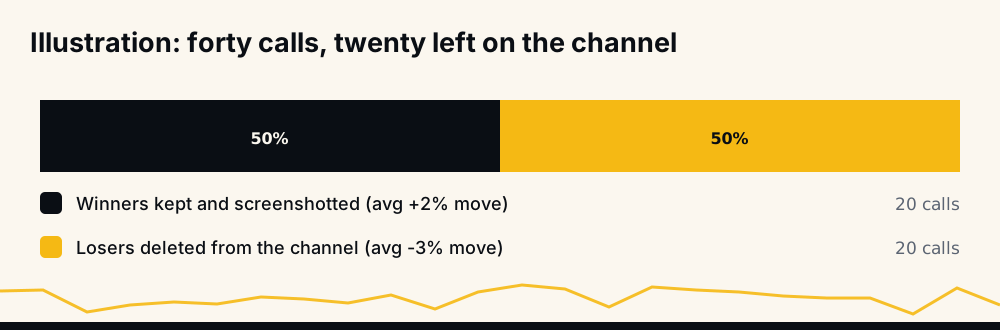
A new subscriber scrolling back sees 20 calls and 20 wins: a 100% hit rate. The true rate is 50%. Worse, the true results lose money. Summed across the month, the calls moved 20 × 2% − 20 × 3% = −20 percentage points. With wins of 2% and losses of 3%, a trader needs to win 3 ÷ (2 + 3) = 60% of the time just to break even.
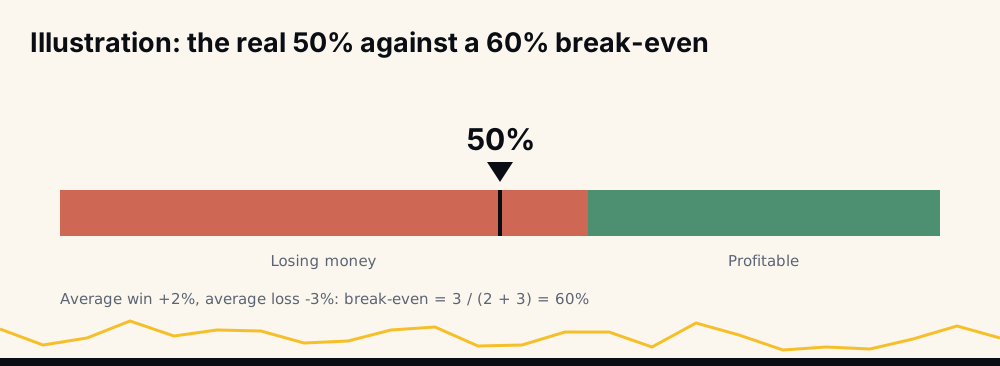
No screenshot of the 20 winners is false. The lie is in the denominator, and an image cannot carry a denominator. What a realistic crypto signal win rate looks like goes deeper into why a rate means nothing without the size of the average loss.
Reason 4: survivorship, or why the perfect channel finds you
You do not need deletion to get a spotless record. You only need many channels and some luck.
Imagine 64 new channels whose calls are pure coin flips. After one call, about 32 have a perfect record. After six calls, 64 × (1/2)^6 = 1 channel is expected to be six for six. That channel has nothing to apologise for, nothing to delete, and a feed full of honest screenshots.
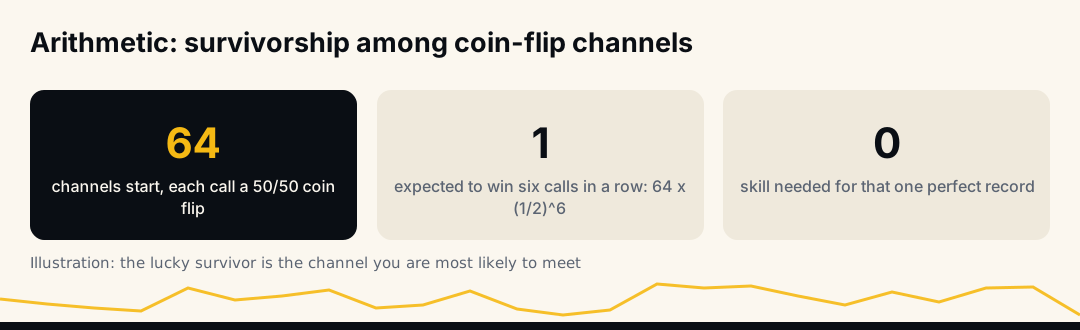
The other 63 go quiet. The survivor grows, gets shared and runs ads, which makes it the channel you are most likely to meet. A short streak, screenshotted, cannot separate skill from survivorship. Only a long record can, and the longer the better.
Reason 5: demo accounts and testnets look like the real thing
Binance runs practice environments next to the live exchange. Its mock trading FAQ (updated 17 September 2025) says "Mock Trading has transitioned to Binance Demo Trading", and the USDⓈ-M Futures API documentation lists a separate testnet at demo-fapi.binance.com, where "most of the endpoints can be used." These are useful tools for learning. They also produce position cards that look like live ones once the edges are cropped.
Regulators have seen this used against investors. The CFTC's advisory on AI trading bots describes a fraud in which the operator "created fake customer accounts and balances using MetaTrader demo accounts." A screenshot cannot show you which server the account lives on.
Reason 6: the image itself can be edited
A screenshot is a picture of a screen, and both the screen and the picture can be changed. A web page's numbers can be altered in the browser before capture, and image editors do the rest. The search data behind this article shows people looking for "fake binance screenshot generator", "binance fake p&l generator" and "trading loss screenshot generator". When a tool for faking a thing is a common search, the thing is not evidence.
The CFTC's investor alert on relationship investment scams lists "sending fake screenshots, showing fake trading information" among the ways fraudsters build trust, and warns: "Fraudsters might also use altered or AI-generated photos or videos to make it falsely look like others have profited." The FTC's crypto scam page makes the same point about testimonials from happy investors: "Those are easily faked."
The reverse also holds. A real screenshot from a real account proves only that one position existed. Authenticity does not rescue an image from reasons 1 to 4.
Reason 7: TP1-only counting
Many signals list several take-profit levels: TP1, TP2, TP3. A common way to report results is to call any signal that touched TP1 a win, even if price then turned and hit the stop. The screenshot shows TP1 being reached; the rest of the trade is off camera.
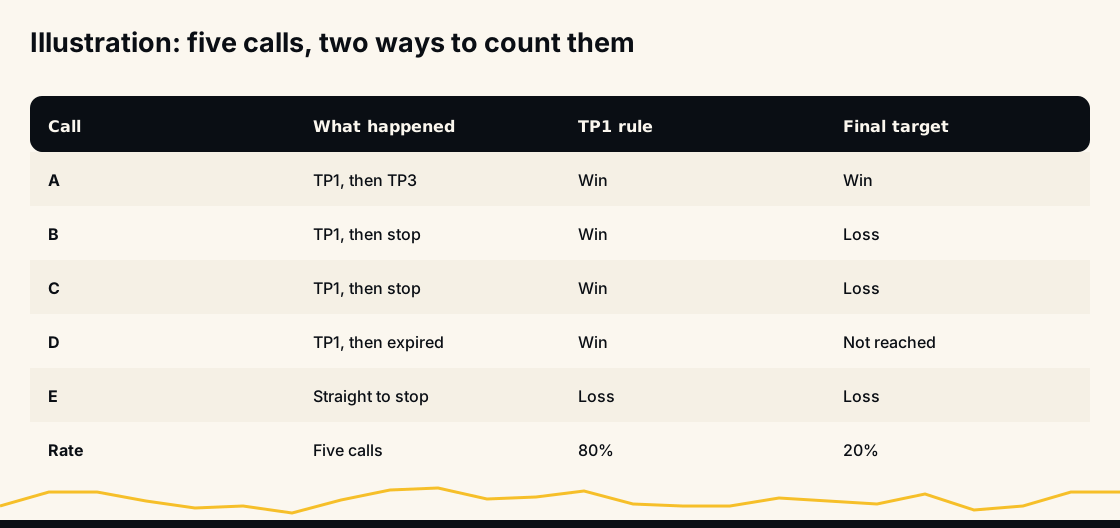
In the five invented calls above, four touched TP1, so the channel reports 80%. Only one reached its final target. Two of the "wins" ended at the stop. Whether a trader made money on calls B and C depends on how much they closed at TP1, which the channel's 80% does not say. How to verify a crypto signal win rate lists five different things a "win" can mean and how to recompute under the strictest one.
Reason 8: results recomputed after the fact
The last trick does not need an image at all: the end-of-month recap. "+1,240% this month" is usually the ROI% of every winning card added together. Adding percentages from different positions, each on different margin at different leverage, produces a number with no meaning. Ten trades at +100% ROI on 10 USDT each made 100 USDT on 100 USDT of margin, not 1,000%.
Recaps can also be rebuilt from edited calls. An entry zone becomes its best price, a missing stop is never mentioned, a target is counted from the low of the day.
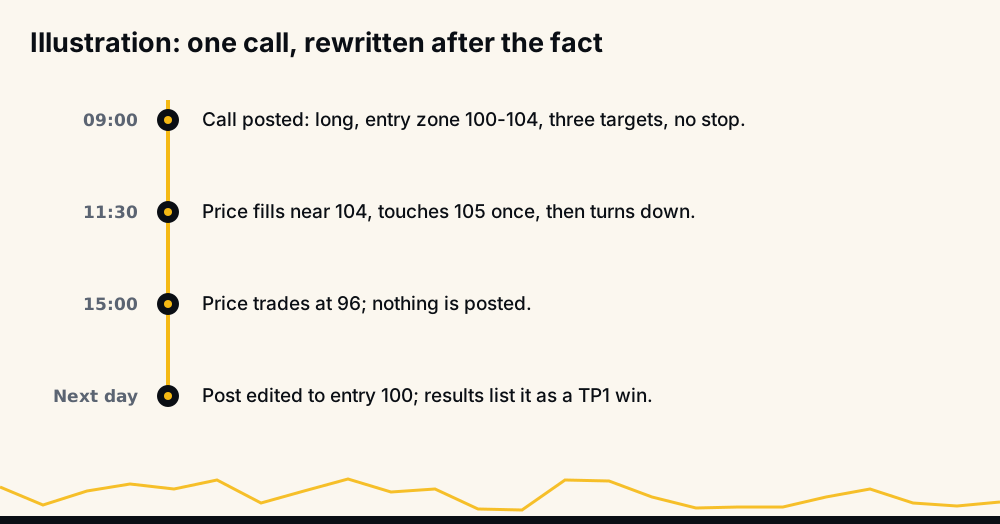
In that invented example, a long posted with an entry zone of 100 to 104 fills near 104, touches its first target at 105 for a move of about 1%, and falls to 96, about 7.7% below the fill. The next day the post reads "entry 100", and the recap counts a 5% TP1 win. The trade a follower actually had never shows up.
What counts as a record instead
A record is evidence because it was fixed before anyone knew the outcome and because it keeps the failures. Four properties separate one from a gallery:
- Timestamped before the outcome. Each call carries the time it was issued, and that time can be checked against the market. A call that cannot be dated before its move is a story.
- Misses included. Losing, expired and unfilled calls stay in the file, so the denominator is honest.
- Downloadable. A file has a row count. Rows can be counted, filtered and compared with the posting frequency; a scroll cannot.
- Recomputable. Entry, exit and times on each row let you recompute the rate yourself, and spot-check rows against exchange price history.
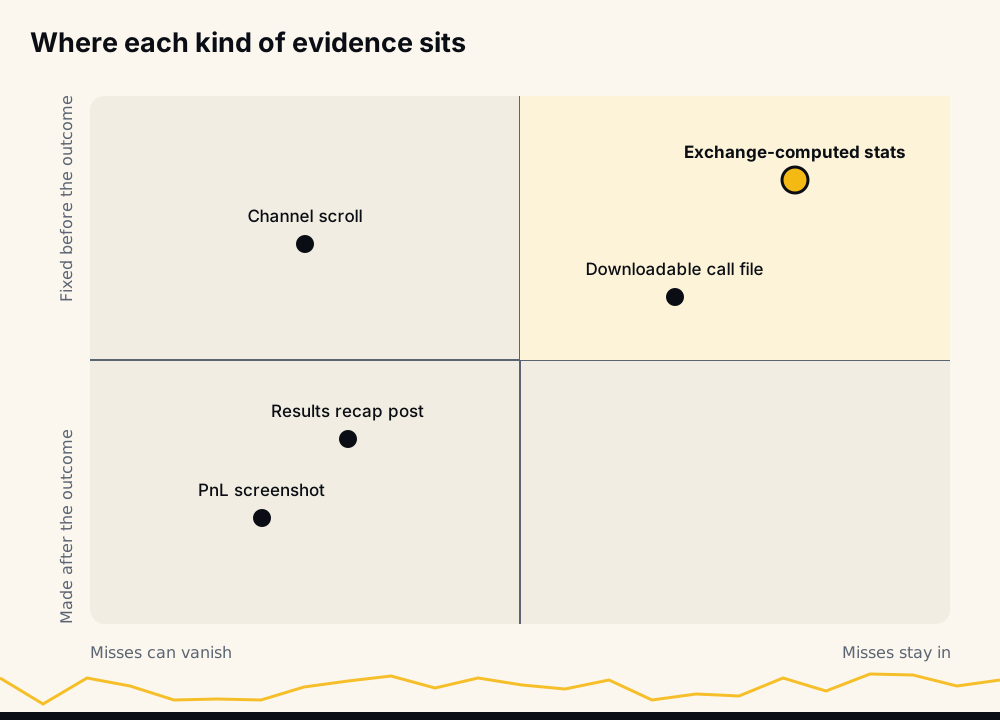
A provider's own file is still self-reported. Stronger evidence comes from somebody who does not sell the signals. Binance's copy trading pages are one example: the lead portfolio indicators FAQ (updated 15 July 2026) defines win rate as "Number of Profitable Closed Positions / Total Number of Positions * 100%", with ROI and PnL updated hourly by Binance from the portfolio itself. Independent trackers that log a channel's calls as they are posted can serve the same role; their value depends on whether they capture calls the moment they appear. Telegram crypto trading bots: legit vs scam applies the same "full history beats screenshots" test to bots.
A step-by-step test of any provider's claims
You can run this in an evening before you pay anyone.
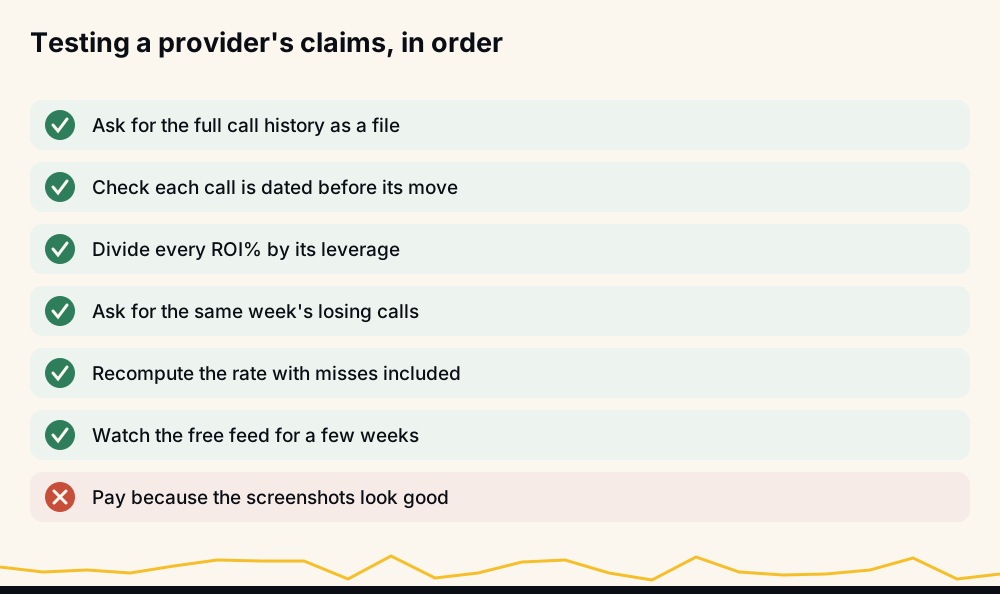
- Ask for the full call history as a file. Not a highlights album, not a results post. If none exists, you have your answer.
- Check each call is dated before its move. Pick ten rows at random and look at the pair's price history around the stated time. The entry must have been reachable after the call, not before it.
- Divide every ROI% by its leverage. Turn the advertising back into price moves. A provider whose cards all run above 50x is selling leverage.
- Ask for the same week's losing calls. A provider with a real record answers in one message. A provider with a gallery changes the subject.
- Recompute the rate with misses included. Wins divided by every resolved call. Compare it with the headline. Then compare the average loss with the average win, as in reason 3.
- Watch the free feed for a few weeks. Write down each call when it appears, with the time. Your own log is a record nobody can edit.
- Price the decision. How much crypto signals cost shows what a subscription has to earn to pay for itself; set that against the rate you recomputed, not the one on the card.
What HafizeBot publishes instead of screenshots
We hold ourselves to the same test. HafizeBot sends AI-generated signals from a model that evaluates 240+ indicators, formulas and components across 523 Binance USDⓈ-M pairs, and the record sits in three places.
- /performance, regenerated hourly from the trade database since June 2026, with columns Wins, Missed and Open. Broadcast signals carry a target and a maximum hold, not a stop. A signal that does not reach its target in time is Missed, and every miss counts against the target-hit rate.
- /reports, 33 monthly spreadsheet reports from June 2021 to February 2024.
- /data, the same archive as one downloadable file of 33,694 signals, with entry and close prices and times on each row, so you can recompute it and spot-check rows against Binance price history.
That is our own record, not an independent audit, and the two sources count differently; our write-up of the three-year archive explains how. Rates from the archive should be quoted only as reported in those spreadsheets.
The cheapest test is to watch. The free channel t.me/getbinancefutures posts the stronger signals (strength 3 and up) 20 minutes after VIP, so you can log calls yourself and compare them with /performance.
Frequently asked questions
Can a Binance PnL screenshot be faked? Yes. Numbers on a web page can be changed before capture, images can be edited or generated, and demo or testnet accounts produce cards that look like live ones. Even a genuine screenshot shows only one position at one moment, so it cannot prove a track record either way.
Is a high ROI% on a futures screenshot proof of a good trade? No. Binance calculates ROI as PnL divided by initial margin, and initial margin shrinks as leverage rises, so ROI% is roughly the price move times leverage. Divide the ROI% by the leverage on the card to see the actual move, which is often only a few percent.
How can I tell if a signal group deletes losing calls? You cannot tell from the channel, because Telegram removes deleted posts for every subscriber. Log the calls yourself as they appear for a few weeks, then compare your log with the channel's history and results posts. Missing calls in their version are your answer.
What is better evidence than a screenshot? A downloadable file in which every call is timestamped before its outcome and misses are included, so you can count the rows and recompute the rate. Stats computed by a third party from the account itself, such as an exchange's copy trading figures, are stronger still because the provider does not produce them.
Are screenshots of other members' profits more reliable? No. Regulators warn that people in a group chat who claim large profits may be part of the scheme, and that altered or AI-generated images are used to make it look as if others have profited. Member screenshots carry every weakness of the provider's own, plus an unknown author.
Before you trust the next screenshot
A screenshot answers the question "did one position look good at one moment?" The question you need answered is "what happened to all the calls?" Only a record answers that one: calls dated before their outcomes, misses kept, in a file you can count.
Start with ours if you like. Read the performance page, misses included, download the archive from /data, or follow the free Telegram channel and keep your own log. If you want every VIP signal instantly with optional autotrading on your own Binance account, there is a 3-day free trial, and plans start at 50 USDT a month with /join in @hafizebot. This is information, not investment advice; trade only what you can afford to lose.