HafizeBot is an AI signal service for Binance USDⓈ-M futures, on Telegram and the website. You get rated signals with entry and target, a public record you can recompute, and autotrading on your own Binance account with a key that never needs withdrawal rights. You do not get spot, other exchanges, card payment, refunds, a stop in the signal, or a published record for March 2024 to May 2026.
We wrote this review ourselves, so read it as a self-assessment. Where a claim can be checked, we link the page that shows it, and each limitation was confirmed against our terms, help center or product rules on 17 October 2026. There is no star rating and there are no testimonials, because neither could be checked.
Who wrote this review, and why that matters
A review from the company being reviewed starts with a conflict of interest. What we can do is change what you are asked to trust: instead of our opinion, the record and the rules, with links.
Two pages already cover narrower questions. Whether HafizeBot is legit deals with fraud: does it exist, can it take your money, what the two records say. The pricing breakdown deals with payment mechanics. This page is the buyer's view: what you actually receive on each plan, what is missing, and who should not pay at all.
A shorter version sits on our reviews page. There are no third-party reviews to show: HafizeBot has no Trustpilot page and no independent audit, and the home page says so.
What HafizeBot is
HafizeBot sends AI-generated trading signals for Binance USDⓈ-M perpetual futures. The signals come from a model that evaluates 240+ indicators, formulas and components; how they are made is not published, and our terms say so. The home page counts 523 Binance USDⓈ-M pairs scanned.
Each signal names a pair, a direction (long or short), an entry, a target and a strength rating. It reaches members through @hafizebot on Telegram and its VIP channel. VIP members can also let the bot place the signals as orders on their own Binance account, within limits they set.
That is the whole product: signals, an optional autotrader, and a public record. Nobody at HafizeBot holds your trading funds; the only money you send us is the plan price.
What you get on each plan
There are four ways in: the free channel and three paid tiers. All three tiers receive identical signals at the same moment. What changes between them is how much the autotrader may put to work and which risk controls you can set.
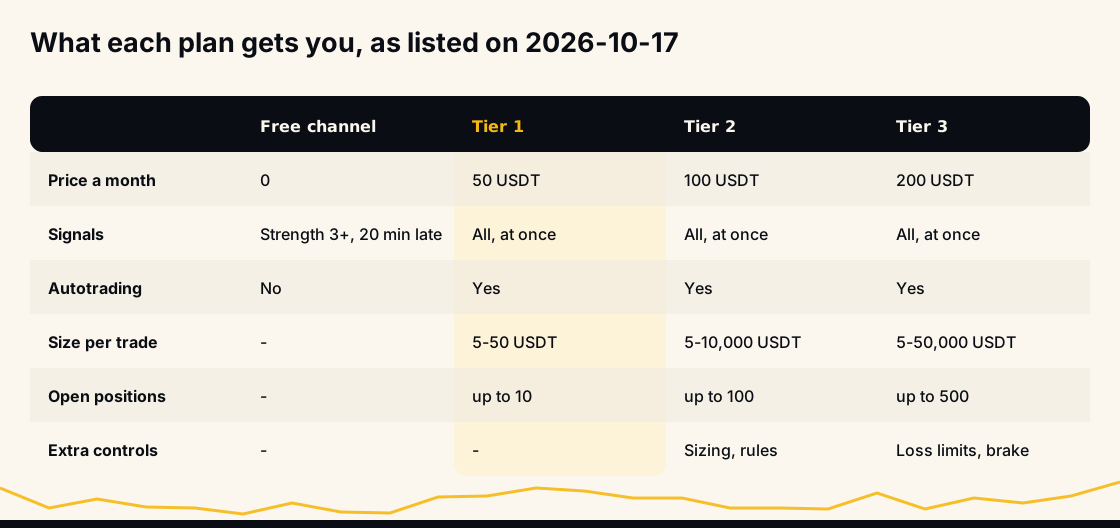
As listed on the plans and prices page on 17 October 2026:
- Tier 1, 50 USDT a month (500 for 12 months): the signals the moment they are sent, autotrading at 5 to 50 USDT per trade and up to 10 open positions, the core strategy controls, and hourly VIP market reports.
- Tier 2, 100 USDT a month (1,000 for 12 months): up to 10,000 USDT per trade and 100 open positions, plus Smart sizing, trade rules, take-profit distance, a filter for signal types and bans on whole Binance groups such as TradFi or Meme.
- Tier 3, 200 USDT a month (2,000 for 12 months): up to 50,000 USDT per trade and 500 open positions, plus daily and weekly loss limits, a drawdown brake and sizing that follows your wallet, with priority support.
The plans page adds a sentence worth repeating: the Tier 3 settings are optional risk tools with trade-offs, and none of them makes the signals more profitable. Pick a tier by the size you intend to trade, and leave hope out of it.
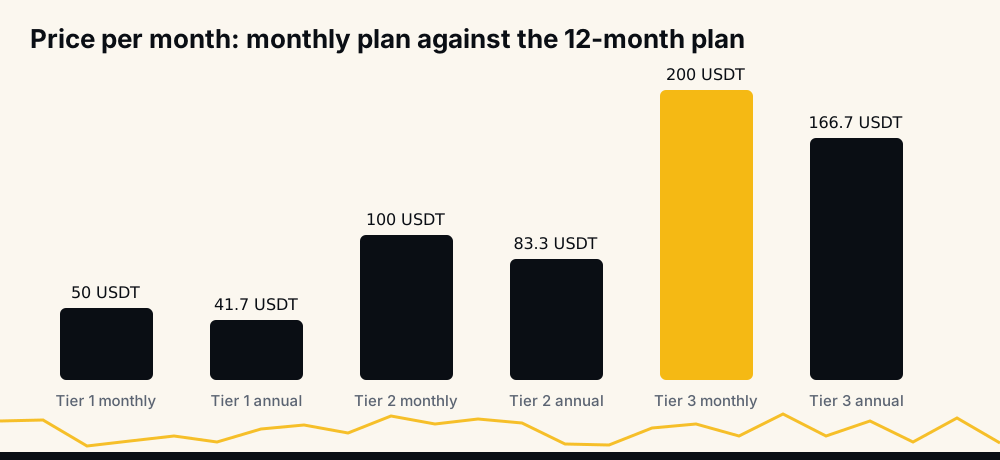
The 12-month plans cost ten times the monthly price: twelve months for the price of ten. That only helps if you stay a year, so a month first is the cautious order.
The record you can check yourself
This is the part of HafizeBot we would point a sceptic at first, because it does not depend on our word.
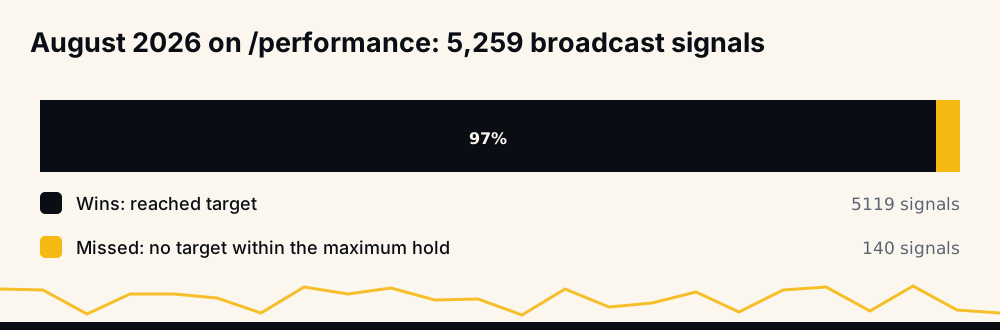
The live record. Since June 2026, the performance page is regenerated hourly from the table the bot writes when it sends a signal. It sorts broadcast signals into three columns: Wins, Missed and Open. A missed signal is one that did not reach its target within the maximum hold, and it counts against the target-hit rate. In August 2026 that rate was 97.3% across 5,259 signals, with 140 missed counted against it.
The archive. Between June 2021 and February 2024 we published 33 monthly reports, listing 33,694 signals. They are downloadable as spreadsheets at /reports and as one file at /data. Any rate quoted from them is as reported in those spreadsheets, under their own counting rule, which is weaker than the live one: a row still open when its month was cut is not scored as missed.
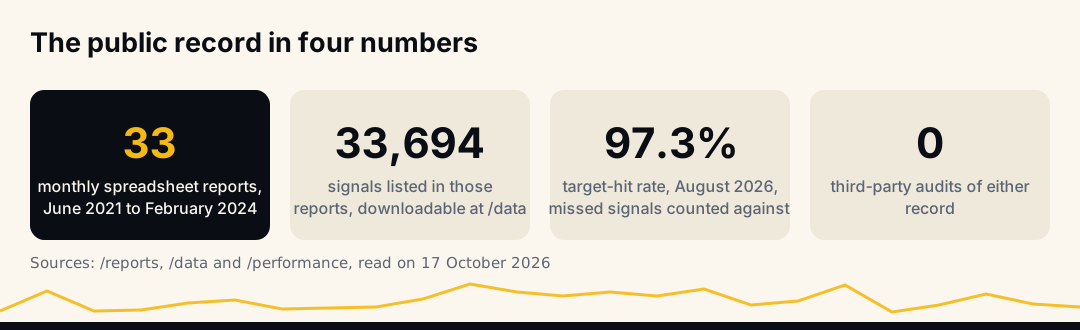
A target-hit rate is not account profit, and the performance page says so; more on that below.
The gap in the record: March 2024 to May 2026
The archive ends with the February 2024 report. The live page starts in June 2026. Nothing in between is published: no spreadsheets, no live table, no monthly figure. The home page states that reports stopped in February 2024, and the performance page states that its history starts in June 2026.
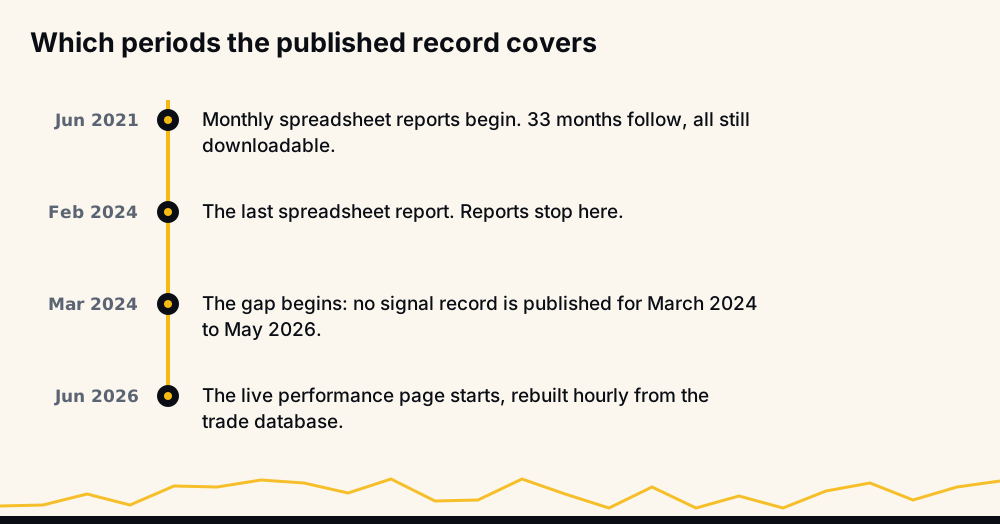
We will not fill that gap with a figure from memory, because a number with no rows behind it is what we tell readers not to trust. What it means for you: the public record is two separate stretches, and the live one is young. A few months shows whether a service publishes faithfully; it does not characterise a strategy across market regimes. If that bothers you, watch more live months before paying.
The free channel, and what it leaves out
The free channel at t.me/getbinancefutures costs nothing and needs no sign-up. It carries the stronger signals, strength 3 and up, 20 minutes after VIP. VIP gets the full signal stream the moment each one is sent, plus optional autotrading.
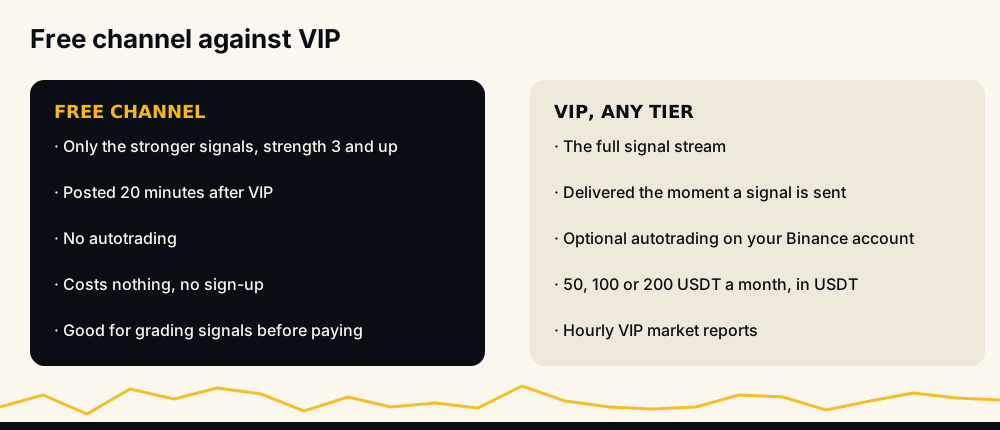
The 20-minute delay is fixed. In the 2021 to 2024 archive, across all signals, a quarter of those that reached their target did so within about twelve minutes, so some free-channel posts arrive after the move is over. Our help page on what the free channel's delay costs has the numbers.
The free channel is still the best way to judge us before paying. Log two weeks of its posts, grade them yourself against Binance's chart, and compare your tally with the performance page.
Autotrading and the safety of your key
Autotrading is optional and runs only on Binance USDⓈ-M futures. You create a Binance API key with futures trading enabled and withdrawals off, and add it on the website. Your funds stay on your own Binance account the whole time.
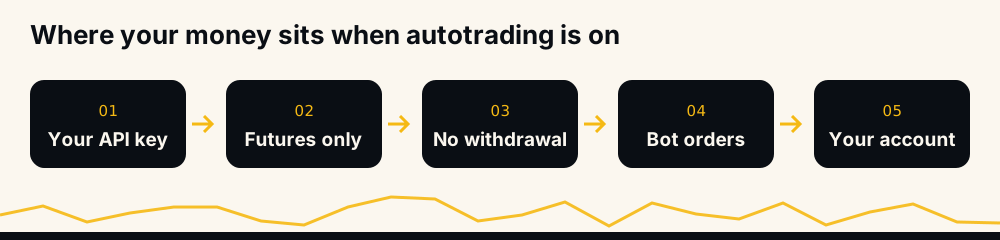
What the bot will and will not do, as our help page on withdrawals states:
- It never withdraws or transfers money, and never needs withdrawal permission. A key that allows withdrawals is accepted with a warning, so turn that permission off yourself.
- Keys are stored encrypted and are never displayed back. Deleting the key on Binance locks the bot out at once.
- You set your own leverage, position size, maximum open positions and stop-loss. The bot asks you to lower a stop that sits beyond what your leverage allows before liquidation; the line is 70% of the liquidation distance.
- Your Binance futures account must be in One-way mode. Hedge mode makes Binance refuse the bot's orders, as our one-way mode help page explains.
The general rules for any bot key are in how to connect a trading bot to Binance safely, and the trade-offs between position modes in hedge mode vs one-way mode on Binance.
What you don't get: the limitations
Each item below was checked against a source on 17 October 2026, named in brackets so you can re-check it.
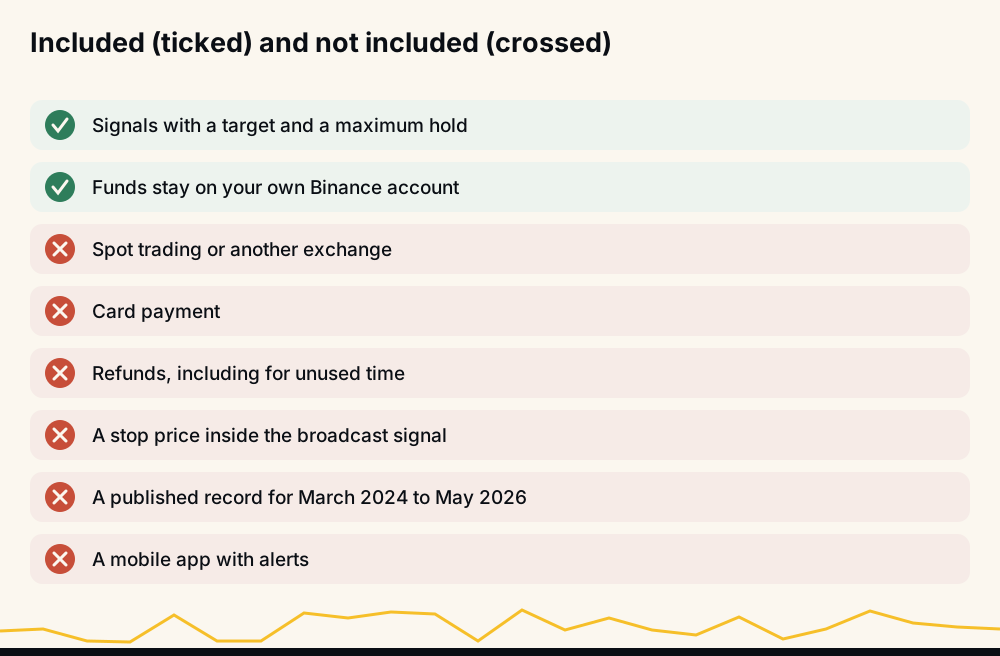
No spot, no other exchange
Binance USDⓈ-M futures only. No spot, no COIN-M, no Bybit or OKX (terms, reviews page). Where Binance futures are not open to you, autotrading is not either; see can I use HafizeBot in my country.
USDT only, and no refunds
Plans are paid in advance in USDT; there is no card and no payment processor. Nothing renews unless you switch on /subscribe. The terms are blunt about refunds: plans, renewals and balance top-ups are not refundable, in whole or in part, including for unused time, and the balance is not paid out (terms). If a payment did not reach your balance, the terms say to send the transaction ID to the admin account to have it checked.
The signal carries no stop
Broadcast signals carry a target and a maximum hold, not a stop (performance page). If you trade by hand, choosing a stop is your job. If you autotrade, it is your stop-loss setting that protects the position, and a position with no stop can be liquidated; why you can be liquidated before your stop covers the arithmetic.
A missed signal does not close your trade
When a signal misses, the performance page counts it against the rate, but the position on your account is not closed at that point and can still reach its target later (performance page). It can also keep losing. What to do then is in what happens when a crypto signal expires.
The trial is deliberately small
The 3-day free trial of Tier 1 includes autotrading capped at 10 USDT of margin per entry and 3 open positions. It is one per email address, Telegram account and Binance account, and not for past VIP members (trial page).
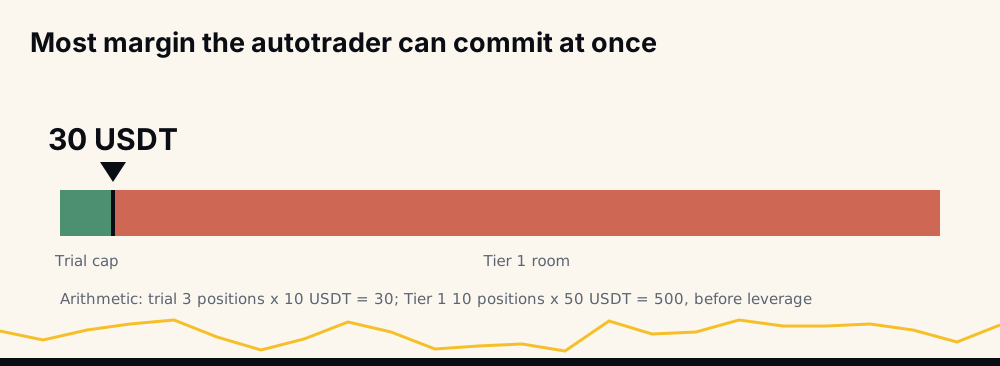
At 3 × 10 USDT, the trial can commit at most 30 USDT of margin at once, against 500 USDT at Tier 1's ceiling. Good for seeing the mechanics; too small to tell you what a full account would have done.
Telegram first, and no mobile app
Telegram is the main channel. The website works without Telegram: you can sign up with an email code and pay, get signals and autotrade there (home page, sign-in page). But there is no mobile app, and the website's signals page shows each signal while it is open without sending alerts (reviews page).
Other limits worth knowing
- Outages happen. Signals and orders can be delayed or missed when exchanges, networks or Telegram have problems (terms).
- Market entries. The autotrader uses market orders to catch a signal fast, so small slippage against the signal price is normal (pricing breakdown).
- When VIP ends, positions stay. Auto-trading stops opening trades; open positions and their take-profit and stop stay until they fill or you close them (terms).
- No downgrade mid-plan. A lower tier cannot be bought while a higher plan runs (terms).
- No recipe. The model is proprietary and its workings are not disclosed (terms). You judge it by the record; there is no explanation to judge it by.
Why your account will not match the record
Even if the published rate holds, your result will differ. The performance page shows unleveraged moves from the published entry. Your account adds the entry you actually got, Binance's trading fees and funding, your leverage, your stop and the signals your filters skipped.
Most of those gaps cut against you, and leverage multiplies what is left in both directions, which is why we never turn a target-hit rate into a monthly return. The seven gaps are laid out in why your results differ from the signal provider's. Screenshots of winning trades prove nothing for the same reason: they show the result without the denominator.
Who HafizeBot is for, and who it is not for
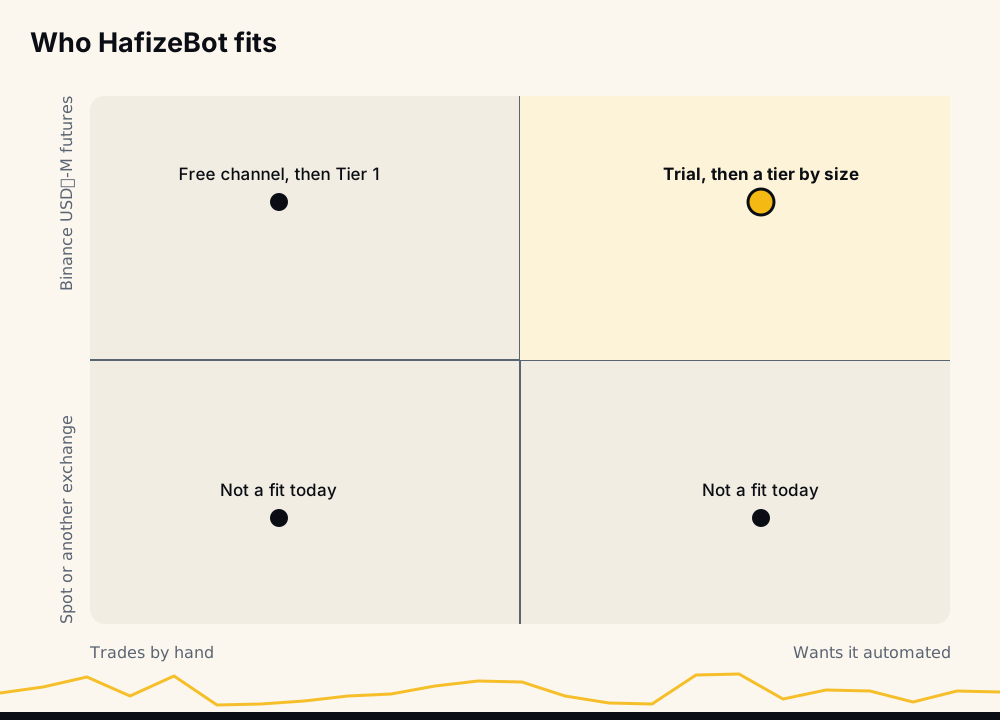
It fits you if:
- you already trade Binance USDⓈ-M futures, or are ready to open that account and learn how it liquidates;
- you want signals you can verify against a public record before and after paying;
- you want automation but insist that the funds stay on your own exchange account;
- you are comfortable paying in USDT and setting your own stop, leverage and size.
It does not fit you if:
- you trade spot only, or on an exchange other than Binance;
- you need card payment or a refund window;
- you want someone else to choose your risk, or a promised monthly return;
- you cannot afford to lose the margin you would put in.
How to test it before you pay
- Read the performance page and the definitions under its table. Check that Missed sits in the denominator.
- Download one archived month from /reports and count its rows yourself.
- Join the free channel and grade two weeks of posts.
- Start the 3-day trial with
/trialin @hafizebot, with a futures-only key and the smallest size. - Only then pick a tier, by the size you intend to trade.
If you are still comparing providers, how much crypto signals cost puts our prices next to the market's, and HafizeBot vs Cornix, 3Commas and other signal bots compares what each kind of service actually does.
Frequently asked questions
Is HafizeBot worth paying for? It depends on whether you trade Binance USDⓈ-M futures and whether the public record convinces you after you have checked it yourself. Use the free channel and the 3-day trial first. Pay only when the live record and your own tally agree, and only at the size you can afford to lose.
Does HafizeBot have independent reviews? No. There is no Trustpilot page and no third-party audit, and we do not publish anonymous testimonials. What exists instead is the raw record: an hourly performance page since June 2026 and 33 downloadable monthly spreadsheets for June 2021 to February 2024.
Can I get a refund?
No. Our terms say plans, renewals and balance top-ups are not refundable, including for unused time, and the balance is not paid out. Nothing renews unless you switch on /subscribe, so the main protection is to start with the free trial and a single month.
Does HafizeBot work with spot or with exchanges other than Binance? No. Signals and autotrading cover Binance USDⓈ-M futures only. Spot, COIN-M futures and other exchanges are not supported.
Why is there no record for March 2024 to May 2026? Because nothing was published for those months: the spreadsheet reports stopped after February 2024, and the live performance page starts in June 2026. We do not quote a figure for the gap, and you should not trust anyone who does without rows behind it.
Do I need Telegram to use HafizeBot? No, although Telegram is the main channel. You can sign up on the website with an email code, pay, see signals and run autotrading there; the website sends no alerts and there is no mobile app.
The short verdict
HafizeBot is a narrow product: AI signals and an optional autotrader for one market on one exchange, paid in USDT, with a public record you can recompute and a gap in that record we will not paper over. If that matches how you trade, the cheapest way to find out whether it works for you is free: the free channel, the performance page and the trial in @hafizebot.
None of this is investment advice. Futures trading carries a high risk of loss, past results do not guarantee future ones, and you should trade only what you can afford to lose.