Yes, Binance has its own trading bots: futures grid, futures DCA, TWAP, VP and arbitrage, plus spot grid, spot DCA and rebalancing. They cost nothing beyond normal trading and funding fees, and they repeat rules you set: you pick the coin, the range and the direction. A signal autotrader is different in one way that matters most: someone else decides the trade, and the software places it on your account through an API key.
What trading bots does Binance have?
Binance lists its bots on the Trading Bots landing page FAQ (updated 30 January 2026). As of 17 October 2026 the list reads:
- Spot Grid and Futures Grid: buy and sell orders spread across a price range you choose.
- Spot DCA and Futures DCA: Binance describes Spot DCA as placing more orders as price moves, to improve the average price; Futures DCA appears in the same list and fee rules.
- Rebalancing Bot: keeps a portfolio at a target mix of assets.
- Arbitrage Bot: funding-rate arbitrage, which Binance Academy says typically pairs a futures position with a spot position.
- Spot TWAP, Futures TWAP and Futures VP: execution tools that split a large order over time or in line with traded volume.
The Binance Trading Bots terms (updated 4 January 2026) group them the same way and add one sentence worth reading twice: "Binance makes no representation or warranty as to the outcome of the use of any Trading Bot."
For a futures trader the ones that matter are Futures Grid, Futures DCA, Futures TWAP and VP.
Who decides the trade: the real difference
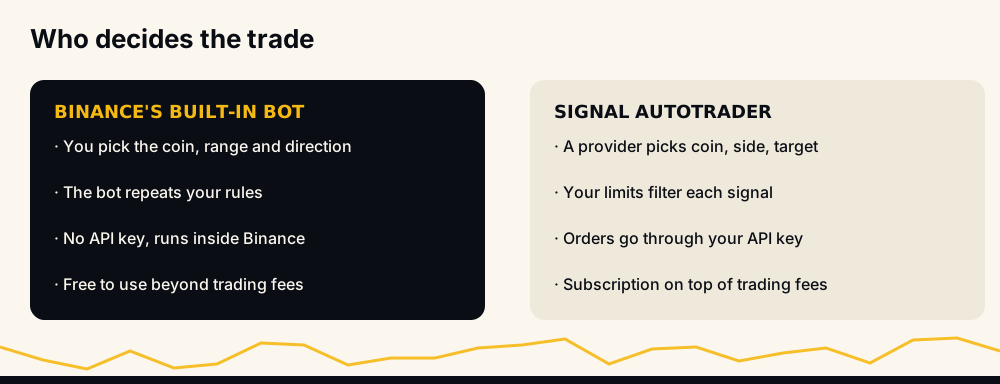
A Binance bot has no opinion. A futures grid trades the band you drew, in the direction you chose, at the leverage you set. A TWAP order executes a buy or a sell you already decided on. Binance's own TWAP FAQ has you choose Buy/Long or Sell/Short before anything happens. The bot automates the clicking. The thinking stays with you.
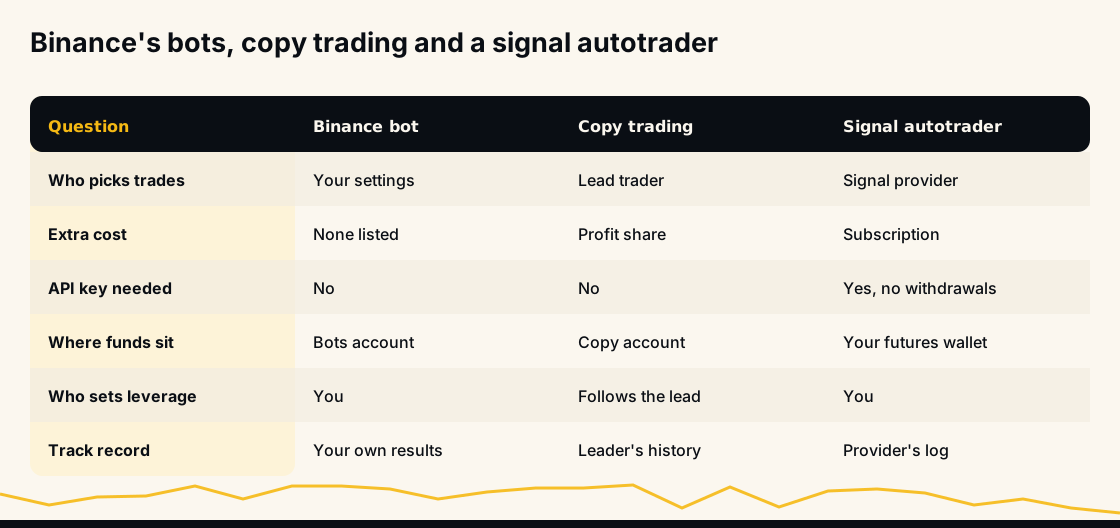
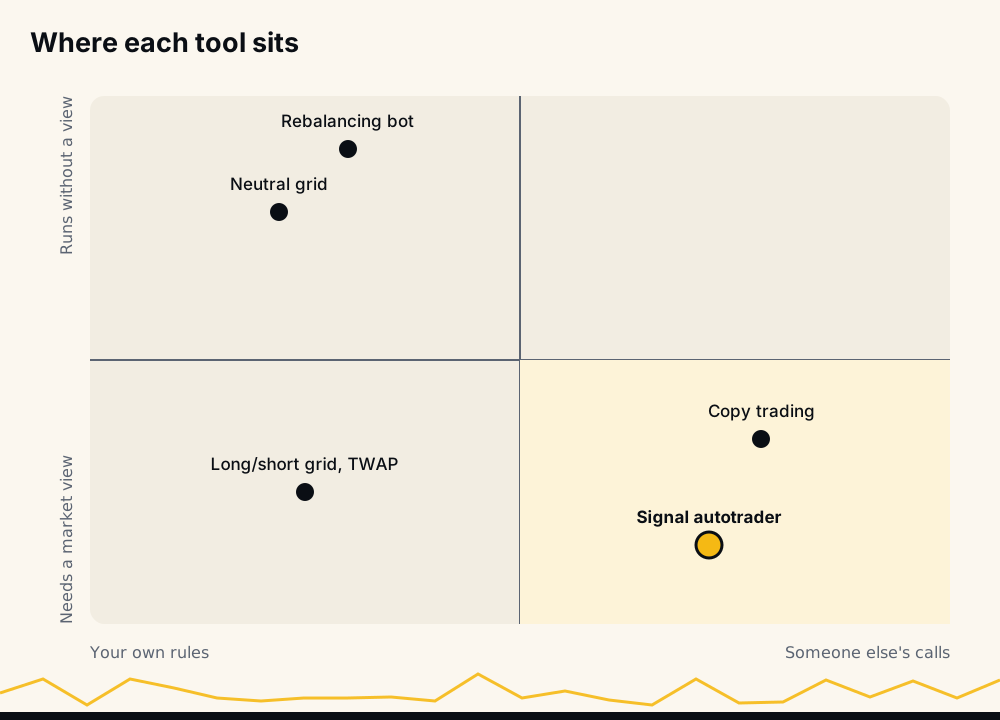
A signal autotrader inverts that. A provider decides which coin, which side and which target, and the autotrader turns each call into an order on your account, inside limits you set. Copy trading on Binance sits between the two: a lead trader decides, and your copy portfolio mirrors them.
So the real comparison is your own strategy, automated against someone else's strategy, automated, and it turns on whether you have a strategy worth automating.
How a Binance futures grid bot works
Binance's Futures Grid FAQ (updated 12 October 2026) defines it as "a trading bot that automates the buying and selling of Futures contracts" across a range. You set:
- The range, an upper and a lower price.
- The number of grids, which splits that range into levels.
- The direction: long, short or neutral. The long/short grid FAQ explains that a neutral grid "does not initially open positions"; a long or short grid can open an initial position in its direction.
- Leverage and margin mode, cross or isolated.
- Optionally, a stop-loss and a take-profit for the whole grid, by price, PnL or ROI.
Each time price crosses a level, the grid buys or sells, and the gap between two levels is its profit per grid. "If the highest or the lowest grid is exceeded, no more positions will be opened." The grid stops on its own when you end it, when a take-profit or stop-loss triggers, or when "Insufficient margin causes some positions to be liquidated or fail to place orders".
Two setup details trip people up. The Trading Bots Account FAQ (updated 8 January 2026) says futures grids run in One-way mode only ("Hedge mode is not supported"), and that grid funds sit in a separate Trading Bots Account: "You cannot manually transfer assets between your Spot or Futures Accounts and the Trading Bots Account."
When a grid bot wins, and when it loses
Binance is direct about the conditions: futures grid trading "performs best in volatile and sideways markets when prices fluctuate in a given range." That sentence is the whole case for a grid, and its limit.
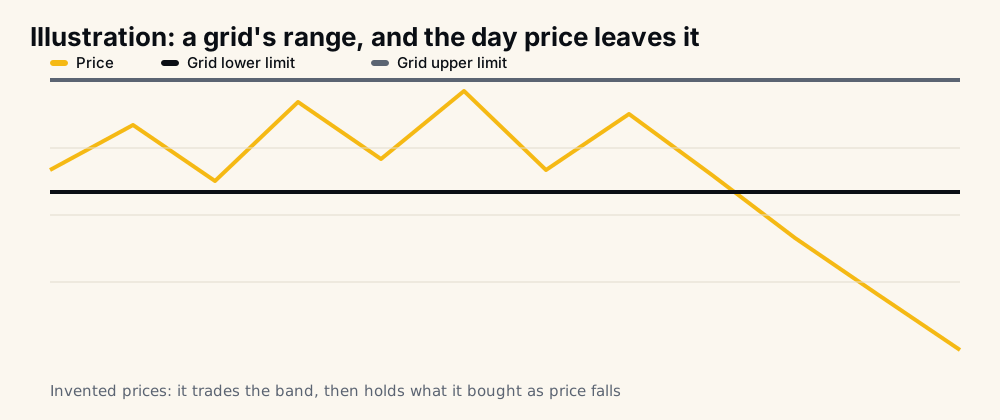
Inside the band, a grid harvests every swing. When price trends out of the band, the same FAQ warns, "if the market goes in the opposite direction, you can also potentially include more losses", and "all of your margin balance could be liquidated in the event of extreme price movement."
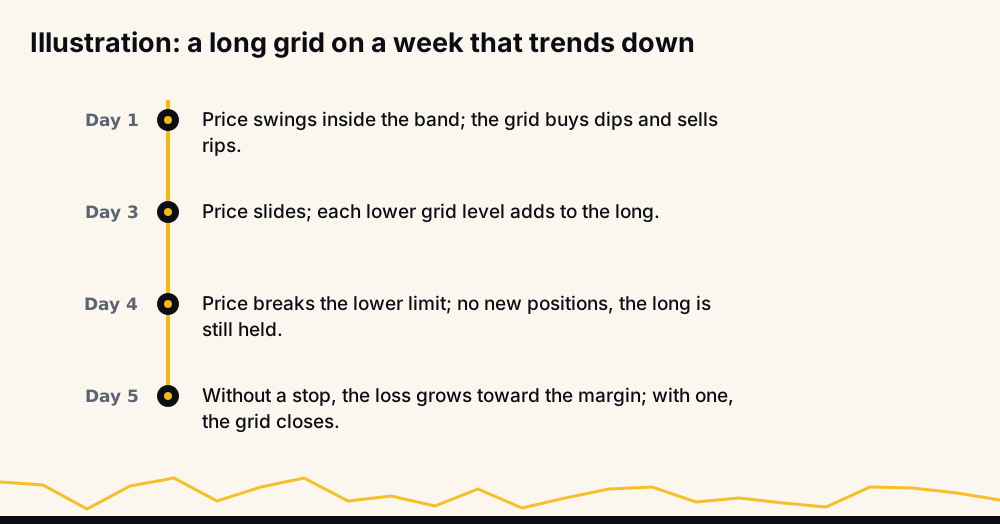
The grid did what it was told: it bought each dip, stopped opening positions below the lower limit, and kept everything it had bought. Without a grid stop-loss, the open loss grows toward the margin. Many small gains in a range, one large loss in a trend.
DCA, spot or futures, carries a sharper version of the same risk. Buying more as price falls lowers your average entry, and it also grows a losing position. On futures, with leverage, that is the fastest route to the problem described in liquidated before your stop-loss.
TWAP and VP: execution tools, not trade ideas
TWAP and VP solve a different problem: filling a large order without moving the price against yourself. Binance's TWAP FAQ (updated 30 January 2026) says a TWAP strategy splits a large order into smaller pieces at regular intervals, with a duration of "5 minutes" to "24 hours" and a minimum size of "the equivalent notional amount of 1,000 USD." Binance says it is favoured "when the order is larger than the order book's available liquidity."
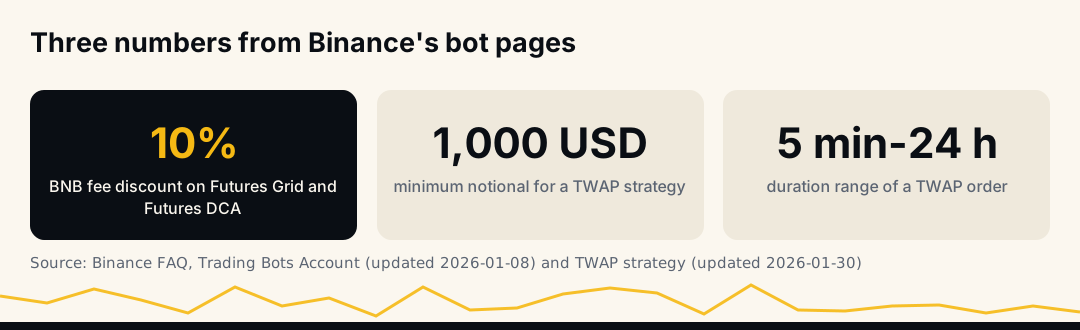
For positions of a few hundred USDT, TWAP is below the minimum. Neither tool tells you what to trade.
How a signal autotrader works
A signal autotrader adds what Binance's bots lack: a source of trade ideas, executed on your own account.
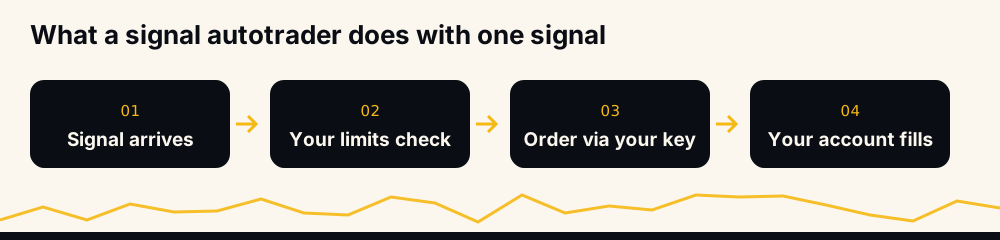
- A signal arrives from the provider: the coin, the side and a target.
- Your limits check it: if the signal breaks a rule you set (size, leverage, how many positions may be open), it is skipped.
- The order goes out through a Binance API key you created, with trading permission and withdrawals off.
- The position sits on your own account, in your futures wallet, where you can see it in the Binance app and close it by hand.
Some tools only execute a channel you already follow; those are compared in Cornix alternatives for Binance Futures. The API key is where the due diligence sits; see connecting a trading bot to Binance safely.
Copy trading: the option Binance builds in
Binance also runs futures copy trading, the closest built-in relative of a signal autotrader. A lead trader trades; your copy portfolio follows. The copy trading FAQ (updated 16 July 2026) says "Lead traders can receive up to 30% profit share from their copy traders", and it lists a leverage different from the lead trader's as a reason a copy order fails.
So copy trading takes no API key and no subscription, but you pay out of profit and you inherit the leader's leverage. We compared the two models in detail in copy trading vs crypto signals.
Are Binance trading bots free? What each option costs
Binance's bots carry no fee for the bot itself. The Trading Bots Account FAQ says grid trading follows the normal fee rates: "Futures Grid follows the Futures market trading fees and funding fees." Paying with BNB gives "a 10% discount for Futures bots (USDⓈ-M Futures Grid and Futures DCA)." The Spot DCA FAQ says it outright for its bot: "There are no additional fees."
That is a real advantage any paid tool has to earn its price against. Still, a grid pays a fee on every fill, and the more grids you set, the smaller each grid's profit; Binance warns you when profit per grid falls below the maker fee.
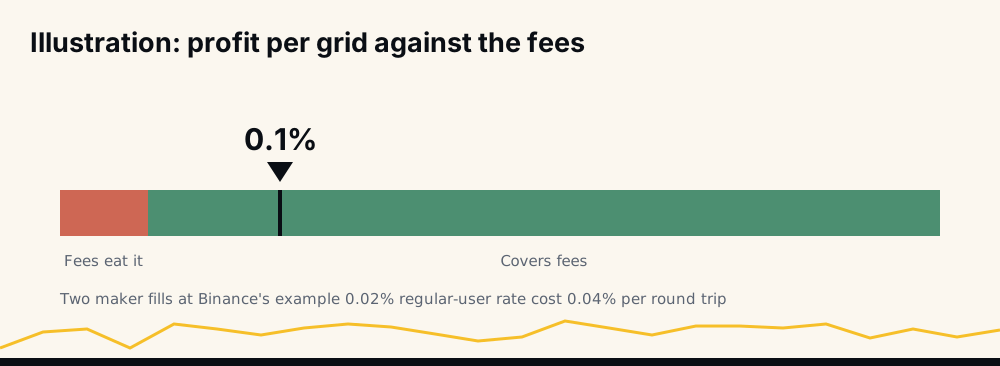
Binance's fee structure FAQ (updated 1 May 2026) uses 0.02% maker and 0.05% taker as its example regular-user rates, charged on the position's notional value, not your margin. With those, the month below is arithmetic you can redo:
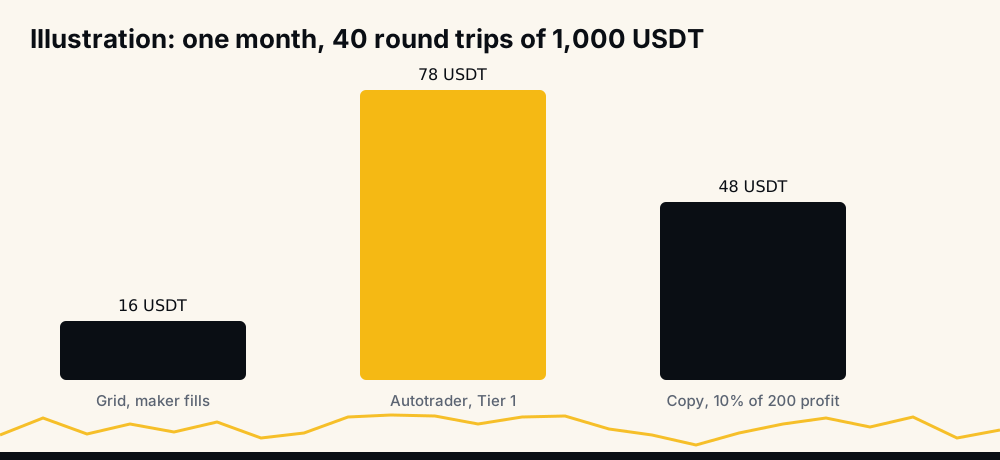
- Grid with maker fills: 40 × 1,000 × 0.04% = 16 USDT.
- Signal autotrader: assuming a taker entry and a maker exit, 40 × 1,000 × 0.07% = 28 USDT, plus a 50 USDT subscription = 78 USDT.
- Copy trading: the same 28 USDT of fees plus a 10% profit share on an illustrative 200 USDT profit = 48 USDT. In a losing month the share is zero.
Funding is left out; it applies to any futures position alike. The full fee picture is in Binance futures fees explained, and the subscription side in how much a crypto trading bot costs and how much crypto signals cost.
Control and transparency
A Binance bot is transparent because you are the strategy. With a signal provider the method is theirs, so the published record is what you can check: all of the signals, including the ones that missed, rather than a screenshot gallery. Our checklist for that is in how to verify a crypto signal win rate.
API key security: the cost of outside software
Binance's bots run inside your account, so there is no key to leak, a genuine point in their favour. An outside autotrader needs a key, and its permissions decide the worst case.
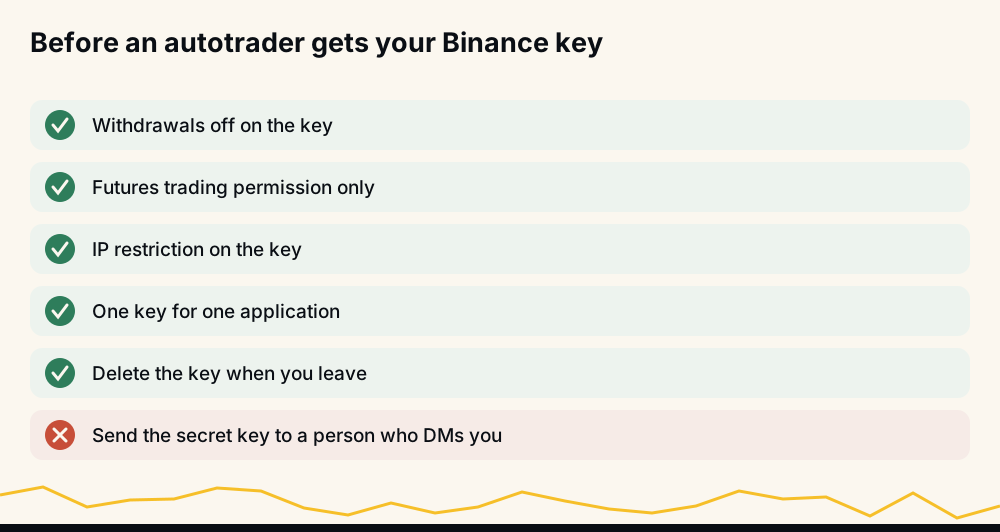
Binance's API key FAQ (updated 20 March 2025) adds two guard rails of its own. "Adding IP access (IPv4 format) restrictions is mandatory to enable withdrawal permission", and since January 2023 a system-generated key without an IP restriction can only be set to reading. A trading key with withdrawals off can still place bad trades, but it cannot move your money off Binance.
Anyone who asks for withdrawal permission to "trade" is a reason to walk away; see a Telegram trading bot that won't let you withdraw.
What can go wrong with each
Binance futures grid: the range breaks and the grid holds a losing position; too many grids and fees eat the profit; high leverage with no grid stop-loss and the margin is liquidated. All three are in Binance's own FAQ.
DCA on futures: it adds to a loser by design. It works while price comes back, and costs the most when it does not.
Copy trading: the leader's behaviour changes, their leverage becomes yours, and the profit share applies only in your good months.
Signal autotrader: poor signals, or poor settings: leverage too high, a stop beyond your liquidation price, too many open positions. A wrong position mode or a key without futures permission makes orders fail. Stopping the software leaves its positions open; what happens to open positions if the bot stops explains which exits keep working.
Which one fits you: a decision table
| If you... | Consider | Why |
|---|---|---|
| expect a coin to stay in a range | Binance futures grid | Built for "volatile and sideways markets" |
| already know what to buy and only need to fill a large order | Futures TWAP or VP | Execution only; TWAP starts at 1,000 USD notional |
| want zero tool cost and will set every parameter | Any Binance bot | No fee beyond trading and funding |
| have no strategy and want someone else's calls, paid only from profit | Binance copy trading | Profit share up to 30%, the leader's leverage |
| want someone else's calls with your own leverage, size and stop | A signal autotrader | Subscription, API key, your own limits |
| cannot watch a position through a trend | None of the leveraged options | All of them can lose in a trend |
You can run more than one: Binance keeps grid funds in the separate Trading Bots Account, while an autotrader trades your futures wallet. Use different coins for each.
Where HafizeBot fits, as one example
HafizeBot is a signal autotrader for Binance USDⓈ-M Futures, so it belongs in the last group. The signals are AI-generated by a model that evaluates 240+ indicators, formulas and components, across the 523 USDⓈ-M pairs the home page lists as scanned.
- Your account, your money. The key needs futures trading only; use a key with withdrawals off. HafizeBot never withdraws or transfers, and funds stay on your own Binance account.
- Your limits. Members set their own leverage, size, maximum open positions and stop-loss. If a stop sits beyond what the chosen leverage allows before liquidation, the bot asks the member to lower it.
- One-way mode, the same requirement as Binance's futures grid.
- Cost. VIP Tier 1, 2 or 3 is 50, 100 or 200 USDT a month, or 500, 1,000 or 2,000 USDT for 12 months, paid in USDT with nothing renewing unless you switch on /subscribe. Signals reach all three tiers at the same moment; tiers differ in autotrading limits and controls, set out on plans and prices.
- The record. /performance is regenerated hourly from the trade database, with every missed signal counted against the target-hit rate. The archive at /reports and /data holds 33 monthly reports with 33,694 signals from June 2021 to February 2024.
That is a bill Binance's grid does not have; whether it is worth paying depends on the record.
FAQ
Does Binance have trading bots? Yes. Binance lists grid, DCA, rebalancing, arbitrage, TWAP and VP bots for spot and futures. You set every parameter yourself, and the bot repeats your rules.
Is the Binance trading bot free? The bot itself has no fee. Bot trades pay the normal spot or futures trading fees, and futures bots also pay or receive funding. Paying fees with BNB gives a 10% discount on Futures Grid and Futures DCA fees, per Binance's Trading Bots Account FAQ.
Are Binance trading bots profitable? They can be in the conditions they are built for, and lose outside them. Binance says futures grids perform best in sideways markets and makes "no representation or warranty as to the outcome". Profit depends on your range, leverage and stop.
Is a trading bot on Binance safe? Binance's built-in bots need no API key, which removes one risk entirely. The trading risk remains: a leveraged futures grid can be liquidated in an extreme move. For an outside autotrader, use a key with withdrawals off and an IP restriction.
Is a signal autotrader better than a Binance grid bot? They do different jobs. A grid automates your own range strategy at no tool cost; a signal autotrader automates someone else's signals for a subscription, worth paying only if the provider's full published record holds up.
Can I use a Binance grid bot and an autotrader at the same time? Yes. Binance keeps grid funds in the separate Trading Bots Account, and an autotrader trades your futures wallet. Binance's futures grid needs One-way mode, as does HafizeBot's autotrader, and keeping them on different coins keeps your positions easy to tell apart.
Before you choose
If you have a range you trust, Binance's own grid is free beyond fees and is the honest place to start. If you want trade ideas you do not have to make yourself, look at the record first: /performance counts every missed signal, and the free channel at t.me/getbinancefutures posts the stronger signals (strength 3 and up) 20 minutes after VIP. A 3-day free trial of Tier 1, with autotrading capped at 10 USDT of margin per entry and 3 open positions, is /trial in @hafizebot; /join opens the plans. This is not investment advice; trade only what you can afford to lose.