The leverage to use on crypto signals is the one that keeps your stop-loss well inside the liquidation price, because leverage by itself does not decide what a trade can lose. Your risk per trade and your stop distance set the position size, and the size times the stop is the loss. Leverage only sets how much margin that position locks up and how far price can move before Binance liquidates it.
So the useful question is not "3x or 10x?" but "which leverage leaves my stop room to fire, and how many positions can my balance carry?" Below is the arithmetic in the order you would do it, then two worked accounts. None of it recommends a particular leverage; it is maths you can redo with your own numbers.
Leverage does not set your risk: size and stop do
Take a 1,000 USDT position on Binance USDⓈ-M Futures with a stop 5% below entry. If the stop fills, you lose about 50 USDT plus fees, at 2x, 5x or 10x alike. Only the margin behind it changes: 500 USDT at 2x, 200 at 5x, 100 at 10x.
Our position size calculator puts it in one line: "Leverage changes the margin needed, not the risk: the risk is set by the size and the stop." Binance's own FAQ on leverage and margin (updated 2026-03-27) says the same from the other side: "the Initial Margin is determined by the leverage you select."
There is one important exception, covered below: if you size by margin rather than by risk, raising leverage does raise what each trade can lose.
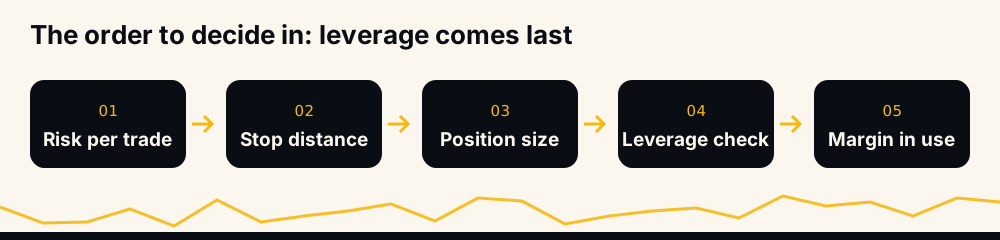
Step 1: decide the risk per trade
Risk per trade is the share of your account you accept losing if the stop fills. Many traders keep it around 1% to 2% so that a losing run does not finish the account; the arithmetic works for any figure. On a 500 USDT account, 1% is 5 USDT. On 5,000 USDT, it is 50.
Fix this number first: it is the only one that describes your loss directly. How much money you need to start crypto futures explains why the risk share, not the deposit, decides how long an account survives.
Step 2: size the position from the stop distance
Once the risk is fixed, the position size follows from where the stop sits:
Position size (USDT) = risk amount ÷ stop distance
A 5 USDT risk with a 4% stop gives a 125 USDT position. The same 5 USDT with a 2% stop allows 250 USDT; with an 8% stop, only 62.50 USDT. If you enter later than a signal's posted price, your distance to your own stop changes, and so does the size that keeps the loss at 5 USDT.
The position size calculator does this for any coin, rounded to Binance's order step, fees included. Where to put the stop in the first place is its own subject: how to set a stop-loss in crypto.
Step 3: what leverage changes, margin and liquidation distance
Only now does leverage enter. It does two things.
- Margin = position size ÷ leverage. The 125 USDT position needs 62.50 USDT of margin at 2x, 25 at 5x and 12.50 at 10x.
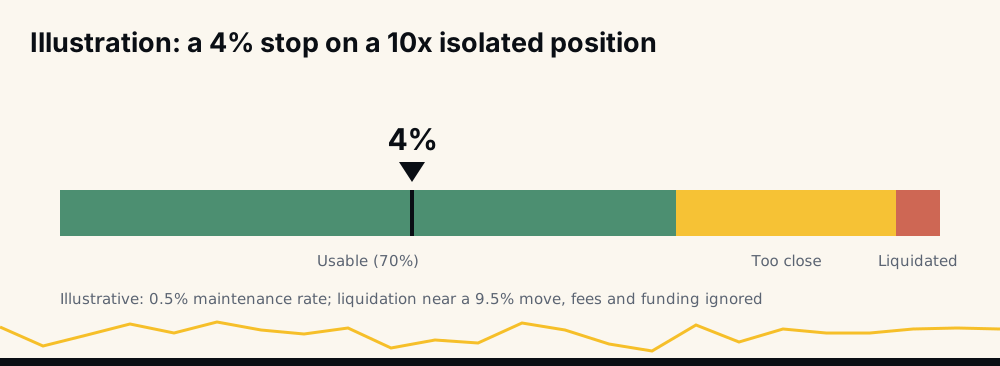
- It sets the liquidation distance. On isolated margin a position loses its whole margin on a move of about 100% ÷ leverage. Binance liquidates a little earlier, because the position must keep its maintenance margin, which the liquidation price FAQ (updated 2025-12-31) defines as "Position Notional * Maintenance Margin Rate", less a maintenance amount, on your position's tier.
So the move to liquidation is roughly 100% ÷ leverage, minus the maintenance rate. The rate grows with size: "The larger the position, the higher the Maintenance Margin rate," says the leverage and margin FAQ. At an illustrative 0.5% rate, 2x liquidates after about 49.7%, 5x after about 19.6%, 10x after about 9.5% and 20x after about 4.5%. Binance's liquidation protocols (updated 2026-01-04) add that liquidation "will always be triggered when a position's Mark Price reaches its liquidation price." Why your liquidation price changes explains what moves that level after you open.
The liquidation calculator uses each coin's real Binance brackets instead of the illustrative rate.
Keep the stop well inside liquidation
A stop beyond the liquidation price never fires. A stop just inside it fires only in a calm market: a fast move, a gap between last and mark price, or a stop-limit that does not fill can let liquidation arrive first. Liquidated before your stop loss lists the eight ways that happens.
A working rule of thumb is to give the stop a clear share of the liquidation distance rather than all of it. HafizeBot's autotrader uses 70%, the rule already explained in Binance futures leverage limits. Applied to leverage alone, that gives the widest stop each level can carry:
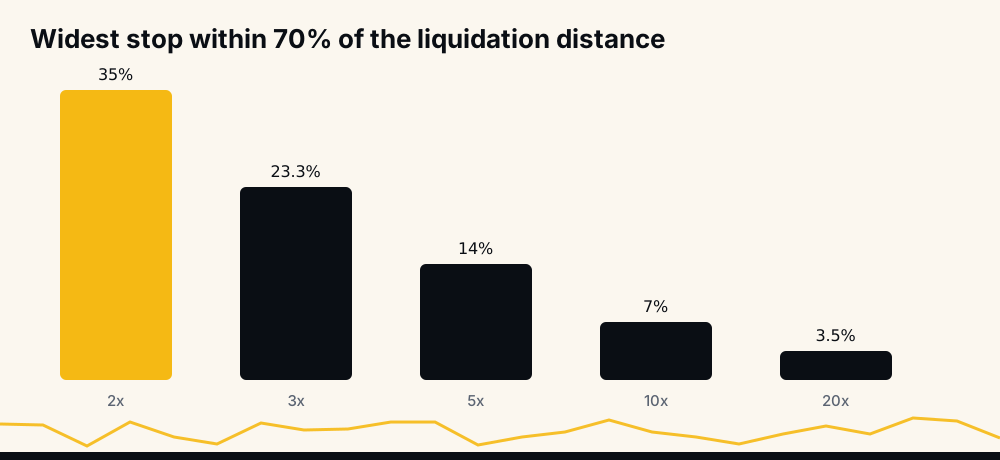
Read the chart backwards and it answers the title: start from your stop and pick a leverage whose widest usable stop is larger than it. A 4% stop fits 10x (7%) but not 20x (3.5%). A 12% stop fits 5x (14%) but not 10x.
When leverage does raise your risk: sizing by margin
Many traders, and many bots, do not size from the stop. They put a fixed margin on each trade, say 50 USDT, and let leverage set the position. Then the position is margin × leverage, and so is the loss:
- 50 USDT at 2x is a 100 USDT position; a 5% stop costs 5 USDT.
- 50 USDT at 5x is 250 USDT; the same stop costs 12.50.
- 50 USDT at 10x is 500 USDT; it costs 25.
With fixed margin, every step up in leverage multiplies the loss at the stop, the fees and the funding. That's what "high leverage is risky" really means: it quietly turns the same deposit into a bigger trade.
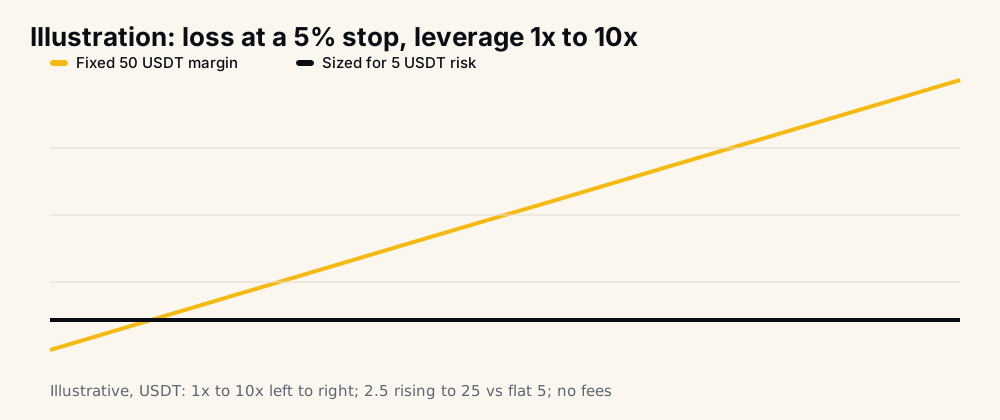
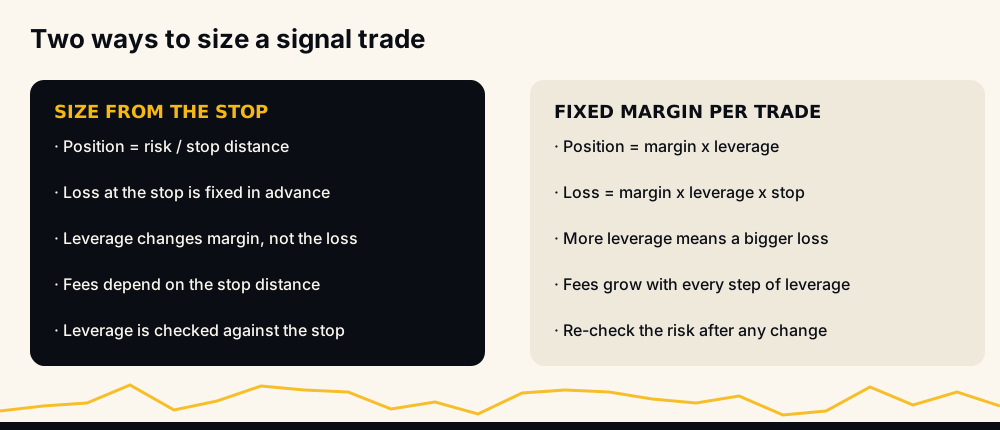
If your tool sizes by margin, margin × leverage × stop distance is what you lose. Check that product before every change.
Isolated or cross margin for signal trades
The two margin modes change what a single bad trade can reach. Binance Academy's article on isolated and cross margin (updated 7 May 2026) puts it directly: with isolated margin "the amount of margin is limited to a specific position", while cross margin "uses all available funds in your account as collateral for your trades."
- Isolated: each signal trade carries its own margin. The liquidation distance above applies per position, and a loss cannot take more than that margin. The cost: low leverage locks more margin per trade, and the liquidation distance is the tight one.
- Cross: the whole futures balance stands behind every position, so liquidation sits much further away. The cost: a stop that fails lets one trade draw down the balance shared by all the others, and Binance's liquidation protocols cancel "all open orders of the trader" in cross mode when liquidation starts.
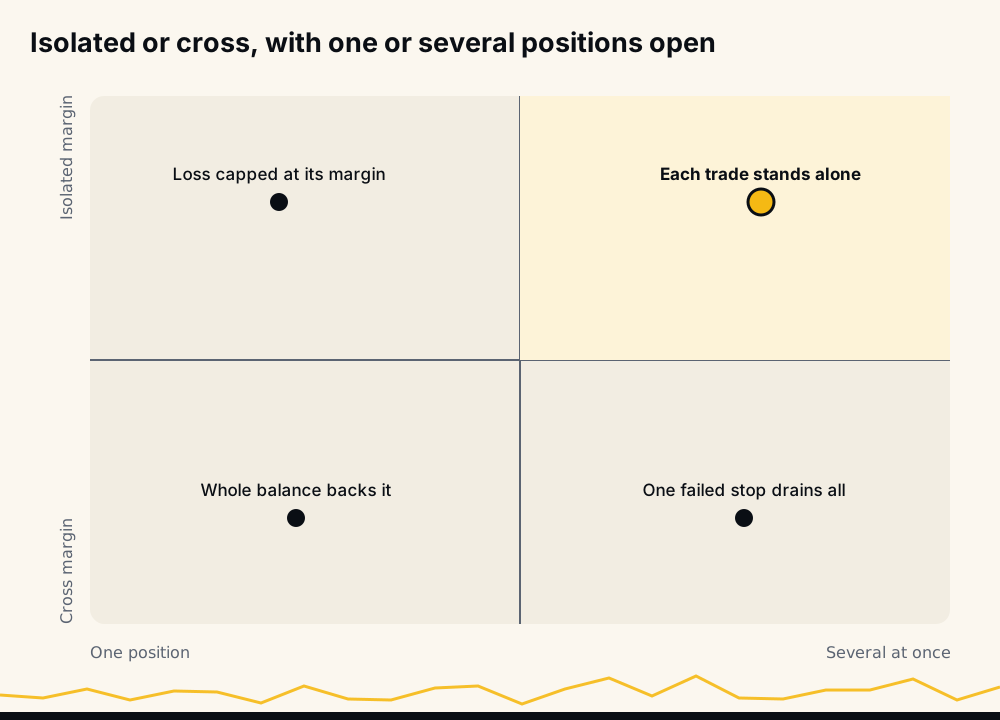
On isolated margin, the 70% check is a hard per-trade limit. On cross margin, the stop still has to be your exit, because liquidation would come only after the loss has eaten into everything else.
How many positions can the account carry at once
Signal trading usually means several positions open together, and crypto coins often move in the same direction at the same time. Two numbers decide whether the account can carry them:
- Worst case at the stops: number of positions × risk per trade. Five positions at 1% each can cost 5% if they all stop together.
- Margin in use: number of positions × position size ÷ leverage. This must fit in the balance with room to spare for fees, funding and price moves.
Leverage only touches the second number. Lower leverage locks more margin, so fewer positions fit; higher leverage frees margin but narrows each isolated position's path. The worst case at the stops is the same either way, as long as every stop fires.
Fees grow with notional, not with leverage
Binance charges trading fees on position value. Margin doesn't come into it. Its fee structure FAQ (updated 2026-05-01) gives "Trading Fee = Position Value * trading fee", and its funding rate FAQ calculates funding the same way, from the nominal value of the position. Binance futures fees explained covers the rates, maker and taker, and how to pay less.
That has two consequences for leverage:
- Sized from the stop, fees do not depend on leverage. They depend on the stop distance: a tighter stop means a bigger position for the same risk, so fees eat a bigger share of it.
- Sized from margin, fees grow with leverage. 50 USDT of margin at 10x pays fees on 500 USDT, ten times what it pays at 1x.
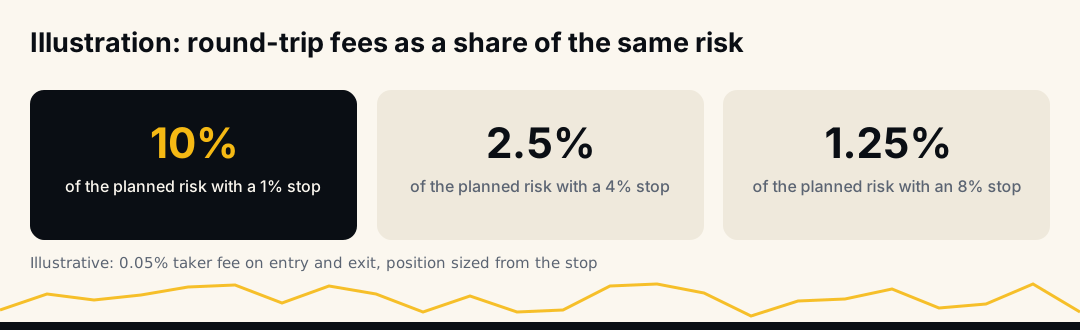
The chart assumes an illustrative 0.05% taker fee on entry and exit, the rate Binance's fee FAQ uses in its own example; your real rate depends on your VIP level, BNB discount and whether you fill as maker.
Worked example: a 500 USDT account
This is only an illustration. A 500 USDT account risks 1% per trade (5 USDT), uses a 4% stop and allows three positions at once.
- Position size: 5 ÷ 4% = 125 USDT per trade.
- Fees: 125 × 0.05% × 2 ≈ 0.13 USDT per round trip at the illustrative rate.
- Worst case if all three stop: 15 USDT, 3% of the account, at any leverage.
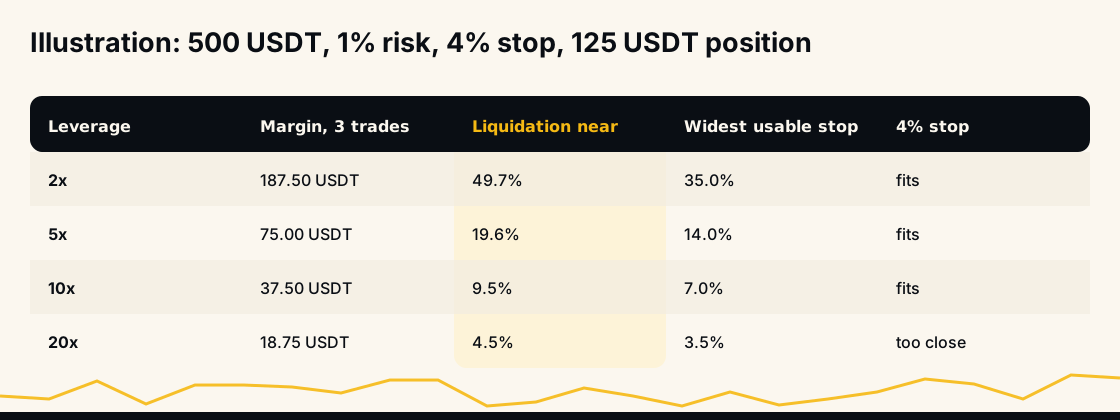
At 2x the three positions lock 187.50 USDT, over a third of the account. At 10x they lock 37.50, and the 4% stop still sits inside the 7% usable zone. At 20x the stop is past the 3.5% line: liquidation near 4.5% leaves half a percent of room, which one fast candle can cross. The loss at the stop is 5 USDT in every row.
Worked example: a 5,000 USDT account
Also an illustration. A 5,000 USDT account risks 1% (50 USDT), uses a wider 8% stop and allows six positions.
- Position size: 50 ÷ 8% = 625 USDT per trade.
- Fees: 625 × 0.05% × 2 ≈ 0.63 USDT per round trip, 1.25% of the risk.
- Worst case if all six stop: 300 USDT, 6% of the account.
The wider stop rules out more leverage. 10x carries a widest usable stop of 7%, so an 8% stop does not fit, even though liquidation near 9.5% is technically further away. 5x (14%) fits with room. At 5x the six positions lock 750 USDT; at 2x they would lock 1,875 USDT, 37.5% of the account.
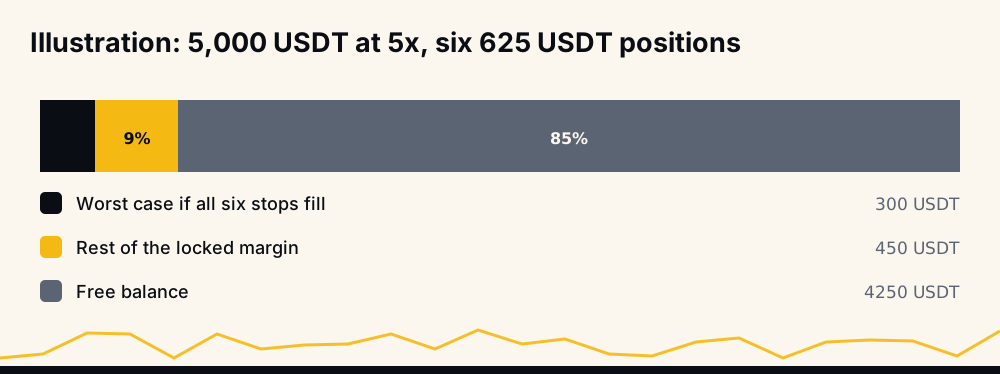
The bigger account did not earn more leverage; its wider stop capped it.
Binance's own caps on leverage
Your choice also has to fit Binance's limits: the maximum falls as a position grows, by brackets per coin; sub-accounts of regular users are limited to 5x; new futures accounts to 20x for their first 30 days. Binance futures leverage limits explains each, with the error codes. On isolated margin you cannot lower leverage while a position is open, so choose it before entering. How leverage trading works in crypto has the general arithmetic.
How HafizeBot's autotrader handles leverage
In HafizeBot's autotrader each member sets their own leverage, position size, maximum open positions and stop-loss, on their own Binance account. When autotrading is switched on, the bot states the defaults a new member starts on: 5 USDT of margin per trade at 2x (a 10 USDT position) on isolated margin, up to 3 positions, and a 10% stop-loss. In the arithmetic above that is 1 USDT at the stop per trade, 3 USDT if all three stop, and a 10% stop well inside the 35% that 2x can carry.
By default the size setting is margin per trade, so raising leverage raises the position and the loss at the stop. The bot checks the other direction for you. If a leverage change would put your stop beyond what that leverage allows before liquidation, it refuses and tells you the widest stop that fits; a member who has widened the stop to 30% and asks for 5x, for example, would be asked to lower the stop to 14% or less first (/setStopLoss, then /setLeverage).
The signals are AI-generated, from a model that evaluates 240+ indicators, formulas and components across 523 Binance USDⓈ-M pairs. Broadcast signals carry a target and a maximum hold, not a stop, so the stop on your account is yours to choose. The key needs futures trading only; use a key with withdrawals off, because HafizeBot never withdraws or transfers funds. Autotrading also needs the futures account in One-way mode.
Frequently asked questions
What leverage should I use for crypto signals? Work it out from your stop, not the other way round. Fix your risk per trade, size the position from the stop distance, then use a leverage whose liquidation distance leaves the stop well inside it, for example with the 70% rule: at most 35% at 2x, 14% at 5x, 7% at 10x.
Does higher leverage mean higher risk? Not by itself. If you size from your stop, the loss at the stop is the same at 2x or 10x; leverage changes the margin and the liquidation distance. If you put a fixed margin on each trade, higher leverage makes the position bigger and does raise the loss.
What is the best leverage for a small account? There is no single number. A small account feels the margin limit sooner, which tempts traders towards high leverage, but the stop still has to fit inside the liquidation distance. With a 500 USDT account, 1% risk and a 4% stop, 10x fits the 70% rule and 20x does not.
Is isolated or cross margin better for signal trading? Isolated margin limits each trade's loss to its own margin and keeps several signal trades independent, at a tighter liquidation distance. Cross margin backs every position with the whole balance, so liquidation is further away but one failed stop can reach the others.
How do I calculate my liquidation distance on Binance? Roughly 100% ÷ leverage, minus the maintenance margin rate of your position's tier, on isolated margin. For a real coin and size, use Binance's own calculator or our liquidation calculator, which reads each coin's brackets.
Do Binance fees depend on leverage? No. Fees are charged on position value, so they depend on how big the position is. Leverage raises fees only when it raises the position, as it does when you keep the same margin per trade.
The short version
Choose risk first, size from the stop second, and leverage last: the highest leverage worth considering is the one whose usable liquidation distance still contains your stop, and the lowest is set by how much margin your positions may lock up. Every Binance rule here comes from Binance's own FAQs.
HafizeBot publishes its signals with their results on the live performance page, regenerated hourly since June 2026, with each missed signal counted against the target-hit rate; the 2021 to 2024 archive is in the monthly reports. The free channel posts the stronger signals (strength 3 and up) 20 minutes after VIP. To try autotrading under your own leverage and stop, send /trial in @hafizebot for 3 days of VIP Tier 1, with trial autotrading capped at 10 USDT of margin per entry and 3 open positions; plans are 50, 100 or 200 USDT a month via /join.
This is not investment advice; leveraged futures can lose your whole margin, so trade only what you can afford to lose.