On Binance USDⓈ-M Futures, the funding rate is a periodic payment between longs and shorts on perpetual contracts. Your cost at each settlement is position notional (mark price × size) × funding rate, charged only if you hold the position at the funding time, by default every 8 hours. Leverage does not change the rate, but it multiplies the cost measured against your margin: 10x pays ten times more per dollar of margin.
What is the funding rate on Binance Futures?
Binance's own FAQ, Introduction to Binance Futures Funding Rates (updated 6 March 2026), defines it in one sentence: "Funding rates are periodic payments transferred between holders of long and short positions in Perpetual Contracts."
Two details on that page matter for everything below:
- It is peer to peer. "Funding Payments are transferred directly between traders holding opposing positions." Binance is not the counterparty.
- Binance takes no cut. "Binance does not charge fees on Funding Payments." Your trading fees are a separate bill, covered in Binance Futures fees explained.
Why perpetual futures need funding
A dated future is pulled back to spot by its expiry. A perpetual never expires, so nothing forces it to meet the spot market; a crowd of eager buyers could hold it above spot for weeks.
Funding fixes that with money instead of a calendar. When the perpetual trades above the spot index, holding a long costs something and holding a short earns something, so traders have a reason to sell the perpetual. When it trades below, the incentive flips. Binance states the purpose as keeping the perpetual price tied to the underlying index. If perpetuals are new to you, crypto futures trading for beginners covers the basics first.
Who pays whom: positive vs negative funding
Binance's FAQ: with a positive rate, "traders long on a perpetual contract will pay a funding fee to traders on the opposing side"; with a negative rate, "traders short on a perpetual contract will pay a funding fee to long traders."
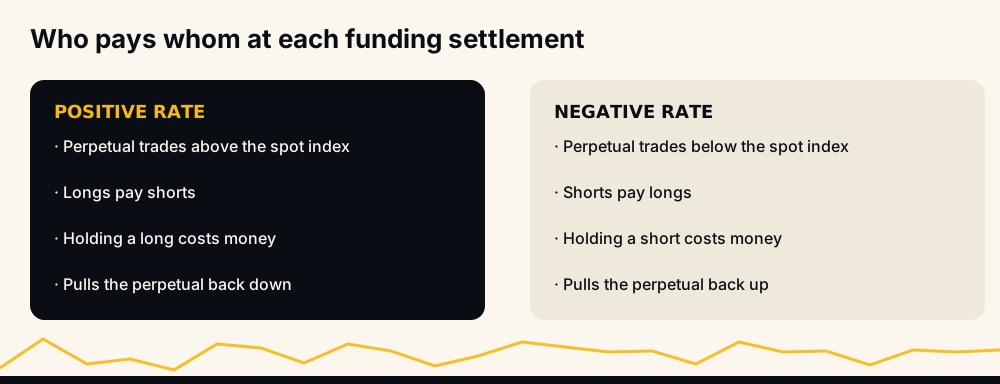
So funding is not always a cost: a short collects while the rate is positive, a long while it is negative. You cannot choose the sign; it changes settlement by settlement.
How is the Binance funding rate calculated?
Binance publishes the formula on the same FAQ page:
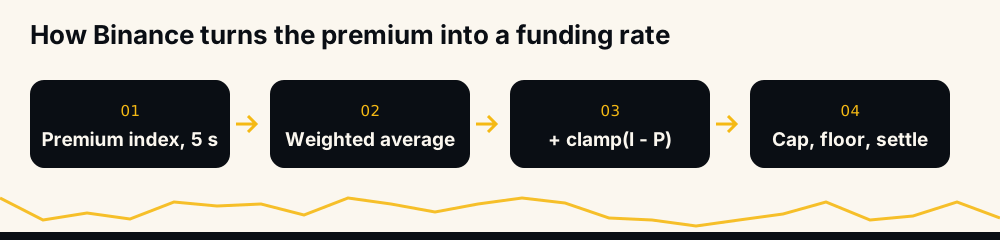
Funding Rate (F) = [Average Premium Index (P) + clamp(interest rate − Premium Index (P), 0.05%, −0.05%)] ÷ (8 ÷ N)
where N is the contract's funding interval in hours. For a contract on the default 8-hour interval, 8 ÷ N is 1 and the divisor disappears.
The premium index
The premium measures how far the perpetual's order book sits from the spot index:
Premium Index (P) = [Max(0, Impact Bid Price − Price Index) − Max(0, Price Index − Impact Ask Price)] ÷ Price Index
The impact prices are the average fill for a fixed-size order on each side of the book (200 USDT divided by the initial margin rate at maximum leverage). Binance computes the premium every 5 seconds and takes a time-weighted average with later samples counting more, 5,760 data points for an 8-hour interval. The price index itself is the multi-exchange spot index explained in mark price vs last price on Binance.
The interest rate and the clamp
Binance fixes the interest rate at 0.03% a day by default, which its FAQ writes as "0.01% per funding interval since funding occurs every 8 hours" (some contracts, such as ETHBTC, use 0%). The clamp limits how far the premium can pull the rate away from that interest rate.
The arithmetic is worth redoing once. If the average premium is anywhere between −0.04% and +0.06%, the clamp absorbs the difference and the funding rate comes out at exactly 0.01%. Binance's own worked example uses a premium of 0.0429%: 0.0429% + (−0.0329%) = 0.0100%.
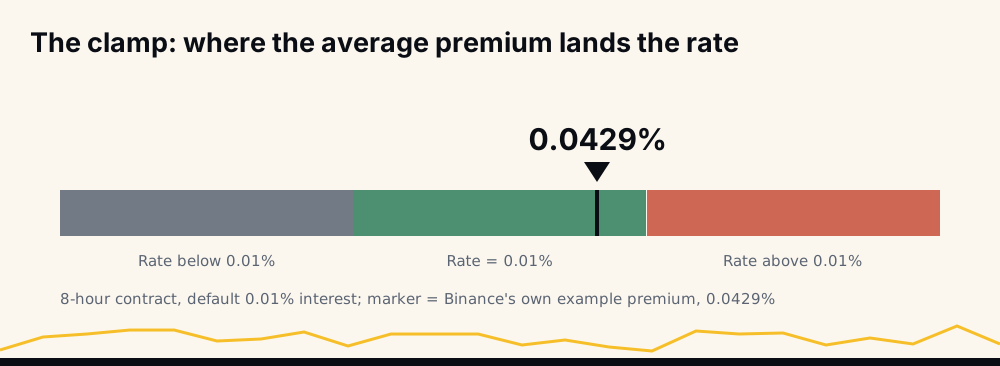
Outside that band the rate moves with the premium: an average premium of 0.10% gives 0.10% − 0.05% = 0.05%.
Caps and floors
The rate cannot run without limit. For a named list of large contracts, including BTCUSDT, ETHUSDT, SOLUSDT and XRPUSDT, the cap and floor are ±0.75 × the maintenance margin ratio at maximum leverage; Binance's example is ADAUSDT, where a 0.65% maintenance margin ratio gives ±0.4875%. For other USDⓈ-M perpetuals, "the capped funding rate ... is set at ± 2%." Contracts whose limits were adjusted are listed by the API endpoint GET /fapi/v1/fundingInfo.
How often is funding paid on Binance?
"The default funding interval is every 8 hours at 00:00 (UTC), 08:00 (UTC), and 16:00 (UTC)." That is three settlements a day.
The default is not a promise for every contract. Binance's FAQ says payments occur "as specified in the Contract Specifications for each Perpetual Contract" and that it "reserves the right to update the funding interval of a perpetual contract". It also sets two automatic rules:
- Faster when stretched. When a contract's previous settlement hits its funding rate cap or floor, Binance moves it from every eight or every four hours to every hour, from the next settlement.
- Back when calm. An hourly contract returns to every four hours after the rate stays at or below 0.025% in absolute value for 16 consecutive cycles, on the 17th.
A contract that switches to hourly settles 24 times a day instead of three. The fundingIntervalHours field in GET /fapi/v1/fundingInfo shows it for every contract that has been adjusted, and the countdown above the contract's chart shows the time to the next settlement.
Only positions open at the funding time pay
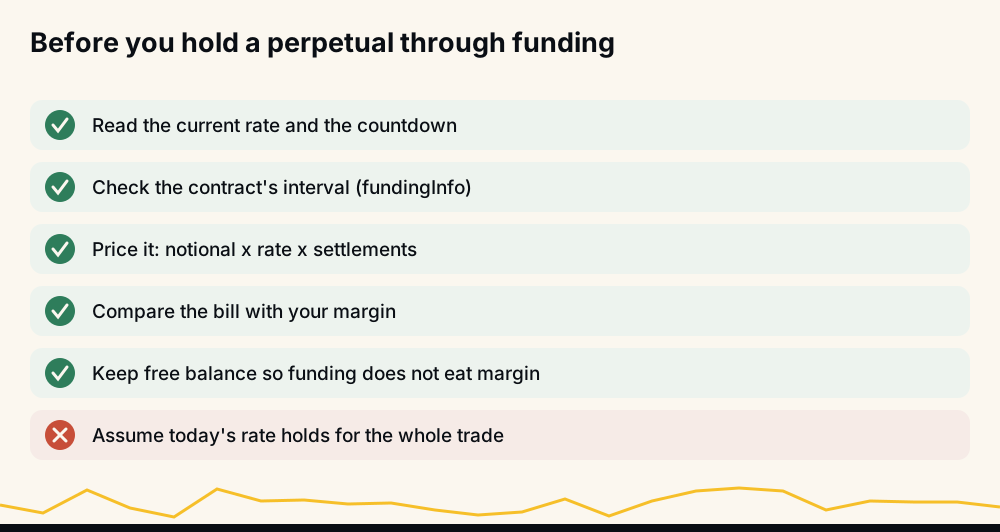
This is the rule that decides most people's bill. Binance's FAQ: "You are only liable for funding payments in either direction if you have open positions at the pre-specified funding times," and "If you close your position prior to the funding time, you will not pay or receive any funding."
Funding is not charged by the hour: a position held from 08:01 to 15:59 pays nothing, while one held from 07:58 to 08:02 pays a full interval.
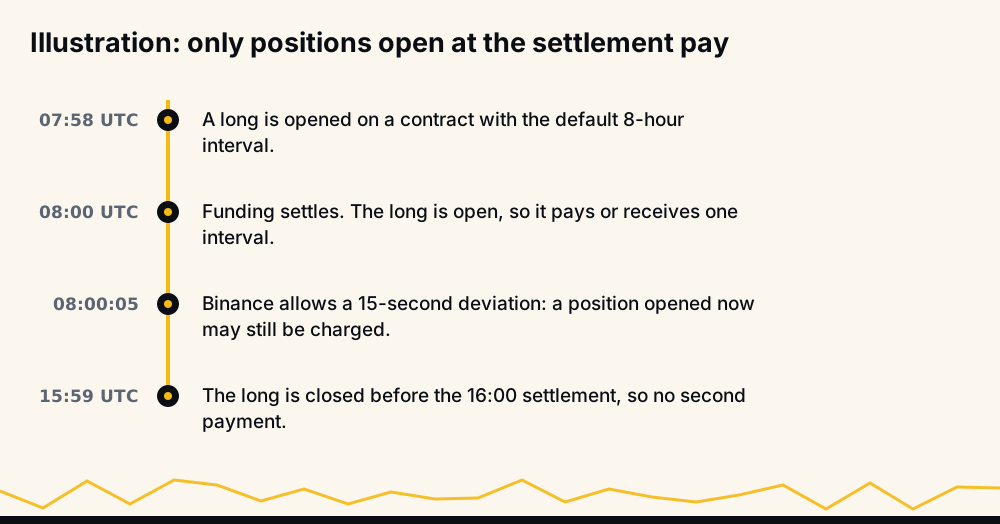
There is a margin of error at the edge. Binance notes "a 15-second deviation in the actual funding fee transaction time", and gives the example of a position opened at 08:00:05 UTC that may still be charged. Do not plan trades to the second around a settlement.
How are funding costs calculated on leveraged crypto positions?
The formula is short, and Binance prints it:
Funding Amount = Nominal Value of Positions × Funding Rate, where Nominal Value = Mark Price × Size
Margin and leverage are not in it: the fee is charged on the whole position, not the collateral. Leverage does not change the rate; it changes how big the position is relative to your money.
Take 500 USDT of margin and hold for 7 days at 0.01% per settlement, 21 settlements in all:
- 2x: 1,000 USDT notional, 1,000 × 0.0001 × 21 = 2.10 USDT, 0.42% of margin
- 10x: 5,000 USDT notional, 10.50 USDT, 2.1% of margin
- 50x: 25,000 USDT notional, 52.50 USDT, 10.5% of margin
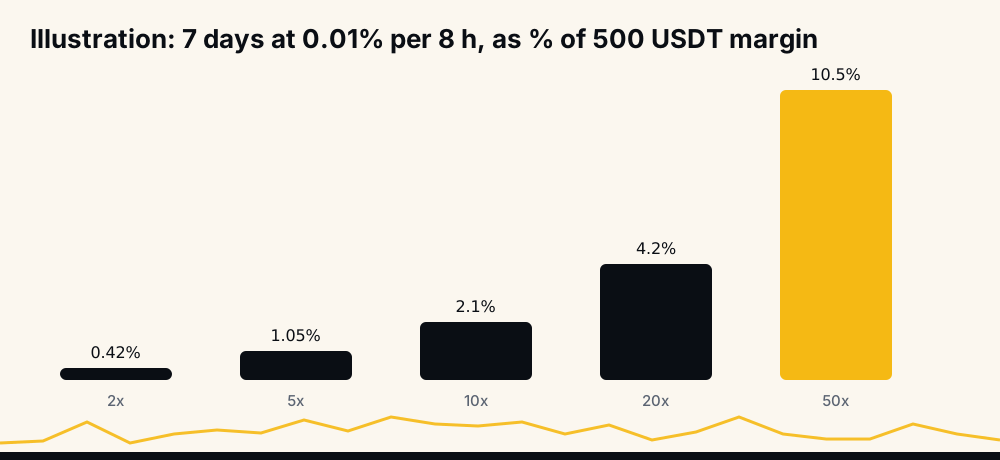
The shortcut: funding as a share of margin = rate × number of settlements × leverage. How leverage trading works in crypto does the same multiplication for fees and liquidation distance.
Worked examples you can redo
The numbers below are examples; the formulas are Binance's. Real rates change at every settlement.
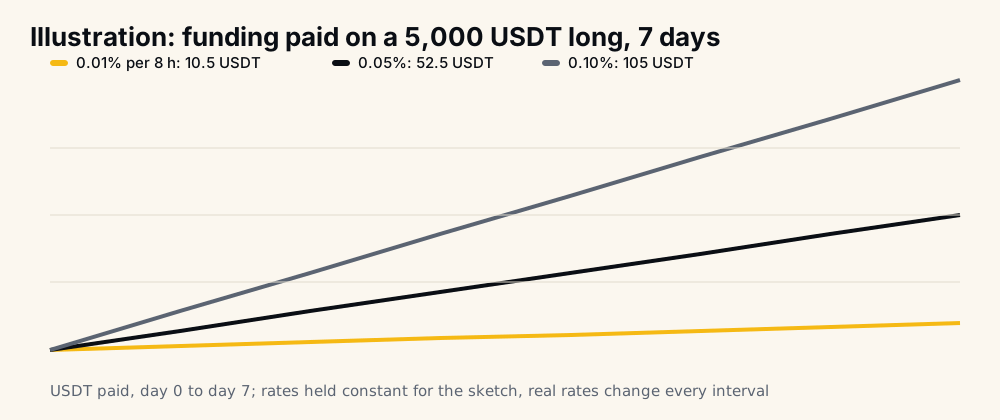
1. A quiet long held for a week. Long 0.1 BTC with the mark price at 50,000 USDT: 5,000 USDT notional. At 0.01% each settlement it pays 0.50 USDT, three times a day, 1.50 USDT a day, 10.50 USDT for 7 days. On 500 USDT of margin (10x) that is 2.1% of the margin before the price has moved at all.
2. The same long in a crowded market. Same 5,000 USDT notional, but the rate climbs as buyers pile in. At 0.05% the week costs 52.50 USDT; at 0.10% it costs 105 USDT, 21% of the 500 USDT margin.
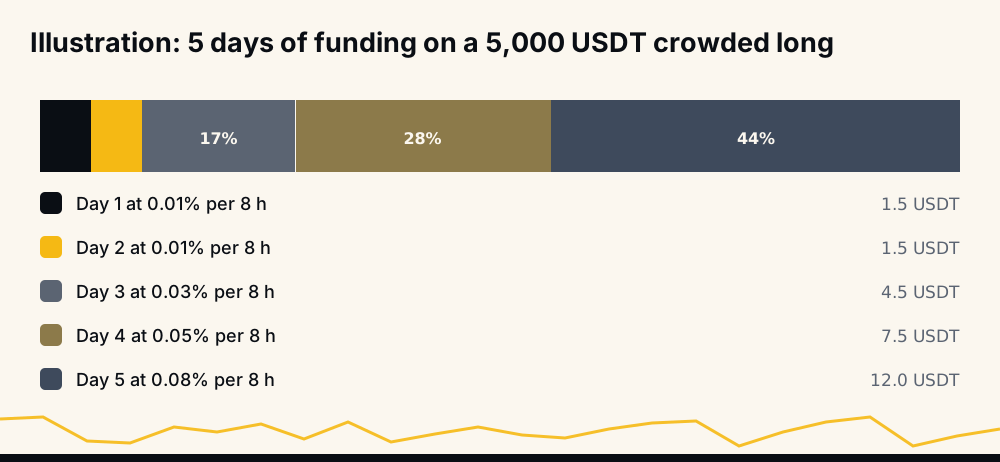
3. A rate that drifts up while you hold. Real crowding builds gradually. Five days at 0.01%, 0.01%, 0.03%, 0.05% and 0.08% per settlement cost 1.50 + 1.50 + 4.50 + 7.50 + 12.00 = 27 USDT, and the last two days are 72% of the bill.
4. A short collecting. Short 5,000 USDT notional at −0.02%: the short receives 1.00 USDT per settlement, until the rate flips.
To annualise a rate, multiply by settlements per year: 0.01% × 3 × 365 = 10.95% a year of notional, which is why the "small" default rate is not small on a position held for months.
What funding looked like on BTC, ETH and SOL in the last 30 days
We pulled the settled history from Binance's public endpoint GET /fapi/v1/fundingRate on 17 October 2026, for the 90 settlements from 16 September to 15 October 2026:
- BTCUSDT: all 90 settled at 00:00, 08:00 and 16:00 UTC. The highest rate was 0.0100%, the lowest −0.0041%, and 18 settlements were negative. The 90 rates add up to 0.30%.
- ETHUSDT: 13 negative settlements, rates adding up to 0.34%.
- SOLUSDT: 17 negative settlements, rates adding up to 0.34%.
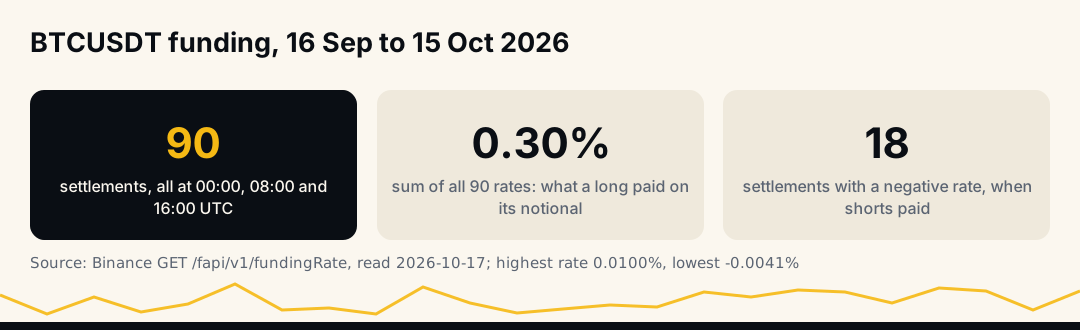
So a BTC long of about 10,000 USDT notional held all month paid roughly 30 USDT; at 10x, about 3% of its margin. That is the mild case: a calm month on the largest contract.
Funding and your liquidation price
Binance's FAQ: "Funding fees (if any) will be deducted from the available balance in your Futures Account." If that balance is not enough, "the funding fees (if any) will be deducted from your position margin," and Binance adds that this may affect your liquidation price.
On a thin account that turns a slow cost into a risk: every payment taken from margin moves the liquidation price closer. Why your liquidation price changes on Binance covers this and the other causes, and liquidated before your stop-loss explains what happens when that level overtakes a stop.
Where to see funding history in the app and API
Binance shows funding in several places:
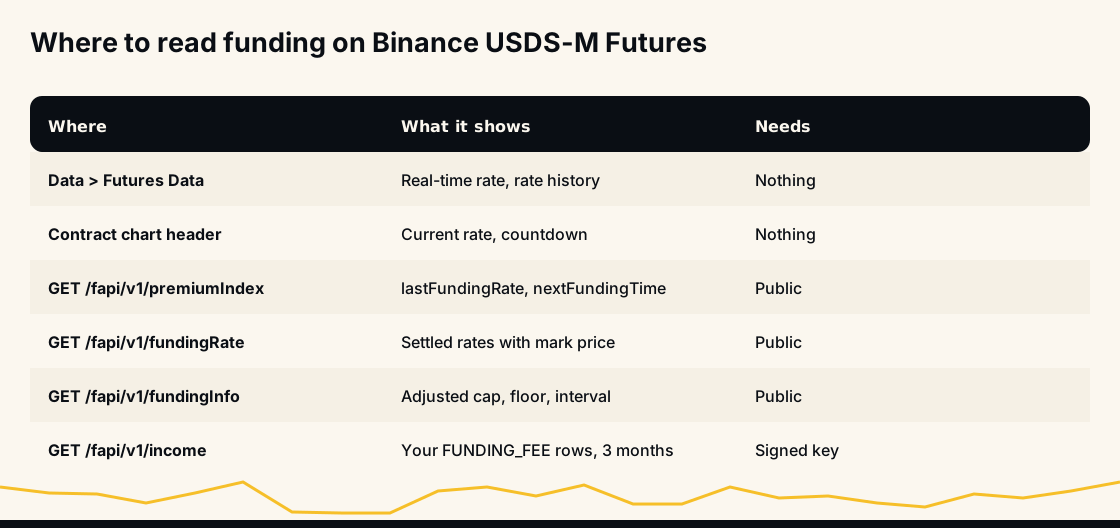
- In the app or on the website: Binance's FAQ points to [Data] → [Futures Data], then Real-Time Funding Rate or Funding Rate History. The contract page also shows the current rate and the countdown to the next funding above the chart.
GET /fapi/v1/premiumIndex: the currentlastFundingRate,interestRateandnextFundingTime.GET /fapi/v1/fundingRate: settled rates with the mark price, up to 1,000 rows per request.GET /fapi/v1/incomewithincomeType=FUNDING_FEE: what you paid and received. It needs a signed key, returns 7 days by default and keeps three months.
The displayed rate during an interval is an estimate. Binance describes it as "an estimation of the last 8 hours of the premium index", so the settled rate can differ from what you saw an hour earlier. If you script these calls, the Binance API rate limits that break trading bots are worth reading first; fundingRate and fundingInfo share a 500-requests-per-5-minutes limit per IP.
When does funding matter, and when can you ignore it?
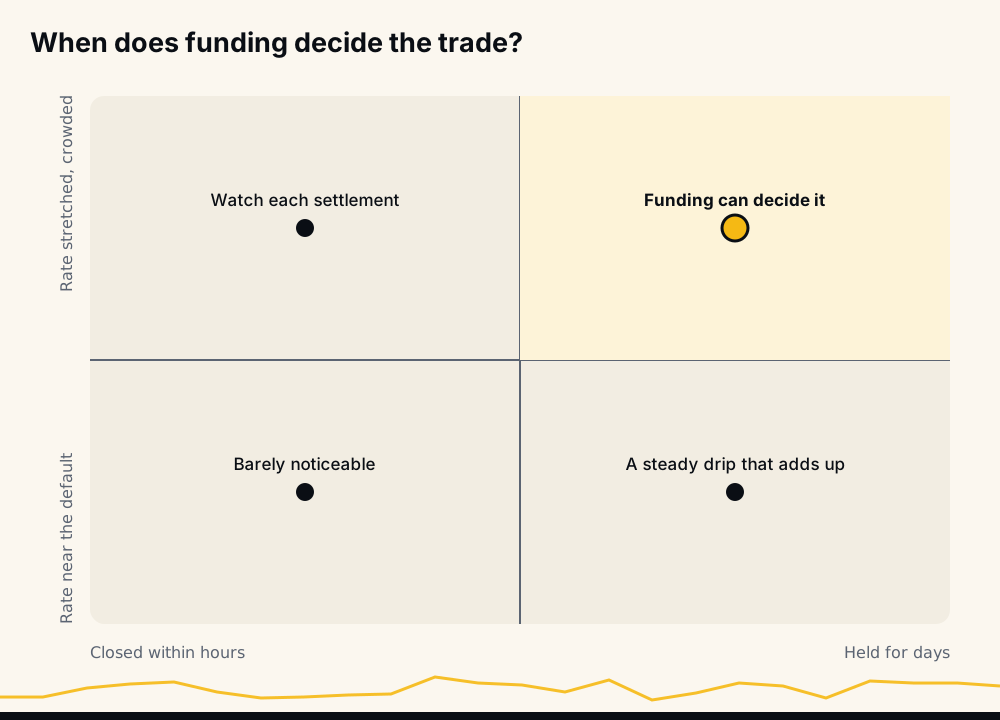
- Trades closed within hours at normal rates: often no settlement at all.
- Multi-day holds at normal rates: a steady drip that, with leverage, reaches whole percent of your margin within a week.
- Crowded trades: longs pay the most exactly when the trade is most popular, so a position that looks fine on price can lose to its funding.
- Contracts that switched to hourly: eight times as many settlements a day as the default.
Funding is one line of the full cost of trading, alongside fees and slippage; how much crypto signals really cost puts all of them in one monthly bill.
Funding on HafizeBot autotrades
HafizeBot sends AI-generated signals from a model that evaluates 240+ indicators, formulas and components across 523 Binance USDⓈ-M pairs. Members who switch on autotrading trade on their own Binance account, with their own leverage, position size, maximum open positions and stop-loss; the key needs futures trading only, so use a key with withdrawals off.
Binance, not HafizeBot, charges funding on those positions, exactly as above. Two points follow:
- Your leverage setting scales your funding. The same signal at 2x and at 20x pays the same rate, on ten times the notional relative to margin.
- A missed signal is not closed on your account. As what happens when a crypto signal expires explains, the position stays open until its target, your stop, you or liquidation closes it, and it pays or receives funding at every settlement while it is open.
Broadcast signals carry a target and a maximum hold, not a stop, and every outcome is published on the performance page, where a signal that misses its target in time counts against the target-hit rate.
Frequently asked questions
How is the Binance funding rate calculated? Binance averages the premium of the perpetual over the spot index, sampled every 5 seconds, and adds a clamp that pulls it toward the 0.01% default interest rate per 8 hours. If the average premium sits between −0.04% and +0.06%, the rate is exactly 0.01%; the result is then held within the contract's cap and floor.
How often is funding paid on Binance Futures? By default every 8 hours, at 00:00, 08:00 and 16:00 UTC. Some contracts use other intervals, and Binance moves a contract to hourly settlements after a settlement hits its cap or floor, then back to every four hours once rates calm down.
Does leverage increase the funding fee? Not the rate, but the cost relative to your money. Funding is charged on the position's notional value, mark price times size, so at 10x the same rate costs ten times as much per dollar of margin as at 1x.
Do I pay funding if I close my position before the funding time? No. Binance charges funding only to positions open at the funding timestamp, so closing before it means you neither pay nor receive. Binance notes a 15-second deviation in the actual transaction time, so leave a margin around the settlement.
What does a negative funding rate mean on Binance? It means the perpetual trades below the spot index, and shorts pay longs. A long position receives funding at each settlement while the rate stays negative.
Where can I see funding rate history on Binance?
On the website and app under Data, Futures Data, Funding Rate History. Through the API, GET /fapi/v1/fundingRate returns settled rates, and GET /fapi/v1/income with incomeType=FUNDING_FEE returns what your own account paid or received over the last three months.
The short version
Funding is a payment between longs and shorts, set by how far the perpetual trades from spot, settled every 8 hours by default and faster on stretched contracts. You pay notional × rate at each settlement you are open for, so the real cost of a hold is notional × rate × settlements, and leverage decides how much of your margin that is. Read the rate and the interval before you hold for days, not after.
To judge HafizeBot by its record rather than its claims, read the performance page, misses included, or download the monthly archive at /data. The free Telegram channel posts the stronger signals (strength 3 and up) 20 minutes after VIP. VIP gets signals instantly plus optional autotrading, from 50 USDT a month, with a 3-day free trial via /trial in @hafizebot. This is information, not investment advice: leveraged futures can lose more than you expect, so trade only what you can afford to lose.