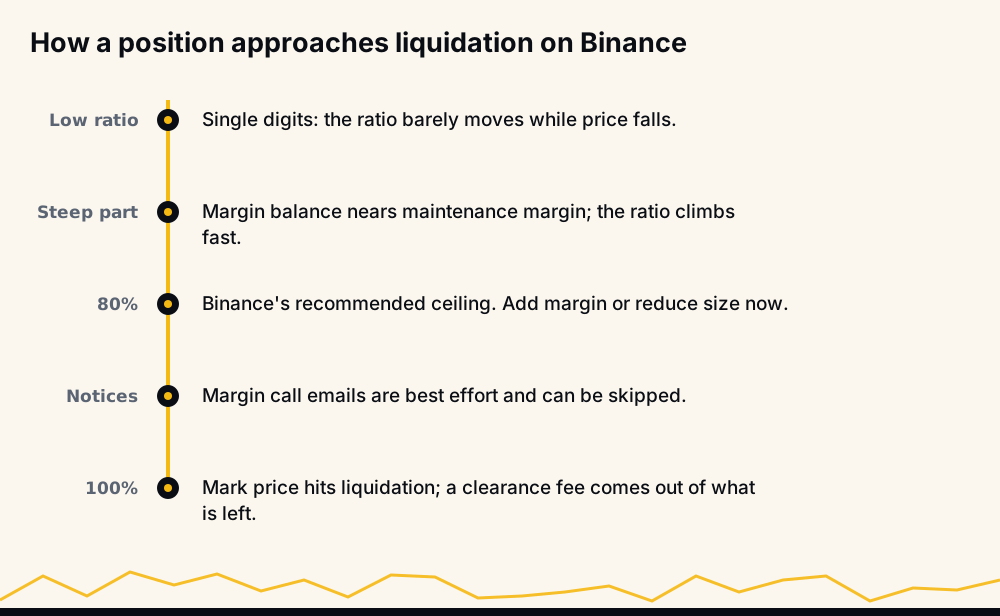
Binance's margin ratio is maintenance margin ÷ margin balance, where margin balance is your wallet balance plus unrealized PnL. Lower is safer. At 100% your positions are liquidated, and Binance recommends keeping it below 80%. Because the ratio climbs slowly at first and then very fast, 80% usually arrives only moments before liquidation.
This article takes the formula apart, runs one position from entry to liquidation with numbers you can redo, and shows what moves the ratio and how to bring it down. The examples are illustrative and use a simplified maintenance rate.
What margin ratio means on Binance Futures
The margin ratio answers one question: how much of the money backing your positions is already spoken for by Binance's minimum requirement? At 10%, the minimum takes a tenth of your margin balance. At 100%, it takes all of it, and there is nothing left to absorb a further loss.
Binance's help page "How to Reduce Your Chances of Getting Liquidated" (updated 2 January 2026) puts it in one line: "The margin ratio is calculated as maintenance margin divided by margin balance." It adds: "When your margin ratio reaches 100%, some, if not all, of your positions will be liquidated."
Binance's unified Portfolio Margin account uses a ratio the other way up: its uniMMR FAQ divides equity by maintenance margin, says "a higher uniMMR indicates a lower risk", and liquidates at 105%. On a standard USDⓈ-M futures account it is the reverse. A rising margin ratio is bad news.
The margin ratio formula, piece by piece
Three definitions from Binance's futures blog (available balance, margin balance and total balance) and its leverage FAQ make the ratio:
- Wallet balance = total net transfer + total realized profit + total net funding fee − total commission.
- Margin balance = wallet balance + unrealized PnL.
- Maintenance margin = notional position value × maintenance margin rate − maintenance amount.
- Margin ratio = maintenance margin ÷ margin balance.
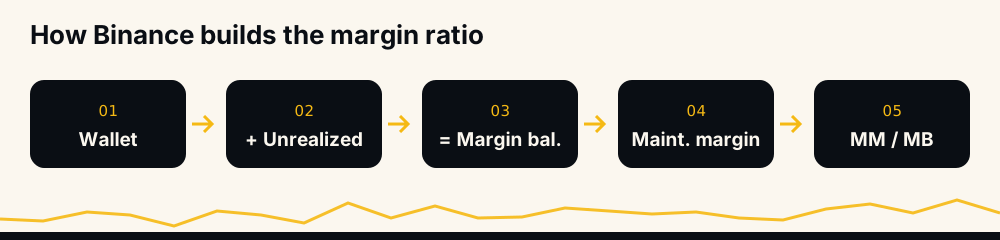
Binance's margin requirement FAQ defines notional value for USDⓈ-M contracts as "Position Size (calculated in coin) * Symbol Mark Price". So both halves of the ratio move with the mark price: the unrealized PnL in the margin balance, and the notional in the maintenance margin. The blog states the trigger from the other side: "Liquidation is triggered when Margin Balance < Maintenance Margin."
Maintenance margin and the tier table
Maintenance margin is the floor Binance keeps behind a position. Its rate depends on the coin and on how large the position is: Binance's leverage and margin FAQ (updated 27 March 2026) says it "is calculated based on the notional value of open positions across different value tiers." Bigger positions sit in higher tiers with higher rates.
The maintenance amount keeps the requirement continuous at a tier boundary. With illustrative tiers of 0.4% up to 50,000 USDT and 0.5% above it with a maintenance amount of 50:
- At 50,000 notional: 50,000 × 0.4% = 200, or 50,000 × 0.5% − 50 = 200. The same.
- At 100,000 notional: 100,000 × 0.5% − 50 = 450 USDT, against 400 if the first rate applied all the way.
Your real tiers for each coin are on Binance's Leverage & Margin page, and in the API under GET /fapi/v1/leverageBracket as maintMarginRatio and cum.
Worked example: one cross position from entry to liquidation
Illustrative numbers: a cross wallet of 1,000 USDT, a long of 0.1 BTC at 80,000 on 10x, a 0.4% maintenance rate, no maintenance amount, fees and funding ignored.
At entry, notional is 8,000, maintenance margin 8,000 × 0.4% = 32, margin balance 1,000. Margin ratio = 32 ÷ 1,000 = 3.2%.
Now let the mark price fall and redo the two halves each time:
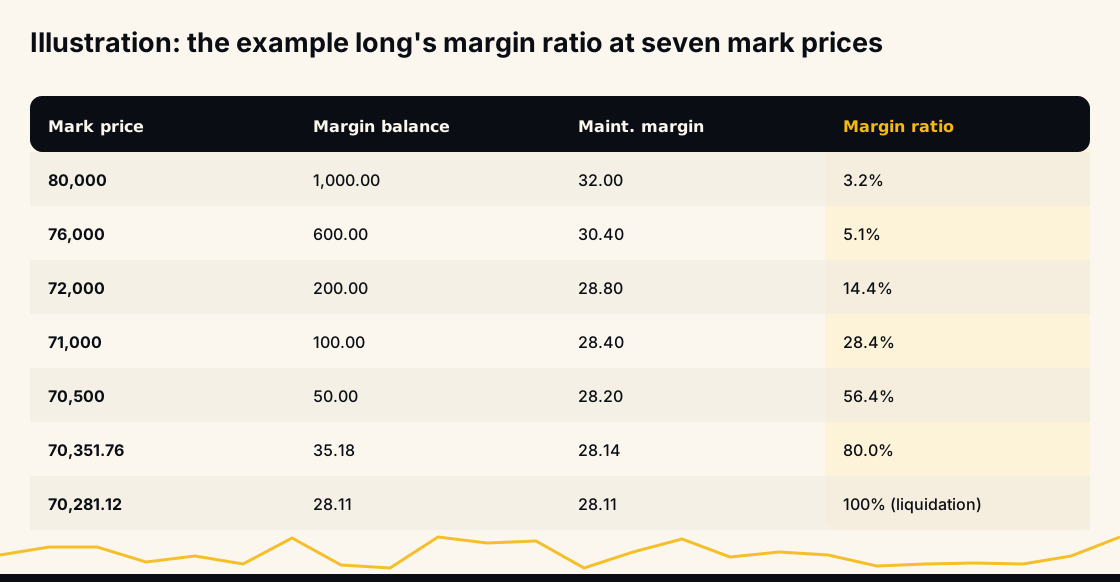
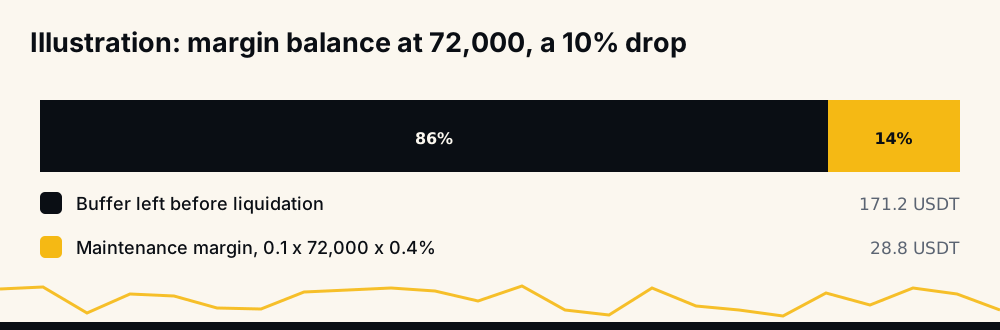
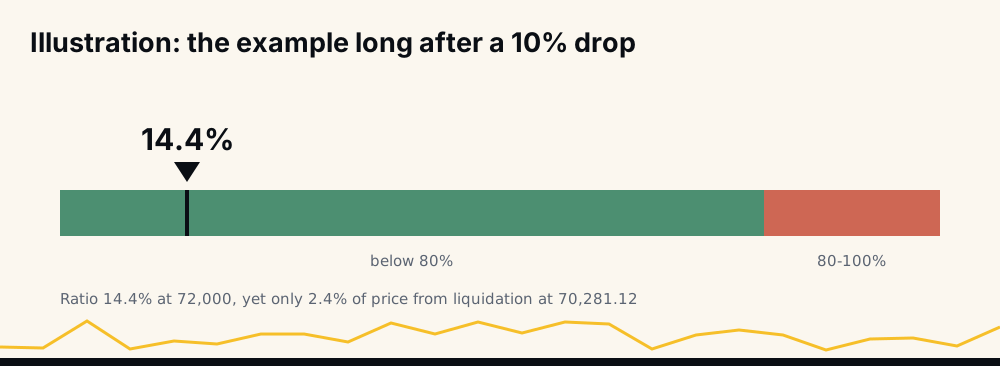
At 72,000, a 10% drop, unrealized PnL is −800, margin balance 200, maintenance 0.1 × 72,000 × 0.4% = 28.80, and the ratio is 14.4%. That looks comfortable. It is 2.4% of price away from liquidation.
Why margin ratio jumps near the end
The ratio's top half barely moves: maintenance margin drifts from 32 to about 28 as the notional shrinks. The bottom half falls in a straight line, 10 USDT for every 100 USDT of price. Dividing a near-constant by something heading to zero produces a curve that is flat for a long time and then nearly vertical.
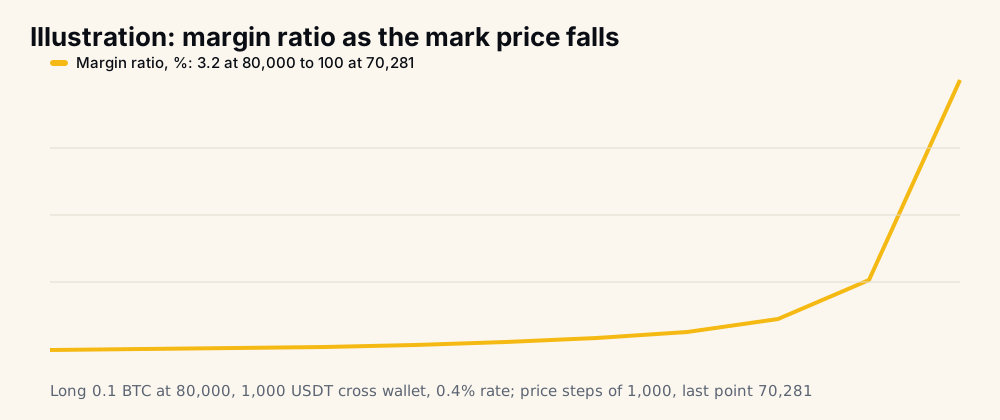
In this example the ratio is still under 10% after a drop of 8.75% (9.7% at 73,000). The next 3.7% of price, from 73,000 to 70,281.12, takes it all the way to 100%. Solve for 80% and you get a mark price of 70,351.76. Liquidation is at 70,281.12. The gap between Binance's recommended ceiling and liquidation is 70.64 USDT of price, under 0.1%.
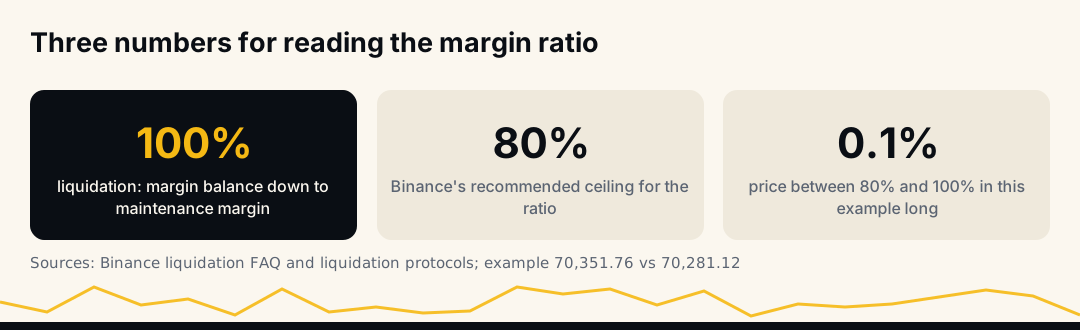
That is the practical lesson. A low ratio says you are fine right now; it says little about how far price can move. Distance to the liquidation price says that, and it is the number to watch.
Margin ratio and liquidation price are the same event
The ratio reaches 100% at exactly the price where margin balance equals maintenance margin, which is how the liquidation price is defined. For a single one-way position Binance's formula reduces to (wallet − size × entry) ÷ (size × rate − size) for a long. Here: (1,000 − 8,000) ÷ (0.0004 − 0.1) = 70,281.12.
Check it with the ratio: at 70,281.12, unrealized PnL is −971.89, margin balance 28.11, maintenance margin 0.1 × 70,281.12 × 0.4% = 28.11. Ratio 100%. Binance's liquidation protocols say positions are liquidated when the mark price reaches the liquidation price; the two descriptions meet at the same tick. Everything that moves the liquidation price, covered in why your liquidation price changes on Binance, moves the margin ratio too.
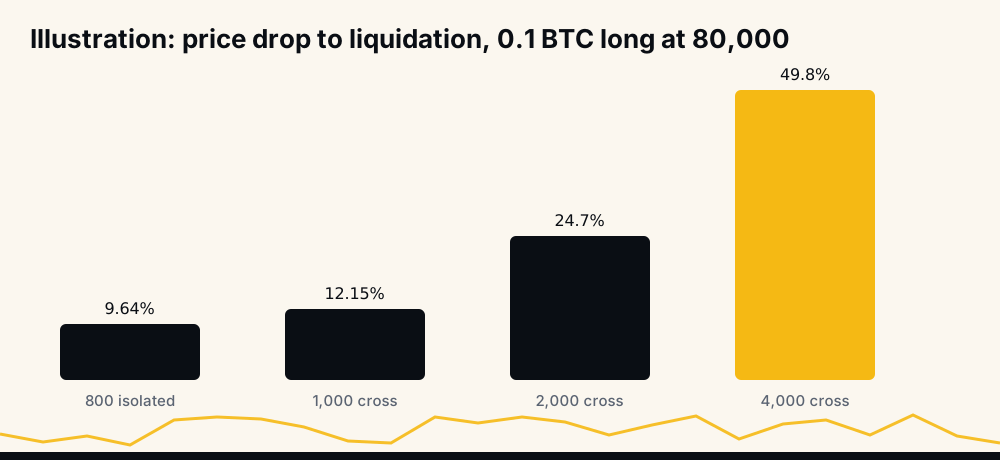
More wallet behind the same position pushes both away. Here is how far price can fall before liquidation for the same 0.1 BTC long with different amounts of margin behind it.
Cross, isolated and Multi-Assets mode
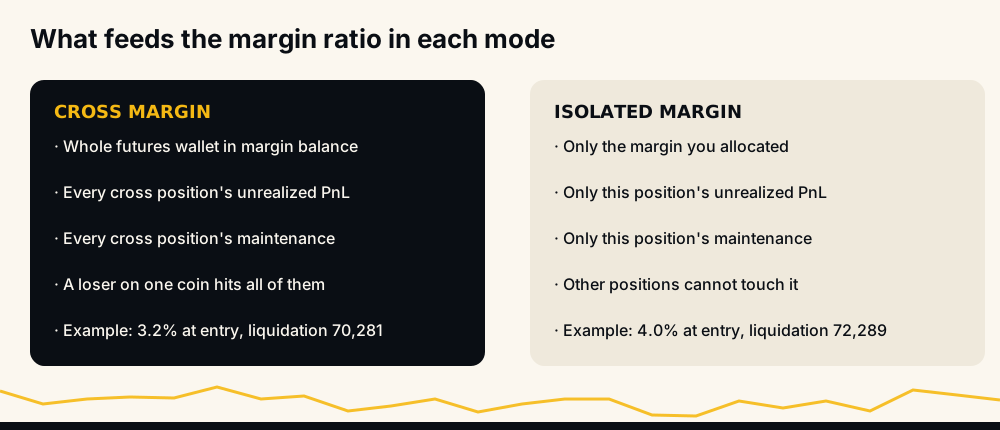
Cross margin pools the wallet. Every cross position's maintenance margin is in the top half and every cross position's unrealized PnL is in the bottom half, so a loser on one coin raises the ratio for all of them.
Isolated margin checks a position on its own: the margin you allocated plus its unrealized PnL against its own maintenance margin. Binance's liquidation FAQ notes that isolated positions get "different liquidation prices depending on the margin allocated to each position." Applying the ratio to the example with 800 USDT isolated, it starts at 4.0% and reaches 100% at 72,289.16, about 2,000 USDT of price sooner than the 1,000 USDT cross version. The full trade-off between the two modes is in isolated vs cross margin on Binance.
Multi-Assets mode uses an account-level version. Binance's FAQ "How to Calculate Margin Ratio in the Multi-Assets Mode" gives "Account Margin Ratio = Account Maintenance Margin / Account Equity", summed across cross positions in USD. Its own examples: 199.596 ÷ 416.02 = 47.98%, and with unrealized losses 199.61 ÷ 321.515 = 62.08%. "Once the margin ratio reaches 100%, all positions will be liquidated."
What raises your margin ratio
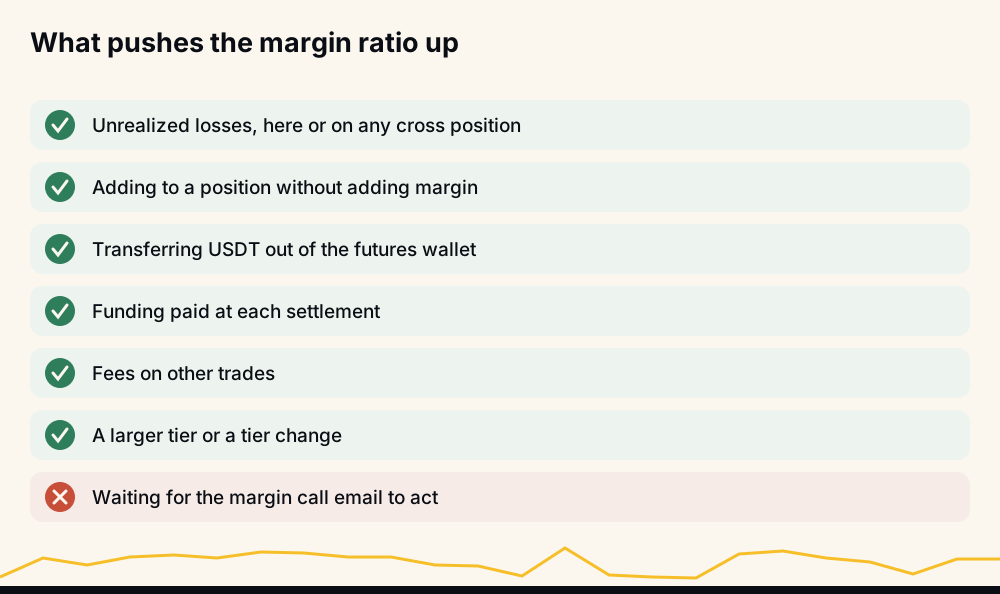
Anything that shrinks the margin balance or grows the maintenance margin:
- Unrealized losses, on this position or, in cross mode, any other.
- Adding to the position: more notional, more maintenance margin, and on cross no new wallet behind it.
- Transferring funds out of the futures wallet.
- Funding paid: 0.01% on 8,000 USDT of notional is 0.80 USDT a settlement, taken from the wallet. See Binance funding rate explained.
- Trading fees on other trades, since commission comes out of the wallet balance.
- A higher tier, when the position grows past a boundary or Binance changes a coin's tiers.
Unrealized profit on a cross position lowers the ratio for the whole wallet. Close that winner and its profit moves into the wallet balance while its maintenance margin disappears, so the ratio falls a little further.
How to lower your margin ratio on Binance
People search for "how to increase margin ratio" when they mean making it safer, which on Binance means lowering it. The levers are the formula's two halves:
- Add to the margin balance: transfer USDT into the futures wallet (cross), or add margin to an isolated position from the Positions tab.
- Cut the maintenance margin: close part of the position. Halving the example long halves its maintenance margin and its loss rate.
- Close the losers that drag a cross wallet, before they take the winners with them.
- Use a stop-loss that sits well inside liquidation, so the position closes before the ratio's vertical stretch. How to set a stop-loss in crypto covers placement.
Lowering leverage does not move the maintenance margin, which depends on notional. It only changes how much initial margin is locked, and Binance's leverage FAQ notes you cannot reduce leverage on an open isolated position. If adding margin is refused, the usual reason is in margin is insufficient (-2019).
What is a safe margin ratio on Binance?
Binance's liquidation protocols FAQ (updated 4 January 2026) says: "It is recommended to keep a margin ratio below 80%." That is a ceiling to stay under, and as the example shows, it can be very close to liquidation.
Do not rely on the warning emails either. The same FAQ says Binance will use reasonable endeavours, with no obligation, to send margin call and liquidation call notices, and that if the two come too close together, only the liquidation call is sent.
A more useful safety test is distance: how far, in percent, the mark price is from your liquidation price, compared with how far the coin moves in a bad day. For a single long with one maintenance rate and no maintenance amount, the two are linked exactly: distance to liquidation (as a share of the liquidation price) = rate × (1 − ratio) ÷ (ratio − rate). At a 0.4% rate, a 10% ratio leaves only about 3.75% of price; on a coin with a 2.5% rate, a 20% ratio leaves about 11.4%. The same ratio means different room on different coins. A related number, return on margin, is worked through in Binance futures PnL and ROE calculation.
Checking margin ratio in the app and the API
Binance's futures blog lists the margin ratio among the details shown in the Positions tab, next to entry price, mark price and unrealized PnL.
In the API, GET /fapi/v3/account returns totalMaintMargin and totalMarginBalance, both in USDT in single-asset mode, and per position maintMargin, isolatedMargin and isolatedWallet. With only cross positions open, totalMaintMargin ÷ totalMarginBalance follows the same formula as the panel. The user-data stream also has a MARGIN_CALL event. Like the emails, it is a warning that may or may not arrive in time, so a script that watches the ratio itself is more dependable.
How HafizeBot's autotrader fits
HafizeBot's autotrader places orders on your own Binance account, under limits you set: /setMarginType (ISOLATED by default, or CROSSED), /setLeverage, /setPositionSize, /setPositionLimit for how many positions can be open at once, and /setStopLoss. Position size and the position limit decide how much notional, and so how much maintenance margin, the wallet carries.
On isolated margin, the bot refuses a stop-loss that sits beyond about 70% of the distance to losing the whole margin at your leverage, because Binance would liquidate first; at 10x the widest stop it accepts there is 7%. On cross it accepts the stop and warns you. The key needs futures trading only; use one with withdrawals off.
The signals are AI-generated, built from 240+ indicators, formulas and components. The live performance page counts every missed signal against the target-hit rate (97.7% of 4,220 signals in September 2026), and the monthly reports hold the 2021 to 2024 archive.
Frequently asked questions
What is margin ratio on Binance Futures? It is maintenance margin divided by margin balance, shown as a percentage. It tells you how much of your margin balance the minimum requirement already uses. At 100% Binance liquidates.
How is margin ratio calculated on Binance? Add unrealized PnL to the wallet balance to get the margin balance. Compute maintenance margin as notional at mark price × the tier rate − the maintenance amount. Divide the second by the first.
What is a safe margin ratio on Binance? Binance recommends staying below 80%. Because the ratio rises very fast near the end, a ratio far below that, together with a comfortable distance to the liquidation price, is the better test.
Is a higher margin ratio better on Binance? No, on a standard futures account a higher margin ratio means more risk. Binance's Portfolio Margin account uses a different ratio where higher is safer, so check which account type a figure comes from.
How do I lower my margin ratio quickly? Transfer USDT into the futures wallet, add margin to an isolated position, or close part of a position. Closing losing cross positions also helps, because their losses count against every cross position.
Why did my margin ratio go up when the price did not move? Something else moved one half of the formula: funding paid, fees on another trade, a transfer out, a new position, another cross position losing, or a tier change on the coin.
The short version
Margin ratio = maintenance margin ÷ (wallet balance + unrealized PnL). 100% is liquidation, below 80% is Binance's advice, and the curve between them is steep enough that distance to the liquidation price is the better gauge. Sources: Binance's liquidation, margin requirement, leverage and margin, and Multi-Assets FAQs, its futures blog and the USDⓈ-M API documentation.
To see signals as they are sent, the free channel t.me/getbinancefutures posts the stronger ones (strength 3 and up) 20 minutes after VIP. A 7-day trial of VIP Tier 1 runs autotrading capped at 10 USDT of margin per entry and 3 open positions; VIP is 50, 100 or 200 USDT a month through /join in @hafizebot.
This is not investment advice; leveraged futures can lose your whole margin, so trade only what you can afford to lose.