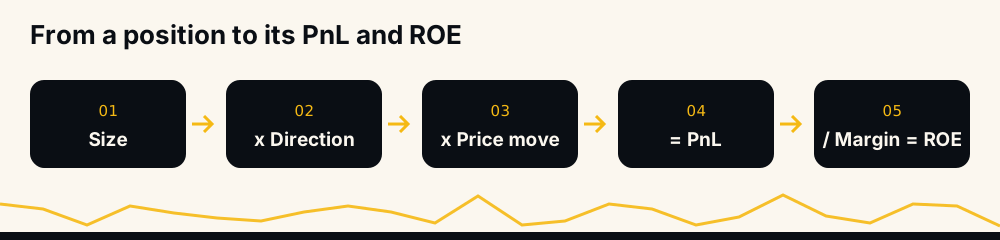
On Binance USDⓈ-M Futures, PnL = position size × direction × (exit or mark price − entry price), with direction 1 for a long and −1 for a short. ROE (Binance labels it ROI%) = PnL ÷ initial margin, and initial margin is size × entry price ÷ leverage. Leverage changes ROE but never the PnL in USDT. Unrealized PnL leaves fees and funding out; closed positions count them.
Every number below can be redone with a calculator. The formulas come from two Binance help pages: "How to Calculate Profit and Loss for Futures Contracts" (updated 2 February 2026) and "How to Use the Binance Futures Calculator" (updated 9 January 2026). Prices in the examples are illustrative, and every formula is quoted the way Binance writes it, so you can put the help page next to this one and follow along line by line.
The two formulas Binance uses
Binance's PnL page writes unrealized PnL for a USDⓈ-M contract as:
Unrealized PnL = size × direction × (mark price − entry price)
Its calculator page gives the margin side: initial margin = size × entry price × IMR, where IMR = 1 ÷ leverage, and ROI% = PnL ÷ initial margin. Same figure, two names. Binance's own pages say ROI; most traders say ROE.
One detail matters before you compare with the app. The PnL page labels the ROI denominator "Entry Margin" but writes it as size × mark price × IMR. The calculator page uses size × entry price × IMR. At the moment you open, the two are identical. Then they drift.
Worked example 1: a BTCUSDT long, step by step
You buy 0.1 BTC of BTCUSDT at 80,000 USDT with 10x leverage. Four lines of arithmetic follow.
- Notional value: 0.1 × 80,000 = 8,000 USDT.
- Initial margin: 8,000 × (1 ÷ 10) = 800 USDT.
- Mark price rises to 82,000: PnL = 0.1 × 1 × (82,000 − 80,000) = 200 USDT.
- ROE on entry margin: 200 ÷ 800 = 25.00%.
With the PnL page's mark-price denominator, the margin is 0.1 × 82,000 × 0.1 = 820 and the ROE reads 200 ÷ 820 = 24.39%. If the figure on your screen sits between the two, check which basis your Positions tab is set to before suspecting the maths.
Binance's own check case is simpler: a long of 1 BTC from 50,000 to 55,000 is (55,000 − 50,000) × 1 = 5,000 USDT.
Worked example 2: an ETHUSDT short
Now the other side. You sell 2 ETH of ETHUSDT at 3,000 USDT on 5x.
- Notional 6,000 USDT, initial margin 6,000 ÷ 5 = 1,200 USDT.
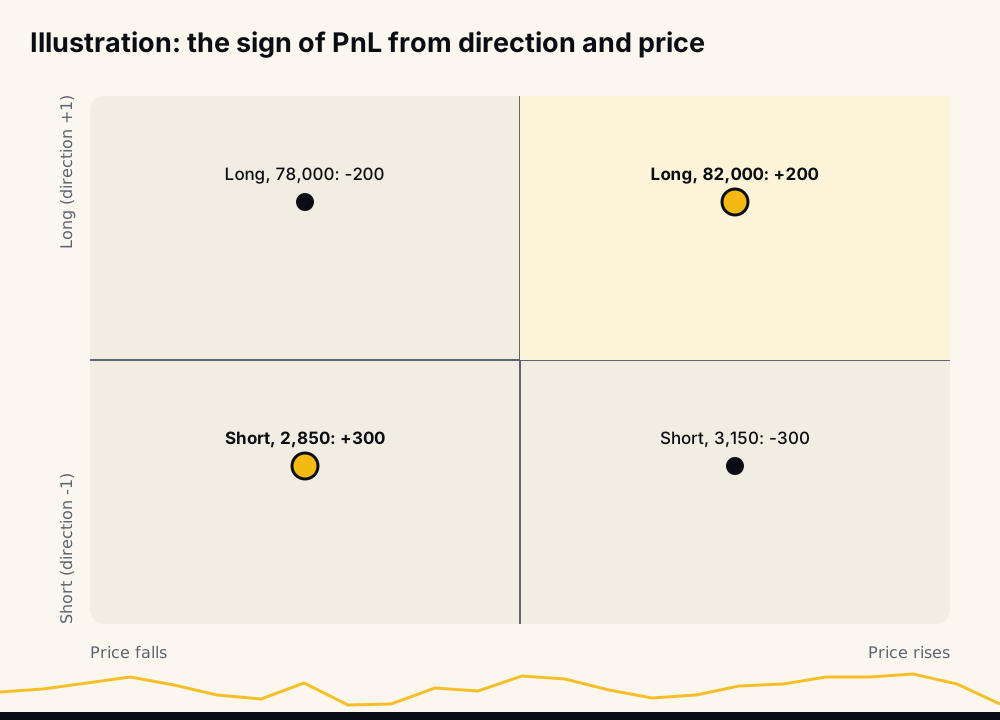
- Mark falls to 2,850: PnL = 2 × (−1) × (2,850 − 3,000) = +300 USDT, ROE 300 ÷ 1,200 = +25.00%.
- Mark rises to 3,150 instead: PnL = 2 × (−1) × (3,150 − 3,000) = −300 USDT, ROE −25.00%.
The direction term does all the work for a short. Drop it and a winning short shows up on your sheet as a loss of exactly the same size, which is the most common spreadsheet error in futures. Binance's short example writes it the same way: (45,000 − 50,000) × −1 = 5,000 USDT of profit on 1 BTC.
Why leverage changes ROE and leaves PnL alone
Leverage sits only in the denominator. Take the same 0.1 BTC long and the same move to 82,000: PnL is 200 USDT at every leverage; the margin shrinks as leverage grows, so ROE scales up with it.
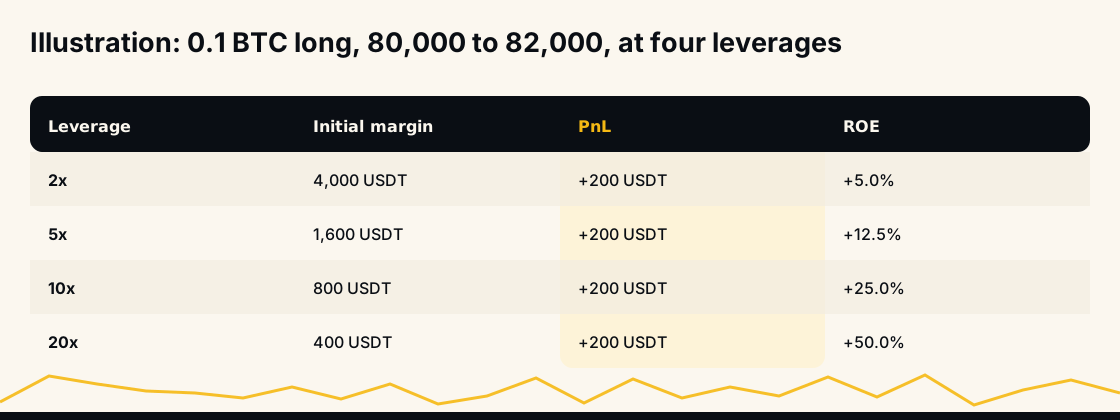
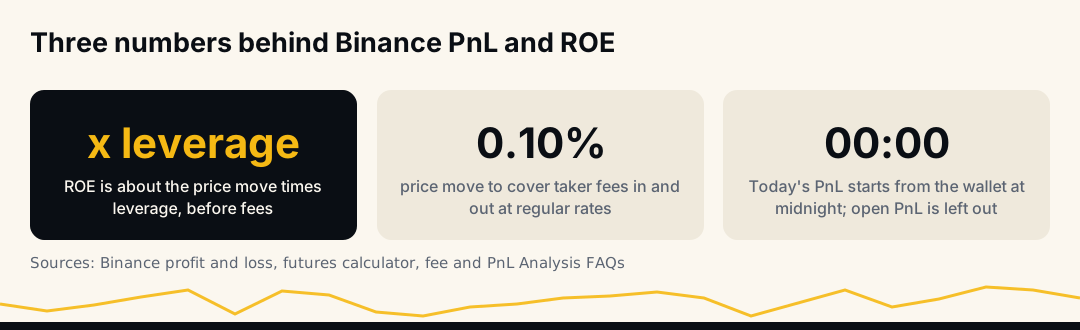
A shortcut follows from the formulas: ROE ≈ price move × leverage. A 2.5% move at 10x is 25%; at 20x it is 50%. It cuts both ways. A 2.5% move against you at 20x is −50% of the margin, and Binance liquidates a position before the loss reaches the whole margin, as why your liquidation price changes works through.
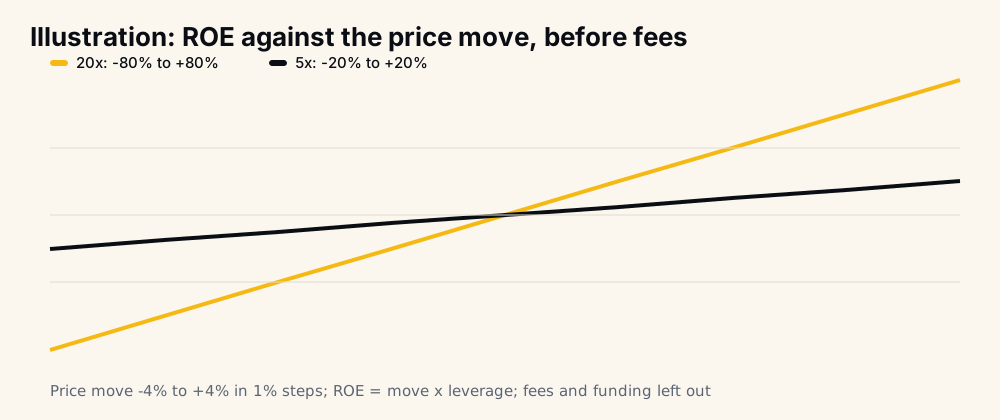
So a high ROE mostly measures leverage. Two traders who caught the same move with the same 200 USDT of profit can show 5% and 50%. For choosing leverage from risk rather than from the ROE it displays, see what leverage to use on crypto signals.
Mark price or last price: which PnL you are looking at
Binance computes unrealized PnL from the mark price and realized PnL from the last price, the price your orders actually fill at. The mark price is a fair-value price built to resist a single wick; mark price vs last price on Binance covers how.
The PnL page also lets you switch: in the Positions tab, click PnL(ROI%) and choose the price basis. The same formula applies, with last price in place of mark.
In example 1, if the last price is 82,100 while the mark is 82,000, the mark-based PnL reads 200 USDT and the last-price PnL reads 0.1 × (82,100 − 80,000) = 210 USDT. Neither is wrong. What you get when you close is set by your fill price, then reduced by the closing fee.
Does Binance PnL include fees?
The unrealized PnL formula has no fee term, so the open position's number ignores the opening fee you already paid and the closing fee still to come. Nor is funding.
Binance's fee FAQ (Fee Structure & Fee Calculations, updated 1 May 2026) gives a regular user's rates in its examples: "a Regular User's maker fee is 0.02% and a Regular User's taker fee is 0.05%". Fees are charged on notional value, so they grow with leverage even though PnL does not. Rates by VIP level, the BNB discount and which orders count as maker are all in Binance futures fees explained.
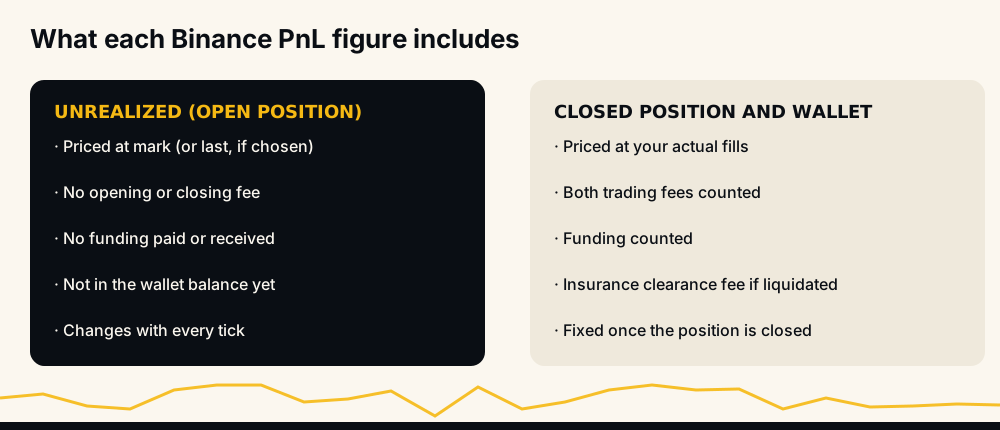
The wallet sees everything. Binance's futures blog gives the wallet balance as total net transfer + total realized profit + total net funding fee − total commission. In the API, GET /fapi/v1/income lists REALIZED_PNL, FUNDING_FEE and COMMISSION as separate income types, so you can add them up yourself.
Worked example 3: closing the long, with fees and funding
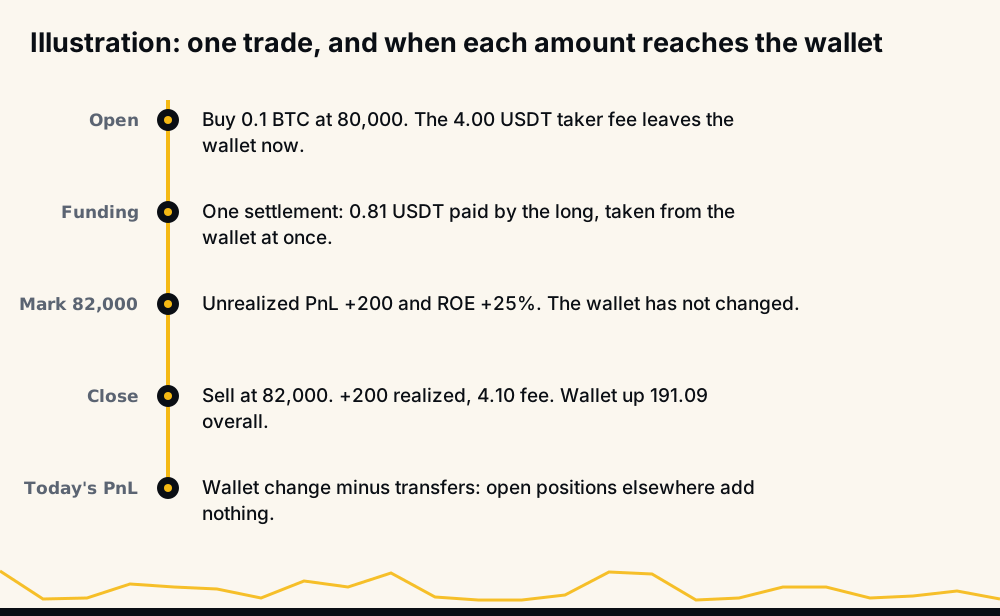
Close the 0.1 BTC long from example 1 at 82,000, with market orders both ways (taker), after one funding payment.
- Opening fee: 8,000 × 0.05% = 4.00 USDT.
- Closing fee: 0.1 × 82,000 = 8,200 notional × 0.05% = 4.10 USDT.
- Funding: one settlement at 0.01% on about 8,100 USDT of notional, paid by the long = 0.81 USDT (illustrative rate).
- Price PnL: 200.00 USDT. Net: 200.00 − 4.00 − 4.10 − 0.81 = 191.09 USDT.
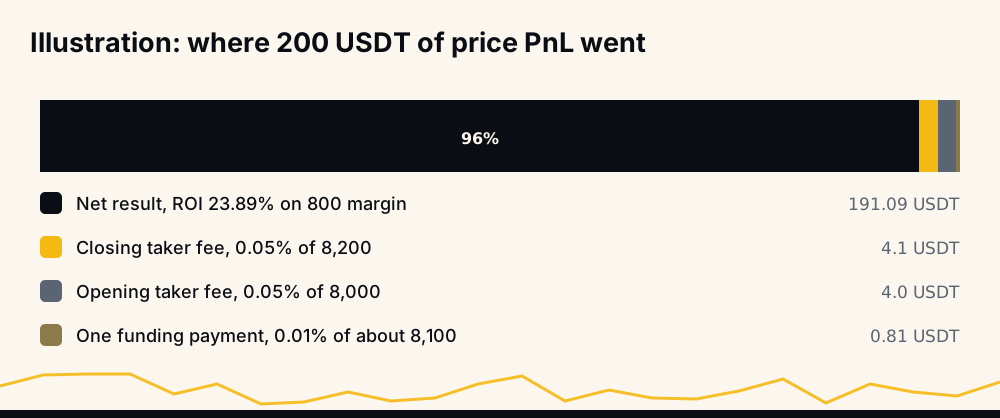
Binance's PnL page now describes an updated ROI for this case:
ROI = (realizedPNL + commissionFeeTotal + fundingFee + insuranceClearFee) ÷ (entryPrice × openedVolume ÷ leverage)
Fees and funding paid enter as negative amounts, which is how they appear in your transaction history. Here that is 191.09 ÷ (80,000 × 0.1 ÷ 10) = 191.09 ÷ 800 = 23.89%, against the 25.00% the open position showed. Binance says the change gives "a clearer picture of your net returns on each position."
The insurance clearance fee only appears after a liquidation. On a normal close it is zero.
The break-even price after fees
A round trip costs two fees. So a long has to rise a little before it is flat. With a fee rate f on each side, the long breaks even at:
Break-even = entry × (1 + f open) ÷ (1 − f close)
For the 80,000 long with taker fees both ways: 80,000 × 1.0005 ÷ 0.9995 = 80,080.04, a 0.10% move. Close with a resting limit order (maker, 0.02%) instead and it is 80,000 × 1.0005 ÷ 0.9998 = 80,056.01.
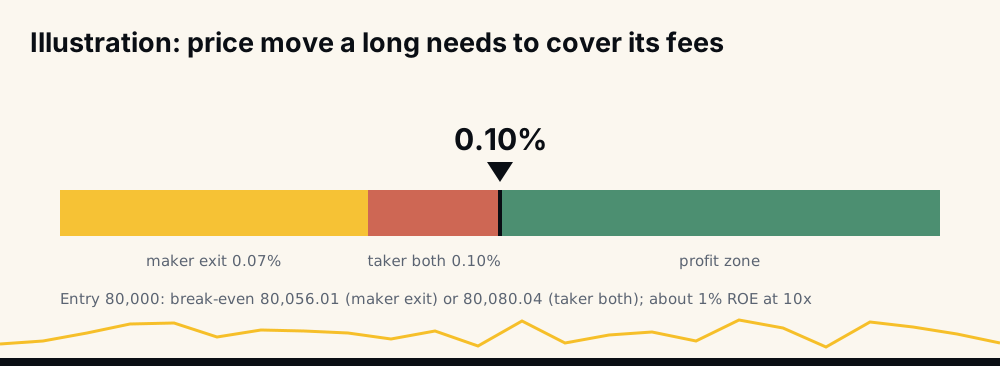
At 10x, that 0.10% is about 1% of ROE. It is gone before the trade earns anything. For a short the signs swap: entry × (1 − f open) ÷ (1 + f close), so 79,920.04 with taker fees both ways.
Today's PnL and PnL Analysis are a different number
The PnL Analysis page and "Today's PnL" work differently. They do not add up position PnLs. Binance's FAQ "How Are PNL Calculated on Binance Futures and Options PNL Analysis" (updated 5 February 2026) defines it from the wallet:
PnL = ending wallet balance − beginning wallet balance (00:00 on the start date) − net inflow
It notes that the wallet balance "does not include unrealized profits/loss until the position is closed." So an open position up 150 USDT adds nothing to today's PnL, while funding paid on it does count.
Worked example 4: you start the day with 1,000 USDT in the futures wallet, close the trade from example 3 (+191.09 net), transfer in 500 and hold another position showing +150 unrealized. The wallet ends at 1,691.09, and today's PnL = 1,691.09 − 1,000 − 500 = 191.09 USDT. The 500 is a transfer. The 150 is not realized yet.
COIN-M contracts use the inverse formula
COIN-M contracts (BTCUSD and similar) are margined and settled in the coin, so PnL is computed from the reciprocal of price:
PnL (coin) = contract size in USD × ((1 ÷ entry price) − (1 ÷ exit price)), with a minus sign for shorts.
Worked example 5, Binance's own: a long of 100 contracts of 100 USD from 50,000 to 55,000 earns (1/50,000 − 1/55,000) × 10,000 = 0.0182 BTC. In USDT terms at 55,000, that is about 1,000 USDT, but the account books it in BTC, and the BTC itself moves in value.
Everything else here is USDⓈ-M.
Worked example 6: redo a position from the Positions tab
Try it on a position of your own. Illustrative numbers: a short of 150 XRP at an entry of 2.40, 10x, mark 2.31.
- Notional at entry: 150 × 2.40 = 360 USDT. Initial margin: 36 USDT.
- PnL: 150 × (−1) × (2.31 − 2.40) = +13.50 USDT.
- ROE: 13.50 ÷ 36 = 37.50% on entry margin; on the mark-price denominator, 13.50 ÷ (150 × 2.31 × 0.1) = 13.50 ÷ 34.65 = 38.96%.
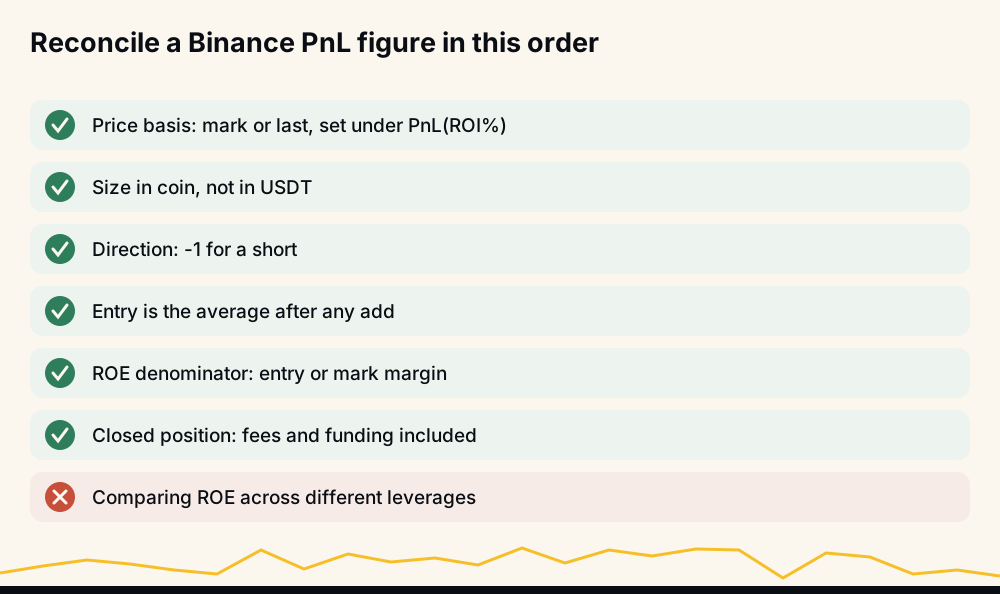
If your screen disagrees with both, it is almost always one of three things: a stale entry price after an add (the entry is an average), the wrong basis selected, or a closed position's net ROI compared with an open one's gross ROE. Binance's futures calculator, described in the FAQ linked at the top, runs the same PnL and ROE formulas before you place an order.
How HafizeBot's signals relate to your ROE
HafizeBot's signals are AI-generated, built from 240+ indicators, formulas and components, and each carries a target and a maximum hold. The live performance page shows, for every settled month, the target-hit rate and the "average move per settled signal", which is the unleveraged price move. In September 2026, 97.7% of 4,220 signals reached their target, with every missed signal counted against the rate.
That page says it directly: "A target-hit rate is not account profit: your own results depend on your leverage, stop-loss and position size." The formulas above are the bridge. Multiply a signal's move by your leverage and you have roughly your ROE before fees. Multiply it by your position size and you have the PnL in USDT, which is why position sizing decides more of your result than leverage does. A missed signal is scored as missed on the page and can still be open on an account, so the account side needs your own stop.
With autotrading, the bot places orders on your own Binance account under the settings you choose: /setLeverage, /setPositionSize, /setPositionLimit and /setStopLoss. Your positions, fills and fees are then in your own Binance history, where every formula in this article can be checked. The monthly reports hold the 2021 to 2024 archive as spreadsheets.
Frequently asked questions
How do you calculate PnL on Binance Futures? Multiply the position size by the price change and by the direction: 1 for a long, −1 for a short. A 0.1 BTC long from 80,000 to 82,000 is 0.1 × 2,000 = 200 USDT. Open positions use the mark price unless you switch the basis to last price.
What is the difference between ROE and PnL on Binance? PnL is the profit or loss in USDT. ROE (ROI% on Binance) is that PnL divided by the initial margin, so it depends on leverage. The same 200 USDT is 25% ROE at 10x and 50% at 20x.
Does Binance PnL include fees? Unrealized PnL does not include trading fees or funding. The updated ROI Binance shows for closed positions adds commission, funding and any insurance clearance fee, and the wallet balance always includes them.
Why is my ROE so high when the price barely moved? ROE is roughly the price move times leverage. A 1% move at 50x shows as 50% ROE, and the same 1% move against you is a 50% loss of margin. The PnL in USDT is the number to compare between trades.
What is today's PnL on Binance Futures? It is the change in your futures wallet balance since 00:00 on the day, minus transfers in. Because it is wallet-based, it counts closed trades, fees and funding, and leaves out unrealized PnL on positions still open.
What is unrealized PnL on Binance? It is the profit or loss an open position would have at the current mark price (or last price, if you choose that basis), before fees. It becomes realized when you close, at the price you actually fill.
The short version
PnL is size × direction × price change; ROE is PnL over initial margin, so leverage scales it and leaves the USDT figure untouched. Unrealized numbers ignore fees and funding; closed-position ROI and the wallet include them, which is why the two disagree by a few percent. Sources: Binance's profit and loss, futures calculator, PnL Analysis and fee FAQs, its futures blog, and the USDⓈ-M API documentation.
To watch signals as they arrive, the free channel t.me/getbinancefutures posts the stronger ones (strength 3 and up) 20 minutes after VIP. A 7-day trial of VIP Tier 1 runs autotrading capped at 10 USDT of margin per entry and 3 open positions; VIP is 50, 100 or 200 USDT a month through /join in @hafizebot.
This is not investment advice; leveraged futures can lose your whole margin, so trade only what you can afford to lose.