ADL on Binance is auto-deleveraging: the last step of liquidation, used only when a bankrupt position is bigger than the Futures Insurance Fund can absorb. Binance then closes opposing positions that are in profit, starting with the most profitable and most highly leveraged, at the bankrupt order's bankruptcy price, with no trading fee. That is why a winning trade can close without you touching it.
Below: when it happens, Binance's ranking formula with arithmetic you can redo, what the lights and the API tell you, and how to rank lower, all from Binance's own pages. It is written from running an autotrader on Binance USDⓈ-M Futures, where every position sits on a member's own account.
What is ADL in Binance Futures?
Binance's FAQ "What Is Auto-Deleveraging (ADL) and How Does It Work?" (updated 2026-01-13) calls ADL "the final step in the liquidation process", which "occurs only if the Futures Insurance Funds are unable to accept a bankrupt futures position."
In plain terms: someone on the other side of your trade lost more than their margin, the safety net could not cover it, and Binance closed part or all of your profitable position against theirs. You did nothing wrong. Your position was simply the best match in the queue.
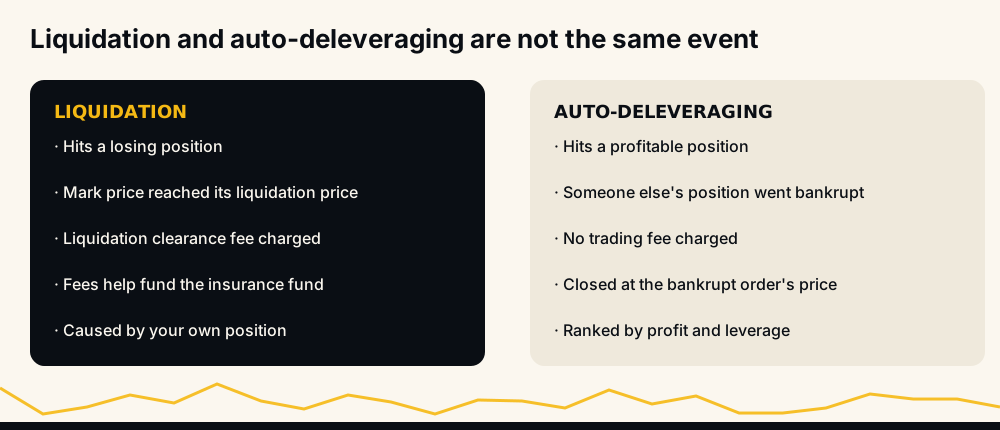
Do not confuse it with your own liquidation. A liquidation closes a losing position because its mark price reached the liquidation price; if that is what happened to you, read liquidated before your stop loss. ADL closes a winning one.
When does auto-deleveraging happen?
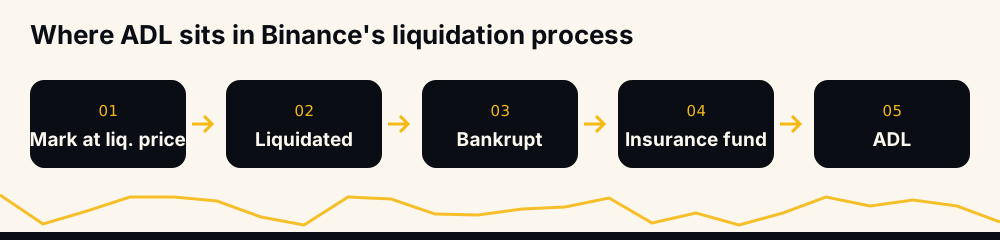
ADL sits at the end of a chain. Binance's liquidation protocols (updated 2026-01-04) describe the steps:
- Mark price reaches a position's liquidation price and the liquidation engine takes it over. Mark price, not last price, is the yardstick; see mark price vs last price on Binance.
- If the engine can close it with margin left, a liquidation clearance fee is taken and the position is done.
- If the trader's assets fall below zero, the position is bankrupt. Binance says "the Futures Insurance Fund will take over the liquidation positions at the bankruptcy price."
- If the fund cannot cover the losses, "the matching engine will automatically liquidate the Bankrupt Positions and some opposing non-bankrupt" traders' positions. That is ADL.
Binance's insurance fund FAQ (updated 2026-01-04) gives the trigger precisely: when the unrealized loss of bankrupt positions taken over by the engine "is larger than the available balance" of the relevant fund, "the liquidation engine can no longer trade that contract type" and ADL is engaged.
How rare is it? Binance does not say. Its Responsible Trading page says "it is not possible to fully avoid auto-deleverage liquidations" and that it is "striving to keep auto-deleverage liquidations to an absolute minimum". The fund is sized to a 99.9% confidence level, but Binance adds that this "is not related to the occurrence of ADL".
Why ADL hits winning positions
Every futures contract has two sides. When a long goes bankrupt, someone holds the matching short, and that short is in profit on the same move. If neither the bankrupt trader's margin nor the insurance fund can pay that profit, the only way to settle is to close the winning side at the bankrupt position's price.
ADL does not punish winners; it uses the positions opposite the loss. In Binance's ranking a profitable position gets a positive score, a losing one a negative score, so losing positions sit at the back of the queue.
How the Binance ADL ranking is calculated
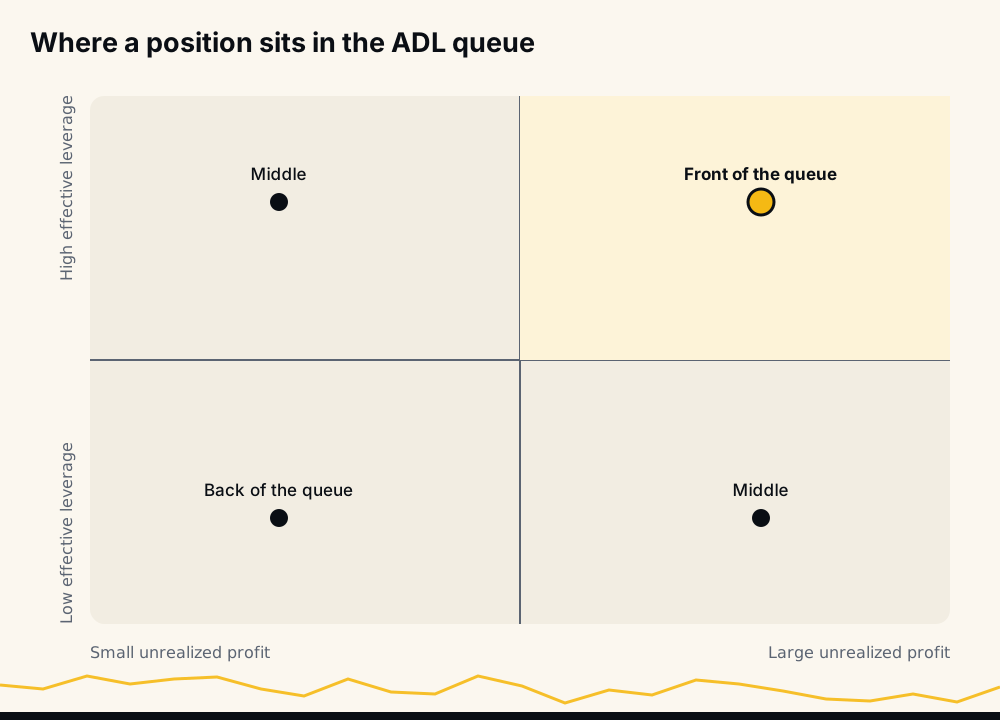
Binance says "positions that are more profitable and more highly leveraged will be queued for ADL liquidation first", and publishes the formula in the same FAQ:
- PnL percentage = Unrealized Profit ÷ abs(Position Notional)
- Effective leverage = abs(Position Notional) ÷ (Account Balance + Unrealized Profit)
- If PnL % ≥ 0: ranking = PnL % × Effective leverage
- If PnL % < 0: ranking = PnL % ÷ Effective leverage
- Leverage PnL quantile = rank(user.ranking) ÷ total user count
Position notional and PnL % are calculated per symbol; account balance plus unrealized profit at the account level.
Notice what "effective leverage" is: notional against what your account is actually worth. The number on the leverage slider doesn't enter into it. A 20x setting on a small position in a well-funded account can have low effective leverage.
The shortcut hidden in the formula
Multiply the two parts for a profitable position and the notional cancels:
PnL % × effective leverage = (profit ÷ notional) × (notional ÷ (balance + profit)) = profit ÷ (balance + profit)
So, for one position in an account, the ranking is the share of your account's value that is unrealized profit on that symbol. That's our arithmetic on Binance's formula; Binance doesn't word it this way.
A worked example: who is first in the queue?
Five illustrative traders, each with a 1,000 USDT balance and one position on the same contract:
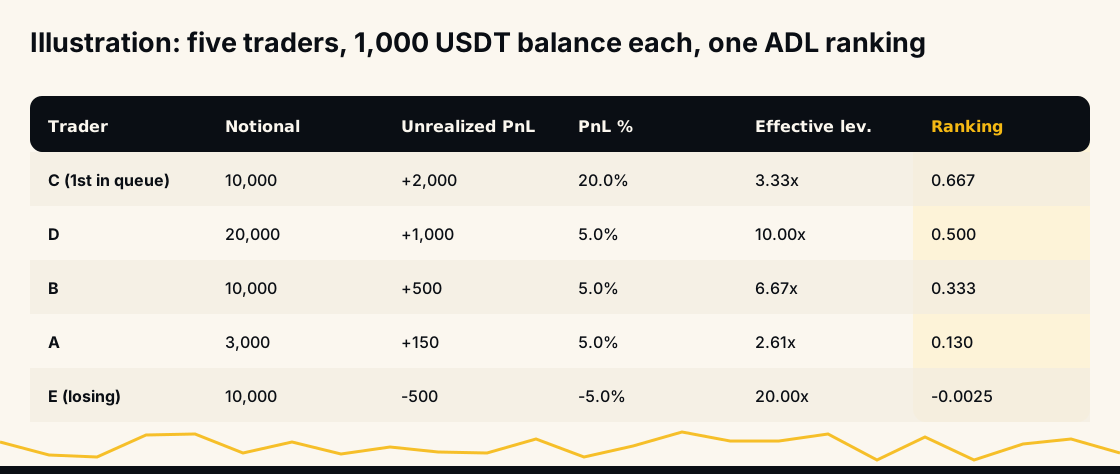
- C holds 10,000 USDT notional with +2,000 profit. PnL 20%, effective leverage 10,000 ÷ 3,000 = 3.33x, ranking 0.667. First in the queue.
- D holds twice the size with half the profit: 5% at 10x effective, ranking 0.500.
- B and A both show 5% PnL, but B's larger position against the same balance ranks 0.333 and A's 0.130.
- E is losing 500 USDT. Its ranking is −5% ÷ 20 = −0.0025, behind every winner despite 20x effective leverage.
Trader C is not the most leveraged; it ranks first because profit has become two-thirds of its account value. Holding a big winner raises your place in the queue even if you never touch the leverage setting.
The ADL indicator: reading the queue lights
Binance's FAQ says "the interface for each futures position will include an indicator of the likelihood that the position will be subject to ADL", and that imminent risk "will be clearly displayed". In the app, hover over ADL in the Positions tab to see your place, as Binance's futures trading guide (2023-05-02) describes.
The indicator is a row of lights. Binance's Responsible Trading page says it shows "a position's queue from lowest priority to highest priority", and "if all lights are lit, in the event of a liquidation, the position may be reduced." More lights mean you are nearer the front. Binance's text does not describe colours, so read the count rather than the shade.
The API gives the same queue as a number. Binance's USDⓈ-M documentation says "Values 0, 1, 2, 3, 4 shows the queue position and possibility of ADL from low to high", updated every 30 seconds.
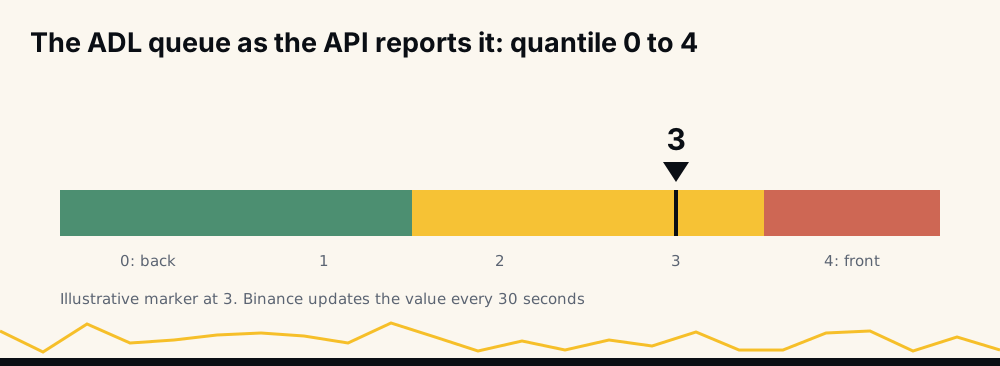
Lit lights are not a prediction. They say where you would stand if an ADL event happened on that contract. The queue is used only when the insurance fund falls short.
What you get when your position is auto-deleveraged
Binance's ADL FAQ is specific about the outcome:
- Price: the position "will be closed at the Bankruptcy Price of the liquidated losing order". Binance warns that "the Bankruptcy Price may be out of the contract's market price range", so your close can print away from the chart.
- Fees: "No trading fee will be charged to the trader whose profitable position is subject to ADL." For what fees normally cost, see Binance Futures fees explained.
- Open orders: cancelled for all tokens in cross margin, or for the same token in isolated margin.
- Notice: "the affected trader will immediately be sent a notice setting out the amount and liquidation price."
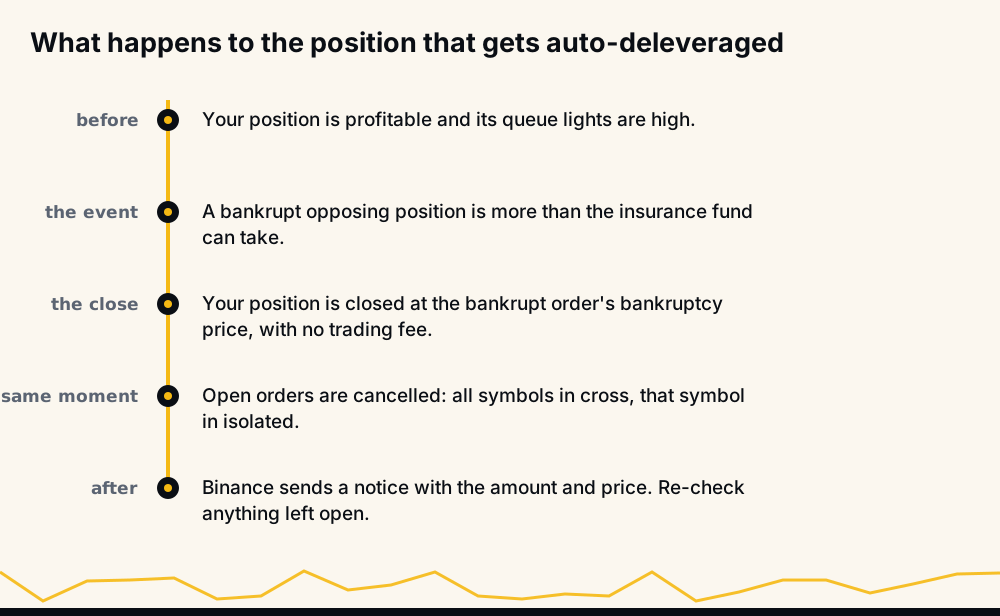
The cancelled orders matter most. Binance's pages speak of positions being "reduced", so if only part of yours was closed, the rest is still open with its stop-loss and take-profit gone, and in cross margin your orders on other symbols went too. Re-place protection first, then look at what you lost. Whatever profit the position shows at the closing price is realized; what you lose is the rest of the move you were waiting for.
Which contracts are more exposed to ADL?
- Coin-margined contracts. Binance's FAQ says they "are more likely to be subject to ADL than USD-margined contracts", because all coin-margined contracts using the same collateral "will share one Futures Insurance Fund".
- Shared pools. USDⓈ-M funds are pooled too. Binance's insurance fund FAQ gives an example: "BTC, ETH, and BNB USDT-margined contracts share the same insurance fund", with other contracts on other pools. Balances are under Data → Futures Data → Insurance Fund History.
- The ADL guarantee. Binance's announcement (updated 2025-08-15) guarantees no ADL on BTCUSDT, ETHUSDT and BNBUSDT perpetuals, BTCUSDC and ETHUSDC perpetuals, and the BTCUSDT and ETHUSDT quarterlies, while their combined open interest stays within 10 billion USDT. If ADL losses still occur there, Binance says it will compensate users from each contract's insurance fund.
- A per-symbol rating. Since 2025-11-19 the API offers
GET /fapi/v1/symbolAdlRisk, rating each symbol's ADL risk high, medium or low every 30 minutes. Binance says it weighs the insurance fund balance, position concentration, order book depth, volatility, average leverage, unrealized PnL and margin utilization.
How to check ADL through the API
Three USDⓈ-M endpoints cover it, all from Binance's developer documentation.
- Queue position:
GET /fapi/v1/adlQuantile, weight 5, optionalsymbol. Each entry holdsLONG,SHORTandBOTHvalues from 0 to 4. In hedge mode with cross margin,HEDGEreplacesBOTHand is only a marker to ignore, and with both sides open,LONGandSHORTshow the same value. The modes are covered in hedge mode vs one-way mode on Binance. - Past events:
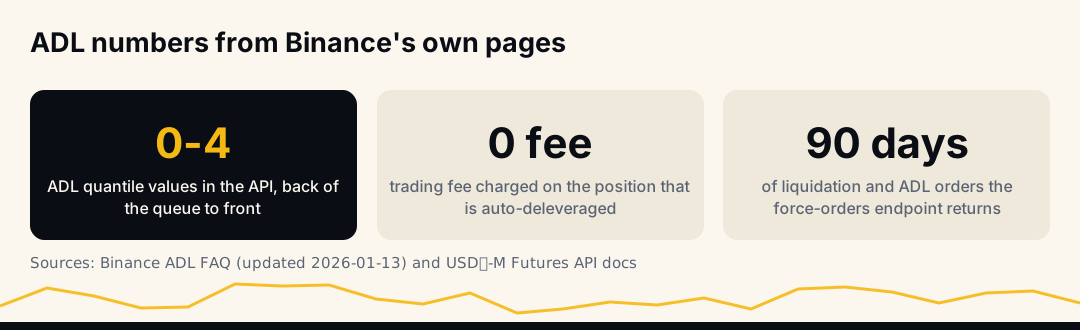
GET /fapi/v1/forceOrders("User's Force Orders") withautoCloseType=ADLreturns ADL orders;LIQUIDATIONreturns liquidations. Without astartTimeit covers the 7 days beforeendTime, and data goes back 90 days. Weight is 20 with a symbol and 50 without, which counts against the limits in Binance API rate limits that break trading bots. - Live: in the user data stream's order update, Binance's sample marks the client order ID
adl_autocloseas an "ADL auto close order", next toautoclose-for liquidations.
A script that polls the quantile can warn you when a position reaches 3 or 4.
How to see an ADL in your Binance history
Start from Binance's notice, which gives the amount and price. Then find the closing trade in your futures Trade History at that time: a close you did not place, at a price that may sit away from the chart. If you had a take-profit or stop on that symbol, Order History will show it cancelled at the same moment.
The force-orders endpoint is the cleanest record if you use the API, since it separates ADL from liquidation.
How to avoid ADL on Binance
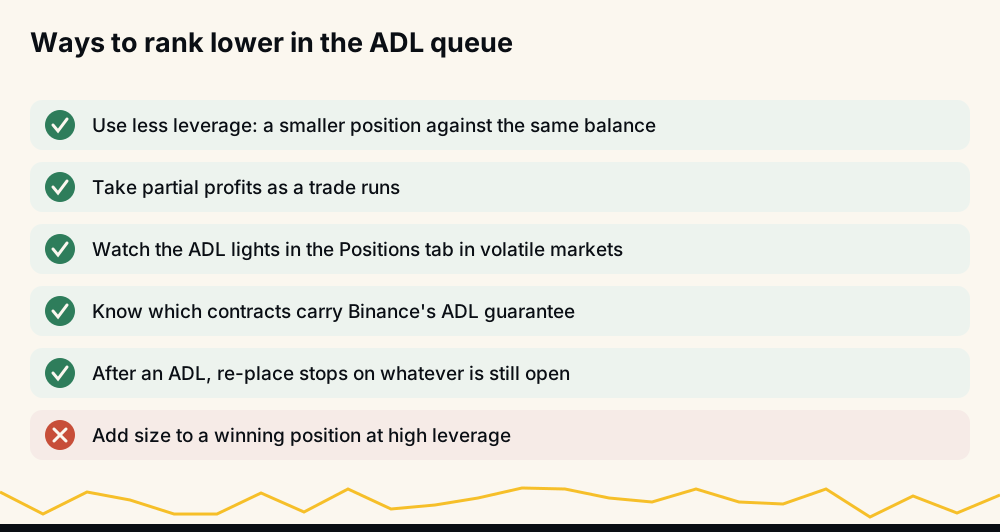
You cannot opt out, but you can rank lower. Binance's own advice is that traders at risk "could prevent it from happening by reducing their leverage". The ranking formula shows why, and adds a few more levers:
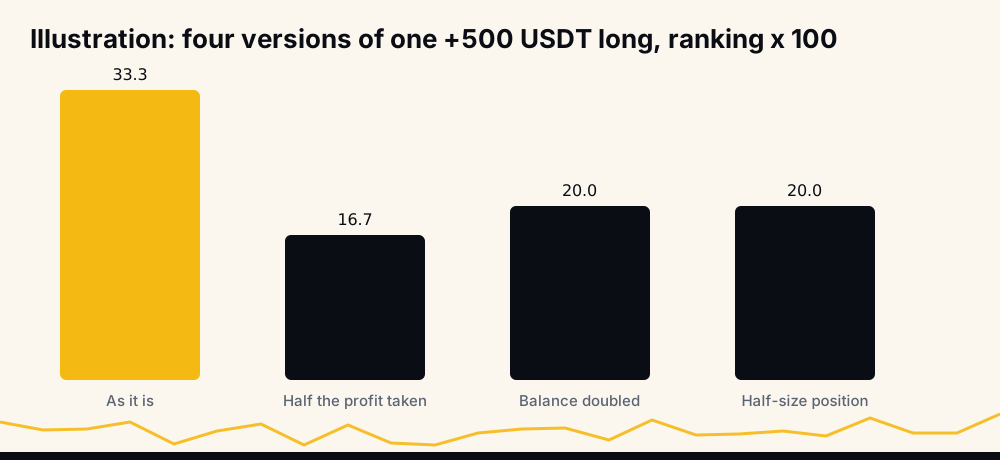
- Smaller position against the same balance. Lower leverage means less notional per USDT of balance, so less profit for the same move and a lower ranking.
- Take partial profits. Closing half moves that profit into your balance and halves the open profit. In the illustration, 0.333 drops to 0.167.
- More balance behind the position lowers effective leverage.
- Watch the lights in the Positions tab during violent markets, and check the per-symbol rating if you trade through the API.
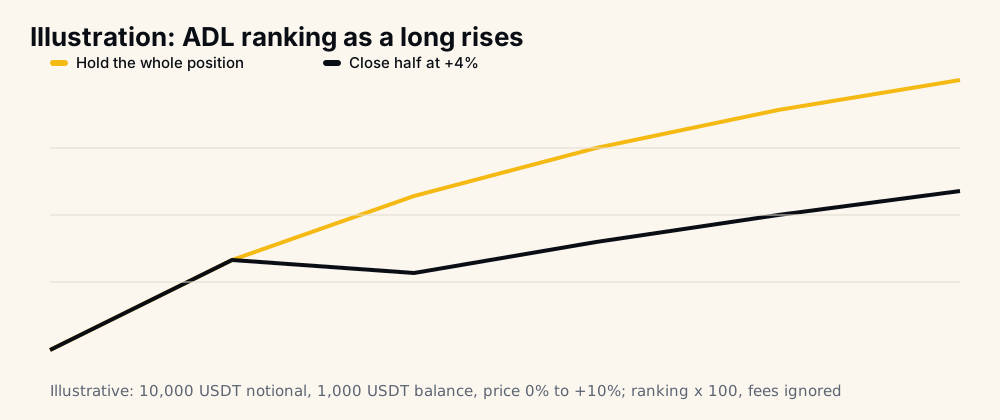
Lower leverage also moves your own liquidation price further away; see why your liquidation price changes and how leverage trading works in crypto.
How HafizeBot's autotrader fits
HafizeBot sends AI-generated signals from a model that evaluates 240+ indicators, formulas and components across 523 Binance USDⓈ-M pairs. Members who switch on autotrading set their own leverage, position size, maximum open positions and stop-loss, on their own Binance account in One-way mode. The key needs futures trading only; use a key with withdrawals off, because HafizeBot never withdraws or transfers funds.
So ADL exposure follows the member's own settings: the bot does not pick your leverage. An ADL on a member's position happens on their own Binance account and shows in their Binance history. The bot also asks members to lower a stop that sits beyond what their leverage allows before liquidation, the rule covered in Binance Futures leverage limits.
Broadcast signals carry a target and a maximum hold, not a stop. The live performance page, regenerated hourly since June 2026, lists wins, missed and open signals and counts every missed signal against the target-hit rate. The monthly reports hold the June 2021 to February 2024 archive.
Frequently asked questions
What is ADL in Binance futures? ADL, auto-deleveraging, is Binance's last step in liquidation. When a bankrupt position is bigger than the insurance fund can absorb, Binance closes opposing profitable positions to settle it, starting with the most profitable and most highly leveraged.
Why did Binance close my profitable position? Most likely ADL: a trader on the other side went bankrupt and the insurance fund could not take the position. Your position was closed at the bankrupt order's bankruptcy price with no trading fee, and Binance sends a notice with the amount and price.
What do the ADL lights mean on Binance? They show your position's place in the auto-deleveraging queue, from lowest to highest priority. Binance says that if all lights are lit, your position may be reduced if an ADL event happens. Lit lights show a queue position. They don't forecast an ADL event.
How is the ADL queue ranked? For a profitable position Binance multiplies PnL percentage by effective leverage; for a losing one it divides. Effective leverage is notional divided by account balance plus unrealized profit, so a large open profit pushes you forward even at modest leverage.
Do you pay fees when you are auto-deleveraged? No trading fee is charged to the trader whose profitable position is closed by ADL, according to Binance's ADL FAQ. Your open orders are cancelled, though: on every symbol in cross margin, on that symbol in isolated margin.
How can I avoid ADL on Binance? You cannot opt out, but you can rank lower: use less leverage, take partial profits, keep more balance behind positions, and watch the ADL lights in the Positions tab. Binance guarantees no ADL on certain BTC, ETH and BNB contracts while their open interest stays within its limit.
The short version
ADL closes winning positions only when a bankrupt one is too big for the insurance fund. The queue ranks you by profit times effective leverage, the lights and the API's 0 to 4 quantile show where you stand, and the close comes at the bankruptcy price with no trading fee but with your open orders cancelled. Sources: Binance's ADL, liquidation and insurance fund FAQs, its Responsible Trading page, the ADL guarantee announcement and its USDⓈ-M API docs.
To let a bot trade under your own leverage and stop, try 3 days of VIP Tier 1 free with /trial in @hafizebot; trial autotrading is capped at 10 USDT of margin per entry and 3 open positions. VIP is 50, 100 or 200 USDT a month via /join; all tiers get signals instantly and differ in autotrading limits. The free channel t.me/getbinancefutures posts the stronger signals (strength 3 and up) 20 minutes after VIP.
This is not investment advice; leveraged futures can lose your whole margin, so trade only what you can afford to lose.