A martingale strategy in crypto futures doubles the position after every move against you, so one small bounce recovers all the losses and books a small profit. It works until a trend runs longer than your wallet can double. On a worked Binance long below, seven doublings turn a 50 USDT entry into 6,350 USDT of exposure to chase a 63.50 USDT gain, and a 29% fall from the first entry ends a 1,000 USDT account.
The rest of the article is arithmetic you can redo: the ladder, the bounce it needs, the drop that ends it, why futures make it harder, what Binance's own DCA bot calls the same idea, and what to do instead if you average down at all.
What is martingale in trading?
The name comes from an old betting system. You bet one unit on a coin flip. If you lose, you bet two. Lose again, bet four. The first win pays back every earlier loss plus one unit, because each bet is one unit larger than all the previous bets combined.
In trading, the "bet" is position size and the "loss" is price moving against you. A martingale trader opens a long, and each time price drops a set distance, adds a new entry twice the size of the last one. The average entry sinks toward the current price with every add, so a modest bounce is enough to close the whole thing in profit.
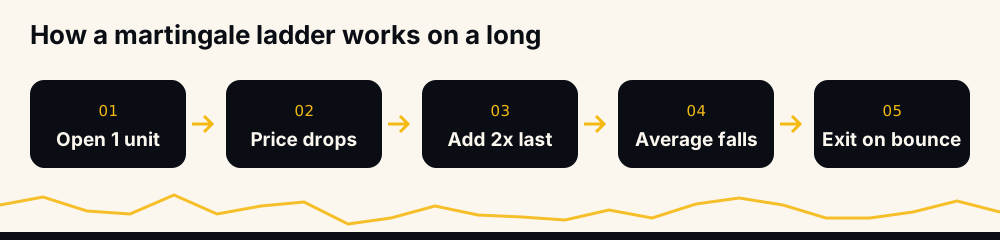
Two features define it, and both matter later:
- The size grows geometrically. With a multiplier of 2, entry number n is 2^(n−1) times the first.
- There is usually no stop. The plan assumes a bounce always comes. A stop would turn the ladder into a sized loss, which is a different strategy.
A martingale ladder on a Binance futures long
Here is a worked example with illustrative numbers. A coin trades at 100 USDT. You open a 50 USDT long (notional, the position's value) and add double the last size every time price falls another 3 USDT. Fees and funding are left out for now.
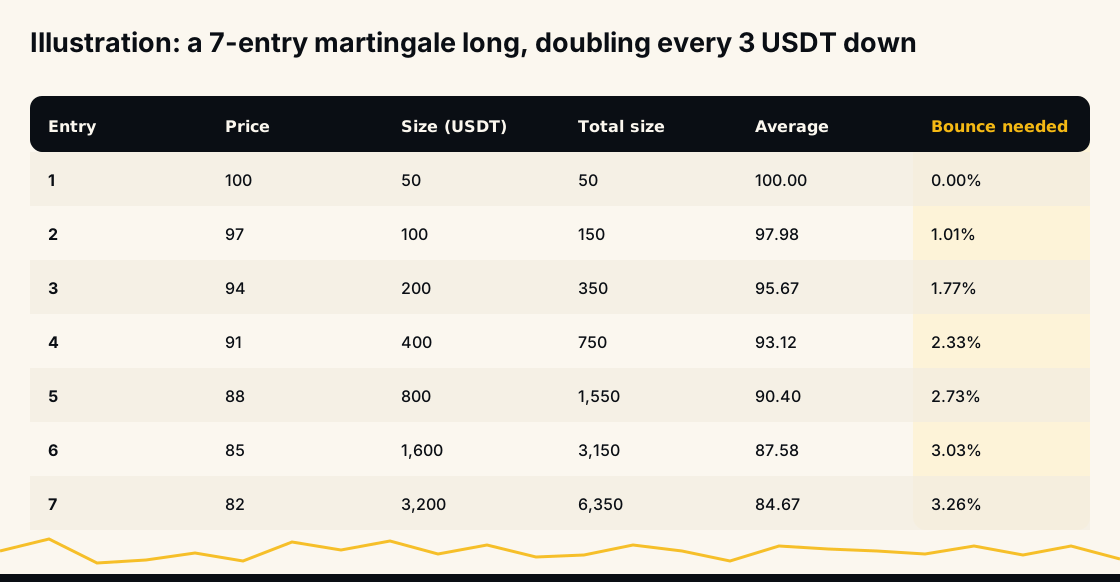
After seven entries, at a price of 82, you hold 6,350 USDT of position at an average of 84.67. Price only needs to climb back 3.26% to get you out even. The open loss at that moment is about 200 USDT, which looks small next to the exposure.
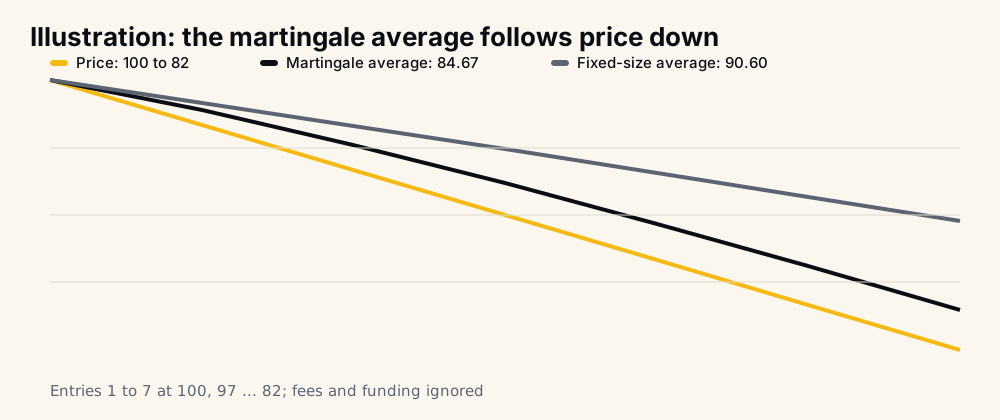
The average entry does what martingale promises: it follows price down closely. A fixed-size trader adding 50 USDT at the same seven prices would sit at an average of 90.60 and need a 10.49% bounce. The martingale trader needs a third of that.
Why martingale looks like it works
Most of the time, a falling coin does bounce 3% at some point. That is why martingale bots post long streaks of small green closes and why "does martingale strategy work in trading" is a question people keep typing. Over a quiet month, the answer looks like yes.
Look at what the green close in the ladder pays. Exiting at 1% above the 84.67 average books 63.50 USDT on 6,350 USDT of exposure. Taker fees at Binance's regular 0.05% on the way in and out (see Binance futures fees explained) cost about 6.35 USDT of that, a tenth of the profit. The wins are small and frequent; the one loss that matters is rare and enormous.
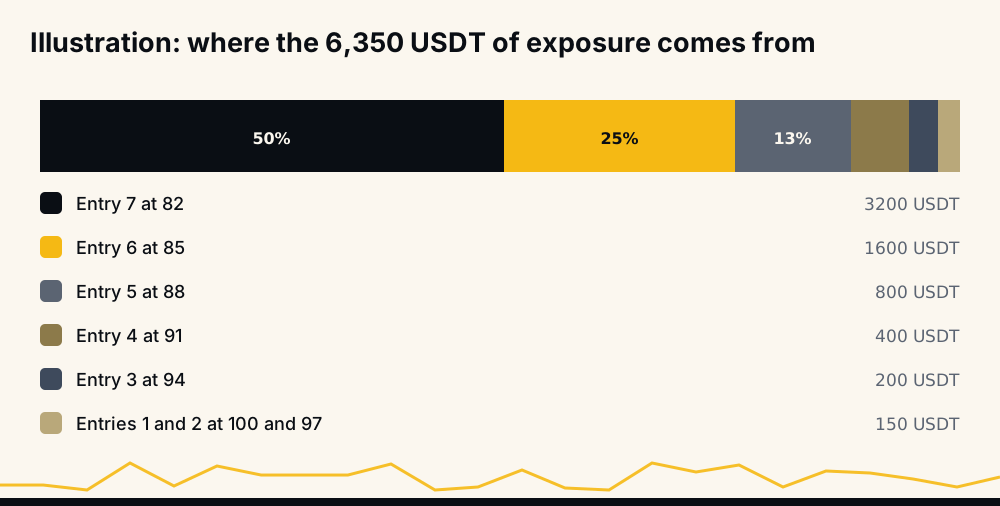
The stack above shows where the risk sits. The last entry is 3,200 USDT, half of everything. The 50 USDT you meant to trade is under 1% of the position you end up holding.
Where martingale breaks: the trend that does not bounce
Take the same ladder on a 1,000 USDT futures wallet on cross margin. With 6,350 USDT of position, the wallet is gone when price reaches about 71.34, before maintenance margin brings liquidation a little earlier. That is 13% below the last entry and 28.7% below the first.
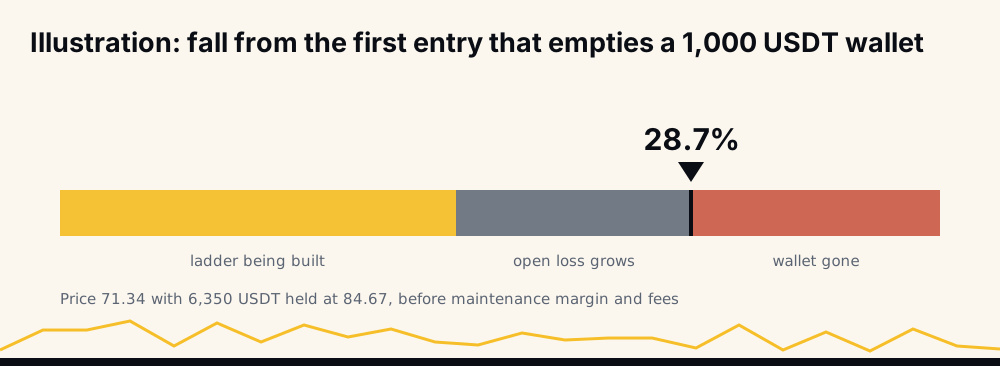
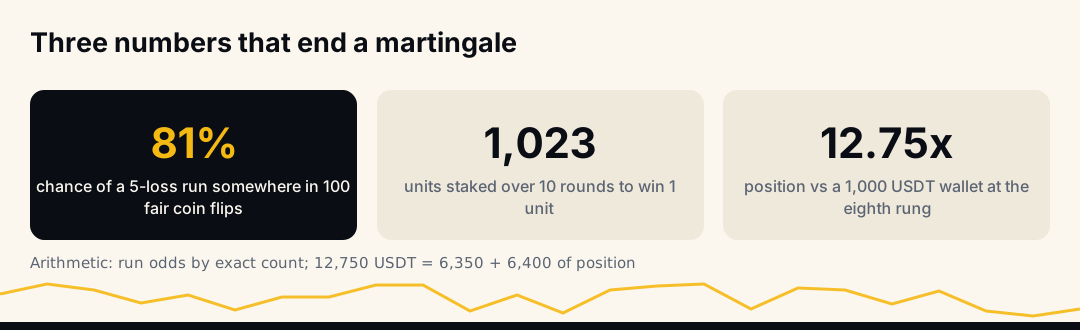
A 29% fall is an ordinary week for many altcoins. And you cannot dodge it by adding an eighth rung: the next entry would be 6,400 USDT, putting 12,750 USDT of position on a 1,000 USDT wallet, nearly 13 times its size.
The coin-flip version shows the same thing with probabilities. At even odds, five losses in a row is a 1-in-32 event, which sounds rare. Across 100 flips, a run of at least five happens about 81% of the time, a run of seven about 32% of the time and a run of ten about 4% of the time. Each extra rung you can afford buys less protection than it costs.
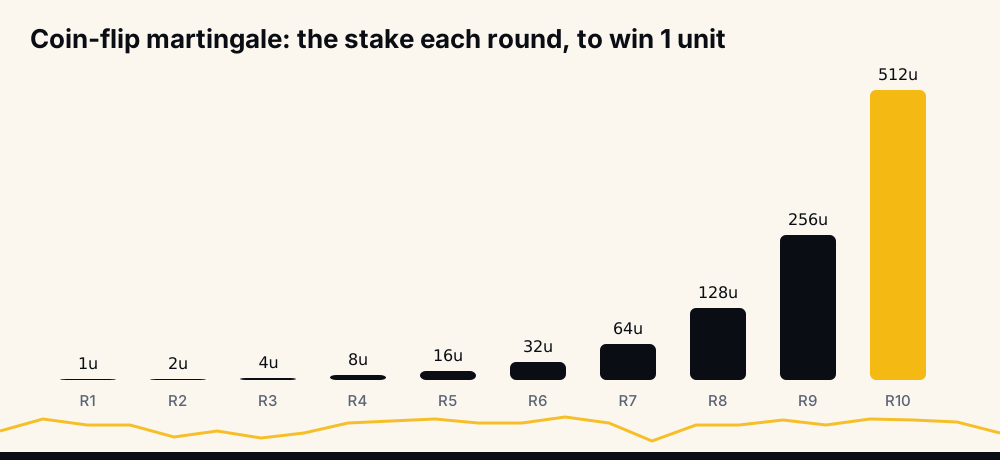
By round ten the stake is 512 units, 1,023 units are at risk in total, and a win still pays one unit. Markets are worse than coin flips here because they trend: a coin that fell yesterday is not 50% likely to rise today, and a delisting or a hack can take it down without any bounce at all.
Why futures make martingale worse
Leverage lets a martingale ladder grow far past the wallet, and that is the problem. On spot, the ladder stops when the cash runs out. On futures it stops when Binance liquidates you, and three Binance mechanics push that point closer.
- Maintenance margin rises with size. Binance's leverage and margin FAQ says "the larger the position, the higher the Maintenance Margin rate." Each doubling can move the position into a higher tier, which brings liquidation closer. This is the futures version of a casino's table limit; Binance futures leverage limits covers the brackets.
- Every add moves the liquidation price. On cross margin the wallet stays the same while the size doubles, so liquidation creeps toward the current price with each rung. Why your liquidation price changes works this through with Binance's formula.
- Funding scales with the position. Funding is paid on notional, usually every 8 hours. At a 0.01% rate the 6,350 USDT position pays about 0.64 USDT a settlement; a ladder held for days through a crowded trade pays far more. See the funding rate explained.
Mark price is the trigger for liquidation, and on a fast drop it can reach your level before last price does; mark price vs last price explains the gap.
Martingale bots and the martingale calculator
Many grid and DCA bots are martingale engines with a setting. Binance's own Spot DCA parameters FAQ has a "DCA Order Size Multiplier": set to 2, a 1,000 USDT DCA order becomes 1,000, then 2,000, then 4,000 USDT. Binance gives the money needed as:
Base Order Size + DCA Order Size × (1 + m + m² + … + m^(n−1))
That is the whole martingale calculator. With a multiplier m above 1, the bracket grows as (m^n − 1) ÷ (m − 1): a multiplier of 2 and ten DCA orders needs 1,023 times the DCA size. A multiplier of 1.5 is gentler, about 113 times over ten orders, and it still grows faster than most wallets.
Two checks before you run any bot with a size multiplier above 1:
- Fill in the formula with your real maximum number of orders. If the total is more than you would lose without flinching, the settings are wrong.
- Find the stop-loss field. Binance's same FAQ lists a stop-loss that ends the round. A martingale bot without one has an unlimited worst case, bounded only by liquidation.
Can you average down on futures?
Yes. On Binance USDⓈ-M Futures in one-way mode, a new order in the same direction adds to your position and Binance recomputes the average entry. Averaging down means adding to a losing position at a better price. Martingale is one way to size those adds; equal-size adds are another.
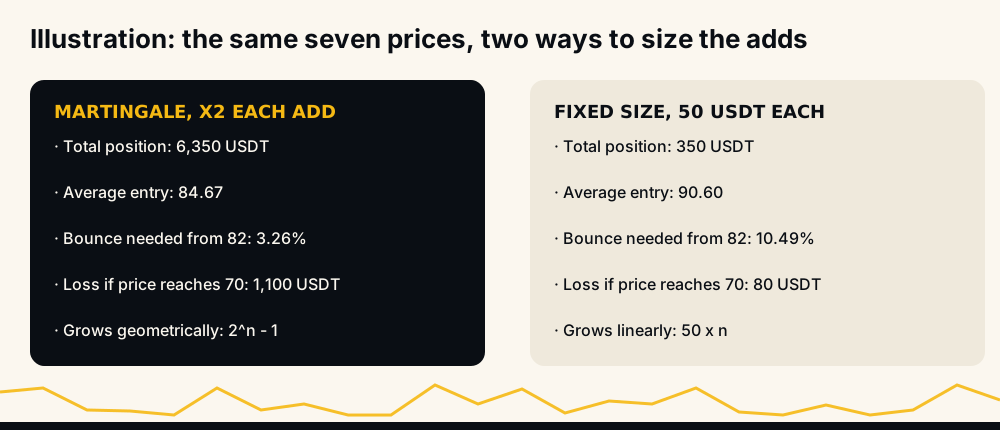
Fixed-size adds grow the position linearly. In the example, seven 50 USDT entries total 350 USDT, and a fall to 70 costs about 80 USDT instead of the martingale's 1,100 USDT. The price of that safety is a slower recovery: the fixed average sits at 90.60, so the trade needs a larger bounce to get out.
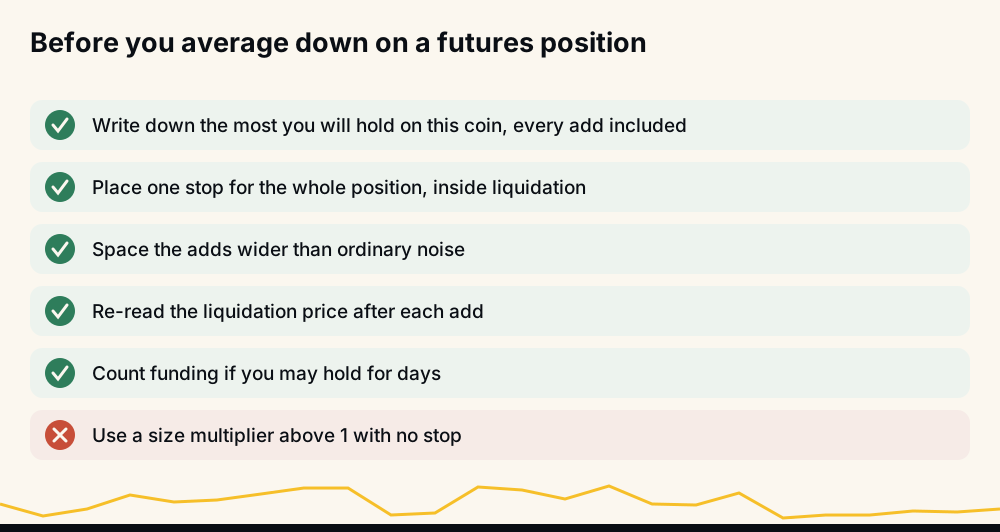
Averaging down is still adding risk to a trade that is going wrong. It is easier to survive when three things were decided before the first entry:
- A maximum total size for the coin, counted as the sum of every entry you might make.
- A stop for the whole position, placed where the idea is wrong, inside the liquidation price. How to set a stop-loss in crypto covers where.
- A spacing between entries wide enough that you are not adding on every tick of noise.
Average down vs cut loss
"Average down vs cut loss" is a choice between two bets. Averaging down bets that price returns to your average before your maximum size is reached. Cutting the loss bets that the reason for the trade is gone. Neither is right by default; what goes wrong is averaging down by habit and cutting losses only when liquidation forces it.
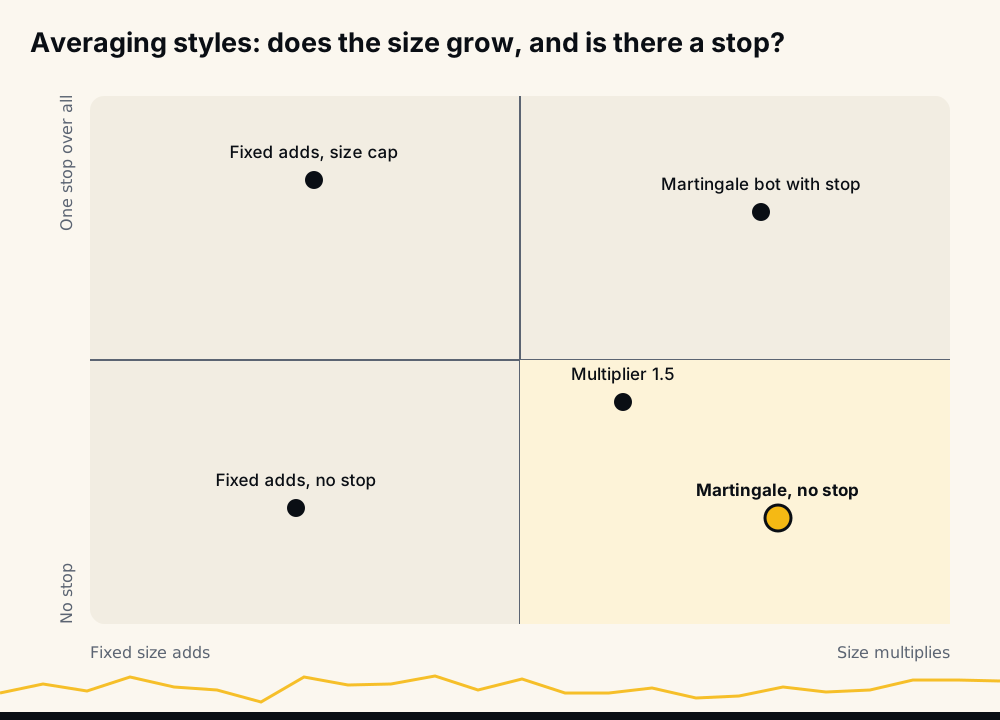
The quadrant sorts the common styles. Doubling with no stop sits in the corner where one trend ends the account. Fixed adds under one stop for the whole position sit in the opposite corner, where the worst case is a number you chose in advance.
There is also the reverse idea, sometimes called anti-martingale or pyramiding: adding to a position that is going your way, usually in smaller pieces, with the stop raised behind it. Its losses are small and its wins can grow, which is the opposite risk profile, and it has its own failure (adding near a top).
How HafizeBot handles repeat entries
HafizeBot's autotrader can add to a coin you already hold, and it never doubles. Each entry, the first or an add, uses at most the position size you set with /setPositionSize. An add happens only when a new signal arrives in the same direction and price has moved a set distance past your last entry on that coin, 3% by default. That is averaging at a fixed size, so the same caution applies: more adds on a falling coin mean more exposure to it.
The limits are yours to set:
/setPositionLimitcaps how many positions are open at once./setStopLosssets the stop as a price move from entry (0 means none), and/setStopTypechooses one stop per entry or one combined stop for the whole position./setLeverageand/setMarginTypedecide the margin behind each entry and whether positions share a wallet.
The API key needs futures trading only; use a key with withdrawals off, since HafizeBot never withdraws or transfers, and paste it on the website at hafizebot.com/app/keys, never in a chat.
The signals are AI-generated, from a model that evaluates 240+ indicators, formulas and components. A broadcast signal carries a target and a maximum hold, without a stop, and the live performance page counts every signal that misses its target within that hold against the rate: in September 2026, 97.7% of 4,220 signals reached their target, with misses counted against. The monthly reports hold the 2021 to 2024 archive. Past results do not tell you what the next trend will do to a ladder.
Frequently asked questions
Does martingale strategy work in trading? It produces many small wins and, eventually, one loss larger than all of them. Whether you are up at a given moment depends on whether that trend has arrived yet. The expected result does not improve by doubling; only the shape of the outcomes changes.
Why is martingale bad for crypto futures? Crypto trends hard and futures add leverage, rising maintenance tiers and funding on a growing position. Together they put the account's end point within one ordinary sell-off, as the 28.7% example shows for a seven-rung ladder on 1,000 USDT.
Is a martingale crypto bot profitable? Its history can look profitable for months because the small closes come often. What decides the outcome is the size multiplier, the number of orders and the stop. Fill in Binance's total-investment formula with your settings before trusting any track record.
Can you average down on futures without martingale? Yes, with fixed-size adds, a cap on the total size for the coin and one stop for the whole position. The worst case is then known in advance, at the cost of needing a larger bounce to recover.
What is a safe martingale multiplier? None is safe without a stop, because any multiplier above 1 grows geometrically. A multiplier of 1.5 grows more slowly than 2, but over ten orders it still needs about 113 times the first add.
The short version
Martingale lowers the bounce you need by raising the size you hold, and the size grows faster than any wallet. If you average down, cap the total, keep one stop over the whole position and add at a fixed size. Sources: Binance's leverage and margin FAQ, its Spot DCA parameters FAQ and the funding, fee and liquidation pages linked above.
To see signals that carry a target and a maximum hold, the free channel t.me/getbinancefutures (4,098 members) posts the stronger signals, strength 3 and up, 20 minutes after VIP. In @hafizebot, /trial gives 7 days of VIP Tier 1, with trial autotrading capped at 10 USDT of margin per entry and 3 open positions; VIP is 50, 100 or 200 USDT a month via /join.
This is not investment advice; leveraged futures can lose your whole margin, so trade only what you can afford to lose.