AI and automation in crypto trading are heading toward more automation and less trust on faith: exchanges are narrowing what a bot's API key can do, regulators are going after inflated AI claims rather than AI itself, and the services likely to last are the ones that publish every result, never hold your money and state the risk in plain words.
Last checked: 11 October 2026. Every regulator and exchange claim below links to the primary source and gives its date. This page looks forward; for the longer history of AI in finance, see our earlier piece on how AI is increasingly used in trading.
This is not a forecast of prices, and nobody can give you one. It is a look at three trends you can already see in official documents, at what automation actually changes for a trader, and at what a service you can trust should look like by now.
The short answer: more automation, less faith
Three things are moving at once.
- The plumbing is getting stricter. Exchanges now push bot users toward keys that can trade but cannot withdraw, and that only work from a known server.
- The claims are getting checked. US, UK and EU regulators have spent 2024 and 2025 warning about AI trading pitches, fining firms that overstated their AI, and acting against unlicensed promoters on social media.
- The proof is moving in public. A service that says "AI" is now expected to show what its signals did, misses included, rather than a screenshot of its best week.
None of this makes trading safer by itself. It makes it easier to tell a tool from a pitch, and that is where the rest of this page goes.
Will AI take over crypto trading?
In the narrow sense, much of it already has: signal services, copy tools and bots connect to exchanges through their APIs and place orders around the clock, with no one clicking a button. In March 2025 the International Organization of Securities Commissions (IOSCO) published a consultation report on AI in capital markets (media release, 12 March 2025) and said AI uses in capital markets will continue to expand.
What AI has not taken over is the part that decides how much you can lose. The leverage you choose, how much of your account goes into one trade, whether you trade at all this month: those stay with a person. The US Commodity Futures Trading Commission put the limit bluntly in its customer advisory AI Won't Turn Trading Bots into Money Machines, announced on 25 January 2024: "AI technology can't predict the future or sudden market changes."
So the honest answer to "will AI replace traders" is: it replaces the watching and the clicking, not the judgment about risk.
Trend 1: Exchange API keys are getting narrower
A bot trades your account through an API key you create on the exchange. That key is the whole security model, and the defaults have tightened.
Binance's own guide, How to Create API Keys on Binance (read 11 October 2026), says two things worth knowing:
- An API key of the default kind (HMAC) with unrestricted IP access "won't have any permission other than reading" unless you change the default security controls. In practice, a trading bot's key now comes with an IP restriction.
- Adding an IP restriction "is mandatory to enable withdrawal permission". A bot has no reason to ask for that permission at all.
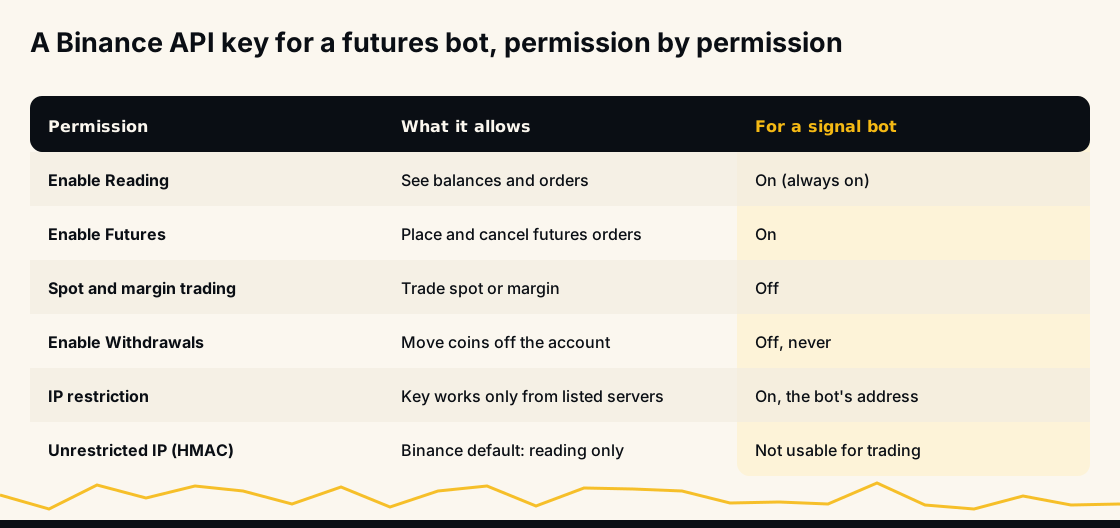
The direction is clear: a key that can place futures orders, cannot move coins out, and works only from the server of the service you chose. If that key leaks, it is close to useless to whoever finds it. Our step-by-step guide to connecting a trading bot to Binance safely walks through each tick box.
What this trend does not fix: a key that can trade can still lose money by trading. Narrow permissions protect you from theft, not from a bad strategy or a setting you did not read.
Trend 2: Regulators target AI claims, not AI itself
No regulator we checked has banned trading bots. What they have done is go after the words used to sell them.
- CFTC, 25 January 2024. The advisory above warns that scammers "claim AI-created algorithms can generate huge returns", sometimes with "100 percent 'win' rates", and tells consumers to weigh how fees, spreads and subscription costs affect returns.
- SEC, NASAA and FINRA, 25 January 2024. A joint investor alert on AI and investment fraud quotes pitches such as "Our proprietary AI trading system can't lose!" and warns to be wary of claims, "even from registered firms and professionals", that AI can guarantee returns.
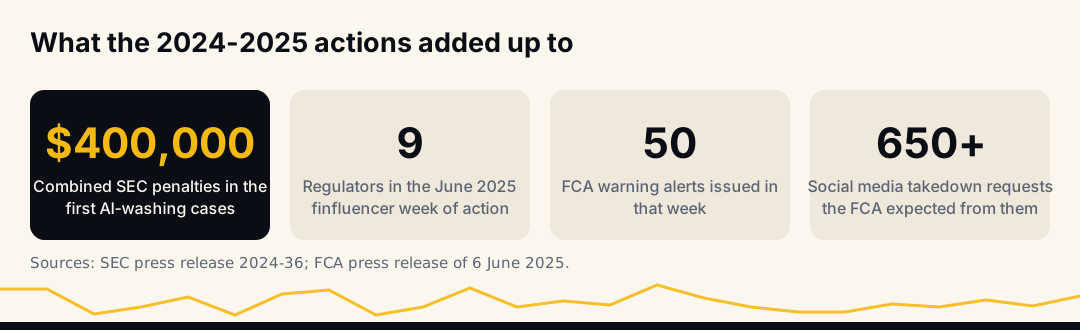
- SEC, 18 March 2024. In its first "AI washing" cases, the SEC settled charges against two investment advisers for saying they used AI that they did not, with $400,000 in combined penalties. The Chair's line: "Such AI washing hurts investors."
- ESMA, 30 May 2024. The EU securities regulator's public statement on AI in retail investment services says decisions stay the responsibility of a firm's management "irrespective of whether those decisions are taken by people or AI-based tools", and that what firms tell clients about their AI use must be "clear, fair and not misleading".
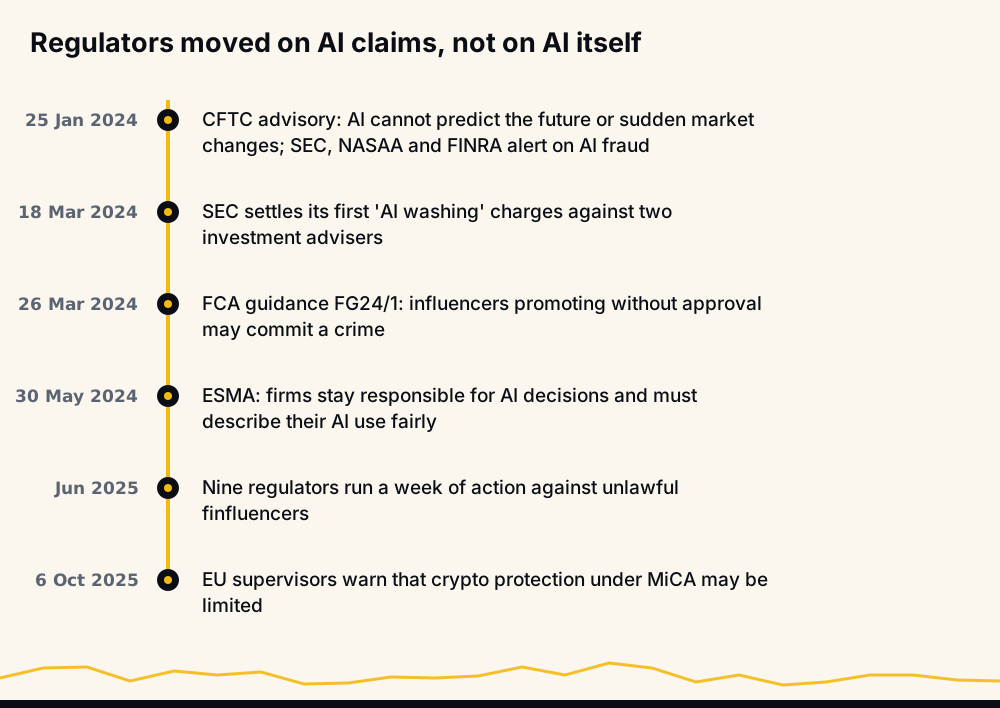
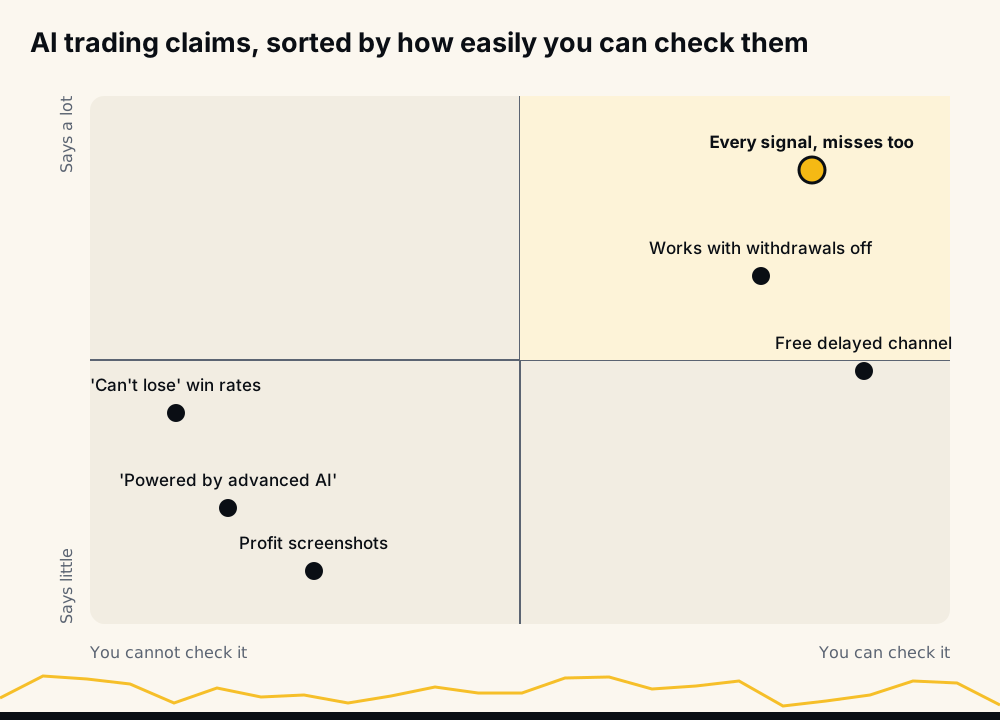
The pattern matters for buyers. "Powered by AI" is no longer a selling point regulators ignore; it is a claim a firm may have to back up.
Trend 3: Finfluencers and paid promotion under pressure
Much of the AI trading hype reaches people through social media, and that channel is getting attention too.
- FCA, 26 March 2024. The UK regulator's finalised guidance FG24/1 on financial promotions on social media says influencers who promote regulated products without approval from an authorised firm "may be committing a criminal offence", and that promotions should "provide a balanced view of the benefits and risks".
- FCA and eight other regulators, June 2025. A week of action against unlawful finfluencers (press release, 6 June 2025) brought together regulators from Australia, Canada, Hong Kong, Italy, the UAE and the UK. In the UK alone it led to 3 arrests and 50 warning alerts, which the FCA expected to produce more than 650 takedown requests.
- EU supervisors, 6 October 2025. The EBA, EIOPA and ESMA warned consumers that "crypto-assets can be risky and that legal protection, if any, may be limited", depending on the asset and the service, and asked people to check that a provider is authorised in the EU.
For the warning signs these regulators keep repeating, our list of crypto signal scam red flags puts them in one place.
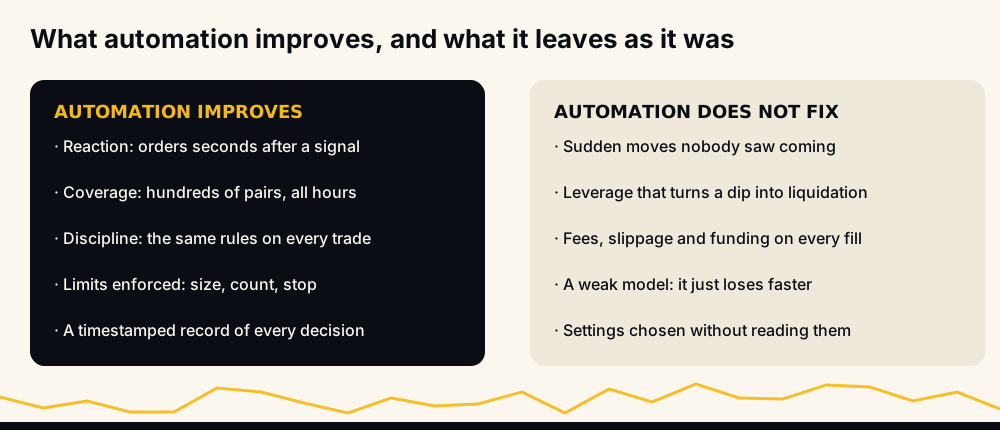
What automation genuinely improves
Strip away the marketing and automation does a handful of real things well.
- Reaction time. An order goes out seconds after a signal, whether it arrives at 3 a.m. or during your working day.
- Coverage. Software can follow hundreds of pairs around the clock; a person can follow a few, for a few hours.
- Discipline. The rules you set apply to the five-hundredth trade exactly as to the first. No revenge trades, no skipped stop because a chart "looked fine".
- Limits enforced every time. Position size, the number of open positions and the stop are applied before the order leaves, not remembered afterwards.
- A record. Every decision is written down with its time, which is what makes an honest track record possible in the first place.
If you are weighing this against trading by hand, our comparison of AI bots and whether they actually work goes through the evidence in more detail.
What automation does not fix
The same list has a mirror image, and it is the part sales pages leave out.
- Sudden moves. A model trained on the past meets a market that has not happened before. That is the CFTC's point, and it applies to every model.
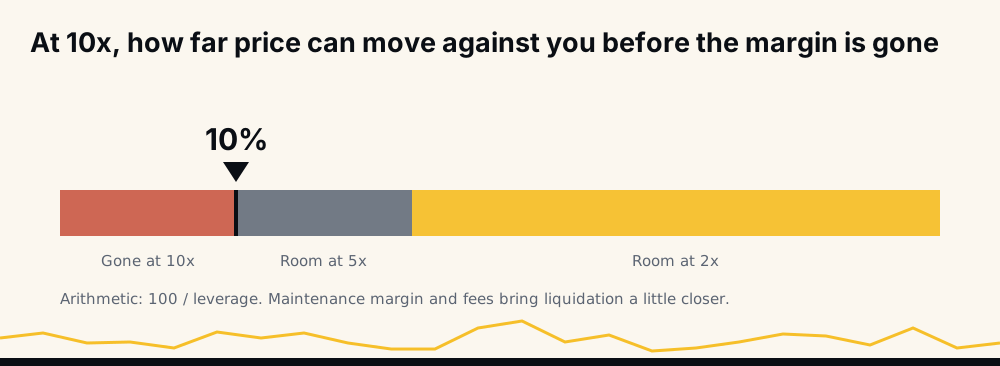
- Leverage. Futures magnify both directions. At 10x, a move of about 10% against you uses up the margin, and maintenance margin and fees bring liquidation a little closer than that.
- Costs. Every fill pays fees, market orders meet slippage, and futures positions pay or receive funding. A bot that trades often pays them often.
- A weak model. Automation executes whatever it is given. A bad strategy, automated, simply loses faster and more consistently.
- Outages and settings. Servers restart, keys get revoked, and a position left open while a service is down is still yours. Our guide to what happens to open positions if the bot stops covers what keeps running and what pauses.
Is AI trading profitable?
Sometimes, for some people, and never because a label says "AI". Whether a strategy makes money depends on how often it is right and on how much a win pays compared with what a loss costs, after fees.
The arithmetic is simple enough to redo yourself. If a win pays half of what a loss costs, you need to be right two times in three just to break even. If wins and losses are the same size, you need half. The chart below is that formula, before fees.
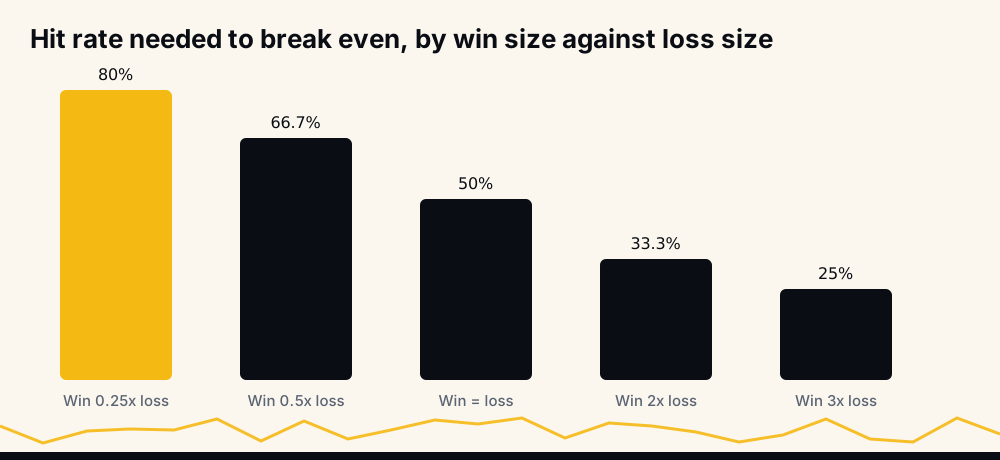
That is why a high hit rate on its own says little about your account. Your leverage, your stop, your position size and the moment you joined all change the result, which is the subject of our page on why your results differ from the signal provider's. A service that quotes a hit rate and implies it is your return is overstating its case.
What a trustworthy AI trading service will look like
Put the three trends together and the bar for a credible service becomes concrete. By now it should:
- Publish every signal it sends, with the misses counted against its rate, so anyone can recount it.
- Never hold your trading money. It works through a key on your own exchange account, with withdrawals off.
- Tell you which server address to allow on that key, so a leaked key works nowhere else.
- State the risk plainly: leverage, liquidation, and that losses happen.
- Describe its AI without overstating it, the standard ESMA set for firms in 2024.
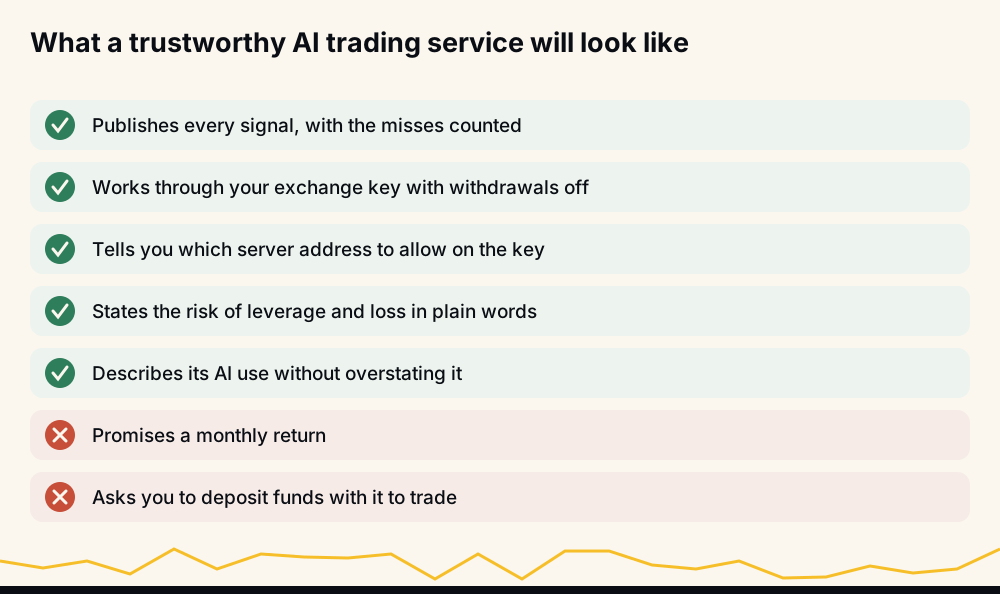
Just as clear is what it should not do: promise a monthly return, or ask you to send funds to it so that it can trade for you. The second is a common pattern in withdrawal scams: once your money sits in their account, getting it back becomes the problem.
How to test any AI trading service before you pay
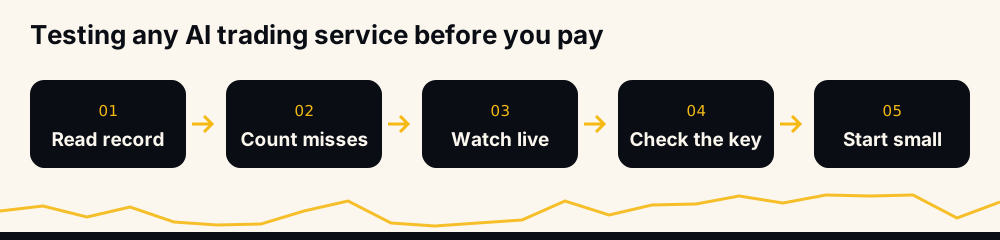
Five steps, in order, and none of them needs you to trust the seller.
- Read the record. Find the full list of signals, not a summary.
- Count the misses. Check that signals which failed are counted against the rate, and recount one month yourself. Our guide on how to verify a crypto signal win rate shows how.
- Watch it live. Follow a free or delayed feed for a couple of weeks and compare what you see with what is published later.
- Check the key. Make sure the service works with withdrawals off and an IP restriction on.
- Start small. Use a size you would not miss, and low leverage, until your own results tell you something.
Where HafizeBot fits, as one example
HafizeBot is one service of this kind, so here is how it measures against the list above, limits included.
- What it is. AI-generated signals for Binance USDⓈ-M Futures from a model that evaluates 240+ indicators, formulas and components, delivered on Telegram through @hafizebot, with optional autotrading for members.
- The record. The live performance page is rebuilt every hour from the table the bot writes when it sends a signal. As of 11 October 2026 it shows that in August 2026, 97.3% of 5,262 broadcast signals reached their target, with the 140 that missed counted against the rate. The 2021 to 2024 archive is a free download at /data.
- The key. Autotrading needs a key on your own Binance account with Enable Futures only, never withdrawals, and the security page gives the one server address to allow. Your funds stay in your Binance account.
- The free view. The free signal channel carries the same signals 20 minutes later, so you can watch before paying.
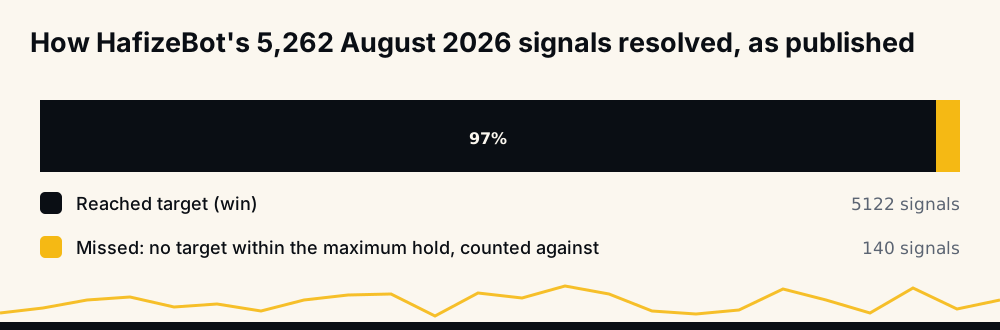
And the limits, stated plainly: no third party has audited these numbers, the live database only starts in June 2026, broadcast signals carry a target and a maximum hold rather than a stop, and a target-hit rate is not account profit.
FAQ
What is the future of AI in crypto trading? More automation, with tighter controls around it. Exchanges are steering bots toward keys that cannot withdraw and only work from one server, regulators are checking AI claims, and published, recountable records are becoming the expected proof.
Will AI replace crypto traders? It already replaces much of the watching and the order entry. It does not replace the decisions that set your risk, such as leverage, position size and whether to trade at all; the CFTC's own line is that AI cannot predict the future or sudden market changes.
Is AI trading legal? None of the regulators cited here bans using a trading bot on your own exchange account. What they act against is fraud, misleading AI claims and unlicensed promotion, and rules differ by country, so check what applies where you live.
Can an AI trading bot steal my money? Not through a key with withdrawals off and an IP restriction, because that key cannot move coins out. It can still lose money by trading, which is why position size and leverage limits matter.
How can I tell if an AI trading service is real? Look for a full public record with misses counted, a key that works with withdrawals off, and plain risk wording. Treat promised returns, perfect win rates and requests to deposit funds with the service as reasons to walk away.
The bottom line
The future of AI in crypto trading looks less like a money machine and more like a well-locked tool with a public logbook. Automation will keep taking over the repetitive work; the risk, and the decision to take it, stays with you. Judge any service, ours included, by what it lets you check, not by how much AI it claims. This is general information, not investment advice, and you should only trade what you can afford to lose.