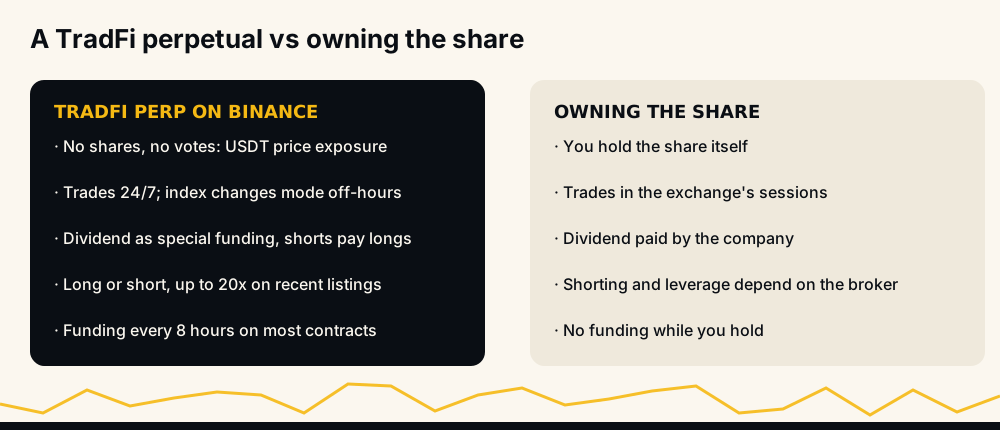
Binance TradFi Perps are USDT-settled perpetual futures on traditional assets: US and Asian shares, ETFs, gold, oil and one currency pair. They trade 24/7 on Binance USDⓈ-M Futures even though the underlying markets close, so Binance prices them from data vendors during sessions and from its own order book at weekends. You hold no shares; dividends arrive as a special funding payment from shorts to longs.
Everything below comes from Binance's own announcements, its FAQ "Perpetual Futures on Traditional Assets" and the contract list Binance publishes through its API, read on 6 November 2026. Products and services in Binance's notices "may not be available in your region", so check yours before planning a trade.
What are perpetual stock futures?
A perpetual future is a contract with no expiry date that tracks an asset's price; a funding payment between longs and shorts keeps it close to that price. If the term is new, what are crypto futures covers the basics.
Binance's FAQ says TradFi Perps "are margined and settled in the same way as other Perpetual USDⓈ-Margined Futures", with one restriction: they are "denominated and settled only in Tether (USDT)". The difference from a crypto perpetual is the underlying: Bitcoin trades every minute of the year, while Tesla shares and gold do not. Most of what is unusual about TradFi Perps follows from that gap.
What you do not get is the asset. Binance's contracts give price exposure in USDT: no shares, no voting rights, no delivery of metal. Dividends are handled through funding, covered below.
What Binance lists: the TradFi perps list
On 6 November 2026 Binance's contract list showed 235 TradFi perpetuals trading, marked with their own contract type next to 565 ordinary crypto perpetuals. Gold, XAUUSDT, was the first, onboarded in December 2025; Tesla, TSLAUSDT, followed on 28 January 2026 as the first share.
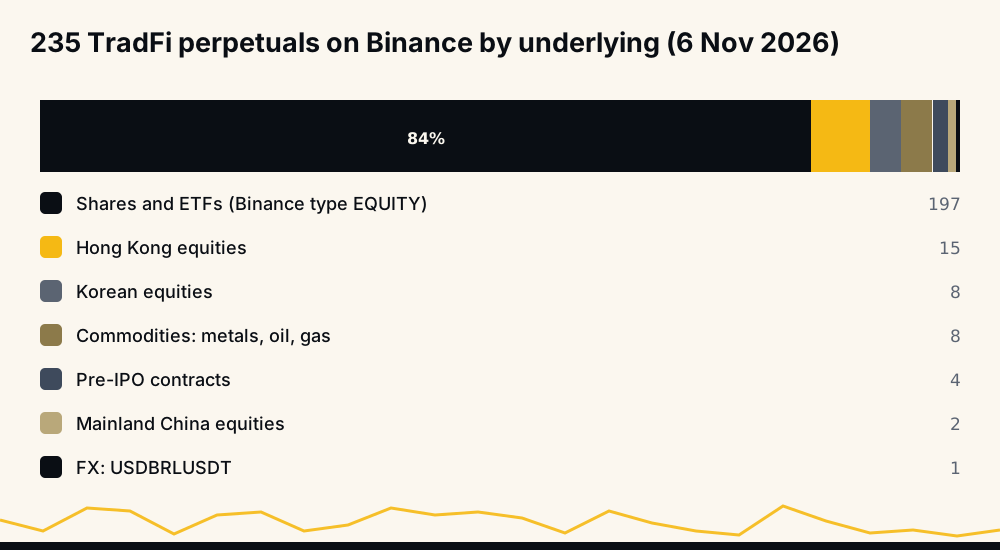
- 197 shares and ETFs that Binance types as equity, from AAPLUSDT and NVDAUSDT to SPYUSDT and QQQUSDT.
- 15 Hong Kong, 8 Korean and 2 mainland China equities, such as TENCENTUSDT, SAMSUNGUSDT and CXMTUSDT.
- 8 commodities: gold, silver, platinum, palladium, copper, two oils and natural gas (XAUUSDT, XAGUSDT, XPTUSDT, XPDUSDT, COPPERUSDT, CLUSDT, BZUSDT, NATGASUSDT).
- 4 pre-IPO contracts on companies not yet listed, and 1 FX pair, USDBRLUSDT.
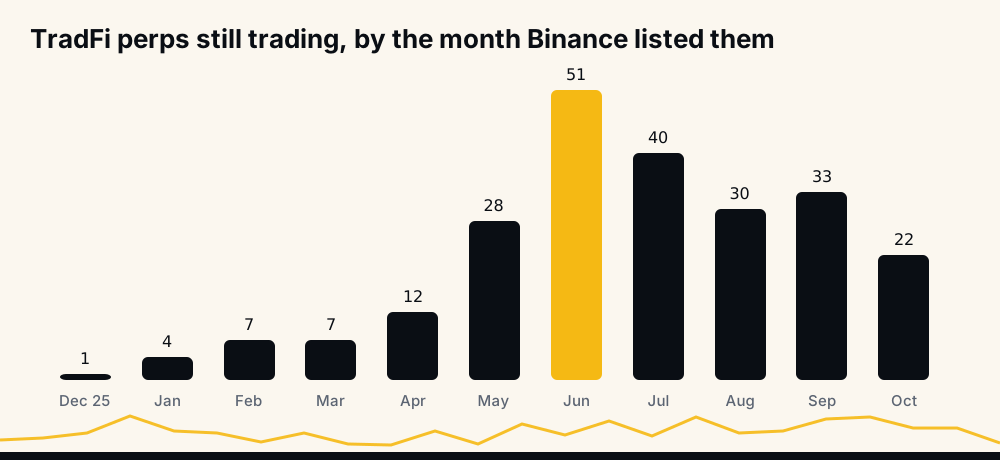
Listings sped up through 2026. The chart counts the contracts still trading by the month they were onboarded.
Trading hours: 24/7 contracts on markets that close
Binance's listing announcements give the trading hours as 24/7, from Tesla in January 2026 to the six US names of 29 October 2026 (EWZS, SMR, OXY, AMGN, PFE and MELI). The FAQ explains the problem this creates: "Equities operate on a 24/5 cycle across distinct sessions, including pre-market, regular, after-hours, and overnight," and gold trades 24/5 with a daily maintenance break.
So the contract never closes, but its reference price changes character through the week. Binance calls these sessions; each one has its own price index mode.
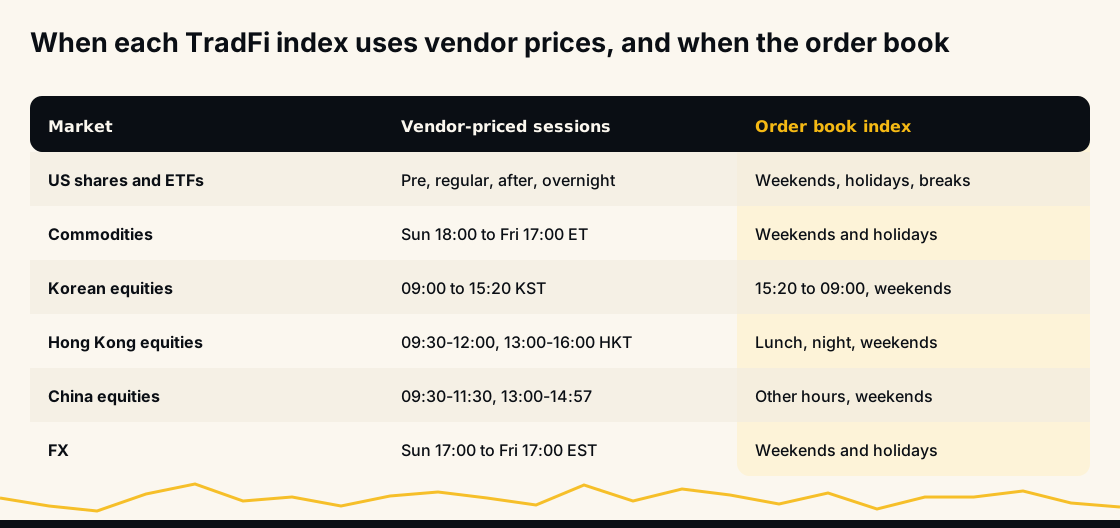
On 15 September 2026 Binance set the commodity sessions to regular hours from Sunday 18:00 to Friday 17:00 New York time, with weekends and holidays priced from the order book. The Asian markets follow their home exchanges: Korean equities 09:00 to 15:20 Korea time, Hong Kong 09:30 to 12:00 and 13:00 to 16:00, mainland China 09:30 to 11:30 and 13:00 to 14:57.
How Binance prices TradFi perps when the market is closed
During regular hours the price index is "constructed from constituent prices quoted by third-party data vendors" and updated every second. In US pre-market and after-hours it is smoothed quickly, and overnight more slowly. At weekends, holidays and maintenance breaks there are no vendor prices, so Binance switches to Orderbook EWMA mode: the index comes from the contract's own order book (the average of the impact bid and ask), smoothed, with its movement limited. Equities moved to this mode on 16 May 2026, replacing a frozen index.
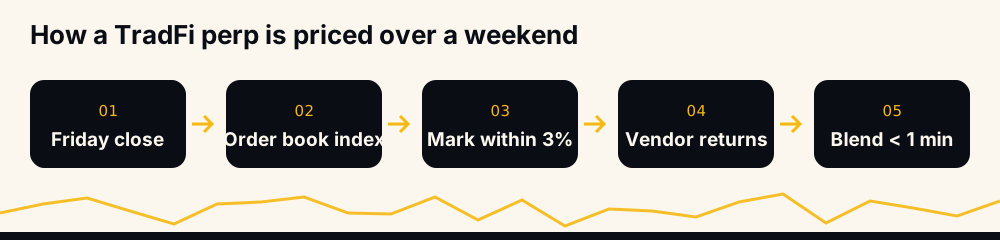
When the market reopens, the index blends from the order-book value to the vendor value, and per the FAQ "the transition will be completed within a minute." Mark price, which decides liquidation, is the usual Binance median of three prices, and since 31 August 2026 its basis for TradFi Perps is averaged over one minute instead of 30 seconds. Why mark price matters more than last price is in mark price vs last price on Binance.
Binance also caps how far mark price may sit from the index:
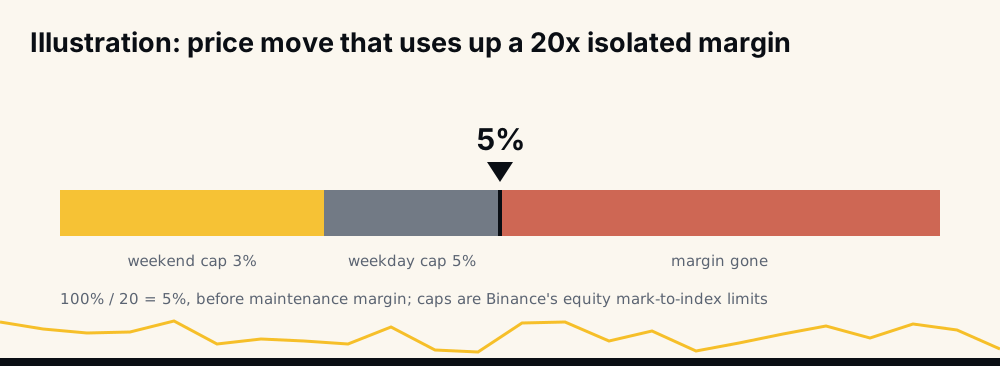
- Equities: ±5% in regular, pre-market, after-hours and overnight sessions; ±3% at weekends and holidays.
- Commodities: ±3% at all times.
- FX: ±0.3% in regular hours; ±0.1% at weekends and holidays.
The weekend gap: the main risk in stock perps
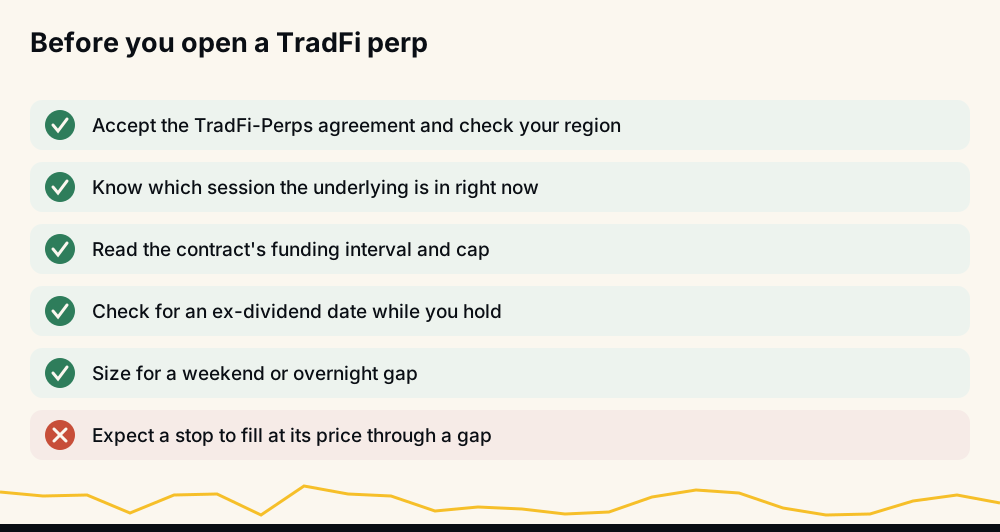
The order book keeps trading through Saturday, but the shares do not. If news lands over the weekend and the stock opens far from Friday's close, the vendor price comes back on Monday and the index catches up within about a minute. A stop sitting between the two prices gets passed in that minute, and a leveraged position can be liquidated in it. A stop moved to break-even on Friday fills wherever Monday's price lands, which can be well past it.
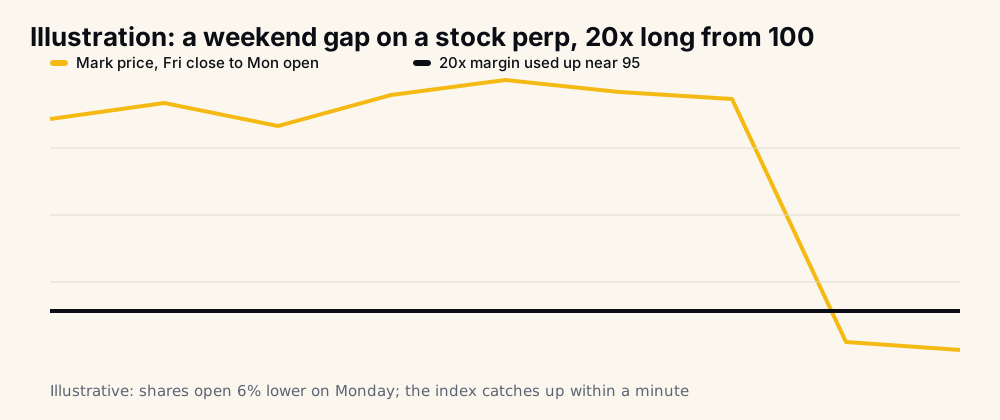
At 20x, the leverage Binance gives its latest listings, a position's margin covers about a 5% move before maintenance margin. That is the same size as the weekday cap between mark and index.
Overnight sessions carry a version of the same risk. On 21 October 2026, Binance reported that "one of the largest US overnight alternative trading systems" had connectivity problems from 03:46 to 06:30 UTC, and it removed that window's premium index from the 08:00 UTC funding calculation of every US-equity TradFi perp. A US share's night-time price comes from a thinner market than its daytime price.
TradFi funding rates
The 29 October 2026 listings settle funding every eight hours, with the rate capped at ±2.00% and an interest rate of 0%. They are also exempt from Binance's rule that switches a contract to hourly funding after it hits the cap.
Not every contract runs on eight hours. From 4 September 2026 nine Korean, Hong Kong and China contracts, including KODEX200USDT, NAVERUSDT and CXMTUSDT, moved to four-hour funding with a ±1.00% cap. Read the funding interval on each contract's page before holding through a settlement. The mechanics are the same as for crypto perps; see the Binance funding rate explained.
Dividends on Binance TradFi perps
On the ex-dividend date a share's price drops by about the dividend. To stop that drop from becoming a windfall for shorts, Binance's "Equity Perpetual Futures: Dividend Adjustment Methodology" runs a one-time special funding in which "short position holders will pay long position holders." For a cash dividend the rate is −D ÷ M, the gross dividend per share over the mark price, and the normal funding cap is skipped for it.
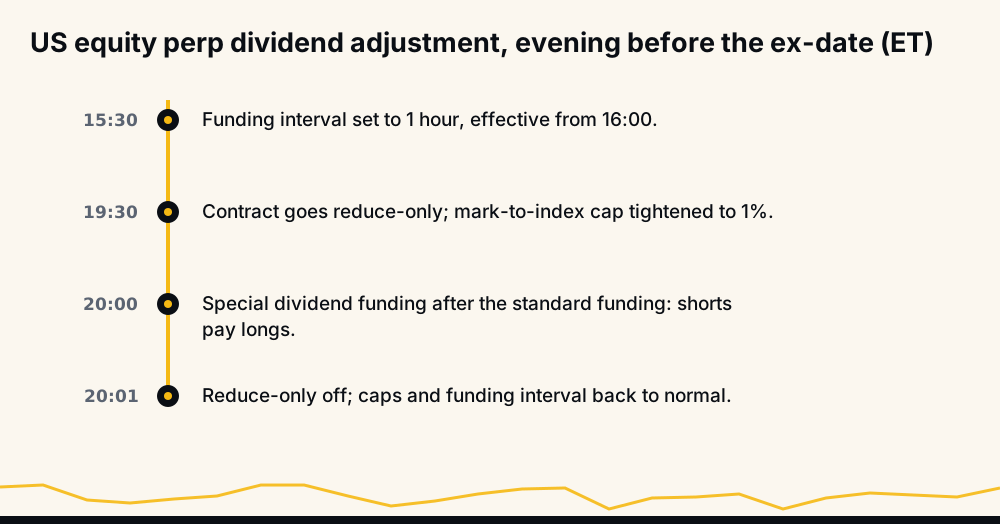
For US shares the steps run on the evening before the ex-date: funding goes hourly from 16:00 New York time, the contract becomes reduce-only at 19:30 with the mark-to-index cap tightened to 1%, and the special funding is paid at 20:00. For ETFs Binance estimates the dividend and announces it 4 to 12 hours ahead; leveraged ETFs such as TQQQUSDT and SOXLUSDT get no adjustment at all.
A real example: for SAMSUNGUSDT, Binance settled 101 won per share, equal to −0.037336%, on 6 November 2026, for net positions held at the ex-dividend time of 28 September 2026 23:00 UTC. It shows in Transaction History as "Special Funding Fee".
Binance TradFi fees and leverage
TradFi Perps have their own promotional fee table. Under the notice of 4 November 2026, a regular user pays 0.0000% maker and 0.0400% taker, a 20% taker discount on the standard USDT rate. VIP 4 to 9 keep a 50% taker discount; a cut to 40% announced on 28 October was withdrawn before it took effect. Standard crypto perp fees are in Binance futures fees explained.
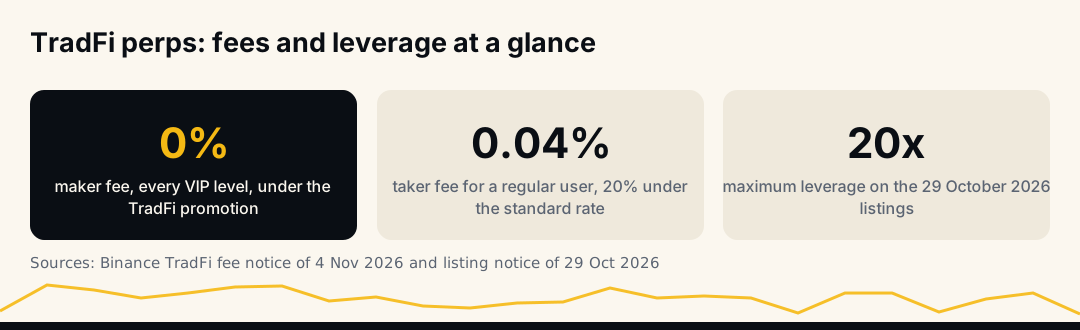
The six contracts listed on 29 October allow up to 20x leverage (Tesla launched in January at 5x), with a 5 USDT minimum notional and a 0.01-unit minimum quantity. Binance can change leverage and margin tiers by notice, as it did for several TradFi contracts in May 2026; Binance futures leverage limits explains the brackets.
Hong Kong quanto contracts and pre-IPO perps
Two kinds of contract on the list behave differently from a plain US share.
Quanto contracts. Some Hong Kong shares come in two versions. A USDT-priced contract such as TENCENTUSDT converts the Hong Kong dollar price into USDT at a live exchange rate. A quanto contract such as HK0700USDT treats 1 HKD as 1 USDT for margin and profit, so the currency's moves never touch your result. Binance's FAQ gives the dividend consequence: on a 5 HKD dividend, one HK0700USDT unit receives 5 USDT, while one TENCENTUSDT unit receives about 0.64 USDT at 7.8 HKD to the dollar. Check which version you hold before comparing prices.
Pre-IPO perps. These track companies whose shares are not listed yet; four were trading on 6 November 2026, including OPENAIUSDT and ANTHROPICUSDT. With no exchange price to follow, Binance prices them by its own pre-IPO methodology, and when the company lists, the contract can be converted into a standard TradFi perp, as Binance did for QNTXUSDT and SPCXUSDT in June 2026.
The TradFi-Perps agreement
Binance asks each account to accept a separate TradFi-Perps agreement before its first order. Its API changelog added an endpoint to "sign TradFi-Perps agreement contract" on 11 December 2025, and an account that has not signed is refused. The refusal we see on members' accounts reads: "Please sign TradFi-Perps agreement contract", with error code -4411. Only the account holder can accept it, inside Binance.
TradFi perps vs owning the shares
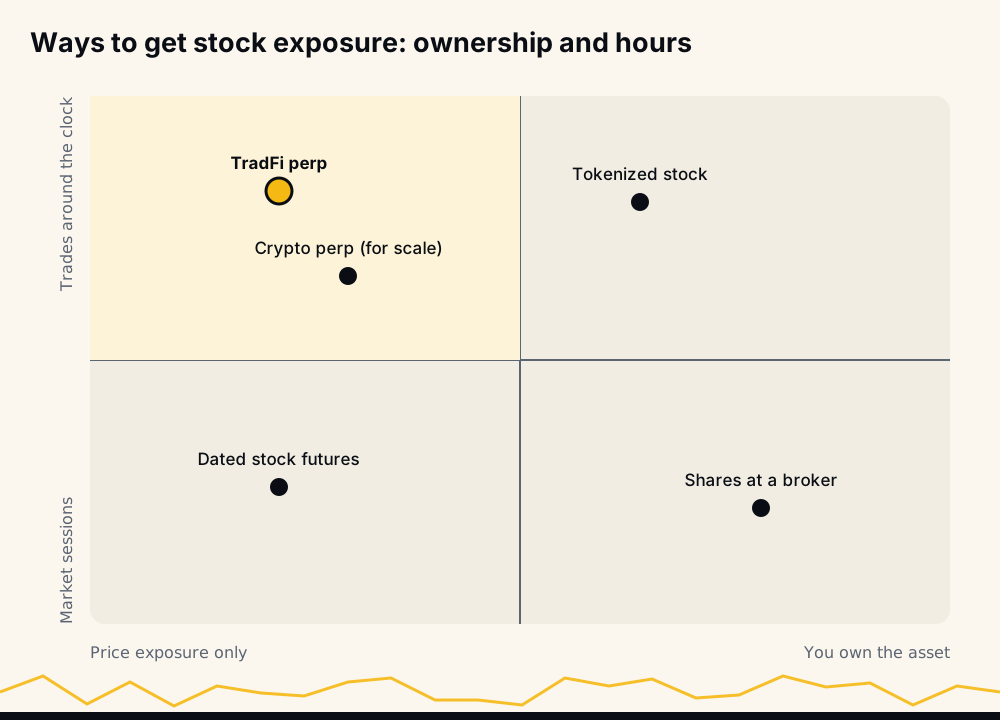
TradFi Perps suit a trader who wants leveraged long or short exposure in the same USDT futures wallet as crypto. They suit an investor who wants to own the company less well. Binance announced separate spot routes to stocks in 2026, such as stock trading on 1 June and the bStocks tokens on 11 June; those sit outside the futures account and are not covered here.
TradFi perps and HafizeBot
HafizeBot's autotrader trades Binance USDⓈ-M Futures on your own account, and Binance treats TradFi Perps as part of that market. Accounts set up since 8 October 2026 start with the TradFi group switched off, so the bot does not open those contracts until you turn it on. If it is on and the agreement is unsigned, Binance refuses the order; the bot then skips TradFi contracts on your account for about a day before trying again, so you do not get a refusal on every such signal. The TradFi agreement help page explains both options.
The usual settings apply to these contracts like any other: /setLeverage, /setPositionSize, /setStopLoss and /setMarginType. Given the weekend gap, a lower leverage on these names leaves more room than the 20x maximum. The API key needs futures trading only; use one with withdrawals off and paste it at hafizebot.com/app/keys, never in a chat.
HafizeBot's signals are AI-generated, from a model that evaluates 240+ indicators, formulas and components. The performance page scores each signal at its own target and counts every miss against the rate; in September 2026, 97.7% of 4,220 signals reached their target. The monthly reports hold the 2021 to 2024 archive.
Frequently asked questions
Does Binance have TradFi? Yes. Binance Futures lists TradFi Perps, USDT-settled perpetuals on shares, ETFs, commodities and one FX pair, inside USDⓈ-M Futures. Availability depends on your region.
Do you get dividends on Binance stock perpetual futures? Not as cash from the company. Binance runs a special funding on the ex-dividend date in which shorts pay longs about the dividend amount; leveraged ETFs are excluded.
Can you trade Binance TradFi perps at the weekend? Yes, the contracts trade 24/7. At weekends the price index comes from Binance's own order book, and it moves to the vendor price within about a minute when the market reopens, so weekend positions carry gap risk.
What are Binance TradFi fees? Under Binance's promotion as of 4 November 2026, regular users pay 0% maker and 0.04% taker on TradFi Perps. VIP 4 to 9 pay half the standard taker rate.
Why was my TradFi order rejected? Most often the account has not accepted the TradFi-Perps agreement, which Binance requires before the first order; the error reads "Please sign TradFi-Perps agreement contract". Region restrictions can also block these contracts.
The short version
TradFi Perps put shares, ETFs, metals, oil and FX into the USDT futures wallet with 24/7 trading, up to 20x leverage and funding every eight hours on most contracts. The cost of round-the-clock trading is a reference price that changes mode when the real market closes, plus a gap risk crypto perps do not have. Sources: Binance's TradFi FAQ, its dividend methodology, its listing, fee, funding and trading-hours notices, and its API changelog and contract list.
The free channel t.me/getbinancefutures posts the stronger signals (strength 3 and up) 20 minutes after VIP. In @hafizebot, /trial gives 7 days of VIP Tier 1, with autotrading capped at 10 USDT of margin per entry and 3 open positions; VIP is 50, 100 or 200 USDT a month via /join.
This is not investment advice; leveraged futures can lose your whole margin, so trade only what you can afford to lose.