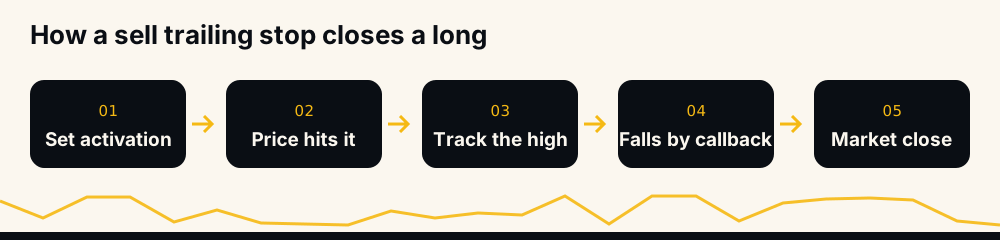
The callback rate on a Binance trailing stop is the pullback, in percent, that closes your position. Once the activation price is reached, Binance tracks the best price since then; a sell trailing stop fires when the price falls to that high × (1 − callback rate), a buy trailing stop when it rises to the low × (1 + callback rate). It then closes at market.
That one number decides how much of a move you keep and how often normal noise shakes you out. Below is how Binance applies it, what the allowed range is, the exits it produces at common settings, and the reasons a trailing stop sits there and never fires.
What is the callback rate in a trailing stop?
Binance's FAQ "What Is a Trailing Stop Order?" (updated 30 July 2026) calls a trailing stop an order that "helps traders limit their losses and protect their gains when the market swings." Its order-types page defines the callback as "the percentage distance between the current market price and the stop price."
The stop does not sit at a fixed level. It moves with the market in your favour and stays put when the market moves against you. For a long, a new high lifts the stop; a dip leaves it where it was. When the dip grows to the callback rate measured from the high, the order fires.
Binance's own note shows the measurement: "Rebound Rate = (Highest Price - Rebound Price) / Highest Price". In its example the price climbs to 11,500 and drops to 11,200, a rebound of 300 ÷ 11,500 = 2.61%, which is more than the 2% callback, so the order executes.
How Binance calculates the trigger
The API documentation for the New Algo Order endpoint spells out both sides:
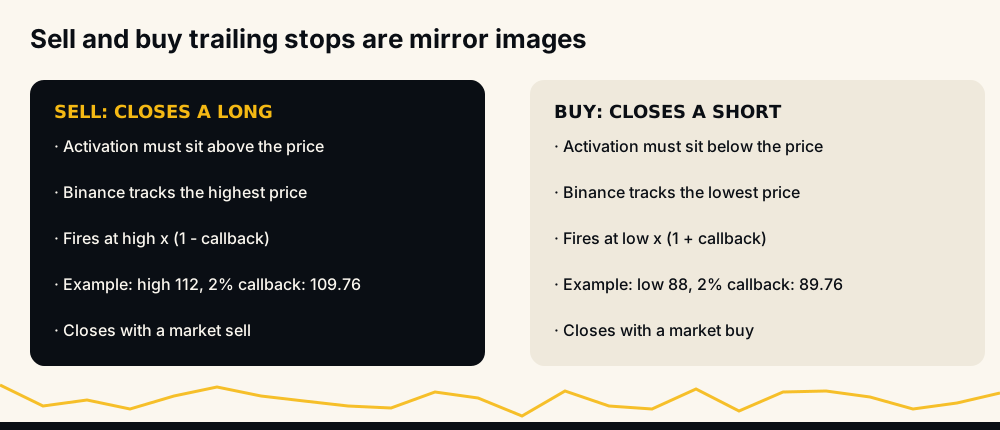
- SELL (closes a long): the highest price since the order was placed must be at or above the activation price, and the latest price must be at or below that highest price × (1 − callbackRate).
- BUY (closes a short): the lowest price since placement must be at or below the activation price, and the latest price must be at or above that lowest price × (1 + callbackRate).
Two conditions, both required. An activation price that was never reached means no trailing at all, however far the price later falls. A pullback smaller than the callback means the order keeps waiting.
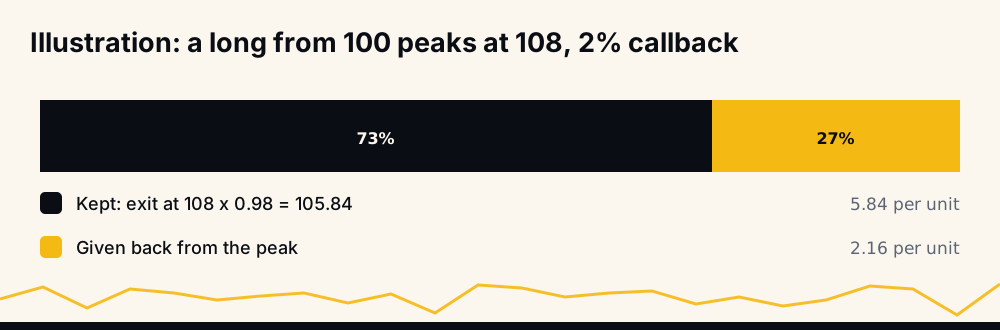
A worked case with illustrative numbers: you are long from 100, with a sell trailing stop activating at 105 and a 2% callback. The price runs to 112. The stop now sits at 112 × 0.98 = 109.76. If the next high is 115, it moves up to 112.70. If the price instead falls from 112 to 109.76, Binance sends a market sell, and you exit about 9.76% above entry before fees and slippage.
The callback rate range on Binance Futures
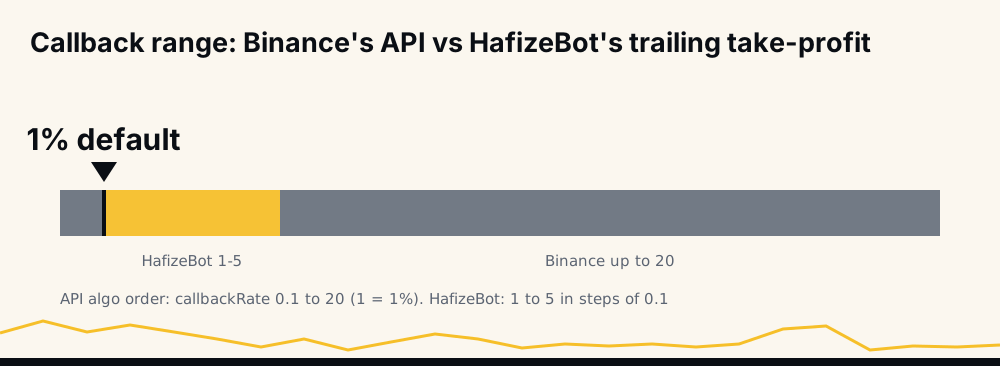
The FAQ gives the manual range as "0.01% to 20% by placing the rate manually in the 'Callback Rate' field." The API's algo order endpoint lists callbackRate with a minimum of 0.1 and a maximum of 20, where 1 means 1%. The two sources differ at the low end, so the field on your own order screen is the final word for that interface.
Spot is separate. Binance's spot trailing stop FAQ (updated 9 April 2026) calls the same idea Trailing Delta, "the percentage of movement in the opposite direction you are willing to tolerate", from 0.1% to 20.0%, and lets the triggered order go out as a limit or a market order. On futures the FAQ's own example says the position closes with "a sell order... executed at market price."
Worked exits: the same peak at five callback rates
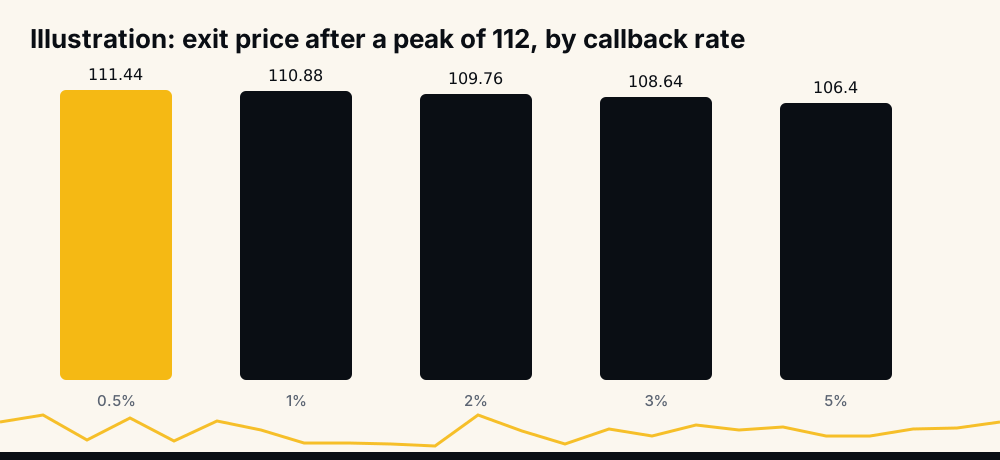
Hold the path fixed and change only the callback. A long from 100 that peaks at 112 exits at:
- 0.5%: 111.44
- 1%: 110.88
- 2%: 109.76
- 3%: 108.64
- 5%: 106.40
Every extra point of callback costs 1.12 here, about 1% of the peak, if the turn really was the top. The case for a wider callback is what happens when it was not: a 1% stop on a jumpy coin can close on a routine wobble at 106, and then you watch the move run to 112 without you.
Binance's FAQ puts the trade-off in its own words: "A higher callback rate is generally a better bet during volatile periods", a lower one in normal conditions, and "there is no optimal callback rate or activation price." It also warns that a callback set too low may fire on normal price swings.
How to choose a callback rate
There is no formula that finds the right callback for a coin you have not watched. What you can do is compare it with the coin's ordinary swings.
- Look at the pullbacks inside a trend you would have wanted to hold. If a coin routinely dips 2% and recovers, a 1% callback will close you on most of them.
- Ask what you are protecting. A callback wider than your open profit can still close the trade below your entry, as the next section shows.
- Remember it closes at market. In a fast drop the fill can land past your trailing level. Market orders pay the taker fee; our Binance futures fees article works through what that costs on notional.
- Re-check it when conditions change. Binance advises revisiting the strategy from time to time; a callback that suited a quiet week may not suit a news day.
Activation price: where trailing starts
If you do not set an activation price, Binance uses the current market price and trailing starts at once. Set one and the order waits.
The activation price has to sit on the correct side. For a SELL it must be above the latest price, for a BUY below it; otherwise the API refuses the order with -2021, "Order would immediately trigger". Our article on order would immediately trigger (-2021) covers that refusal in detail.
The activation level also caps what a callback can protect. Once armed at the activation price, the worst exit is the activation price × (1 − callback). Set activation 1% above a target that is 3% above a long entry, and this is the floor at each callback:
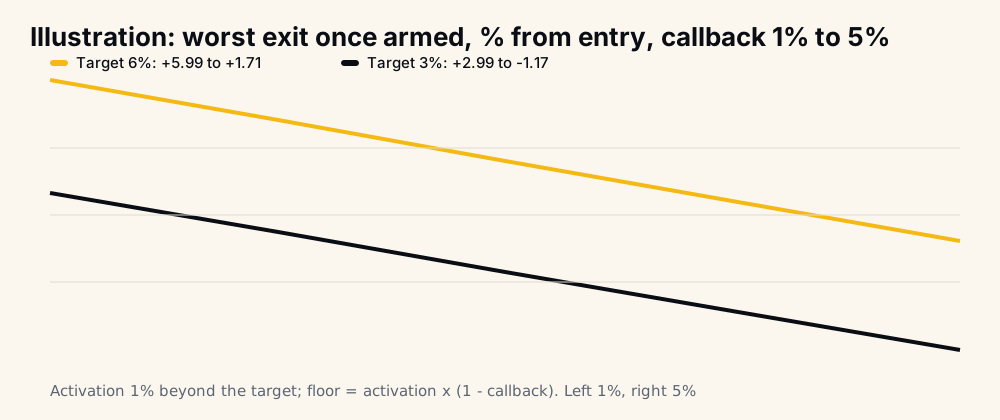
With the 3% target, 1% keeps about +2.99%, 3% keeps +0.91%, and 4% or 5% can close the trade at a loss (−0.13% and −1.17%) if the price turns right after arming. With a 6% target the floor stays positive across the range. Wide callbacks belong on trades whose activation sits well clear of the entry.
Mark price or last price?
You choose what the order watches. The API field is workingType, either MARK_PRICE or CONTRACT_PRICE (the last traded price), and the default is CONTRACT_PRICE. In the app you pick Last or Mark as the trigger when you place the order.
Binance notes that with Mark Price selected the order can activate even if the last price has not reached the activation level, and that "the Last Price might deviate significantly from the Mark Price during extreme price movements." A spike on the last price that the mark price smooths out can trigger a last-price trailing stop and leave a mark-price one untouched. Mark price vs last price on Binance explains how the two are built.
Why a Binance trailing stop is not working
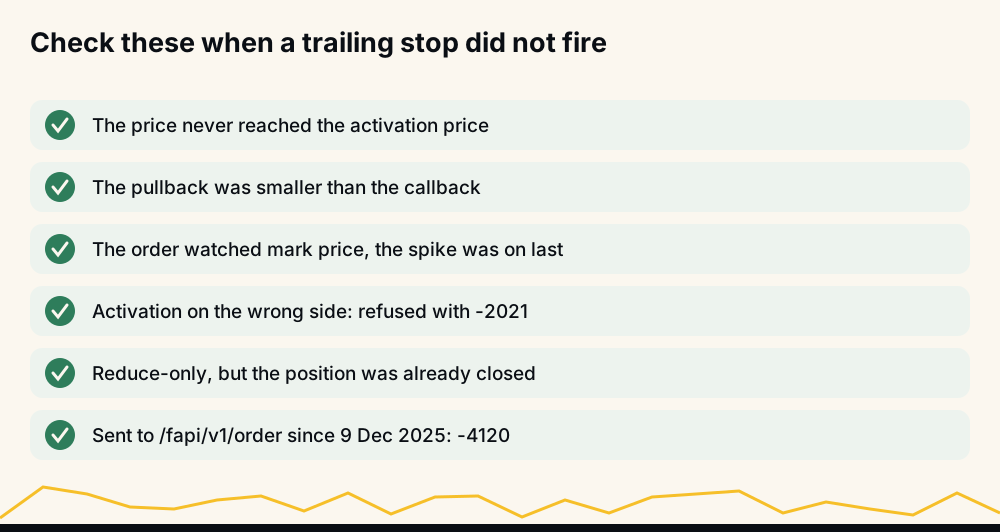
- The activation price was never reached. Binance's Example 2, Situation B: the price moved, but one of the two conditions failed, so "no order is issued".
- The pullback was smaller than the callback. A 0.43% dip against a 2% callback does nothing, by design.
- The order watches the other price. A last-price spike does not move a mark-price order, and the reverse.
- It was refused when placed. Activation on the wrong side returns -2021; nothing was ever working.
- Nothing was left to reduce. A reduce-only trailing order after the position closed some other way is rejected; see reduce-only order failed.
- A bot still uses the old endpoint. Since 9 December 2025 USDⓈ-M Futures run conditional orders, trailing stops included, on the Algo Service. Binance's change log says
POST /fapi/v1/orderand/fapi/v1/batchOrdersblock them with -4120STOP_ORDER_SWITCH_ALGO.
Trailing stop fields in the API
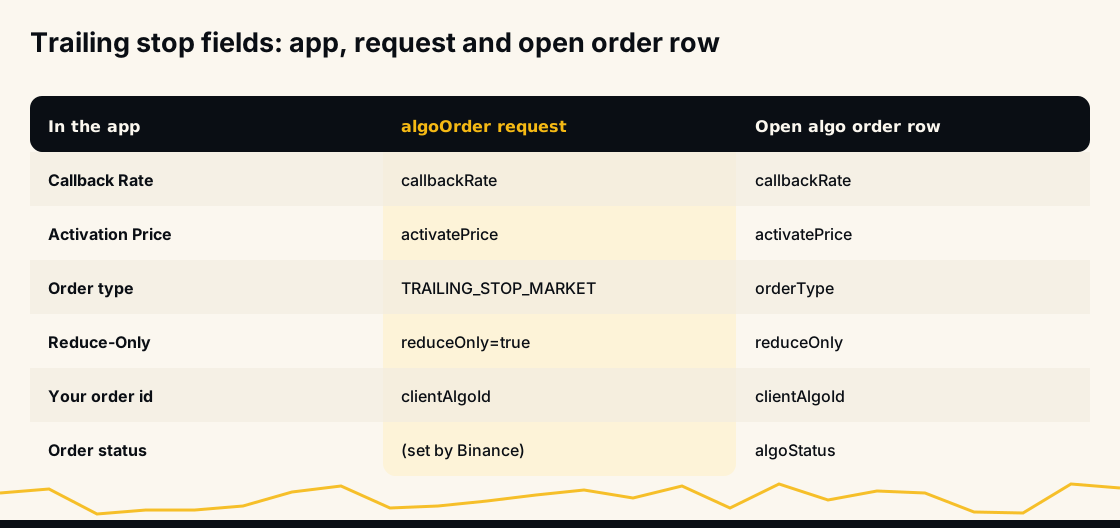
A trailing stop now goes to POST /fapi/v1/algoOrder with algoType=CONDITIONAL and type=TRAILING_STOP_MARKET. The request takes activatePrice (optional, defaulting to the latest price), callbackRate (0.1 to 20), workingType and a quantity, sent with reduceOnly=true when the order only closes a position (One-way mode; Binance refuses reduceOnly in Hedge Mode). Open algo orders come back with algoId, orderType, callbackRate, activatePrice and algoStatus, so a bot has to read them from the algo order endpoints as well as the regular open-orders list.
Modifying one is not possible in place. Binance's Modify Order endpoint says "currently only LIMIT order modification is supported", so a different callback means cancelling the trailing order and placing a new one. Between those two calls the position has no trailing protection, which matters on a fast market.
How HafizeBot's trailing take-profit uses the callback
HafizeBot's autotrader places a take-profit for every entry on the member's own Binance account. The member picks the type with /setTakeProfitType:
- LIMIT (the default) is a reduce-only limit order at the signal's target, placed right after the entry.
- TRAILING is a Binance trailing stop that arms once the price is 1% beyond the target, then follows the best price and closes on a pullback.
The pullback is the member's callback, set with /setTrailingCallback from 1% (the default) to 5% in steps of 0.1 (command page). Open take-profits keep the callback they were placed with; new ones use the new value.
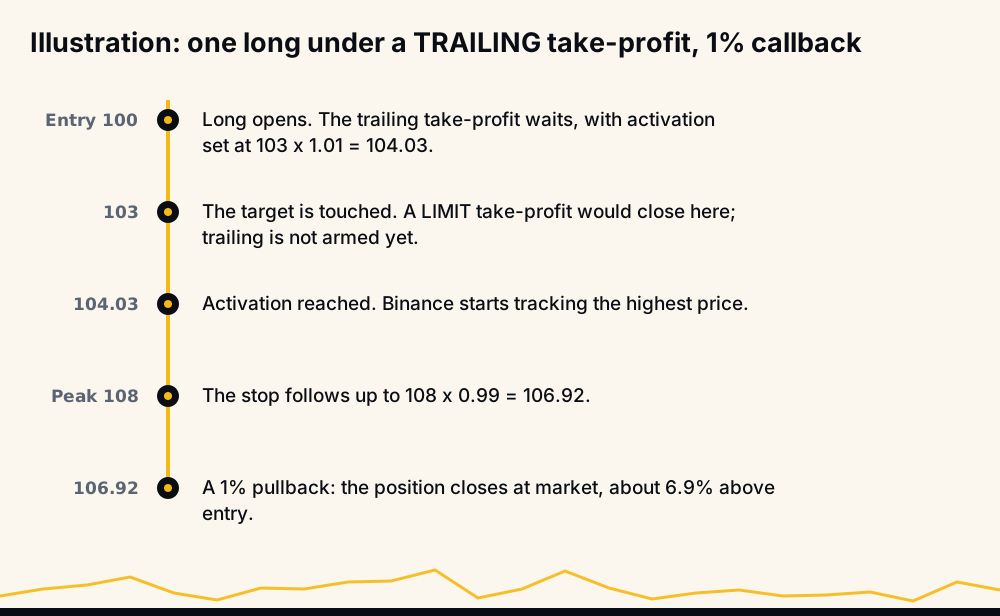
Know what TRAILING gives up. A signal that only touches its target never arms the trailing order, and the position then stays open with no take-profit working; under LIMIT the same signal would have closed in profit. The live performance page scores every signal at its own target, as LIMIT closes it, and does not score trailing. The help page on limit or trailing take-profit sets the two side by side. If you are unsure, LIMIT is the setting the published record describes.
The signals themselves are AI-generated, built from 240+ indicators, formulas and components; September 2026 on /performance reads 97.7% of 4,220 signals reaching their target, with every missed signal counted against the rate. That rate describes targets reached; a trailing exit with your own callback can land above or below them.
Frequently asked questions
What is callback rate in a trailing stop? It is the pullback from the best price since activation that triggers the order, as a percentage. On a sell trailing stop the order fires when the price falls to the high × (1 − callback); on a buy, when it rises to the low × (1 + callback).
What is a good callback rate for a Binance trailing stop? Binance itself says there is no optimal callback rate. A callback smaller than the coin's ordinary pullbacks closes you on noise; one wider than your open profit can close the trade below entry. Compare it with the swings of the coin you trade.
What is the activation price on a Binance trailing stop? It is the price that starts the trailing. Without one, Binance uses the current market price; with one, the order waits until the price reaches it, and it must sit above the market for a sell and below it for a buy.
Why did my Binance trailing stop not trigger? Usually the activation price was never reached, the pullback was smaller than the callback, or the order watched the other price type. It may also never have been accepted: check for -2021 when you placed it.
Can I change the callback rate on an open trailing stop?
Through the API, no: Binance only supports modifying limit orders, so you cancel the trailing stop and place a new one. On HafizeBot, a new /setTrailingCallback value applies to take-profits placed from then on.
Does a trailing stop on Binance Futures close at market? Yes. Once both conditions are met, Binance sends a market order, so in a fast move the fill can be worse than the trailing level and you pay the taker fee.
Summary and sources
The callback rate is a pullback measured from the best price since activation, and the activation price decides when that measurement starts. Together they set the worst exit you can get once the order is armed. Sources: Binance's trailing stop, spot trailing stop and order types FAQs, the USDⓈ-M New Algo Order and Modify Order documentation, and the derivatives change log.
To try a trailing take-profit on your own account, start 3 days of VIP Tier 1 free at hafizebot.com/trial or with /trial in @hafizebot; trial autotrading is capped at 10 USDT of margin per entry and 3 open positions. The free channel t.me/getbinancefutures posts the stronger signals (strength 3 and up) 20 minutes after VIP.
This is not investment advice; a trailing stop does not guarantee its exit price, so trade only what you can afford to lose.