Open interest in crypto futures is the number of contracts still open at a given moment, counted once per contract even though each one has a long and a short side. It rises when a trade opens a new position on both sides, falls when both sides close, and stays the same when an existing position passes from one trader to another. Volume counts every trade; open interest counts what is still held.
That one definition settles most of the confusion. Below are the mechanics, a month of real BTCUSDT readings pulled from Binance's API, how traders usually read open interest against price, and the things the number cannot tell you.
What open interest means in crypto futures
A futures contract always has two parties. Someone is long, someone is short, and the contract exists until one of them closes or it expires. Perpetual contracts never expire, so on a perpetual like Binance's BTCUSDT a contract lives until both sides of it are gone.
CME Group defines open interest as contracts entered into and not yet offset or delivered. Its guide to the volume and open interest columns adds the rule that matters most: "Each open transaction has a buyer and seller, but for calculation of open interest, only one side of the contract is counted." Crypto venues count the same way.
Two consequences follow. Total long open interest always equals total short open interest, because every long has a short on the other side. And open interest says how much is at stake, without saying who is right. For a refresher on the two sides themselves, see long and short positions in crypto.
How each trade changes open interest
Every fill has a buyer and a seller, and each of them is either opening or closing. That gives four cases, and only two of them move the number.
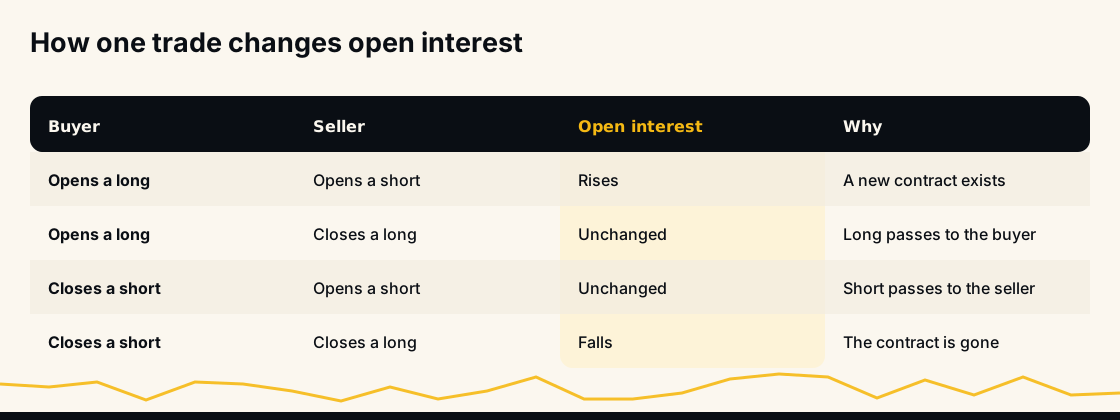
Here is a short sequence to follow:
- Alice buys 5 contracts from Bob. Both are opening. Open interest: 5.
- Carol buys 3 from Dan. Both opening. Open interest: 8.
- Alice sells 2 to Erin. Alice is closing, Erin is opening, so the 2 contracts change hands. Still 8.
- Bob buys 3 from Carol. Bob is closing his short, Carol is closing her long. Open interest: 5.
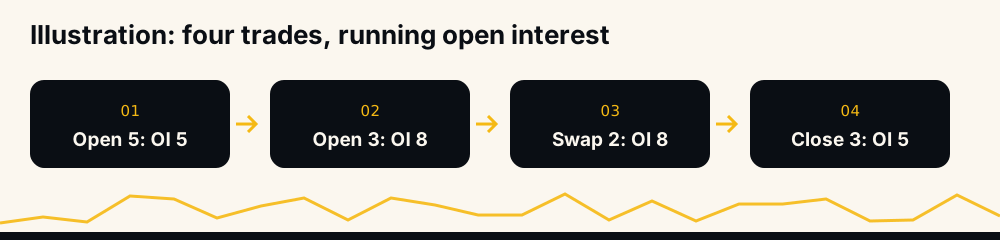
Four trades, 13 contracts of volume, and open interest ended where it was after the first trade. That gap is why the two numbers are worth reading together.
Open interest vs trading volume
Volume is a flow: contracts traded over a period, reset every candle. Open interest is a stock: contracts outstanding at one instant, carried forward until positions close. A busy day of traders swapping the same positions can produce huge volume and no change in open interest at all.
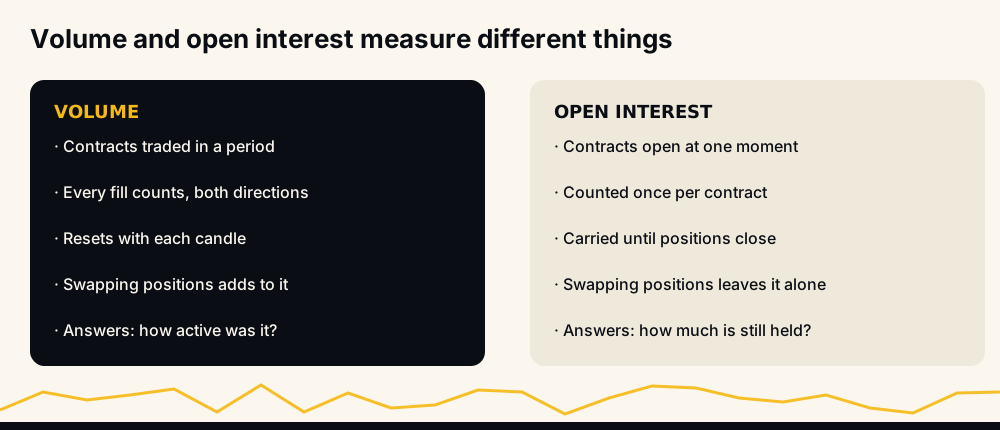
So volume tells you how active a market was. Open interest tells you how much exposure stayed on the books when the activity was done.
A month of real BTCUSDT open interest on Binance
To make this concrete we pulled Binance's own figures for the BTCUSDT perpetual from the Open Interest Statistics endpoint (/futures/data/openInterestHist, daily period). Each reading is stamped with the end of its period, and Binance keeps only the latest month of this history.
The 30 readings run from 00:00 UTC on 9 October 2026 to 00:00 UTC on 7 November 2026:
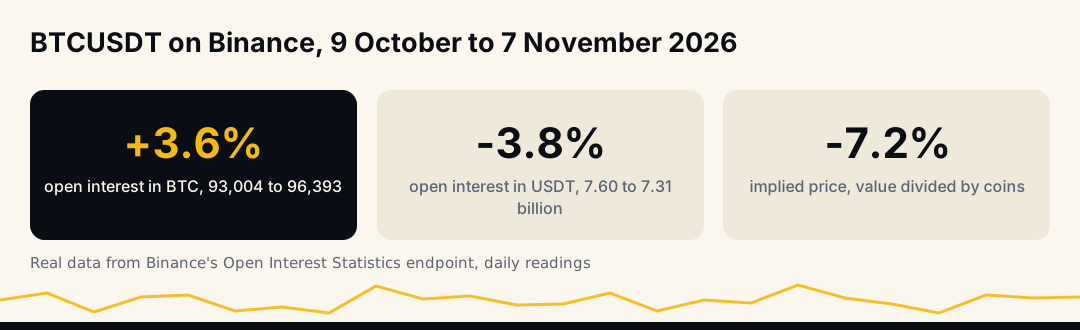
- Open interest in coins went from 93,004 BTC to 96,393 BTC, up 3.6%.
- Open interest value went from 7.60 to 7.31 billion USDT, down 3.8%.
- The implied price (value ÷ coins) fell from about 81,711 to 75,811, down 7.2%.
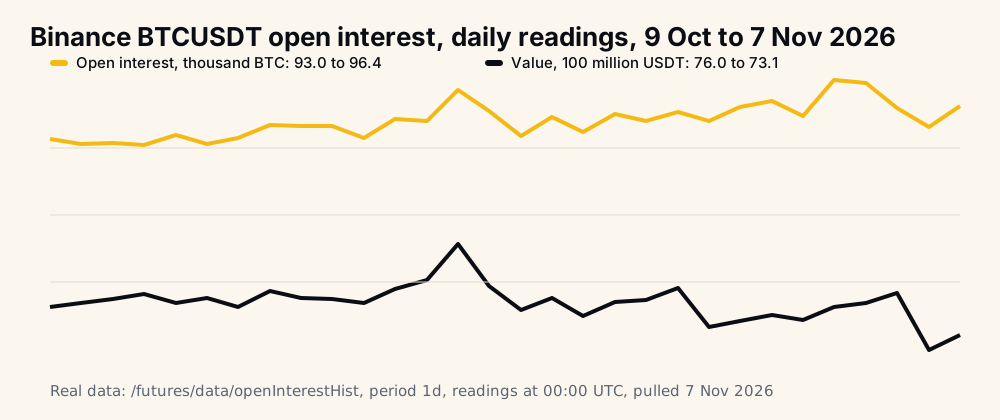
More bitcoin was held in open contracts at the end of the month than at the start, yet a dollar chart of the same data shows a decline. Neither chart is wrong. They measure different things.
Open interest in coins and in dollars
Open interest value is contracts × price. When the price falls 7% and the contract count rises 3.6%, the value falls. A chart labelled "open interest" in USD can therefore drop on a day when not a single position closed.
When you compare open interest over time, use the coin or contract count to ask "did traders add or remove exposure?" and the dollar value to ask "how much money is at stake right now?". Comparing across coins only works in dollars, since 1 BTC and 1 DOGE are not the same unit.
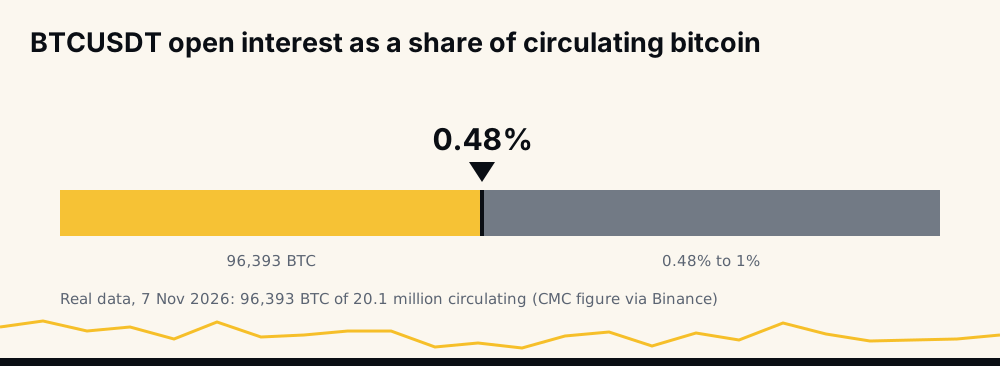
The same endpoint returns a circulating-supply figure supplied by CoinMarketCap. At the last reading, 96,393 BTC against 20.1 million circulating is about 0.48% of all bitcoin, held as open interest on this single Binance contract.
How to read open interest with price
Binance's futures blog (What Information Does Open Interest Convey?, 2020) gives the usual readings, and they are the ones most traders still use:
- Price up, open interest up: new money entering, often read as a trend with support.
- Price down, open interest up: new positions opening into a falling market, often read as bearish.
- Price up, open interest down: shorts closing, a rally that is not drawing new positions.
- Price down, open interest down: longs closing out, which the blog reads as a decline running its course.
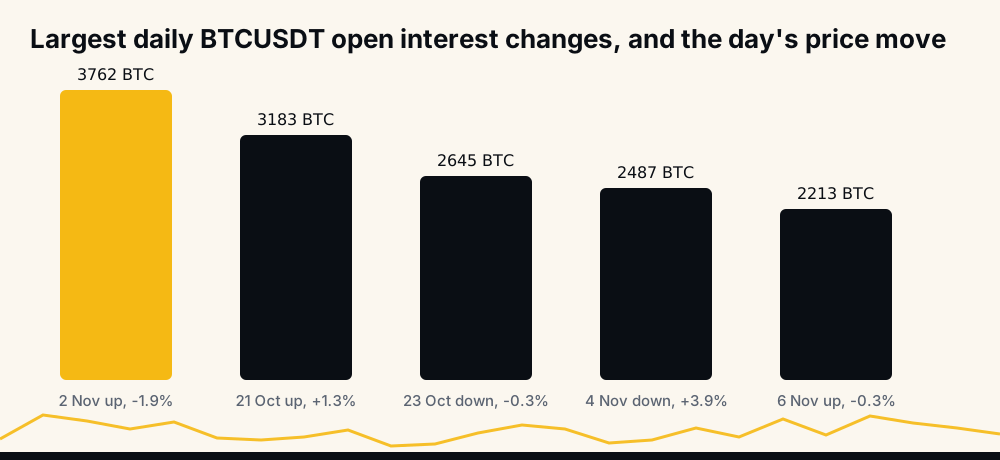
The month above has a real day for each box. On 21 October (UTC), open interest rose 3,183 BTC while the price gained 1.3%. On 2 November it rose 3,762 BTC while the price fell 1.9%. On 4 November it fell 2,487 BTC on a 3.9% rise, and on 5 November it fell 1,988 BTC on a 5.5% drop.
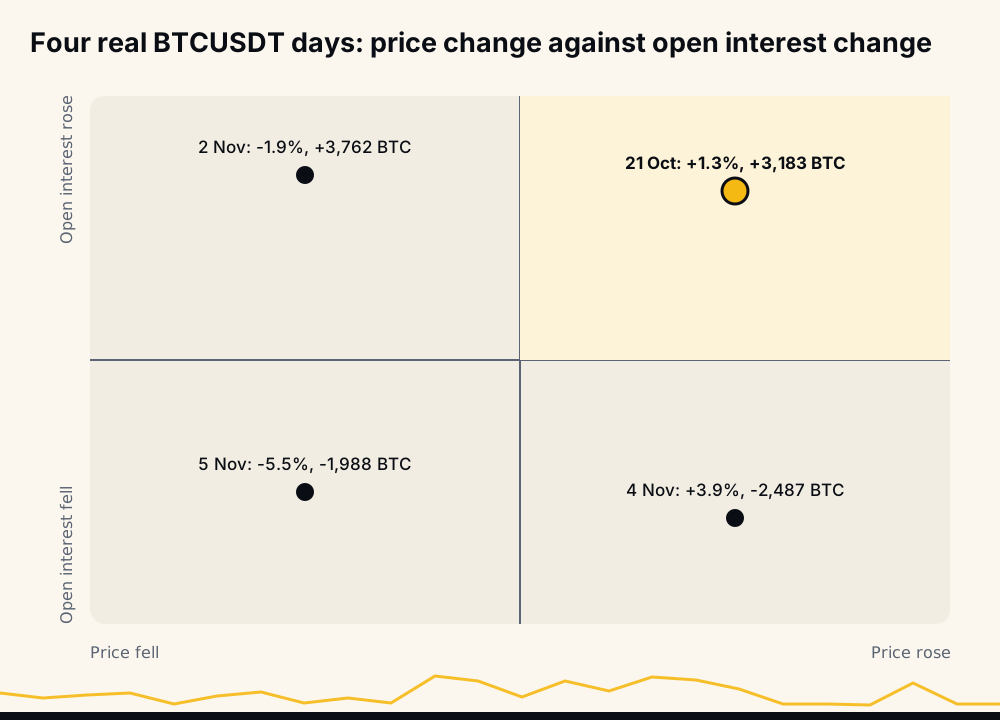
Treat these as descriptions of what happened, and be careful about reading them as forecasts. Binance's own article calls open interest one factor among several. The next section explains why.
What open interest cannot tell you
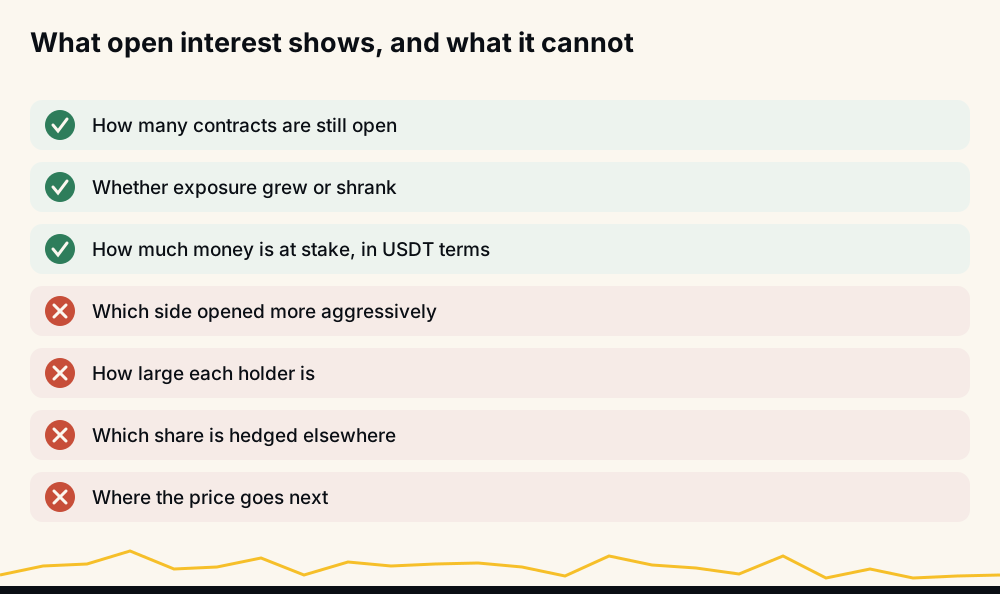
Open interest is a count, and a count has limits:
- Direction. Longs and shorts are always equal. Rising open interest means more of both.
- Who was aggressive. A rise on a green day does not prove buyers opened; it proves both sides did, and price says who paid up.
- Size of each holder. A thousand small traders and one fund can produce the same figure.
- Hedges. Some of the open interest offsets spot holdings or positions on another exchange, so it is not all directional bets.
- Your own trade. It describes the market, and says nothing about where your stop or target should sit.
Open interest, liquidations and funding
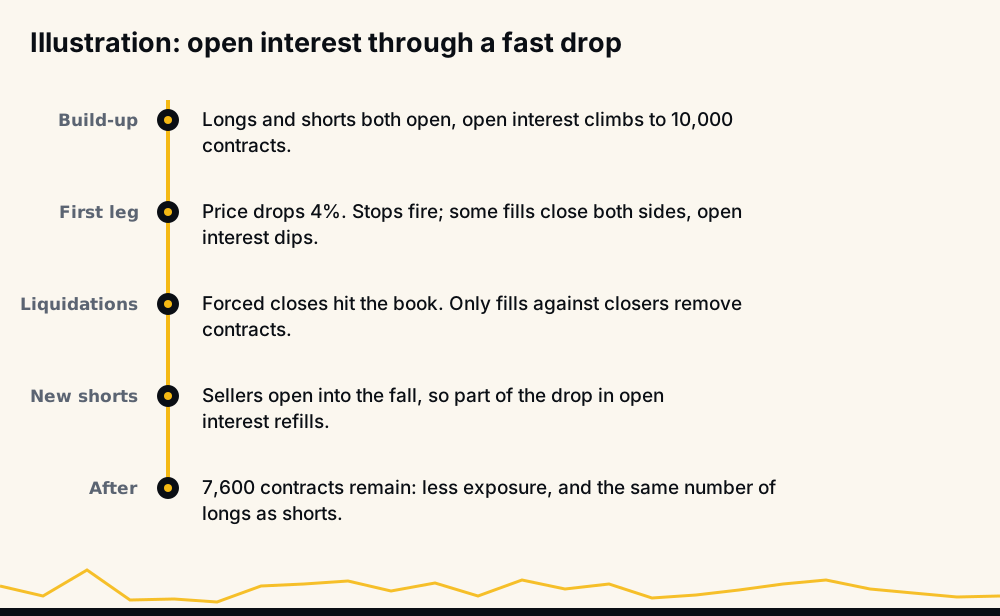
A liquidation is a forced close of one side. Whether open interest falls depends on the counterparty: if the trader who takes the other side of the liquidation order was closing too, the contract disappears; if they were opening, it simply changes hands. That is why a sharp drop often shows a fall in open interest, but rarely one as large as the liquidations reported for the same hour.
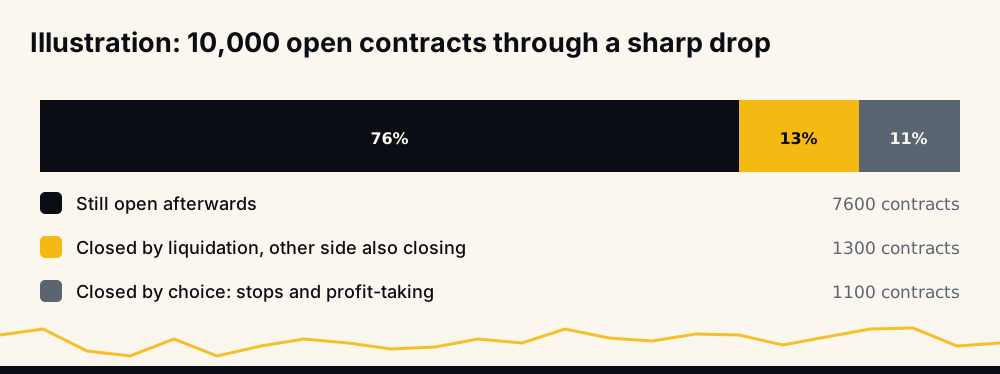
Liquidation itself is covered in why your liquidation price changes on Binance. Here is how a fast move typically plays out in the count, with illustrative numbers.
Funding is the other half of the picture on perpetuals. Open interest shows how big the market is; the funding rate shows which side is paying to keep its positions. Binance's FAQ on futures fees says it "only helps facilitate the exchange of funding amounts between long- and short-position holders"; none of it goes to Binance. A large open interest with a high positive rate means many longs paying shorts every settlement. The mechanics are in Binance funding rate explained.
How to check open interest on Binance
On the website, Binance shows open interest charts in the futures Trading Data section alongside the long/short ratios. Programmatically, two public endpoints cover it, no API key needed:
GET /fapi/v1/openInterestreturns the "present open interest of a specific symbol", in coins for a contract like BTCUSDT, with a timestamp.GET /futures/data/openInterestHistreturns history withsumOpenInterest(coins),sumOpenInterestValue(USDT) and a CoinMarketCap circulating supply, for periods from 5 minutes to 1 day. Binance's docs say "Only the data of the latest 1 month is available", so anything older has to be saved as you go.
A practical note from pulling this data: the timestamp field is the end of the period, so a daily reading stamped 00:00 on 22 October describes the 21st. Line it up with the right candle or every comparison shifts by a day. The docs also say a period with no trades "has no record", so gaps are normal on thin contracts.
Aggregated open interest across exchanges
"Aggregated open interest" adds up the same coin across several venues. Bitcoin futures trade on Binance, on other crypto exchanges and on CME, and each publishes its own count, so the sum is larger than any one of them.
Two cautions apply. First, units differ: some venues count USDT-margined contracts in coins, some coin-margined contracts in dollars, and CME in its own contract sizes, so a fair sum converts everything to one unit first. Second, aggregators update at different times and cover different venue lists, which is why two sites rarely show the same total. The real BTCUSDT figures in this article are Binance's single contract and nothing more.
Options have open interest too, counted the same way per contract, and Binance publishes it separately for its options market. An options figure mixes calls and puts at many strikes and expiries, so it does not add cleanly to futures open interest. Keep the two apart unless the aggregator says exactly how it combined them.
Open interest and HafizeBot's signals
This article is general education about a market statistic. HafizeBot's AI-generated signals are built from 240+ indicators, formulas and components, and we do not publish what goes into them. What we do publish is the outcome: the live performance page counts every broadcast signal from the database, with every missed signal counted against the rate. In September 2026, 97.7% of 4,220 signals reached their target. The monthly reports hold the 2021 to 2024 archive as spreadsheets.
With autotrading, the bot trades Binance USDⓈ-M perpetuals on your own account under settings you choose, such as /setLeverage, /setPositionLimit and /setStopLoss. The key needs futures trading only; use one with withdrawals off.
Frequently asked questions
What is open interest in crypto? It is the number of futures or options contracts that are still open, counted once per contract. Each open contract has one long and one short, so open interest measures the size of outstanding positions without saying which side holds the advantage.
Is high open interest bullish or bearish? Neither on its own. High open interest means many positions are open on both sides. Traders read it together with price: rising open interest with a rising price is usually called supportive, and rising open interest with a falling price bearish.
How do I check open interest for bitcoin on Binance?
Use the Trading Data section of Binance Futures, or call the public endpoint /futures/data/openInterestHist with symbol=BTCUSDT and a period such as 1d. Binance keeps the latest month of that history.
What is the difference between open interest and volume? Volume counts every contract traded during a period. Open interest counts contracts still open at a moment. Traders swapping existing positions add volume without changing open interest.
Why did open interest fall when the price dropped? Positions closed on both sides of some contracts, through stops, liquidations or traders taking profit. If open interest is quoted in dollars, part of the fall can also be the lower price applied to the same number of contracts.
Does open interest count longs and shorts separately? No. Every contract has a long and a short, so total longs equal total shorts and open interest counts each contract once. The long/short ratios Binance publishes are a separate statistic that compares accounts or positions held by groups of traders.
The short version
Open interest is contracts still open, counted once. Both sides opening adds to it, both closing subtracts, and a hand-off leaves it alone. Read it in coins to see exposure change and in dollars to see money at stake, and read it with price, because on its own it has no direction. Sources: CME Group's volume and open interest guide, Binance's futures blog and fee FAQ, and Binance's USDⓈ-M API documentation, with data pulled on 7 November 2026.
To see signals as they are sent, the free channel t.me/getbinancefutures posts the stronger ones (strength 3 and up) 20 minutes after VIP. A 7-day trial of VIP Tier 1 runs autotrading capped at 10 USDT of margin per entry and 3 open positions; VIP is 50, 100 or 200 USDT a month through /join in @hafizebot.
This is not investment advice; leveraged futures can lose your whole margin, so trade only what you can afford to lose.