The advantages of AI trading bots are real but narrow: they watch hundreds of markets at once, act in seconds at any hour, follow their rules without fear or greed, and leave a timestamped record you can audit. The disadvantages are just as real: a model can be fitted to the past, lag when the market changes, apply leverage mechanically, stop when a server fails, lose part of each win to fees, and needs an API key into your account.
This page weighs each side and what to check before trusting any bot. We run one, HafizeBot, an AI signal service and autotrader for Binance USDⓈ-M futures, so where it helps we show how we handle each point and which public numbers you can recount. Whether bots work at all is answered in do AI crypto trading bots actually work, and the buying verdict in are crypto trading bots worth it. This one is about trade-offs.
AI trading bot pros and cons at a glance
A bot is not a smarter trader. It is a faster, more consistent one, and consistency cuts both ways: a good rule gets followed every time, and so does a bad one.
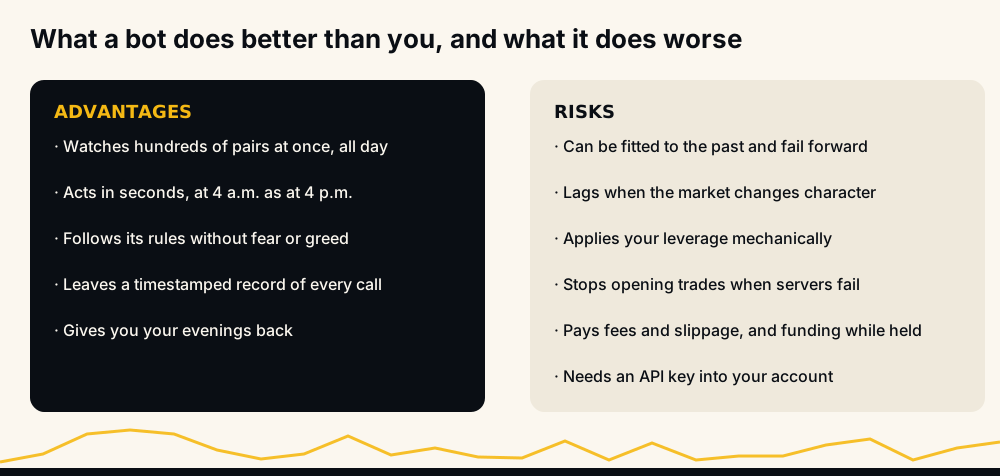
The advantages are about execution: coverage, speed, discipline, a record. The risks are about conditions: the market the rules were built for, the leverage you hand the bot, its servers, the cost of each trade and the key that connects it. None is a reason to avoid bots. Each is a reason to check something specific first.
Advantage 1: speed and coverage no person can match
A person can follow a handful of charts with real attention. A bot re-evaluates every pair it covers, continuously, and does not slow down at 4 a.m. or after a losing week.
HafizeBot's home page says it scans 523 Binance futures pairs (11 October 2026) with AI-generated signals from a model built on 240+ indicators, formulas and components. That sentence is as far as we describe the model; the proof we offer is the record, not the recipe.
Speed matters most when signals play out quickly, so here is how quickly ours did. We took every signal in the public archive at /data that reached its target, 33,081 of them between June 2021 and February 2024, and measured the time from entry_time to close_time in the CSV.
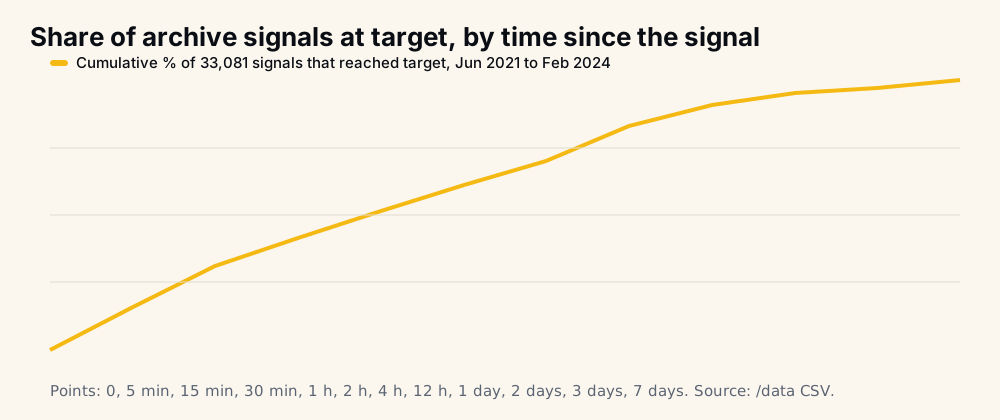
A quarter were done within 11 minutes. A person who sees a signal ten minutes late, or who needs a minute to open the app and size the trade, misses many of those. A bot does not.
How long do AI signals take to reach their target?
The honest answer is a distribution, not one number. In the archive, the median signal reached its target in 66 minutes, 48.5% within the hour and 85.5% within a day. The slow tail is long: 10% took more than about 51 hours.
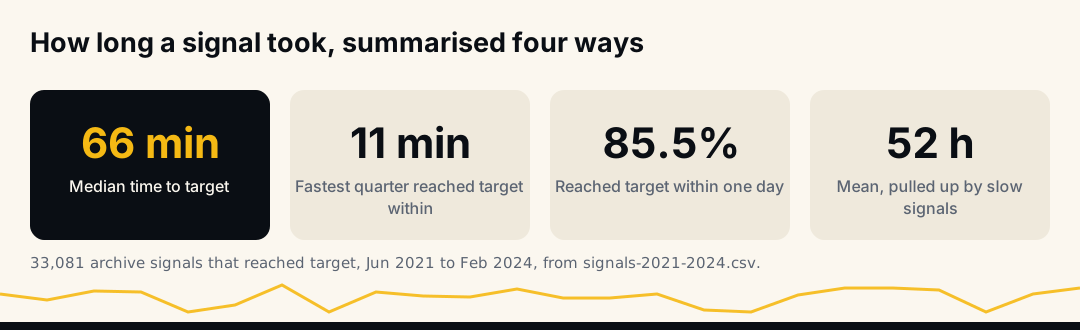
That tail is why an average misleads here. The mean is about 52 hours, because a few signals that took weeks pull it far above the typical case. This page used to claim signals hit target "within an average of 4 minutes". The archive does not support that, so it is gone. You can redo the calculation: download the CSV from /data, keep rows where status is closed, and subtract the two time columns.
Two caveats. These are 2021 to 2024 signals; the live performance page scores every signal since June 2026, and its timings are not summarised here. And time to target is not time in profit: many signals moved against their entry first, which matters once leverage is involved (risk 3).
Advantage 2: discipline that does not get tired or scared
Most manual trading losses come from behaviour, not analysis: closing winners early, holding losers in hope, adding size after a loss, chasing a candle that already moved. A bot has none of those urges. It enters when its rules say enter and exits where its orders say exit.
This is the advantage traders feel most, and the one most often oversold. Discipline is only as good as the rules. A bot running a losing strategy loses with perfect discipline, and faster than you would, because it never pauses to wonder.
So the useful version of the claim is narrow: a bot removes your emotions from execution, not risk from the market. The decisions that carry the risk move to the moment you configure it: how much per trade, which leverage, whether to use a stop and how many positions at once. Make those calmly, before the first trade, and the bot's discipline works for you. Set them to whatever looks exciting, and the same discipline works against you, every time.
Advantage 3: a record you can audit, if the bot publishes one
A human trader's history lives in memory and screenshots. A bot's lives in a database: every signal, its time, its price, its outcome. That makes a bot more auditable than a person, but only if someone publishes the table instead of a highlight reel.
Ours is in two parts. The monthly spreadsheets from June 2021 to February 2024, 33,694 signals in all, are at /reports and flattened into one CSV at /data. Since June 2026, the performance page is rebuilt every hour from the table the bot writes when it sends a signal, with signals that miss their target counted against the rate. The settled months read 98.4% in June (6,304 signals), 97.2% in July (5,448) and 97.3% in August 2026 (5,262).
Two limits belong next to those numbers. A target-hit rate is not account profit: your result depends on your leverage, stop and size. And the page's PnL column adds up only the signals that reached target, so it is not a return either. How to verify a crypto signal win rate walks through checking any provider's figures this way, ours included.
Risk 1: overfitting, or a model that learned the past too well
Overfitting is the oldest problem in automated trading. Give a model enough freedom and enough history, and it will find rules that fit that history almost perfectly, including its noise. The backtest looks superb. Forward, on data it has never seen, the edge disappears, because part of what it learned was coincidence.
AI makes this easier, not harder: more parameters mean more ways to memorise. You cannot see overfitting from outside, but you can see its symptom. A backtest is written after the fact; a forward record is written at the time. Only the second can't be tuned to look good.
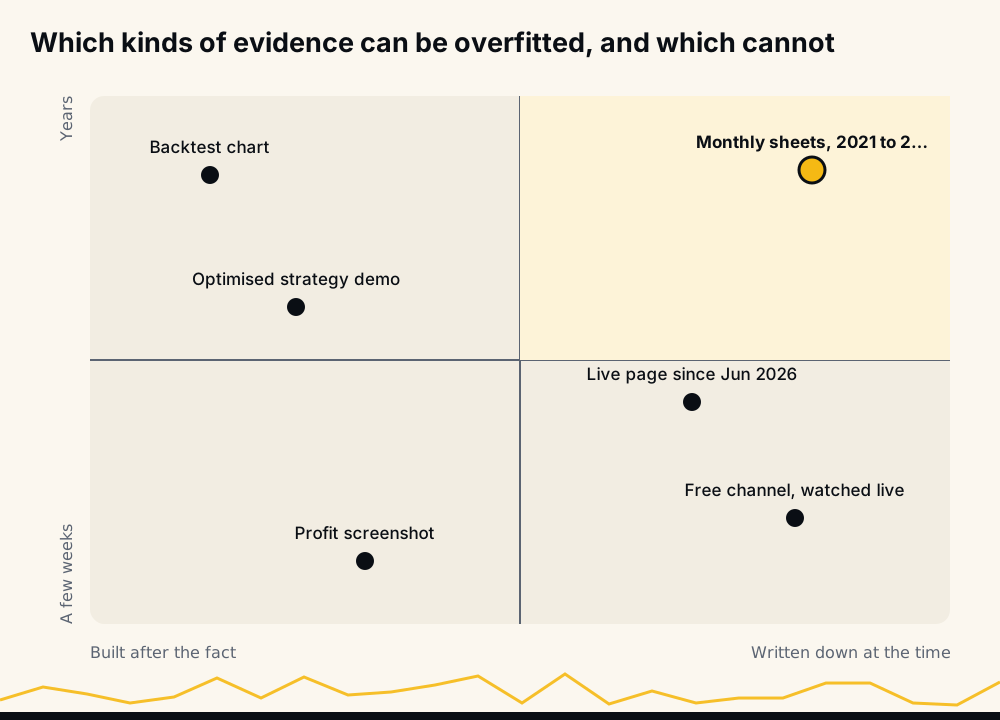
That is why we point at records rather than simulations. The spreadsheets were published month by month as the signals happened, and the live page stores each signal's price the moment it is sent. Neither is a third-party audit, and we have none. What they do is fix each call in place before its outcome is known, which is the property a backtest lacks.
Risk 2: markets change regime, and models lag behind
A market that trends for months behaves differently from one that chops sideways, and both differ from a crash. A model trained mostly on one regime can perform worse in another, and the change rarely announces itself. Bots also hit rule changes of their own: the same signals scored under a different rule produce a different number.
The defence is a record long enough to cover more than one kind of market, with every month shown, including the weak ones and the gaps.
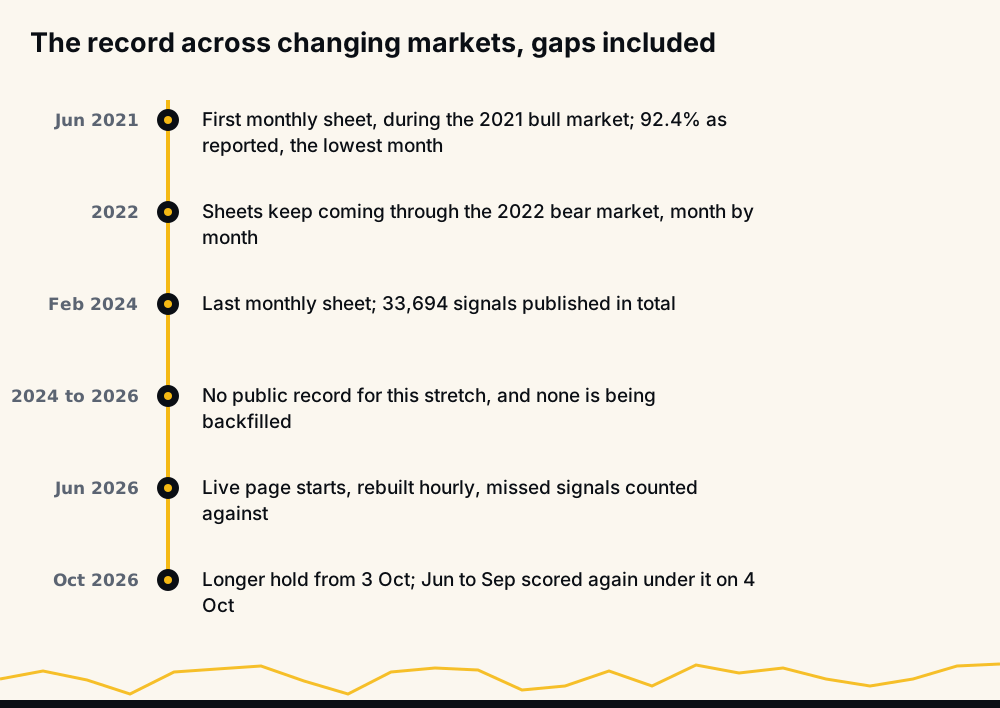
In our archive the weakest month was the first, June 2021, at 92.4% as reported in the sheet. The weakest stretch of the 2022 bear market was August and September, at 93.6% and 94.1%. There is no public record between February 2024 and June 2026, and we say so. On the live page, signals have had longer to reach their target since 3 October 2026, and June to September were scored again under that rule; under the shorter one, June to August read 94.3%, 88.3% and 91.0%. If a bot shows one smooth number for "all time", ask which months it left out.
Risk 3: leverage turns a normal dip into a liquidation
This is the risk that costs people the most. A bot applies your leverage to every trade without hesitating, on bad days as faithfully as on good ones.
The archive shows why it matters. Its CSV records each signal's worst move against the entry while it was open (pnl_min_pct). The median signal that reached its target first dipped 1.3% against the entry. But a minority dipped much further before recovering. On isolated margin, liquidation comes at roughly 100% divided by your leverage, a little sooner once maintenance margin is counted.
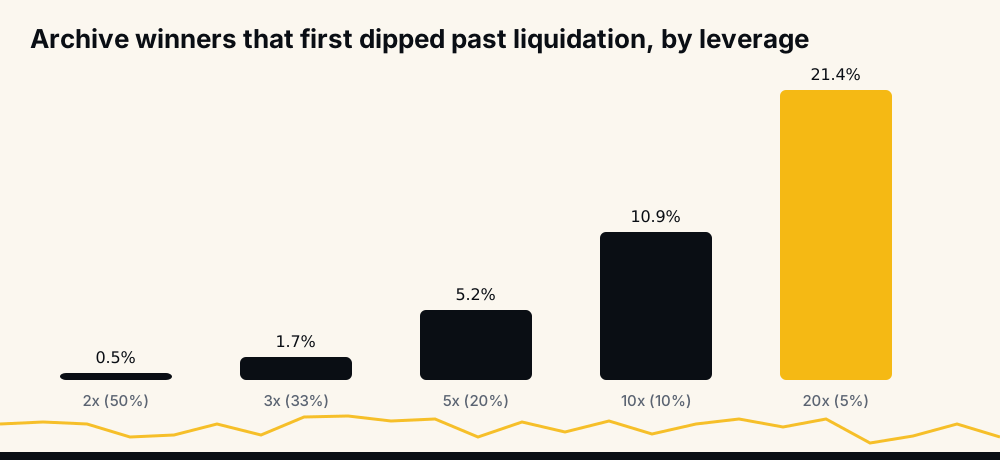
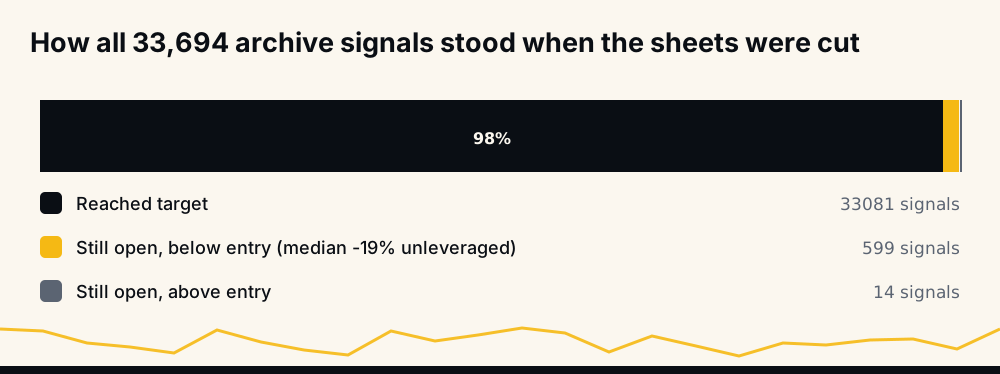
At 10x, 3,617 of those 33,081 "winning" signals would have liquidated a position before the target came. At 20x, 7,070. The signal was right and the trade was still lost. Treat these as a floor, since real liquidation comes slightly earlier. And some signals never came back at all:
On HafizeBot, leverage and stop are the member's own settings. New accounts start at 2x isolated with a 10% stop, and the bot refuses a stop that liquidation would reach first on isolated margin. How leverage trading works explains the arithmetic, and how to set a stop-loss the trade-off.
Risk 4: outages, on the bot's side and the exchange's
"It runs 24/7" really means "it runs whenever its server, its network and the exchange's API are all up". When something fails, what matters is where your exits live.
A bot that keeps its take-profit and stop in its own memory leaves your position unprotected while it is down. A bot that places them on the exchange as resting orders does not: the exchange fills them whether or not the bot is watching. HafizeBot does the second. Right after Binance accepts an entry, the take-profit goes there as a reduce-only limit order (the default type) and, if you set a stop, the stop goes as a stop-market order.
What stops during an outage is everything that needs a running process: new entries and the Telegram notices that tell you about fills. A stop set to 0 means there is no stop order to rest on Binance at all. What happens to open positions if the bot stops goes through the cases minute by minute.
Risk 5: fees, slippage and funding eat small wins
Every automated trade pays the exchange's fee on entry and exit, usually fills a little away from the signal price, and on perpetual futures pays or receives funding while held. Each cost is small; a strategy of many small moves pays them many times.
In the archive, the median signal that reached its target closed 1.48% from its entry, unleveraged. Suppose fees and slippage together cost 0.1% of the position's value per round trip; that is our assumption for the example, not a quoted fee.
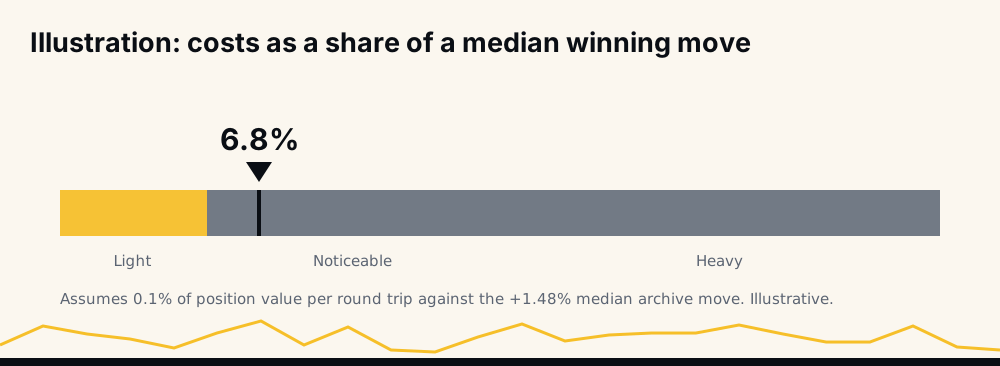
That cost takes about 6.8% of a typical winning move, and leverage does not change the share, because fees and gains both scale with position size. On a losing trade the cost adds to the loss. HafizeBot enters with market orders to catch signals quickly, so small slippage against the signal price is normal. It is one of the reasons your results differ from a signal provider's.
Risk 6: an API key is a door into your account
To trade for you, a bot needs an API key with trading rights. That key is the biggest security decision you make. With the wrong permissions, a leaked key can empty an account; with the right ones, the worst it can do is trade badly.
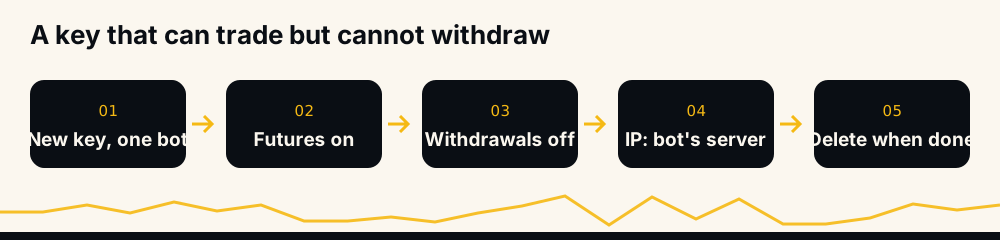
HafizeBot never holds your trading funds; they stay in your own Binance futures wallet. The key needs Enable Futures and nothing else, withdrawals are never needed and the bot warns you if they are on, and our security page gives the server address to restrict the key to. Keys are saved only at hafizebot.com/app/keys and encrypted at rest. Deleting one there switches autotrading off, and deleting it in Binance's API Management ends it for good. How to connect a trading bot to Binance safely explains each permission.
What to check before you trust any AI trading bot
Each risk above has a matching question. A good provider answers all six with something you can open and check yourself, not a promise.
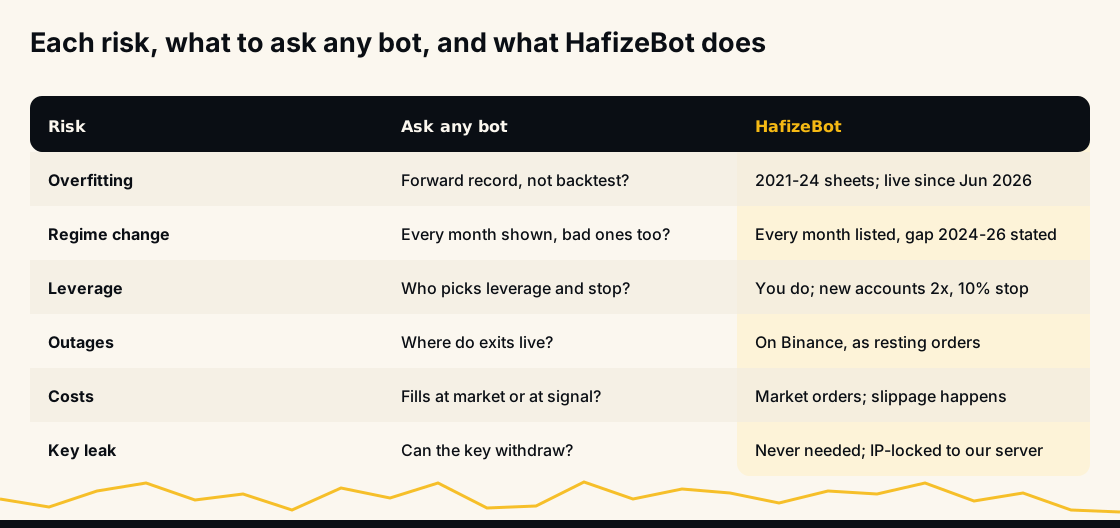
Then do the checks in order. They cost an afternoon and two weeks of watching.
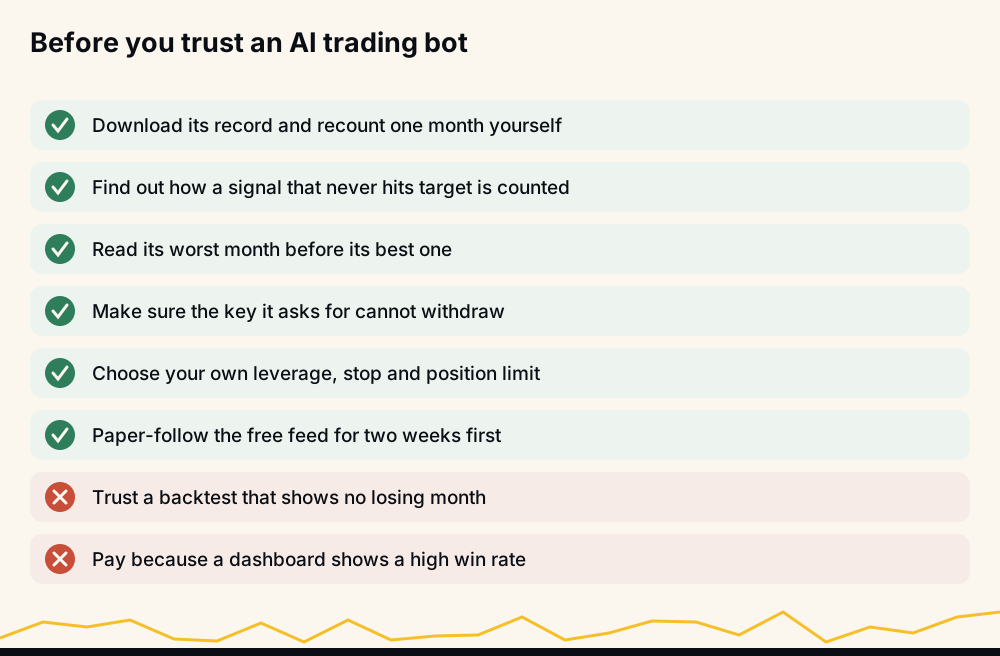
The last two are struck through on purpose. A backtest with no losing month is a warning, not a credential, and a high win rate alone says nothing about profit, as risk 3 showed. Our free Telegram channel carries the stronger signals, strength 3 and up, 20 minutes after VIP, which is enough to compare against the record before you pay anything.
FAQ
What are the main advantages of AI trading bots? Coverage, speed, discipline and a record. A bot watches hundreds of pairs at once, acts in seconds at any hour, follows its rules without fear or greed, and logs every decision. Those are execution advantages; they do not make the underlying strategy profitable.
What are the biggest disadvantages of AI trading bots? Overfitting to past data, weaker results when the market changes regime, leverage applied mechanically, outages that pause new trades, costs that eat small wins, and the security of the API key. Leverage does the most damage in practice, because a correct signal can still liquidate an over-leveraged position.
Are AI trading bots better than manual trading? They are better at execution and no better at judgment than the rules they run. A bot beats a person at speed, coverage and consistency, and loses to an attentive person at noticing that conditions have changed. The settings you choose decide most of the outcome.
Can an AI trading bot lose all my money? It can lose the money in the futures wallet it trades, through high leverage, no stop or too many positions at once. A key with withdrawals off and an IP restriction cannot move funds out of your account, but it can still trade them badly. Limit the wallet, the leverage and the position count.
How fast do AI crypto signals usually play out? In HafizeBot's 2021 to 2024 archive, the median signal that reached its target did so in 66 minutes, a quarter within 11 minutes and 85.5% within a day. The mean was about 52 hours because of a slow tail. You can recompute this from the CSV at /data.
The bottom line on AI trading bots
The pros and cons of AI trading bots come down to one trade: you swap your own hesitation and limited attention for a system's speed and consistency, and take on the risks of that system in return. Both halves are real. A bot worth using shows you its record, tells you how a miss is counted, keeps your exits on the exchange, needs no withdrawal permission on your key and leaves leverage and stops to you.
HafizeBot's record is on the live performance page, the archive is at /reports, and the stronger signals, strength 3 and up, run free and 20 minutes late in the channel above. VIP and autotrading are in @hafizebot, with a three-day trial capped at 10 USDT of margin per entry and three open positions. Nothing here is investment advice. Futures carry a high risk of loss, past results do not guarantee future ones, and you should only trade what you can afford to lose.