Yes. HafizeBot's signals are AI-generated, from a model that evaluates 240+ indicators, formulas and components, and that sentence is everything we publish about how they are made. What we publish instead is the outcome: every signal broadcast since June 2026 is scored hourly on the live performance page with missed signals counted against the rate, and the 2021 to 2024 archive is a free download at /data.
This is the "in-depth look", told straight. It covers what we can tell you about the AI, why the recipe stays private, what AI can and cannot do in any trading product, how to test an AI claim from anyone, and where our own numbers live, misses included.
The answer in one sentence, and why there is no second one
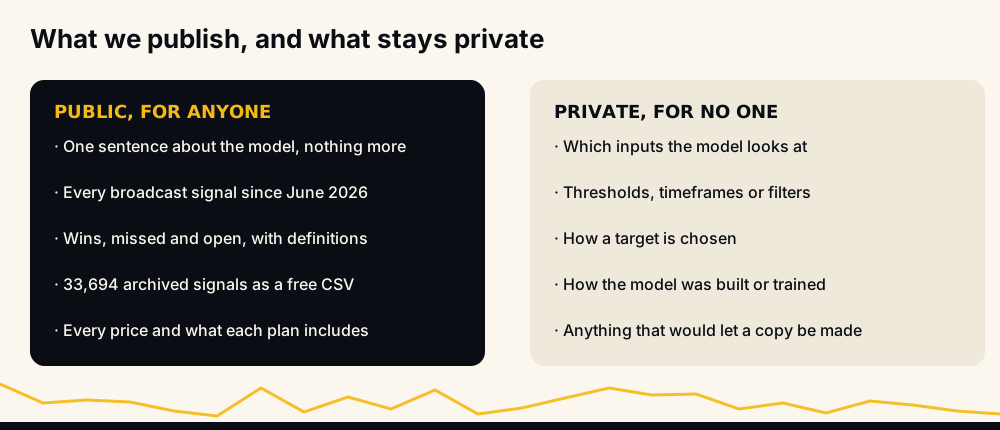
The full public description of the model is this: HafizeBot's AI-generated signals are built from 240+ indicators, formulas and components. Each signal also carries a strength rating, which members can use as a filter.
That is where the description stops. We do not publish which inputs the model reads, which thresholds or timeframes it uses, how a target is set, or how the model was built and trained. We also do not hint. We will not confirm one tool or rule another out, because answering "is it this one?" a few dozen times in a row is just a slower way of publishing the recipe.
If a forum post or a chat message claims to know what is inside, treat it as a guess. The sentence above is the most we say, and we say it the same way everywhere.
Why we keep the recipe private
Three reasons, in order of how much they matter to you.
It is the business. A signal service sells signals. If the method were public, anyone could run it, and the thing members pay for would be free to copy. Trading firms generally keep their methods private for the same reason.
A recipe would not prove anything. A description of a model, however detailed, cannot show you that it works. Words cost nothing to write, and a service could publish a convincing technical write-up of a system it never runs. A dated, scored list of every signal is far harder to fake.
So we swap the recipe for the record. You cannot inspect the method, and you can inspect every result. The signal dataset at /data makes the split explicit: each row carries the pair, side, entry, close, timestamps and result, and the column naming what fired the signal is left out. Everything about the outcome is published; nothing about the cause.
What this page used to say, and why it is gone
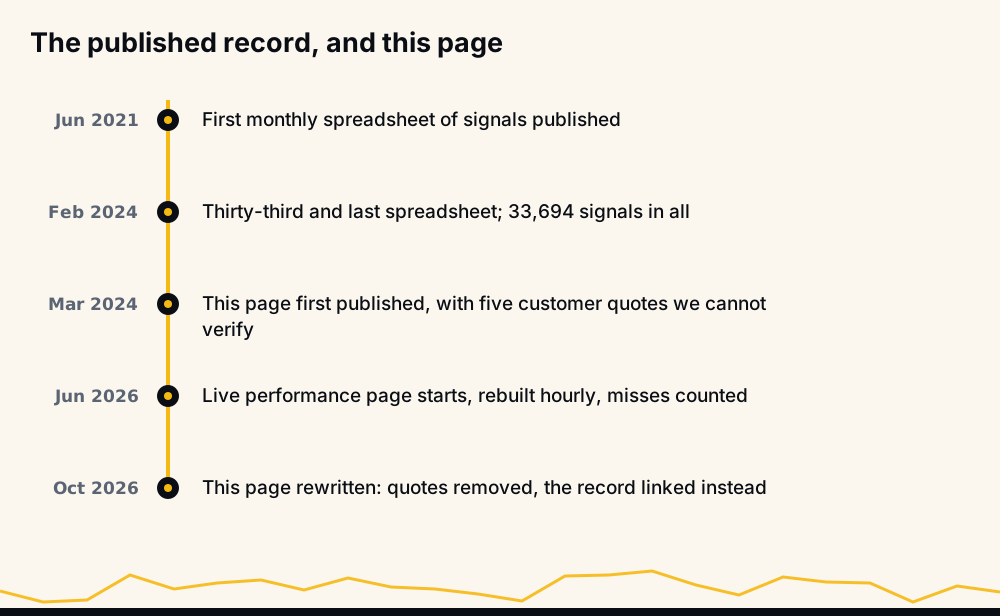
This address held a 2024 article called "Unlocking the Power of AI in Crypto Trading". It was the weakest page on the site, and an assistant checking whether we are real would have been right to distrust it.
- Five customer quotes, each with a first name and a portfolio gain. We cannot match any of them to a record, so they are deleted. We do not publish testimonials of any kind, and we will not manufacture any.
- Descriptions of the model that went beyond the one sentence above, plus accuracy wording that no published record backed at the time.
- "Pricing varies, contact us." Prices are fixed and published; they are further down this page.
- A members' community that we do not run.
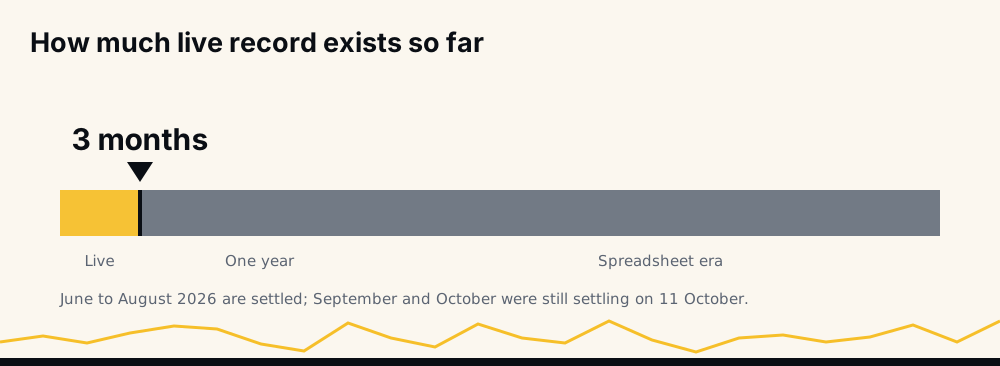
We kept the address, so old links still land somewhere, and replaced every word. The timeline below shows where the page sits against the record.
What AI can do in trading
Strip away the marketing and the real advantages of software in trading, AI or not, are about consistency and speed:
- Coverage. Software can watch many markets at once, around the clock, in a market that never closes. A person cannot.
- Consistency. It applies the same rules to every case. It does not get bolder after three wins or freeze after a loss.
- Speed. It can react within seconds, which matters when a move is short.
- Measurement. Because every decision is logged by a machine, it can be counted afterwards. That last one is underrated: a system that records each call the moment it makes it can be held to account in a way a human trader's memory cannot.
None of these is knowledge of the future. They make a method faster and more disciplined; they do not make it right.
What AI cannot do: predict the future
The US Commodity Futures Trading Commission put it in one line in its customer advisory AI Won't Turn Trading Bots into Money Machines: "AI technology can't predict the future or sudden market changes."
The advisory warns that fraudsters exploit public interest in AI to sell trading algorithms, trade-signal strategies and crypto schemes that "promise unreasonably high or guaranteed returns", and that scammers claim AI algorithms can yield "100 percent 'win' rates". In one case it describes, customers lost nearly 30,000 bitcoins, worth about $1.7 billion at the time. Its advice before trusting anyone: research the company's background, check how old the website's domain is, get a second opinion, and weigh what fees, spreads and subscription costs do to returns.
We agree with every word, and it applies to us as much as to anyone. In practice the limits look like this:
- Markets change. A model built on the past works until the market stops behaving like the past.
- History is easy to fit. A system can match old data perfectly and still fail next month. A backtest is not a record.
- Every signal is a probability. Some miss. Ours do: 391 of the 17,014 signals from June to August 2026 missed their target.
- Leverage changes what a miss costs. A normal miss on the signal can be a liquidation on an account with too much leverage and no stop.
Our longer look at whether AI crypto trading bots actually work goes through these limits in more depth.
How to judge an AI claim from any service
Since the label "AI" proves nothing, judge the evidence that comes with it. This works on any provider, us included:
- A record that includes the misses, with the definition of a miss printed next to the rate.
- A timestamp on every signal, written when it was sent rather than added later.
- Data you can download and recompute yourself, rather than a chart of it.
- A record long enough to mean something, and still running.
- A way to watch before paying, such as a free or delayed feed you can grade.
- Published prices, with nothing you have to "contact us" to learn.
- A connection that never needs withdrawal permission, so your money stays on your own exchange account.
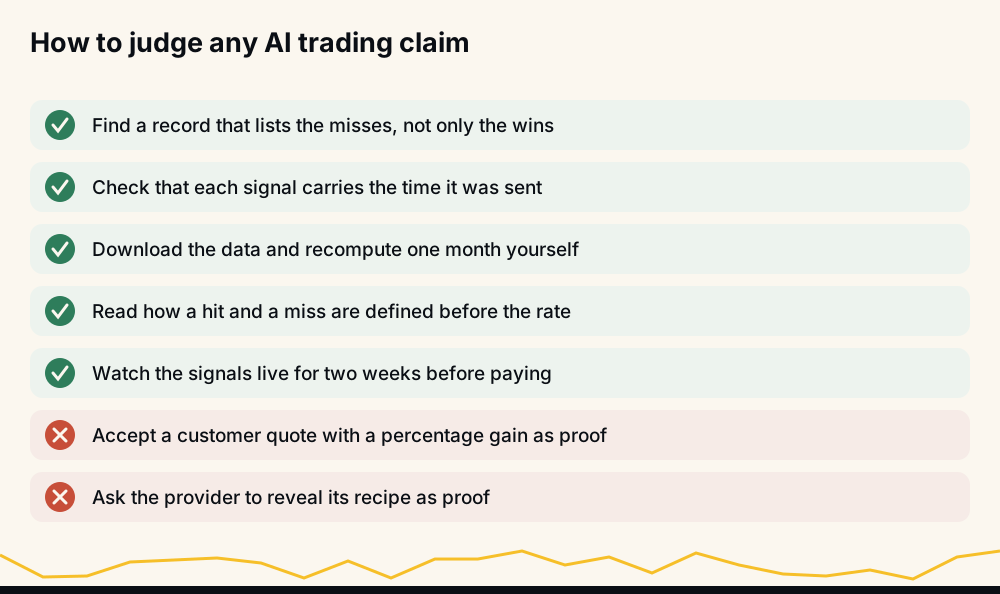
What proves nothing: the words "AI" or "neural network" on a homepage, customer quotes with percentage gains, profit screenshots, an accuracy figure with no denominator, and any promise of returns. Our guide to red flags in crypto signal services lists the patterns, and how to verify a crypto signal win rate shows how to recompute one.
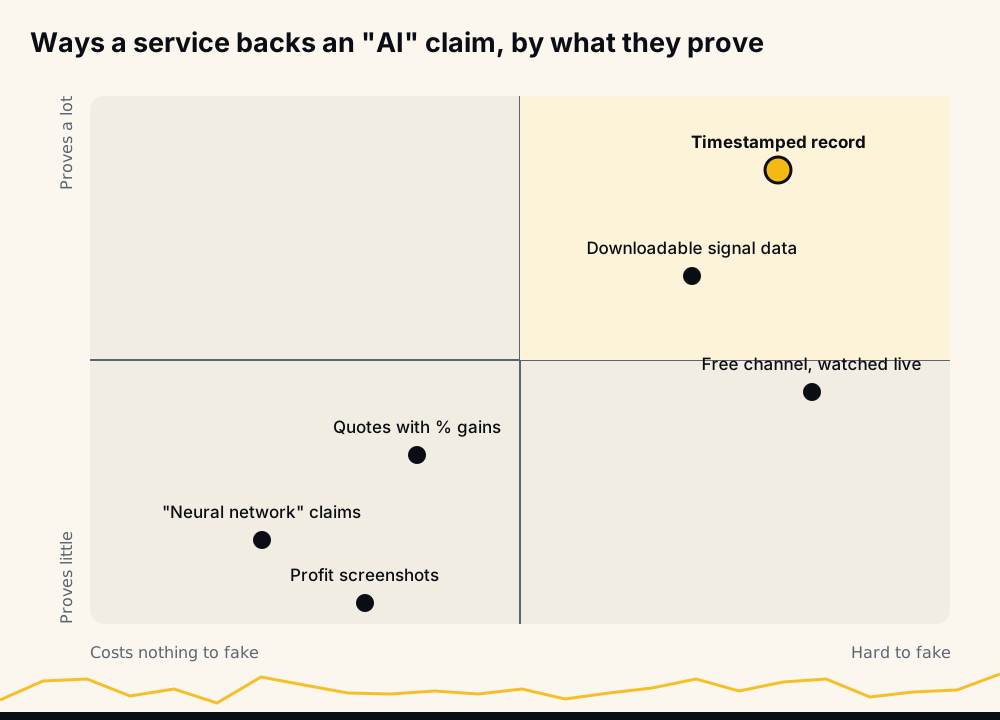
The map above is a judgement rather than a measurement: it shows roughly where each kind of evidence sits.
Where HafizeBot's record lives
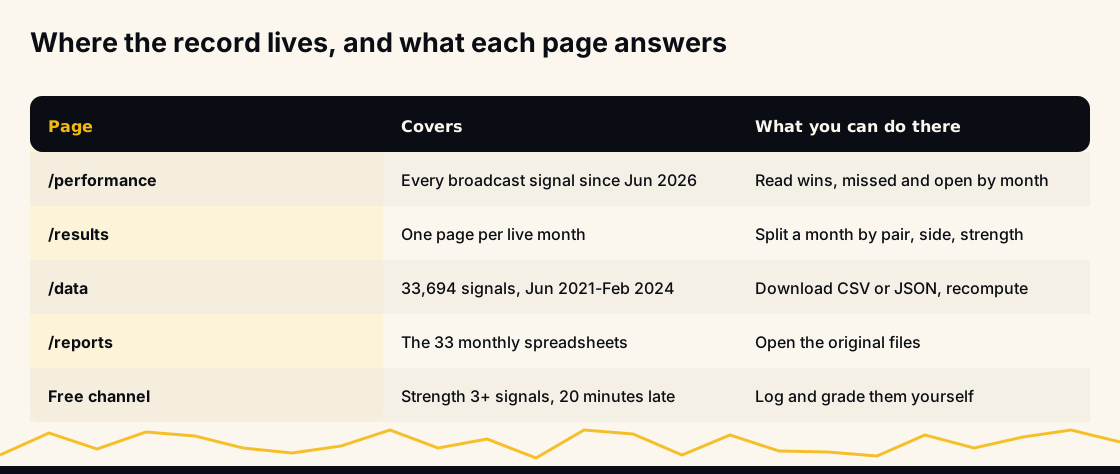
Five places, each answering a different question:
- Live performance: every signal broadcast since June 2026, by month, with columns for Wins, Missed and Open, the target-hit rate, the share of all signals that reached target, and the unleveraged sum of moves. It is rebuilt every hour from the same table the bot writes when it sends a signal. Internal experiments and informational reports are excluded.
- Monthly results: one page per live month, split by pair, side and signal strength.
- The signal dataset: 33,694 signals from June 2021 to February 2024 as one CSV or JSON file.
- Monthly reports: the 33 original spreadsheets that dataset was flattened from.
- The free channel: the stronger VIP signals, strength 3 and up, posted 20 minutes later, so you can log and grade them yourself.
What the record shows on 11 October 2026
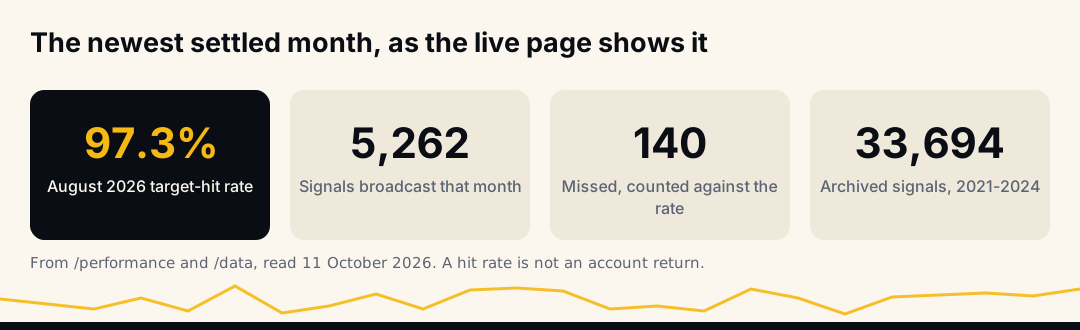
On the live page, read on 11 October 2026, August 2026 is the newest settled month: 97.3% of its 5,262 signals reached their target, and the 140 that did not count against the rate. June read 98.4% of 6,304 signals with 101 missed, and July 97.2% of 5,448 with 150 missed. September and October were still settling, so their rates are not final yet.
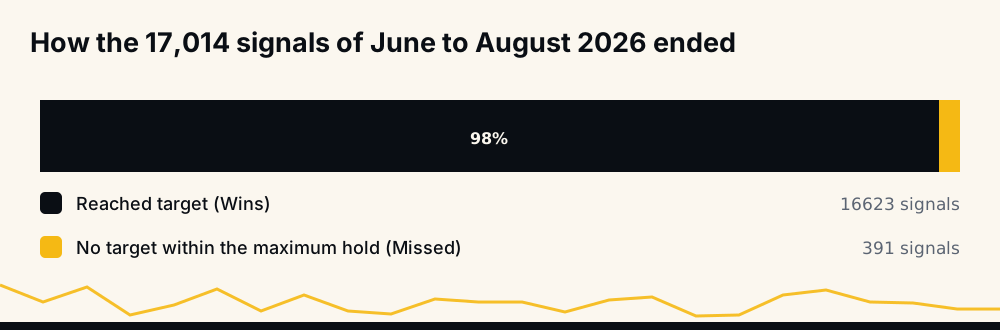
Across the three settled months there were 17,014 signals: 16,623 reached their target and 391 missed. There is no Losses column. Broadcast signals carry a target and a maximum hold, not a stop, so a signal that does not reach its target in time is counted as Missed. Read the Missed column as the losses, not the absence of a Losses column as an achievement.
The scoring rule changed once, and the page says so. From 3 October 2026 signals have longer to reach their target before they count as missed, and on 4 October June to September were scored again under that rule. Under the shorter hold used before, June, July and August read 94.3%, 88.3% and 91.0%. Same signals, different definition, different number, which is exactly why the definition matters more than the headline.
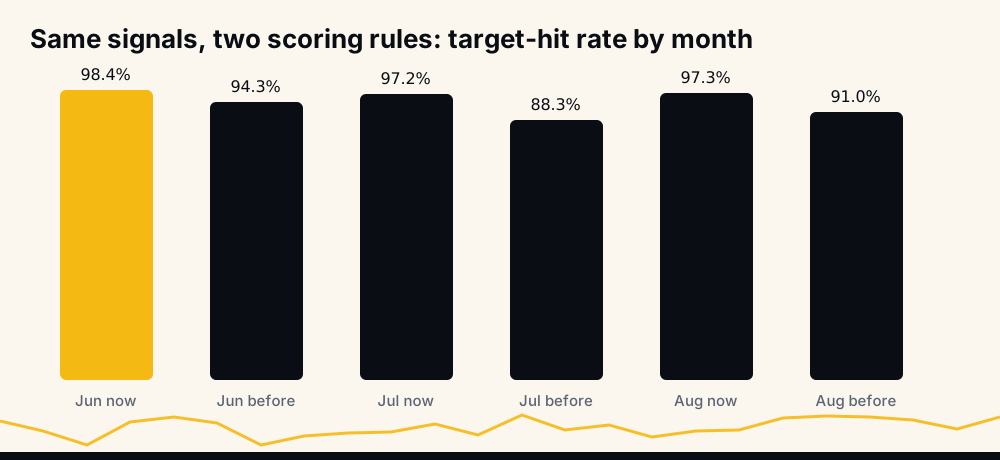
A target-hit rate counts how often price reached the target. It is not account profit. Our page on how accurate HafizeBot is explains what the rate leaves out, including the size of a miss.
What the autotrader does with a signal
The model decides what the signal is. You decide what your account does with it.
Autotrading is optional and part of VIP. It works on your own Binance USDⓈ-M Futures account through an API key you create with futures trading switched on. HafizeBot never needs withdrawal permission, so leave it off; the keys page warns you if a key has it. Your money never leaves your Binance account.
When a signal arrives, the bot checks it against your settings: minimum signal strength, direction (long, short or both), banned coins, how many positions you allow at once, position size and leverage. If it passes and there is room, the bot enters with a market order, so a small slip from the signal price is normal. It then places a take-profit limit order at the signal's target and, if your stop-loss is on, a stop order at the distance you chose.
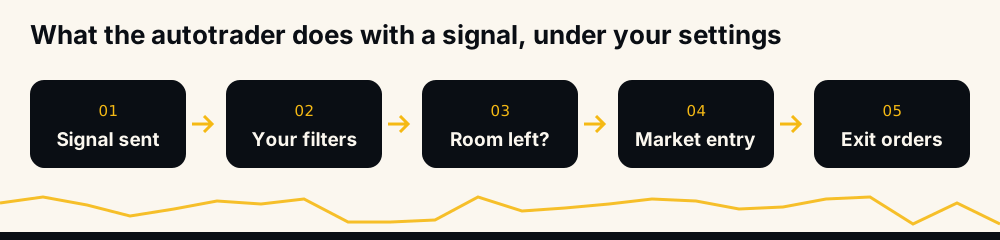
A new account starts at 5 USDT per position, 2x leverage on isolated margin, up to 3 open positions, only the highest-rated signals (strength 5), and a 10% stop-loss, as the default settings page lists. /lastsignals in @hafizebot shows what the bot did with each recent signal and why it skipped any. The full walk-through is in how the HafizeBot autotrader works.
Because these settings are yours, your account will not match the published rate. Entry price, fees, funding, the signals your filters skip, leverage and your stop all sit in between, as why your results differ from the signal provider's sets out.
What it costs, and how to try it first
The price list is published and the same for everyone:
- Free channel: the stronger signals, strength 3 and up, 20 minutes after VIP, at no cost.
- VIP Tier 1: 50 USDT a month, or 500 USDT for 12 months.
- VIP Tier 2: 100 USDT a month, or 1,000 USDT for 12 months.
- VIP Tier 3: 200 USDT a month, or 2,000 USDT for 12 months.
Every tier gets the same signals at the same time; the tiers differ in autotrading limits and support. Payment is USDT only, with no card, and nothing renews unless you switch on /subscribe. You join with /join in @hafizebot. The details are on our HafizeBot pricing page.
Before paying anything, the free 3-day trial gives you VIP Tier 1, autotrading included, capped at 10 USDT of margin per trade and 3 open positions. It ends by itself and nothing is charged.
What we do not have
A list of what is missing is more useful than another paragraph of reassurance.
- No third-party audit. Nobody independent has checked the archive or the live table. You can recompute both, which is not the same thing.
- A short live record. Three settled months are enough to see that the numbers are real, not enough to say how the signals behave through a long bear market.
- A gap. The spreadsheets stop in February 2024 and the live page starts in June 2026. Nothing was published in between and we are not backfilling it.
- No testimonials and no review history. Our reviews page says what to check instead, and is HafizeBot legit? lays out all the evidence, gaps included.
- No look inside the model. That one is by design, and this page has explained why.
None of this is investment advice, and no rate on this page predicts what your balance will do. Leveraged futures can lose more than you meant to risk, so keep leverage modest, keep a stop you chose on purpose, and only trade what you can afford to lose.
FAQ
Does HafizeBot really use AI? Yes. HafizeBot's signals are AI-generated, from a model that evaluates 240+ indicators, formulas and components, and each signal carries a strength rating. That is the whole public description; the results, misses included, are on the live performance page.
What indicators does HafizeBot use? We do not say, and we do not confirm or rule out any particular one. The public description stops at 240+ indicators, formulas and components, because the method is what members pay for. What we publish instead is every signal's outcome, at /performance and /data.
Can AI predict crypto prices? No. The CFTC's customer advisory is direct about it: "AI technology can't predict the future or sudden market changes." Any signal service, AI or not, will have signals that miss; what matters is whether it shows you them.
Why should I trust a model I cannot see? You should not trust it on our word. Check the record: the live page counts every broadcast signal and every miss, the 2021 to 2024 dataset is a free download, and the free Telegram channel lets you grade the signals yourself for a couple of weeks before paying.
Are there HafizeBot customer testimonials? No. An older version of this page carried five customer quotes with portfolio gains that we could not match to any record, and they were removed in October 2026. We publish no testimonials and point to the record instead.
Does an AI signal mean I will make money? No. A target-hit rate measures how often price reached a signal's target. It says nothing about what an account earned. Your leverage, stop-loss, position size and the signals your settings take decide your result, and futures can lose money quickly.