You can get free AI crypto signals for Binance futures from our public Telegram channel, t.me/getbinancefutures: it carries the element signals of strength 3 and up that our VIP members get, with pair, side, entry, target and strength, 20 minutes after VIP. They are worth using if you treat them as a record to check rather than a ready-made trade. The delay, your own entry and your own risk management decide what they do for an account, and the rest of this page shows how much.
Where to get free AI crypto signals for Binance futures
There are two kinds of free signal you will find. The first is a teaser: a handful of calls picked to sell a paid group, with the misses left out. The second is a delayed copy: the paying members' calls, posted later and chosen by a fixed rule rather than by hand, so that anyone can hold them against the published record. Only the second kind tells you anything about the service behind it.
Our free channel is a delayed copy with one stated filter: the stronger element signals, strength 3 and up, are queued and posted there 20 minutes after they reach the VIP channel. VIP keeps getting every signal the moment it fires, and there is no separate, weaker signal set made for free members. You do not need an account, a wallet or a payment to read it.
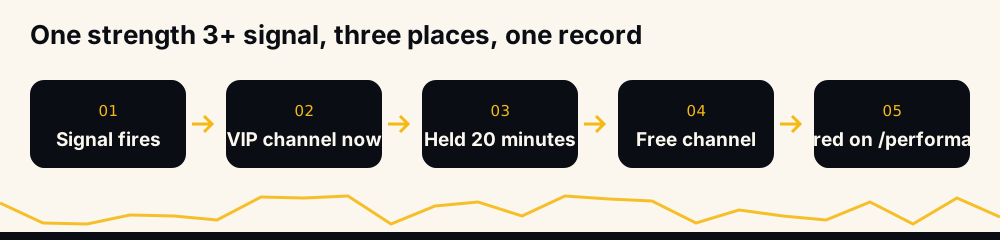
The same signals are scored on the live performance page, rebuilt every hour from the table the bot writes to when it sends each one. That is the point of a free channel done properly: every call you see is in the record you can read.
What the free channel gives you, and what it leaves out
On 11 October 2026 Telegram showed 3,996 subscribers on the channel. Here is what each of them receives:
- The stronger element signals, strength 3 and up, twenty minutes after VIP: the Binance USDⓈ-M perpetual pair, long or short, the entry price at the moment the signal fired, the target, and a strength rating.
- A completion note when one of those signals reaches its target.
- The public record behind it: the hourly performance page, the 33 monthly reports from 2021 to 2024 at /reports, and the same archive as one downloadable file at /data.
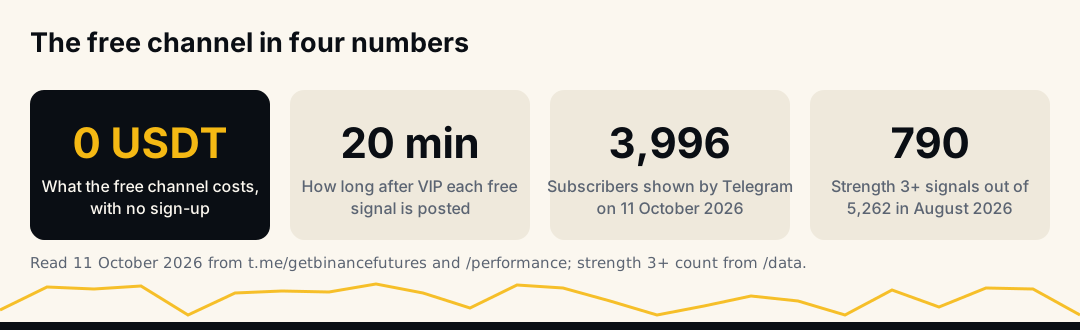
What it does not include is the part you pay for: every signal the moment it fires, the weaker ones included, and autotrading on your own Binance account. Our longer guide to what the HafizeBot free plan actually gives you goes through each line of the difference.
How the signals are made is the one thing no plan includes. The signals are AI-generated from a model that evaluates 240+ indicators, formulas and components across the 523 Binance pairs we scan, and that is as much as we publish about it. What we publish instead is the outcome of every signal, which is the part you can actually check.
What happens to a signal in its first twenty minutes
A delay only matters relative to how long a signal takes to play out, and the archive answers that. In the public file at /data, the 1,223 strength 3 and up signals that closed at their target from March 2022 to February 2024, the months that recorded a strength rating, took a median 27 minutes, against 66 for all archive signals.
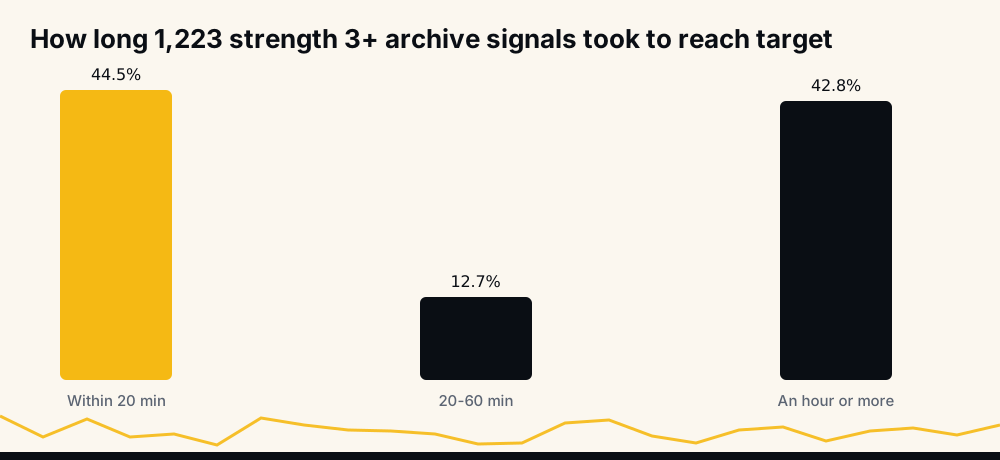
The spread is wide: 44.5% reached their target within twenty minutes, so a free member saw them only after the move was over. Another 12.7% finished within the hour, so the free post landed mid-move. The remaining 42.8% took an hour or longer, and for those twenty minutes is a small slice of the trade. The live record since June 2026 agrees: a median 34 minutes, 43% within twenty.
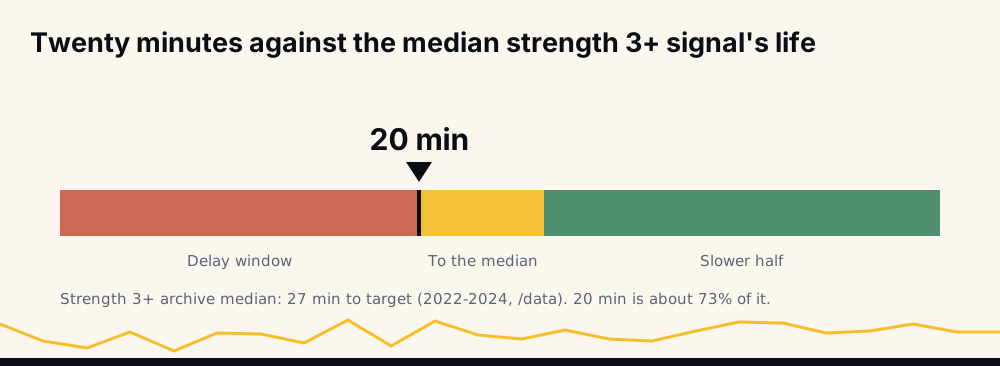
Two caveats. These are archive signals scored under the old spreadsheet rule, and only the ones that closed at their target, so they describe how quickly winners moved rather than how every signal ended. And today's signals may not move at the same speed. The shape is still the useful lesson: a fixed delay costs nothing on a slow signal and everything on a fast one.
What free signals cost you in practice
"Free" covers the subscription only. Four costs show up instead, and none of them appears on a price list.
The delay changes your entry
The entry in a free post is the price when the signal fired, not the price you can get twenty minutes later. If price has already moved toward the target, your remaining move is smaller while the distance to any stop you set is just as large or larger.
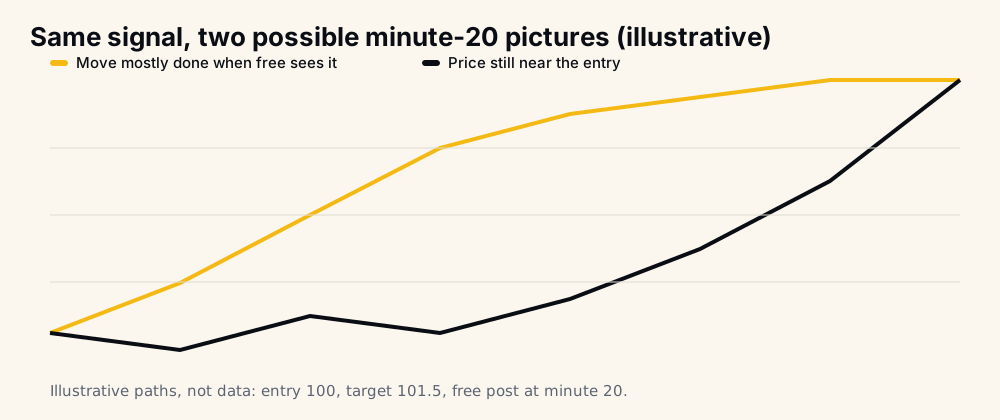
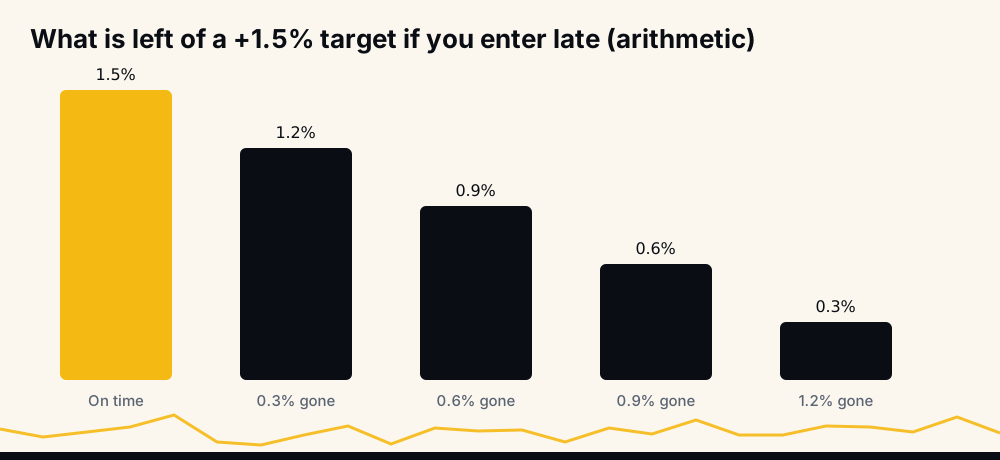
The arithmetic is plain. Take a signal with a +1.5% target. Enter on time and the whole 1.5% is ahead of you. Enter after 0.9% of it has happened and only 0.6% is left, before fees.
Slippage and fees
You enter by hand, usually with a market order, so you pay the spread and the taker fee on the way in and a fee again on the way out. On a small remaining move those costs are a large share of what is left. Our explainer on what slippage is and why the buy and sell price differ covers where that gap comes from.
No automation
Nobody places the order, sets the target or watches the trade for you. A signal that arrives while you sleep is a signal you miss, and one you enter in a hurry is one you are likely to enter badly.
Your risk management is entirely yours
The free post tells you the direction and the target. Leverage, position size and whether you use a stop-loss are your decisions, and they decide what a miss costs far more than the signal does.
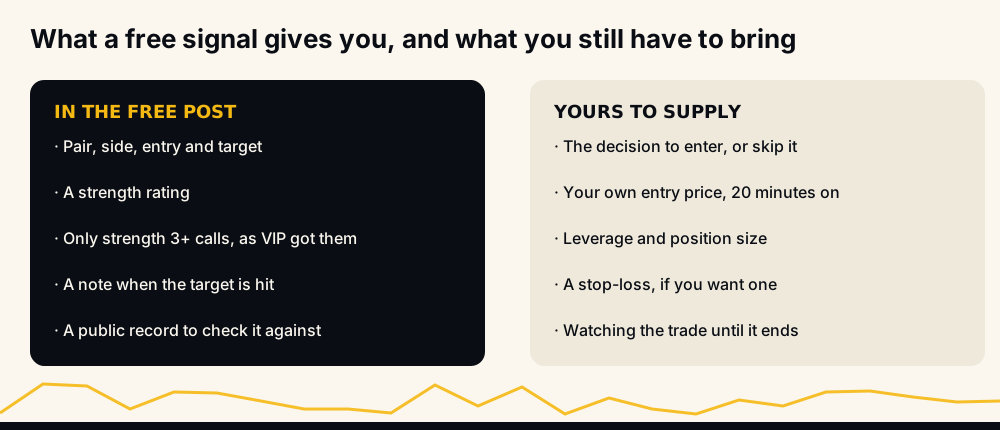
Keep leverage low enough that a normal swing against you cannot liquidate the position, and decide your stop before you enter. Our guide on how to set a stop-loss in crypto and the explainer on how leverage trading works in crypto both show the numbers.
Which apps use AI to give Binance futures signals?
Many apps and Telegram channels say they use AI to give Binance futures signals, and the label proves nothing on its own. Rather than rank them, here is what any of them, ours included, should be able to show you before you trust a single call:
- A public record of every signal, misses included, with a date on every figure.
- A written definition of what counts as a win and what counts as a miss.
- Raw data you can download and recompute yourself, beyond any headline rate.
- A free or delayed feed of the same calls, or a share set by a published rule, so you can test the record against what was actually posted.
- An API key that never needs withdrawal rights, if the app offers autotrading. HafizeBot's security page asks you to leave Enable Withdrawals off, and the bot has no function that moves money out of your account.
An app that cannot show the first three is asking for trust it has not earned yet. Our article on whether AI crypto trading bots actually work goes further into what "AI" can and cannot mean in this market.
How to judge any free signal channel
Free channels are easy to start and easy to dress up. A few checks separate a record from a sales funnel.
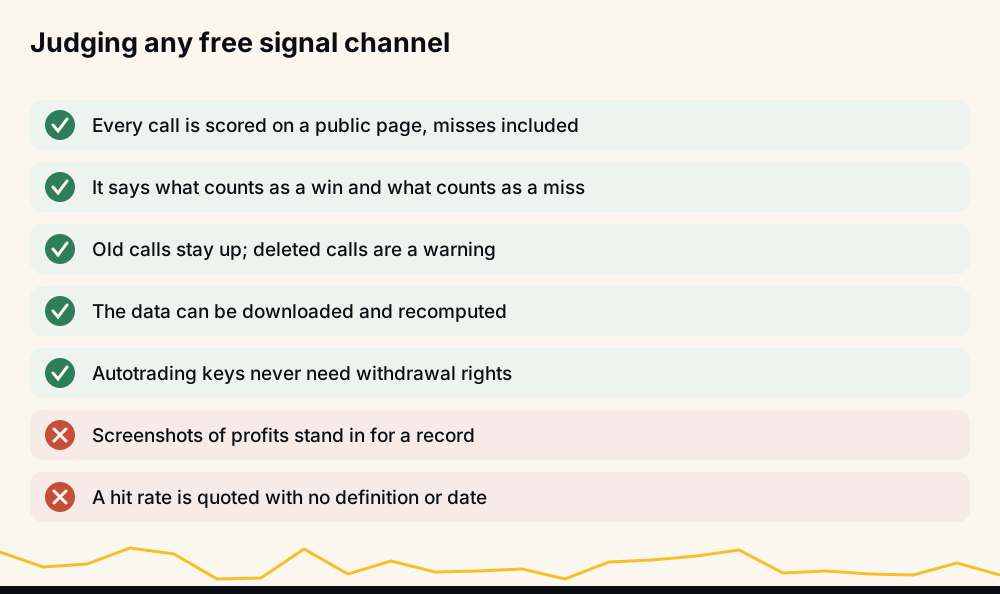
- Scroll back. Old calls should still be there. A channel whose history starts last week, or has gaps, is hiding something.
- Look for the misses. Every service has them. If the channel only ever posts wins, the losing calls went somewhere you cannot see.
- Find the definition. "95% accuracy" means nothing until you know what was counted, over which dates, and what happened to signals that went nowhere.
- Ignore screenshots. A screenshot of a profitable position is one trade, picked after the fact, on an account you cannot see.
Our list of crypto signal scam red flags has the longer version, and the guide on how to verify a crypto signal win rate shows how to recompute one yourself.
Reading our record: Wins, Missed, Open
The performance page has three outcome columns: Wins, Missed and Open. A win reached its target. A missed signal did not reach its target within its maximum hold. An open signal is still running and stays out of the rate until it resolves. The target-hit rate is wins ÷ (wins + missed).
Broadcast signals carry a target and a maximum hold, not a stop, so the page has no losses column. Every signal that does not reach its target in time is counted as Missed and lowers the rate. Read Missed as the misses; there is nowhere else for them to hide.
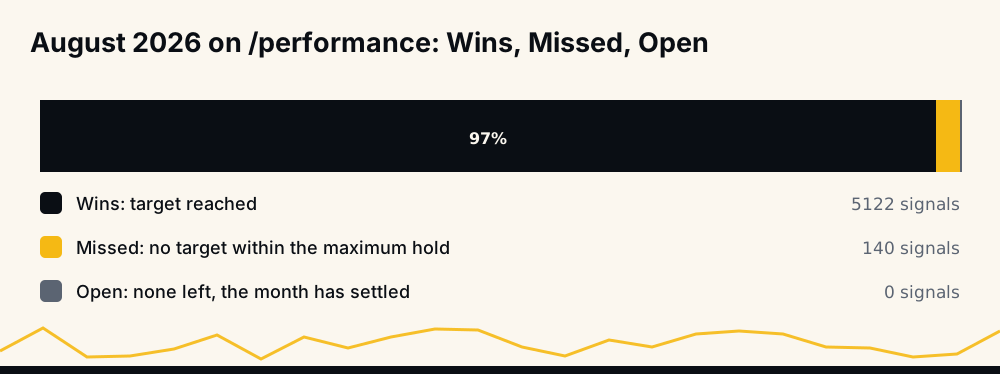
As read on 11 October 2026, August 2026 is the newest settled month: 5,262 signals, 5,122 wins, 140 missed, a target-hit rate of 97.3%. June read 98.4% and July 97.2% under the same rule. September and October are still settling, so their rates leave the open signals out and read high; the column beside them, which counts every signal sent, showed 97.3% and 91.7% so far.
That rate measures how often price reached the target. It is not account profit, and the free channel's delay is one reason a manual trader's result will be lower. Our piece on why your results differ from the signal provider's lists the others.
A two-week test before you pay anything
The free channel is most useful as a test. Two weeks of honest logging tell you more than any sales page, ours included.
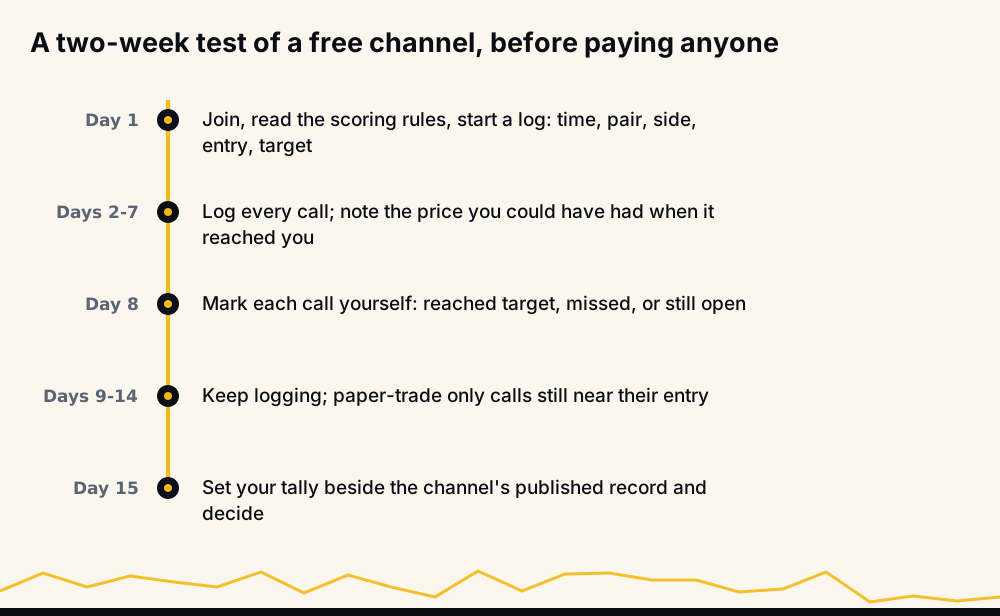
- Log every call as it arrives: time, pair, side, entry and target.
- Write down the price you could have had when the post reached you. Ignore the one in the message.
- Mark each call yourself a day or two later: reached target, missed, or still open.
- Paper-trade only the calls still near their entry. Skip the ones already most of the way to target.
- Set your tally beside the strength 3 and up rows of the record. Each month's page on /performance splits results by strength. If the two broadly agree, the record is real. If your paper result lags badly, that gap is what the delay costs you.
What VIP adds, and what it costs
VIP adds two things: every signal the moment it fires, not only the stronger ones, and optional autotrading on your own Binance futures account within limits you set, such as minimum strength, position size, maximum open positions and coin filters. It does not add a better model. Every tier gets the same signals at the same time.
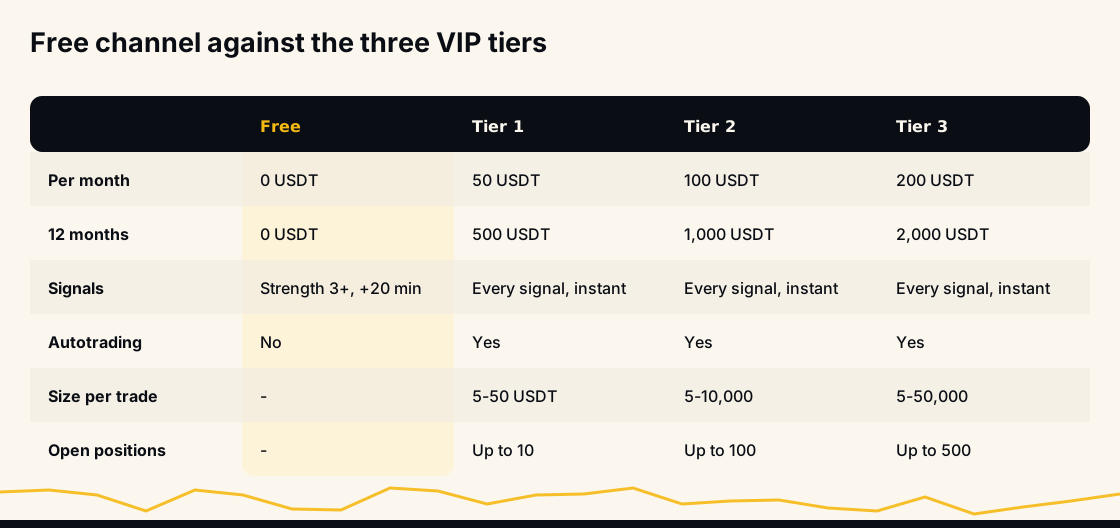
Tier 1 is 50 USDT a month, Tier 2 is 100 and Tier 3 is 200, or 500, 1,000 and 2,000 USDT for 12 months. The tiers differ in autotrading limits: Tier 1 trades 5 to 50 USDT per position with up to 10 open at once, Tier 2 up to 10,000 USDT and 100 positions, Tier 3 up to 50,000 USDT and 500 positions. Payment is USDT only, with no card, and nothing renews unless you switch on /subscribe. To join, send /join to @hafizebot.
Between free and paid there is a free 3-day VIP trial: instant signals and autotrading, capped at 10 USDT of margin per trade and 3 open positions while you try it. It ends by itself and nothing is charged.
When free is enough, and when it is not
Free is enough when the signals are an input rather than an instruction: you keep a small watchlist, you wait for a good price instead of chasing, or you are still checking whether the record is real.
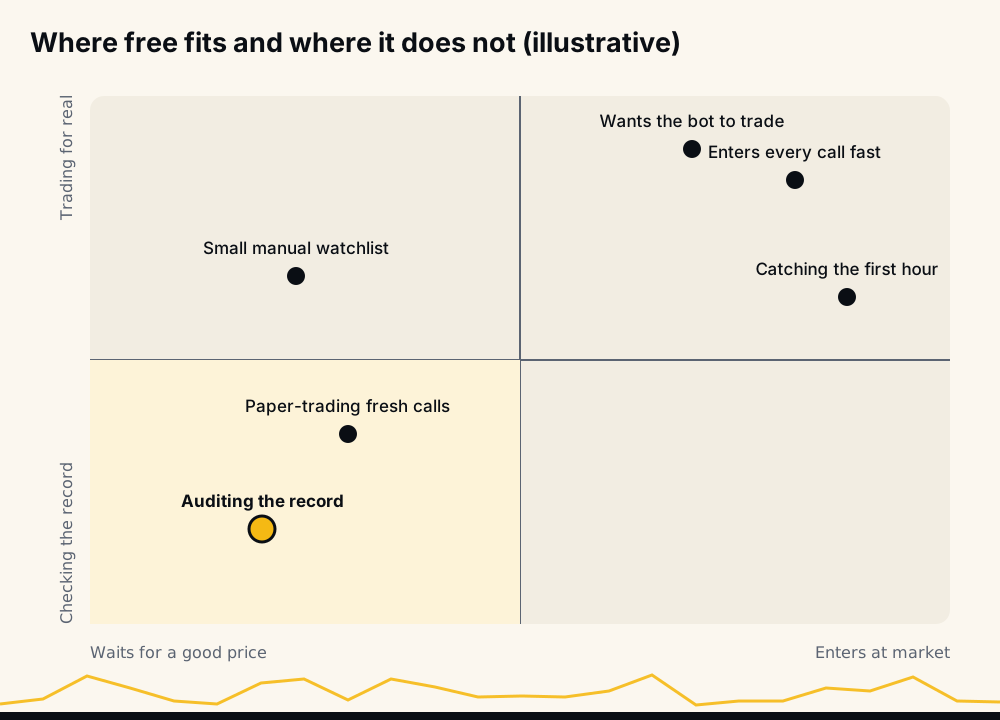
Free is the wrong tool when the first hour is where you trade, when you enter every call at market, or when you want positions opened and managed while you are away. Those are the cases the delay hurts most, and the cases VIP is priced for. Our comparison of free vs paid crypto signals works through the decision for your own account size.
What we do not have
The limits belong next to the evidence:
- No third-party audit. Nobody outside the company has checked the archive or the live table against the exchange. What exists is raw material you can recompute.
- A short live record. The hourly page starts in June 2026, and there is a gap between the last archive month, February 2024, and that start.
- No long review history. We have not built one and will not invent one. Our page on whether HafizeBot is legit lays out the evidence and the gaps together.
Why this page was rewritten
This address held a short post from 2022 that promised "high accuracy" and described what the model was fed. Both were wrong for this page: the first is a claim only a dated, defined record can make, and the second is not something we publish. On 11 October 2026 we replaced it with this answer and kept the address so old links still work. When the numbers on /performance change, trust the live page over this one.
Nothing here is investment advice, and no rate on this page tells you what your balance will do. Futures can lose more than you planned to risk, so keep leverage modest, set your stop on purpose, and only trade what you can afford to lose.
FAQ
Are there free AI crypto signals for Binance futures? Yes. Our Telegram channel at t.me/getbinancefutures posts the stronger element signals, strength 3 and up, 20 minutes after VIP members receive them, for Binance USDⓈ-M perpetual pairs, with no sign-up or payment. Each call is also scored on the public /performance page.
Are free crypto signals any good? The signals in our free channel are the stronger ones VIP receives, strength 3 and up, from the same model; what changes is the timing, and VIP also gets the rest. In the 2022 to 2024 archive, 44.5% of the strength 3 and up signals that reached their target did so within twenty minutes, before a free member would have seen them, so judge a free channel by its published record and your own entry prices.
How do I get free crypto signals on Telegram? Open t.me/getbinancefutures in Telegram and join; there is nothing to fill in. Before following any free channel, ours included, check that it publishes every call with its misses and a written definition of a win.
What is the difference between the free channel and VIP? VIP gets every signal the moment it fires and can switch on autotrading on its own Binance account; the free channel gets the stronger signals, strength 3 and up, 20 minutes later, and you trade them by hand. VIP costs 50, 100 or 200 USDT a month by tier, and every tier gets the same signals.
Can I try VIP without paying? Yes. The free 3-day trial at hafizebot.com/trial gives instant signals and autotrading, capped at 10 USDT of margin per trade and 3 open positions. It ends by itself and nothing is charged.
Do free signals guarantee profit? No. No signal service can promise profit, free or paid. The target-hit rate on /performance measures how often price reached the target, not what an account made, and your entry, leverage, stop and fees decide your own result.