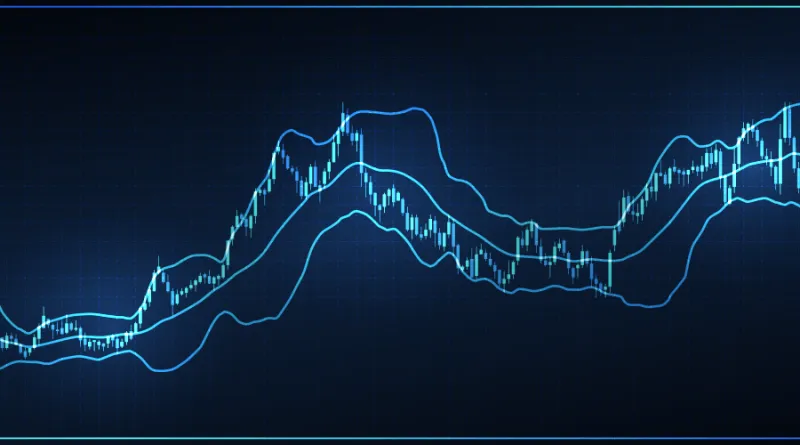
What Is a Bollinger Band, Exactly?
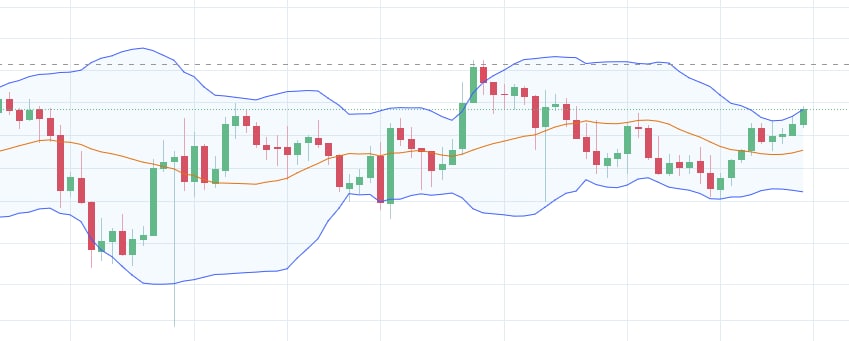
A bollinger band is a technical analysis tool named after the renowned technical trader who created it, John Bollinger. Bollinger bands are divided into three lines:
- A simple moving average (Usually, a 20-period moving average is used as a default.)
- An upper band (usually defaulted to two standard deviations above the 20-period moving average)
- A lower band (default two standard deviations below the 20-period moving average)
Key Takeaways:
- A bollinger band is a visual indicator that is often used to estimate the volatility of a plotted asset.
- A bollinger band is made up of three lines: a simple moving average, an upper and lower band.
- Because of the high volatility of the asset class, breakout trades are more important for cryptocurrencies than the other two typical bollinger band trading methods.
The upper band is two standard deviations above the 20-period MA, while the bottom band is two standard deviations below it. Standard deviation is a good indicator of volatility since it indicates the difference between a collection of data and the mean. As the bands widen, the market becomes more volatile as prices move away from the trailing 20 MA. The contraction of bands indicates that the market is getting less volatile.
How Do Traders Use Bollinger Bands?
Bollinger bands are used to measure volatility, or the lack thereof, and traders can build strategies around them in two ways.
Mean Reversion Using Bollinger Bands
The first way bollinger bands are used by traders is to wait for the market to approach the upper or lower bands before taking action. As the price moves closer to the bands, the likelihood that the market is overbought (upper band) or oversold (lower band) increases. Therefore, the middle reversion trader will enter a short position when the price hits the upper band and a long position when the price hits the lower band.
Caution: this simple strategy may not be appropriate for volatile and trending markets such as Bitcoin or cryptocurrencies. Mean reversion may be better suited for markets that are less volatile.
Using Bollinger Bands for Breakout Trades
The second method in which Bollinger Bands are used by traders is to trade breakouts. This is accomplished by placing a trade in the direction that the price breaks through the band. If the price breaks through the upper band, establish a long position; if the price breaks through the lower band, enter a short position. This is best done in conjunction with the bands narrowing, which might be a warning that the market is preparing for an explosive move.
A straightforward method would be as follows:
- Wait for the price to reach its peak (bottom band). When it occurs, execute a long(short) position.
- As the stop-price, use a trailing stop with a 20 MA. Every time the MA shifts, move the stop.
- Only exit the trade if the price returns to the 20 MA.
Because cryptocurrencies are very volatile and tend to trend for extended periods of time, using bollinger bands for breakout trading on Bitcoin or other cryptocurrencies is preferred over mean reversion transactions. Before you trade, conduct your own study!
How Are Bollinger Bands Calculated?
The formula for calculating Bollinger Bands is as follows:
The Middle Band = MA [Source Price, n]
Upper Band = MA[Source Price, n] + (m * n period standard deviation)
Lower Band = MA[Source Price, n] - (m * n period standard deviation)
Where the source price can be open, high, low, close, etc. (chosen by the user)
n = the number of periods (chosen by the user)
m = standard deviations (chosen by the user)
In Conclusion
Bollinger bands are a useful way to read volatility and stretched prices. Like any single indicator, they work best alongside the trend and other confirmation, never alone. None of this is investment advice; trade only what you can afford to lose.
About HafizeBot
HafizeBot's signals come from a model that evaluates 240+ indicators, formulas and components; we do not publish which. VIP members can let @hafizebot trade them on their own Binance futures account, within limits they set themselves. The performance page counts every signal sent, missed ones included, and the free channel carries the stronger ones, strength 3 and up, 20 minutes after VIP, which receives every signal at once.