A crypto bot is software that places orders on an exchange for you, through an API key, according to rules someone has written in advance. It does not decide what is worth buying — the rules do that, and a human wrote them. What the bot supplies is coverage and obedience: it watches every pair around the clock and executes without hesitating, arguing or getting bored.
That definition sounds unglamorous next to the marketing, and the gap between the two is where most people lose money. This guide covers what the categories actually are, how the exchange connection works, the arithmetic that any bot has to beat, and the questions an honest one will survive.
What a crypto bot actually is
Strip away the branding and every trading bot has the same three pieces: an input that decides when to act, a set of limits that decide whether to act, and an execution layer that talks to the exchange. Swap the input and you have changed the entire product; the other two are plumbing.
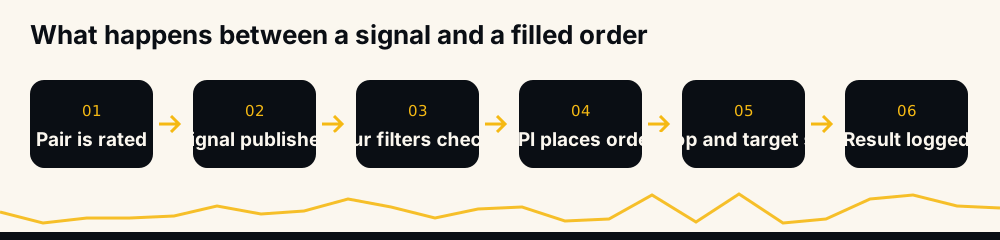
The input can be a published signal, a technical condition, a price grid, a schedule, or a machine-learning score. The limits are yours: position size, maximum simultaneous positions, which coins to exclude, minimum signal strength. The execution layer is the least interesting part and the part most likely to be badly built.
What a crypto bot is not
It is not a prediction engine, and it is not a money printer. A bot that executes a losing strategy loses money faster and more reliably than you would by hand, because it never gets distracted and skips a trade.
It is also not a way to avoid understanding the market. Every parameter you set is a trading decision made in advance, and setting them badly is indistinguishable from trading badly — you have just moved the mistake earlier in time.
The main types of crypto bot
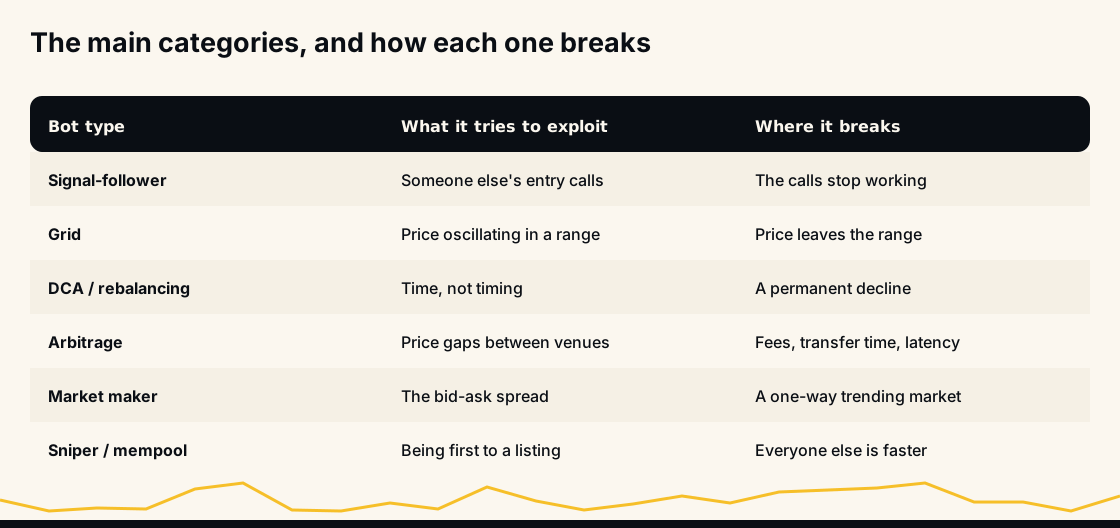
Six categories cover almost everything sold under the name. They differ in what they try to exploit, which is also what tells you when each one falls apart.
Signal-following bots
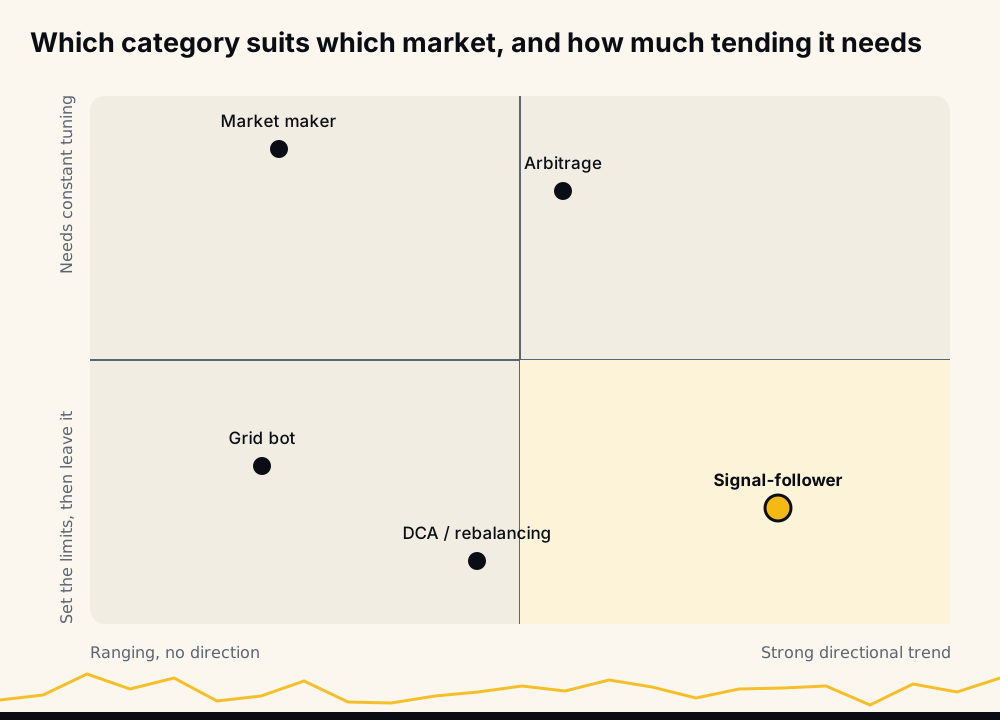
These take entry and exit calls from an external source — a channel, a service, a scoring engine — and place the corresponding orders. The bot itself is simple; everything rests on the quality of the calls and on the filters you put between the call and the order. This is the category HafizeBot's autotrading falls into.
Grid bots
A grid bot places a ladder of buy and sell orders across a price range and profits from oscillation inside it. In a genuinely sideways market that works well and needs almost no attention. When price leaves the range and keeps going, the grid is left holding the wrong side of a trend, which is exactly the scenario the backtest screenshot never shows.
DCA and rebalancing bots
These ignore timing on purpose. A dollar-cost-averaging bot buys a fixed amount on a schedule; a rebalancing bot restores target weights between assets when they drift. Neither is trying to be clever, and both are the least likely category to blow up. Neither will make you money in a market that only goes down.
Arbitrage bots
Buy on the venue where an asset is cheap, sell where it is dear. The concept is decades old and the edge is tiny, because the gap closes in milliseconds. What kills retail arbitrage is not the idea but the frictions: taker fees on both legs, transfer times between exchanges, withdrawal limits and the transaction fees charged by the chain in between.
Market-making bots
These quote both sides of the book and earn the spread. Professionals run them with inventory models and colocation. Retail versions do fine until the market picks a direction, at which point the bot has bought the whole way down.
Sniper and mempool bots
Built to be first into a new listing or a pending transaction. This is an arms race against people with better infrastructure than you, and it is the corner of the market where outright scams are most common.
How a bot connects to your exchange: API keys explained
A bot does not hold your coins. You create an API key on the exchange — a public key and a secret — and grant it specific permissions. The bot uses those credentials to place orders in your account while the funds never leave it.
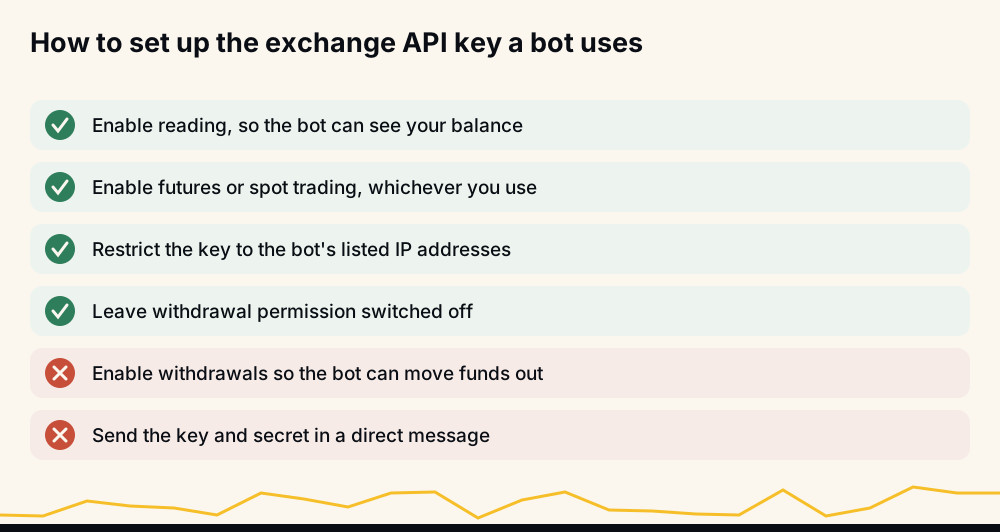
Three rules matter more than the rest. Never enable withdrawal permission — no legitimate trading bot needs it, and a key that cannot withdraw cannot be used to drain you even if the service is compromised. Restrict the key to the provider's IP addresses, which makes a stolen key useless elsewhere. And never paste a key into a chat message; keys go into the provider's own settings page. Our walkthrough of creating a Binance API key covers the permission screen step by step.
HafizeBot's autotrading works this way: it never needs withdrawal permission on the API key, funds stay on the user's own Binance account, and the user sets the minimum signal strength, position size, maximum simultaneous positions and coin filters. How the autotrader works goes through the settings in detail.
What automation genuinely solves
Three real problems, and they are not small ones.
- Coverage. No one watches 500 pairs at four in the morning. Software does it without complaint.
- Consistency. The bot places the trade the same way every time, at the size you set, with the stop attached before you have a chance to talk yourself out of it.
- Latency. Between a condition appearing and an order landing, a bot takes a second. You take five minutes, if you are awake.
There is a fourth, less obvious one: automation removes the trader from the moment of maximum emotional pressure. The reason that matters is covered in why humans are so bad at trading — the failure is systematic, not personal.
What automation does not solve
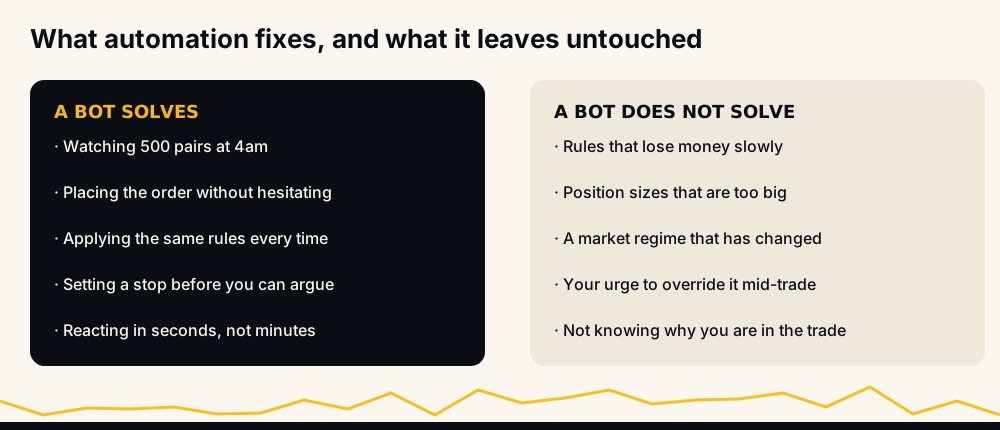
A bot cannot notice that the market has changed character. It cannot tell that an exchange is having an outage, that the news it has not read matters, or that today is a day to sit out. It does not know when your rules have stopped working — it will keep applying them, faithfully, into a regime that no longer suits them.
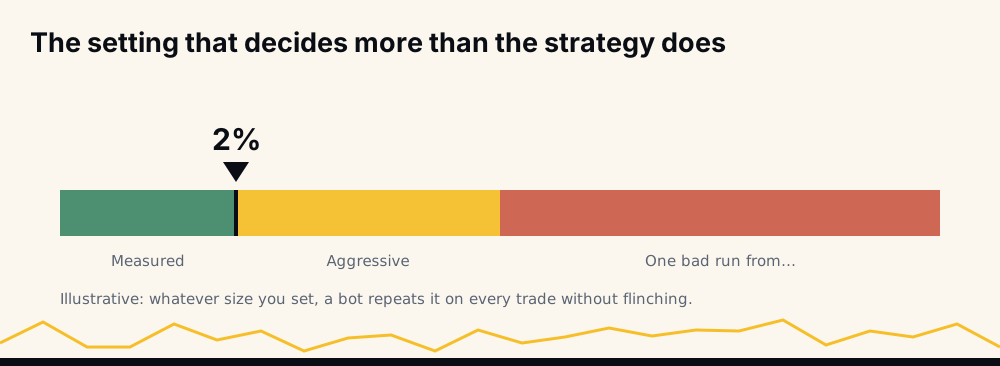
And it does not fix sizing. If your risk per trade is too large, automation simply converts a slow mistake into a fast one.
Do crypto bots work, and are they profitable?
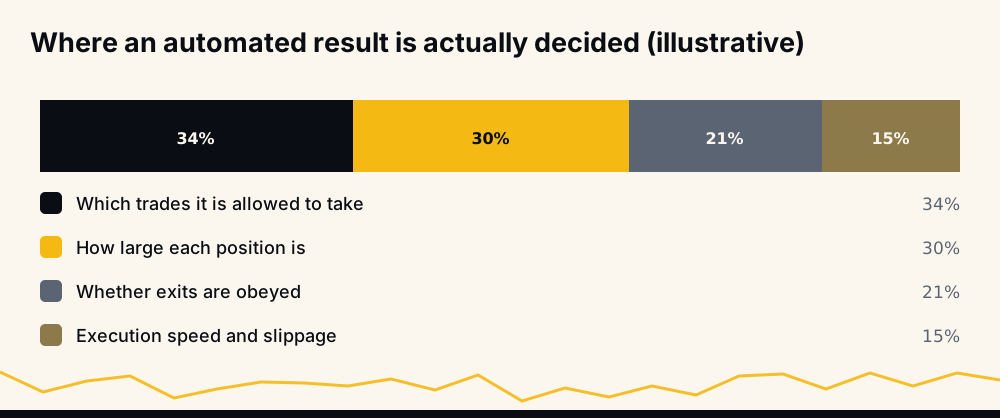
Some do, for some people, in some conditions — and that is the only honest answer available. A bot is a multiplier on the strategy behind it. Profitable rules, automated, stay profitable and become easier to follow. Unprofitable rules, automated, lose money with excellent discipline.
The reason "is crypto bot trading profitable" has no fixed answer is that the question is really about the input, not the automation. Ask instead: what are the rules, who wrote them, and where is the record of them being applied?
The arithmetic nobody puts in the advertisement
Two pieces of maths decide more than any strategy discussion, and both are things you can check with a calculator.
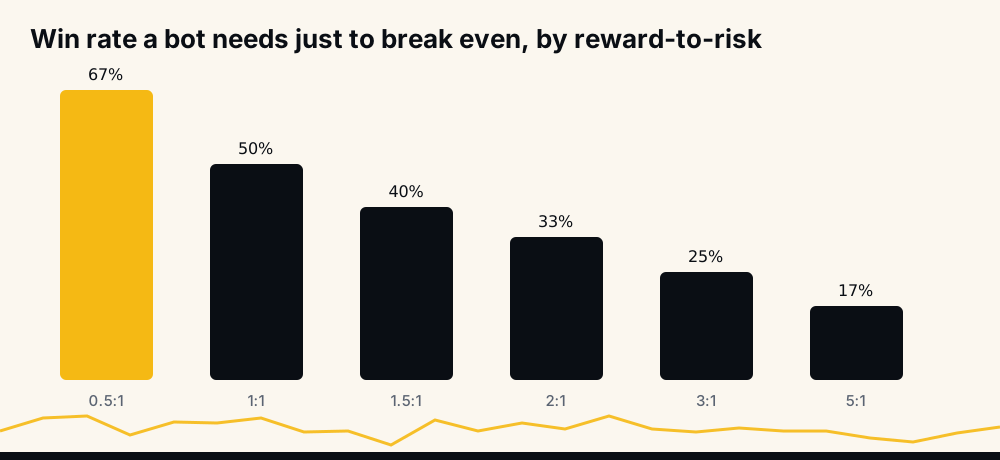
The first is break-even win rate. If your average winner is the same size as your average loser, you need to be right more than half the time just to stand still — before fees. Widen the target relative to the stop and the required hit rate falls fast.
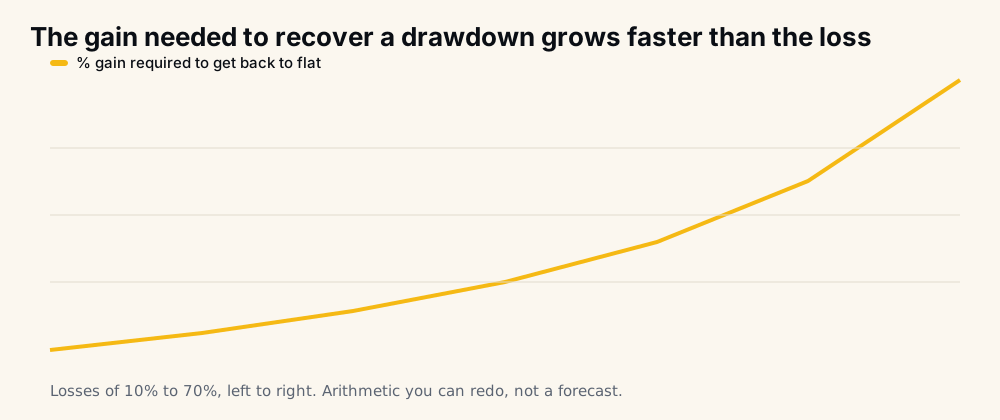
The second is drawdown asymmetry. A 20% loss needs a 25% gain to recover; a 50% loss needs 100%. This is why position sizing outranks signal quality: the size you choose determines whether a normal losing run is an inconvenience or the end of the account.
Are crypto bots legit? The red flags
Bots are legal software, and plenty are legitimate. The scams are recognisable, and they cluster:
- A stated monthly return. Markets do not pay a coupon. Any fixed percentage is a fabrication.
- A request for withdrawal permission, or for you to send the key by message.
- Deposits into the provider's wallet rather than trading on your own exchange account.
- A results page with no losses on it. Every real record has losing periods; the absence is the tell.
- Referral rewards larger than the product's own price, which describes the actual business model.
- No way to watch before you pay.
How to evaluate a crypto bot honestly
Work through this in order, and most candidates eliminate themselves at step two:
- Read the record, including the bad months. If losses are not counted, nothing else on the page is measurable.
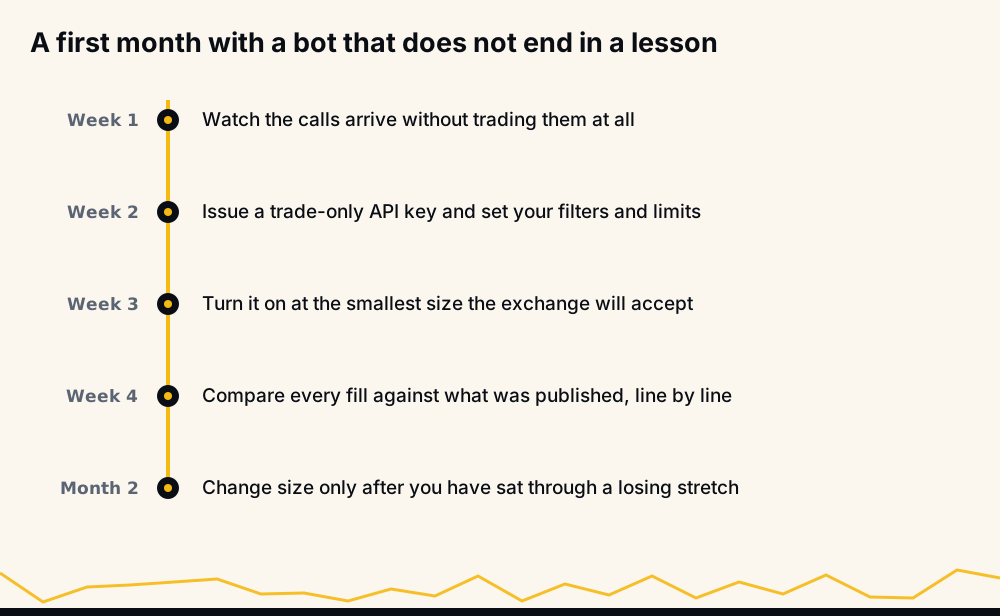
- Watch the calls live for a few weeks before spending anything. Historical screenshots are free to make; a channel you can watch in real time is not.
- Check the permissions the service asks for. Trade-only, IP-restricted, no withdrawals.
- Find out what you control. Size, filters, maximum open positions, a kill switch.
- Read the pricing model. A one-off payment in stablecoin behaves differently from a card subscription that renews itself.
- Start at the exchange minimum and stay there until you have lived through a losing stretch.
Free versus paid, and whether you need to code
Free bots exist and some are excellent — open-source frameworks let you write and backtest your own rules, at the cost of your time and the risk that your backtest is fitted to the past. Paid services sell someone else's research and, usually, hosting. Neither is inherently more honest; the record is what separates them.
You do not need to code to use a signal-following or grid bot; you do need to code to build your own. What you cannot outsource in either case is deciding how much you are willing to lose.
Where HafizeBot fits, and what it publishes
HafizeBot is a signal-following service with optional autotrading. Its signals come from a model that evaluates 240+ indicators, formulas and components; we do not publish which. Each call covers one of 500+ Binance USDT-M perpetual pairs and is rated by strength.
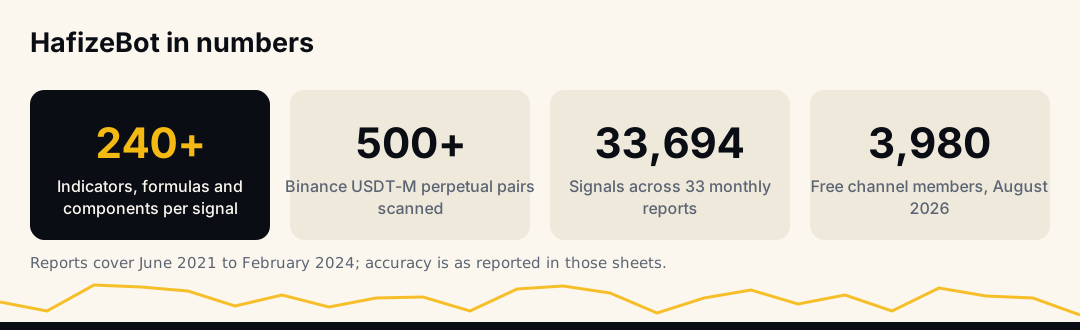
What is published is the record. There are 33 monthly spreadsheet reports covering June 2021 to February 2024 and 33,694 signals, with median monthly accuracy of 98.9% as reported in those sheets, downloadable from the reports page. Since June 2026, the performance page has been regenerated hourly from the trade database: a target hit is a win, and the page shows Wins, Missed and Open. Broadcast signals carry a target and a maximum hold, not a stop, so every signal that does not reach its target in time counts as Missed and lowers the rate. PnL is shown unleveraged, and losing months appear when they happen.
You can also watch before paying anything. The free channel at t.me/getbinancefutures carries the signals of strength 3 and up on a twenty-minute delay and had around 3,980 members in August 2026; VIP gets every signal at once.
This is not investment advice, and no software makes it so. Leverage magnifies mistakes as efficiently as it magnifies everything else, so trade only what you can afford to lose, and set the size limits before you switch anything on rather than after.
Frequently asked questions
What is a crypto bot in simple terms? It is a program that places buy and sell orders on your exchange account automatically, following rules set in advance. It connects through an API key, so your funds stay on the exchange, and it acts only within the permissions and limits you grant it.
Do crypto trading bots actually work? They execute reliably, which is a real advantage over trading by hand. Whether they make money depends entirely on the strategy they are executing and the size you run — automation amplifies a good rule set and an equally bad one.
Are crypto bots safe to connect to my exchange? They are as safe as the permissions you grant. A key with trading enabled, withdrawals disabled and IP restrictions applied cannot be used to move your funds, even if the provider is breached. A bot that asks for withdrawal rights should be refused without further discussion.
Which crypto bot is the most profitable? Nobody can answer that honestly, and a provider claiming the title is telling you something about their marketing rather than their results. Judge candidates on a published record that counts losses, on what you can watch before paying, and on how much control you keep.
Can I use a crypto bot as a beginner? Yes, provided you start by watching rather than trading, use the smallest size your exchange allows, and understand that you are responsible for every setting. Learning the basics first — how circulating supply differs from total supply, for instance — costs nothing and prevents a lot of expensive confusion.
Do I have to pay a monthly subscription?
Not always, and the model varies by provider. HafizeBot is priced in USDT with no card on file, and nothing renews unless you switch on /subscribe, which renews from the USDT balance you deposited; without it, access ends rather than silently continuing to bill.