A blockchain transaction fee is what you bid for space in the next block. It exists for two reasons: it makes flooding the network expensive, and it pays whoever confirms your transaction. Crucially, you are charged for how much block space your transaction occupies, not for how much value it carries — a $20 payment and a $20 million payment cost the same.
That one fact explains most of what confuses people about fees: why a Bitcoin send costs more when your wallet holds lots of tiny coins, and why a failed Ethereum transaction still charges you.
Why blockchains charge a fee at all
A public blockchain is an open queue anyone can join, which would be unworkable if joining were free — one machine could fill every block forever with meaningless self-payments. A fee attaches a real cost to each attempt, so spam becomes an expense that scales with the volume of spam.
The second reason is payment. Producing a block costs electricity under proof of work and locked capital under proof of stake, and fees compensate that. On Bitcoin it matters more with each halving: the subsidy fell to 3.125 BTC in April 2024 and halves again roughly every four years, so fees become a growing share of what pays for security.
The fee is a bid in an auction, not a price on a menu
There is no price list. Your wallet proposes a fee rate, your transaction joins a waiting area called the mempool, and whoever builds the next block takes the most profitable transactions in it.
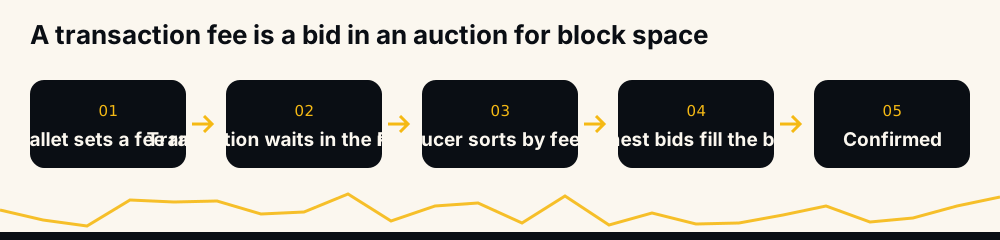
Two consequences follow. A higher bid confirms faster, because it sits nearer the top of the sorted list. And a low bid is not rejected — it waits, sometimes for days, until the queue is short enough that it reaches the top on its own. A "stuck" transaction is almost always a bid that was too low for the traffic at the time.
How Bitcoin transaction fees are calculated
Bitcoin prices its blocks by size. Your fee rate is quoted in satoshis per virtual byte (sat/vB), and your bill is that rate multiplied by the virtual bytes your transaction occupies.
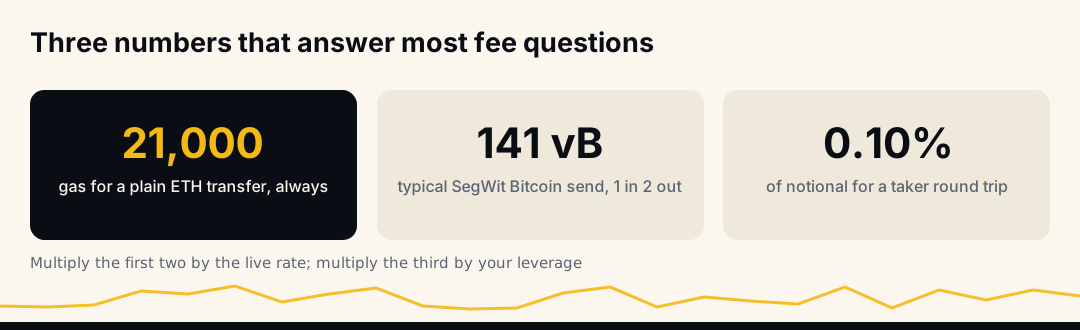
A typical native SegWit payment with one input and two outputs is about 141 vB. At 20 sat/vB it costs 141 × 20 = 2,820 satoshis, or 0.0000282 BTC. The same transaction at 5 sat/vB costs 705 satoshis; in a genuine panic at 150 sat/vB it costs 21,150.
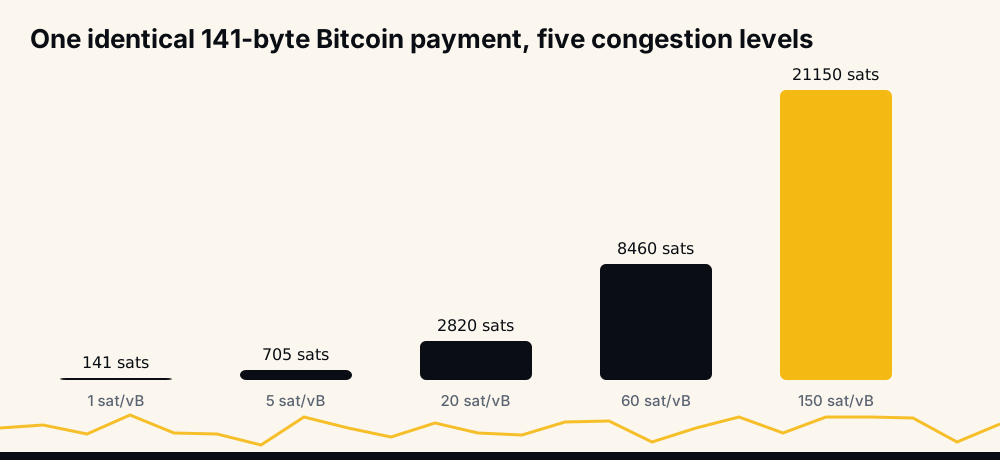
The amount of BTC being moved appears nowhere in that arithmetic. What does appear is the shape of your transaction:
- Number of inputs. Every separate coin you spend adds roughly 68 vB. Ten tiny deposits combined into one payment is a fat, expensive transaction; one large deposit spent alone is slim and cheap.
- Address type. The same payment is around 226 vB from a legacy address, about 141 vB from native SegWit and nearer 111 vB from Taproot.
- Number of outputs. Paying five people in one transaction beats five separate ones.
If your bid was too low, most wallets can fix it: replace-by-fee rebroadcasts the transaction at a higher rate, and child-pays-for-parent lets the recipient drag it into a block by spending the pending output.
How Ethereum fees work since EIP-1559
Ethereum meters computation rather than bytes. Every operation costs gas, and a plain ETH transfer costs exactly 21,000 gas in every network condition. Moving an ERC-20 token costs roughly 45,000 to 65,000, and a swap on a decentralised exchange runs into the low hundreds of thousands.
Since the London upgrade in August 2021, the price per gas has two parts:
Total fee = gas used × (base fee + priority fee)
The base fee is set by the protocol, not by you, and it is burned — destroyed, paid to nobody. The priority fee, or tip, is what you add to make your transaction attractive to a validator. Both are quoted in gwei, a billionth of an ETH.
So a transfer at an 18 gwei base fee plus a 2 gwei tip costs 21,000 × 20 gwei = 420,000 gwei = 0.00042 ETH. Redo that with today's numbers and you have your own fee calculator; it is all any estimator does.
The base fee moves on a rule you can watch live. Each block has a gas limit, the protocol aims for blocks around half full, and a block above that target raises the base fee by up to 12.5% for the next one.
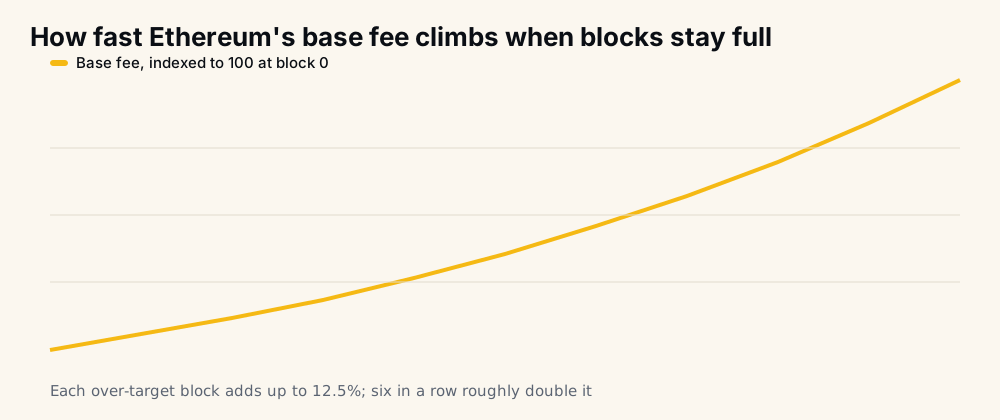
Compounding at 12.5% doubles the base fee in about six consecutive full blocks — roughly a minute and a quarter. That is why gas explodes out of nowhere during a popular mint or a liquidation cascade, and falls back just as fast once the rush passes.
One trap catches everyone once: a failed transaction still costs gas. The work was performed before the failure, so a reverted swap burns real money. The gas limit you set caps how much work you authorise, not what you pay per unit — unused gas is refunded, gas already consumed is gone.
Why BNB Smart Chain is cheap, and what that cheapness costs
BNB Smart Chain uses Ethereum's exact arithmetic — gas units multiplied by a gas price, settled in BNB — but its validators have repeatedly agreed to a very low minimum gas price, and its blocks arrive in seconds rather than minutes. A transfer that costs dollars on a busy Ethereum costs cents there.
That cheapness is not purely engineering. Blocks are produced by a few dozen active validators rather than a set numbering in the hundreds of thousands, which means less hardware to pay for, fewer parties who must agree, and fewer independent parties standing between your transaction and censorship. It is a genuine trade-off, worth understanding before routing large sums by fee alone; the risks that come with public blockchains covers that side of the ledger.
Ethereum's own answer is layer-2 rollups, which batch thousands of transactions and post compressed data back to mainnet. Since EIP-4844 gave rollups cheap data space in March 2024, layer-2 fees have generally been a small fraction of mainnet's.
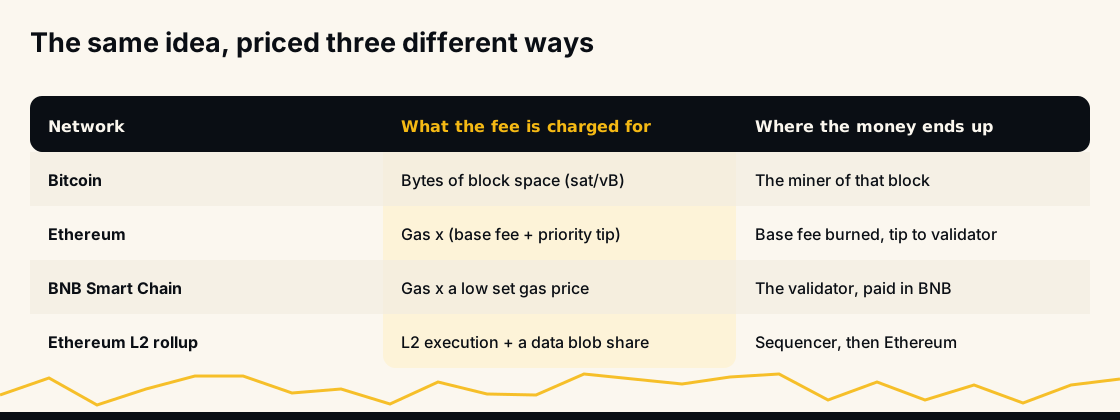
Where do crypto transaction fees actually go?
To whoever does the work of including you: the miner of the block on Bitcoin, the proposing validator on Ethereum and BNB Smart Chain. No company collects them and there is no support desk to appeal to.
Ethereum's burned base fee is the exception that surprises people — it is revenue for nobody, leaving circulation permanently, which is why heavy usage reduces ETH supply.
One fee goes somewhere else entirely: an exchange's withdrawal fee is not a network fee. The exchange sets it, keeps the difference, and often charges a round number well above the real on-chain cost. Compare it against the live network rate before assuming it is a pass-through.
Five changes that reshaped what a transaction costs
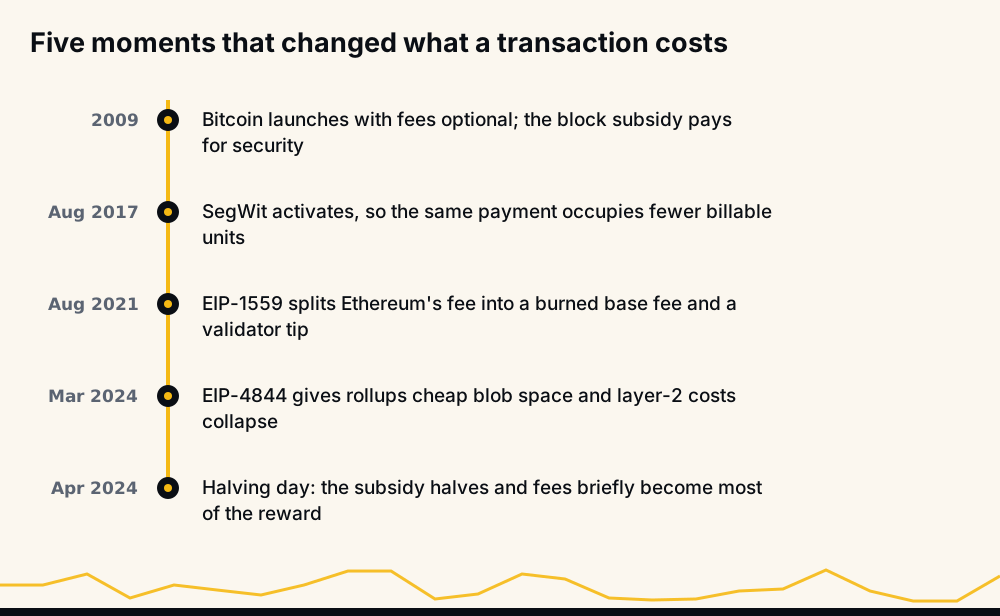
The pattern is the same every time: capacity gets cheaper, demand arrives to consume it, and the fee market re-forms at the new level. Cheap block space stays cheap only until someone finds a use for the slack.
Why fees spike
Supply of block space is fixed in the short run; demand is not. Every spike traces back to a burst of people who all want the same blocks in the same ten minutes:
- Token launches, mints and airdrop claims, where thousands race for a fixed allocation and bid each other up on purpose.
- Violent price moves, triggering liquidations, arbitrage and panic transfers to and from exchanges at the same instant.
- Novel uses of block space, such as the inscription and token protocols that competed with ordinary payments for Bitcoin blocks through 2023 and 2024.
- Halving day, April 2024, when the subsidy dropped and a token protocol launched in the same block — the average Bitcoin fee briefly ran into three figures in dollars.
Notice what is absent: the size of anyone's payment. Fees respond to how many transactions want in, never to how much value they carry.
Exchange trading fees are not blockchain fees
This confusion costs active traders far more money than gas ever will.
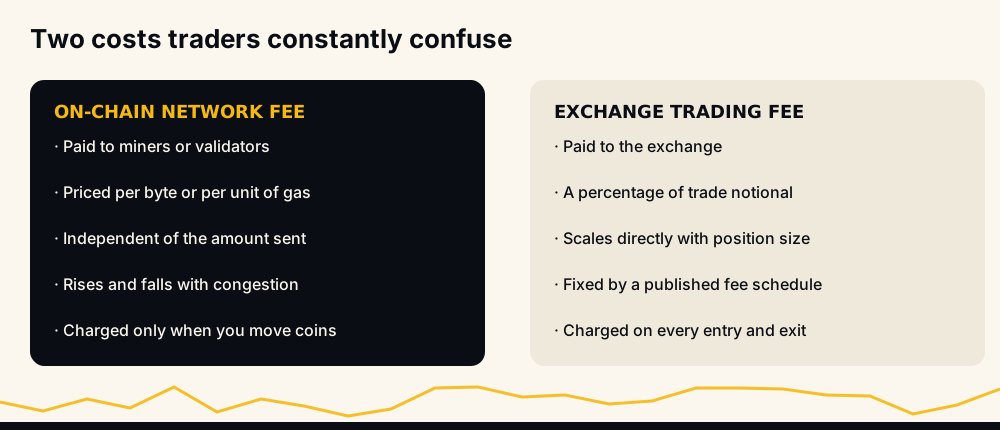
An exchange charges a percentage of what you trade. On the spot market, Binance's standard rate is 0.1% per side, cut to 0.075% when the fee is paid in BNB. On USDT-M futures the rates are 0.02% maker and 0.05% taker — cheaper per trade, but applied to leveraged notional, which is the sting.
Two more costs belong in the same bucket though neither is called a fee. Funding, on perpetual futures, is exchanged between long and short holders roughly every eight hours; you pay or receive it depending on your side. And slippage — the gap between the price you saw and the price you got — is a real cost no fee schedule lists. Why the buying and selling difference occurs unpacks that one.
What a round trip actually costs a leveraged trader
Take a $10,000 notional futures position opened and closed at taker rates.
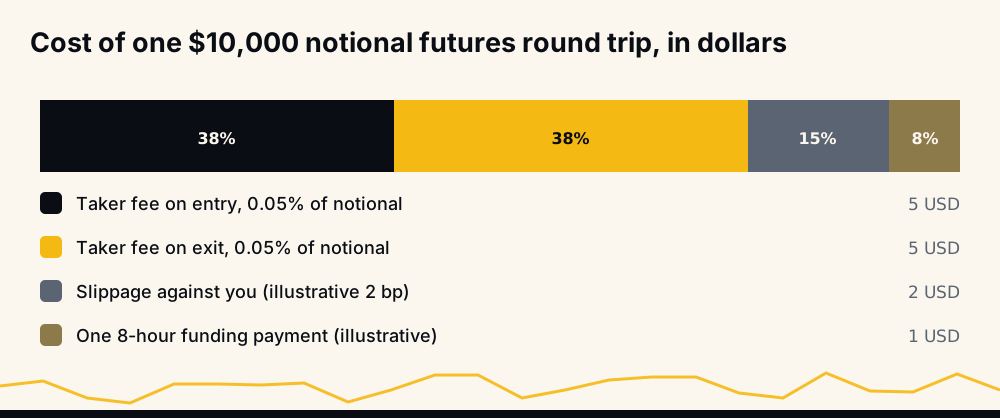
The two fee slices are exact: 0.05% of $10,000 is $5, charged twice, so 0.10% of notional per round trip. The slippage and funding slices are illustrative rather than measured — yours depend on the pair and the timing — but they make the point that the published fee is not the whole bill.
Now apply leverage. If that position was opened on $1,000 of margin, the $10 of fees is 1% of your money, not 0.1%.
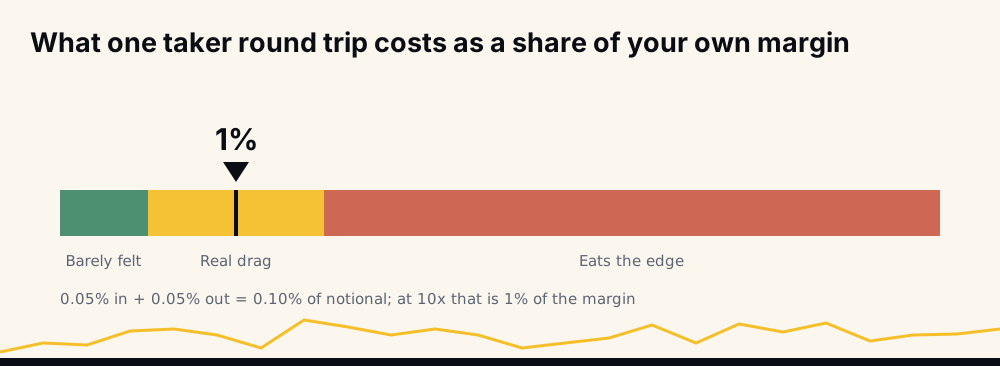
A hundred round trips in a year — two a week — is 100% of that margin in fees alone, and the strategy has to clear that bar before it makes a cent. It is the arithmetic that quietly kills frequent trading on tiny accounts; trading futures with a small account is largely an exercise in respecting it.
Fee drag is also the one entry in your ledger of financial risk that is certain: the market may or may not go your way, but the fee is charged either way. Two habits follow: trade fewer, larger, better positions, and use limit orders where the entry allows, since maker at 0.02% against taker at 0.05% is a 60% discount on that line.
Which crypto has the lowest transaction fees?
Usually the wrong question. Fees on high-throughput chains and Ethereum rollups are routinely fractions of a cent, so between the cheap options the difference rarely decides anything. What decides things is whether the destination supports the network you chose.
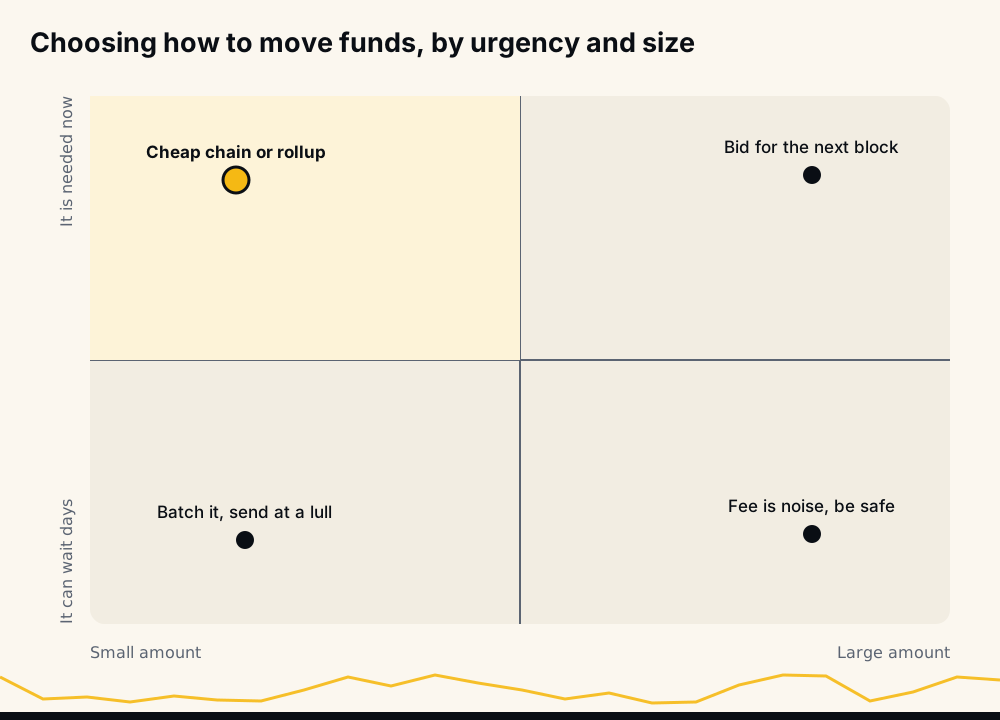
Send on a network the receiving exchange does not credit and the fee you saved is irrelevant, because recovery ranges from a slow support ticket to impossible. Match the network at both ends first, then optimise the fee. And when bridging into decentralised finance, the bridge's own cost and risk usually dwarf the gas on either side.
How to pay less, in practice
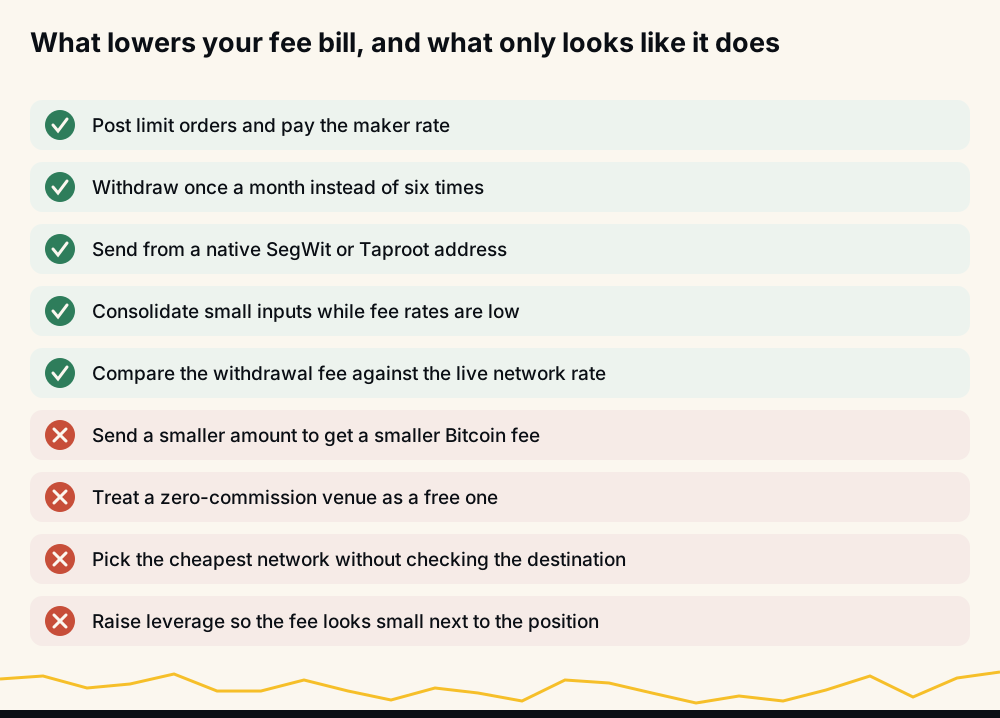
- Batch your withdrawals. One monthly transfer instead of six weekly ones is roughly a sixth of the fee.
- Watch the clock. Bitcoin's mempool has a rhythm; weekends and quiet overnight hours are cheaper than weekday peaks.
- Use modern addresses. Native SegWit or Taproot instead of legacy is a permanent discount on every send.
- Tidy up when it is cheap. Consolidating many small inputs costs a lot during congestion; do it in a lull.
- Set the fee yourself. Wallet defaults overbid for safety. If the money is not urgent, target confirmation within a day.
- Post limit orders. The maker rate is the largest single discount available to an active trader.
- Check the withdrawal fee against the network rate. When they diverge sharply, another supported network is often cheaper.
Are crypto transaction fees tax deductible?
In many jurisdictions, fees directly attributable to acquiring or disposing of an asset are added to your cost basis or deducted from your proceeds, reducing the taxable gain rather than being claimed separately. Fees paid simply to move coins between your own wallets are treated less consistently and in some places are not relievable at all.
Rules differ sharply by country and change often, so treat this as background and confirm with someone qualified where you live. Record-keeping helps everywhere: exchanges export fee columns, and block explorers show the exact fee on every transaction.
What fees look like when a bot is placing the trades
Automation does not change the fee schedule; it changes how often the schedule is applied. A system that trades constantly pays constantly, so signal frequency and fee sensitivity have to be judged together.
HafizeBot publishes outcomes rather than volume claims. The archive at /reports holds 33 monthly spreadsheets covering June 2021 to February 2024 and 33,694 signals, at a median monthly accuracy of 98.9% as reported in those sheets. Since June 2026 the /performance page, rebuilt hourly from the trade database, shows Wins, Missed and Open. Broadcast signals carry a target and a maximum hold, not a stop, so every signal that does not reach its target in time counts as Missed and lowers the rate. PnL is shown unleveraged. Signals are AI-generated from 240+ indicators, formulas and components.
To watch the fee arithmetic against real calls before paying anything, the free channel t.me/getbinancefutures carries signals of strength 3 and up on a 20-minute delay to around 3,980 members. Autotrading never needs withdrawal permission on the API key, with funds staying on your own Binance account.
None of this is investment advice, and no fee saving turns a losing strategy into a winning one. Trade only what you can afford to lose.
FAQ
How much are Bitcoin transaction fees right now? Multiply the current fee rate in sat/vB, which any mempool explorer shows live, by your transaction's size in virtual bytes — about 141 vB for a typical SegWit send. At 20 sat/vB that is 2,820 satoshis. The rate changes constantly; the arithmetic never does.
Does a Bitcoin transaction fee depend on how much I send? No. The fee depends on the block space your transaction occupies, driven by the number of inputs you spend and your address type. Sending 0.001 BTC and 100 BTC costs the same if the transactions are the same shape.
Why are crypto transaction fees sometimes so high? Because block space is fixed and demand for it is not. When a token launch, an airdrop claim or a sharp price move sends thousands of users into the same blocks, they bid against each other and the clearing price rises — on Ethereum the base fee can double in about six full blocks.
Where do crypto transaction fees go? To the miner or validator who includes your transaction. Ethereum is the partial exception: the base fee is burned and paid to nobody, with only the tip going to the validator. An exchange's withdrawal fee is separate again, and the exchange keeps whatever exceeds the real network cost.
What is the difference between a trading fee and a transaction fee? A transaction fee is paid to a blockchain for moving coins, priced by size or computation. A trading fee is paid to an exchange for executing an order, priced as a percentage of what you traded. Active traders pay far more of the second.
Can I avoid crypto fees entirely? Not on-chain — a zero-fee transaction is one nobody has an incentive to confirm. Venues advertising zero commission usually recover the cost in a wider spread, which is harder to see and often larger. The realistic goal is fewer and cheaper transactions, not free ones.